Diabetes mellitus (DM): Nursing process (ADPIE)
Client Report0:00–0:32
Harold Owl is a 63-year-old male client with a history of type 2 diabetes who is referred to the endocrinology clinic by his primary care provider for evaluation.
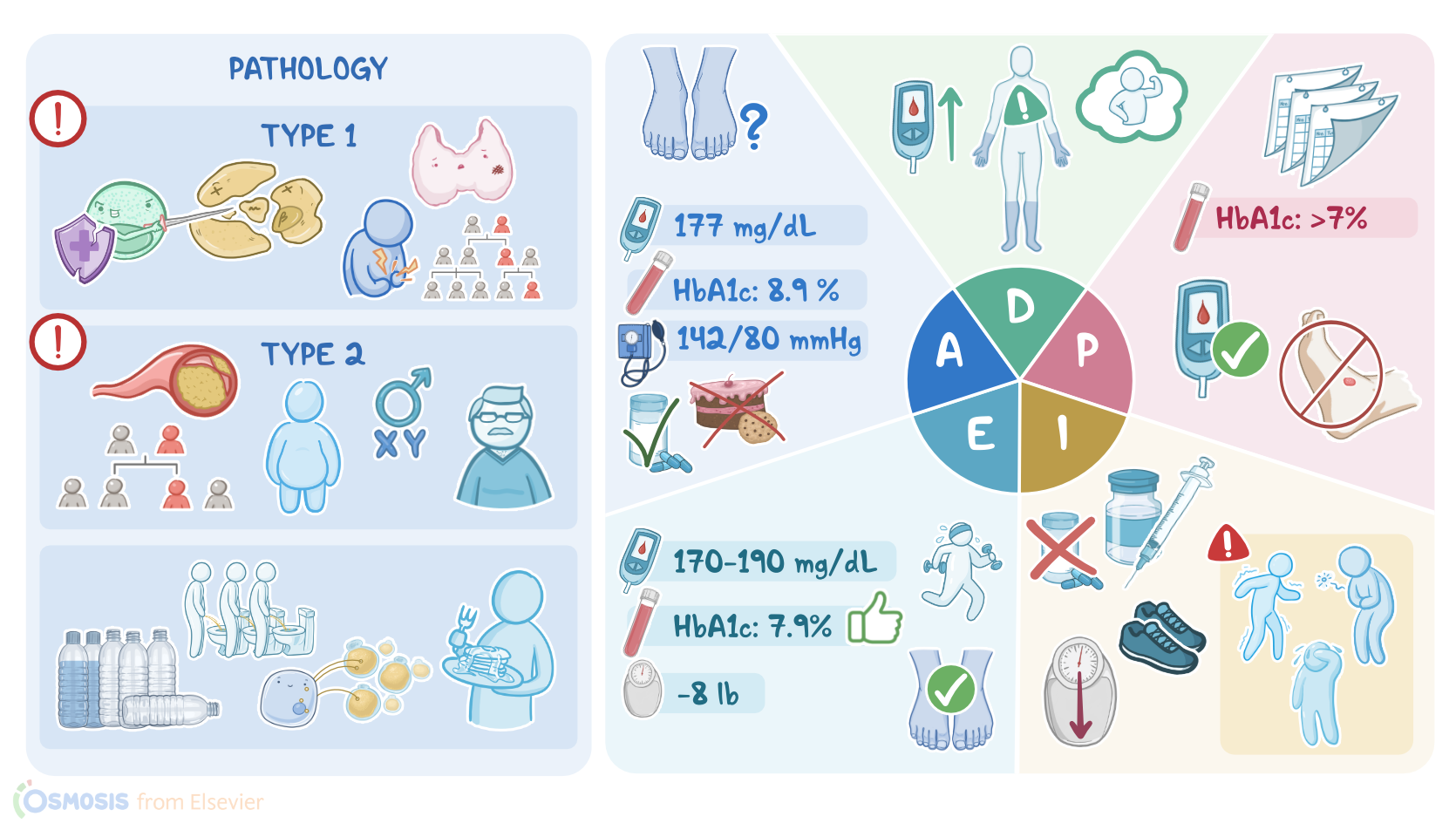
Mr. Owl takes the biguanide, metformin and sulfonylurea glyburide to manage his diabetes, but his latest hemoglobin A1C or HbA1c test was 8.9%, and he has recently developed numbness in his feet.
In diabetes mellitus, commonly just called diabetes, the body has trouble moving glucose from the blood into the tissue cells.
Pathology0:32–7:29
As a result, cells starve for energy despite having high blood glucose levels, which is called hyperglycemia. Normally, high blood glucose stimulates the pancreatic beta cells to produce and secrete the hormone insulin, which in turn reduces blood glucose by stimulating the uptake of glucose into the cells.
In diabetes, the blood glucose stays high because insulin's function is impaired. There are 2 main types of diabetes.
In type 1 diabetes, there's autoimmune destruction of the pancreatic beta cells, so they can't produce and secrete insulin.
The exact cause of type 1 diabetes is unknown, but it's thought to have a genetic and environmental component, and risk factors include personal or family history of type 1 diabetes, as well as celiac disease and thyroid disease.
The onset is usually abrupt, generally appears before the age of 30, and is most often diagnosed during childhood or puberty.
Type 2 diabetes is associated with risk factors like male sex, increasing age, or having a first-degree relative with type 2 diabetes, a body mass index or BMI over 25, a sedentary lifestyle, or a cardiovascular disease like hypertension.
With type 2 diabetes, the symptoms usually begin after the age of 45 and gradually worsen over a few months. Classic symptoms of both type 1 and type 2 diabetes include polyuria, which means that individuals urinate frequently, which is associated with polydipsia, which means they are constantly thirsty and drink a lot of water.
Many clients also present with polyphagia, which is a fancy way to say that they have a large appetite and is associated with unexplained weight loss because tissue cells can't uptake the glucose from food, so they instead use fatty acids from adipose tissue called lipolysis.
Now, clients with type one diabetes are at risk for a serious acute complication called diabetic ketoacidosis, or DKA for short.
This occurs because after lipolysis, the liver turns the fatty acids into ketone bodies, which increase the acidity of the blood.
As a result, clients can develop nausea, vomiting, dehydration, and a characteristic fruity smelling breath, as well as a deep and labored breathing called Cusal respirations.
Severe cases of DKA can also cause mental status changes and acute cerebral edema. An acute complication that is much more common in type 2 diabetes is called hyperosmolar hyperglycemic state or HHS, which is characterized by extreme hyperglycemia along with increased urination.
This can cause severe dehydration as well as nausea, vomiting, and mental status changes. All right.
Now, over time, the hyperglycemia that occurs with uncontrolled diabetes can cause damage to the blood vessels, leading to long-term or chronic complications.
These include macrovascular complications due to damage to the larger blood vessels, resulting in peripheral vascular disease, myocardial infarction, and stroke.
Diabetes can also cause microvascular complications due to damage to the tiny blood vessels throughout the body. In the kidneys, microvascular damage ultimately leads to diabetic nephropathy, which causes renal insufficiency and failure.
In the eyes, microvascular damage can lead to diabetic retinopathy and can eventually cause blindness. Diabetes can also affect the peripheral nerves, causing diabetic neuropathy, which is characterized by decreased sensation in the toes and fingers, sometimes called a stocking glove distribution, as well as autonomic neuropathy, resulting in problems like delayed gastric emptying called gastroparesis, as well as urinary retention or neurogenic bladder and erectile dysfunction in males.
Finally, a combination of microvascular damage and neuropathy can lead to the formation of diabetic foot ulcers, which can become infected easily, are slow to heal, and increase the risk of lower extremity amputation.
Diagnosing type 1 or type 2 diabetes is typically done by measuring blood glucose levels. A random blood sample can be taken any time, or very commonly, a fasting glucose sample where the person doesn't eat or drink anything except water for 8 hours.
A fasting blood glucose level of 100 to 125 mg per deciliter is considered pre-diabetes, and if it's 126. milligrams per deciliter or higher on two separate occasions, the client has diabetes.
A non-fasting or random glucose test can be done at any time, with 200 mg per deciliter or higher being a red flag for diabetes.
Another test is called an oral glucose tolerance test, where a person is given glucose and then blood samples are taken at time intervals to figure out how well it's being cleared from the blood.
At the time interval of 2 hours later, a glucose level of 200 or above indicates diabetes. Another type of test that can be done is the HbA1c test, which tests for the proportion of hemoglobin in red blood cells that has glucose stuck to it, called glycosylated hemoglobin.
This proportion doesn't change day to day, so it gives a sense for whether the blood glucose levels have been high over the past 2 to 3 months, which is the normal lifespan of a red blood cell.
For treatment of type 1 diabetes, insulin is necessary. For type 2 diabetes, some of that insulin resistance can be reversed with lifestyle changes like weight loss and exercise, along with a healthy diet and limiting carbohydrate and fat intake.
In addition, most clients with type 2 diabetes need to take oral anti-diabetic medications like metformin. However, if oral anti-diabetic medications are not effective, type 2 diabetes can also be treated with insulin.
Something to bear in mind is that insulin treatment comes with a risk of hypoglycemia, which is when blood glucose goes below 70 mg per deciliter.
This can occur especially if insulin is taken during fasting or strenuous exercise. Symptoms of hypoglycemia can be mild, like weakness, hunger, or tremors, and they can be treated by drinking or eating carbohydrates.
Severe cases can progress to loss of consciousness and seizures, so intravenous glucose or intranasal or subcutaneous glucagon should be given as soon as possible.
Assessment7:29–9:18
OK. You enter the exam room to begin your assessment and find Mister Owl seated comfortably accompanied by his spouse, Rita Owl.
You ask Mister Owl about his diabetes, and he tells you his blood glucose has been running high the past few months. He says he only checks it once each day, and it is over 200 mg per deciliter most of the time.
He tells you he takes his medications as prescribed. He avoids sweets, but he does not follow a particular diet.
His physical activity consists of doing occasional yard work and gardening. He tells you he recently started having numbness in his feet and that he is worried because he feels like his diabetes might be getting worse.
He goes on to tell you about a relative with diabetes that had a toe amputated and says he wants to do everything he can to prevent problems like that.
During Mr. Owl's physical exam, you note his feet are cool and dry, and his pedal pulses are 2+.
His tympanic temperature is 97.9 °F, or 36.6 °C. Heart rate 68 BPM.
Respirations 18 breaths per minute with clear lung sounds. BP 142/80 millimeters of mercury.
Pain 0 out of 10, and SPO2 96% on room air. His height is 5 ft 11 inches and his weight is 192 lbs or 87 kg.
Lab work is notable for an HbA1c of 8.9% and a fasting blood glucose of 177 mg per deciliter. The results of a monofilament test shows moderate loss of sensation of his feet bilaterally, but he is still able to feel deep pressure and pain.
You document your assessment findings in the medical record to ensure his information is accurate and up to date. The nursing diagnoses you established for Mr.
Diagnosis9:18–9:40
Owl are risk for unstable blood glucose related to insufficient diabetes management, risk for injury related to impaired peripheral arterial circulation and decreased neurosensory function, and readiness for enhanced health management related to desire to prevent disease complications.
Planning9:40–10:05
Next, you collaborate with Mr. Owl and the interdisciplinary team to plan goals for his care.
For the next 3 months, Mr. Owl will maintain a blood glucose level within a normal range.
His HbA1c will be reduced with a long-term goal of less than 7%. His feet will remain free from injury or sores, and he will successfully incorporate his prescribed treatment regimen into his lifestyle.
All right. To implement his plan of care, you first review the physician's orders.
Implementation10:05–12:01
His physician has discontinued his oral anti-diabetic medications and prescribed the long-acting insulin glargine U300. You teach the owl family that this medication is administered subcutaneously every evening and is released slowly over 24 hours.
You teach Mr. Owl how to safely store the insulin and how to easily administer it using the prefilled insulin pen.
Next, you review the importance of his regular glucose monitoring and keeping his regular appointments to monitor his HbA1c.
You explain how to recognize the signs and symptoms of hypoglycemia, such as shakiness, fast heartbeat, hunger, sweating, irritability, or confusion.
As well as other possible adverse effects of insulin glargine that should be reported to his physician, such as injection site irritation, joint pain, headache, muscle pain or weakness, and flu-like symptoms.
Then you discuss lifestyle changes to help Mr. Owl manage his diabetes and prevent complications.
Since Mr. Owl is overweight, losing weight can improve his blood glucose levels, increase his insulin sensitivity, and reduce his risk of long-term complications.
You go over the benefits of eating his prescribed diabetic diet and having a regular exercise routine. You remind him to avoid going barefoot and to always protect his feet by wearing properly fitting footwear.
Mr. Owl agrees to meet with the diabetes nurse educator.
Together they will develop a personalized meal plan, and he will receive detailed education about his health management with a focus on self-injection technique, foot care, and prevention of complications.
You schedule a 3-month follow-up appointment and escort Mr. and Mrs.
Owl to the lobby. All right.
Evaluation12:01–12:50
Three months later, Mister Owl returns to the office, and you evaluate how he is doing so far. Good news.
His HbA1c has decreased to 7.9%. He's been checking his blood glucose as directed, and he pulls out a notebook to show you they are now averaging about 170 to 190 mg per deciliter.
With the help of the diabetes nurse educator, he has increased his physical activity and is making healthier food choices.
You measure his weight and he has already lost 8 lbs. You assess the skin on his feet and find no sores or cracking.
He has been checking his feet every night before bedtime and points out he has found a pair of comfortable and supportive shoes.
You document your findings and tell him his hard work is paying off. All right.
Summary12:50–13:37
As a quick recap, you've been caring for Harold Owl, who was referred to the endocrinology clinic for progression of type 2 diabetes, where the body has trouble moving glucose from the blood into the tissue cells, resulting in hyperglycemia.
Your assessment revealed Mr. Owl has an elevated HbA1c and numbness in his feet.
The nursing diagnoses for Mr. Owl included risk for unstable blood glucose, risk for injury, and readiness for enhanced health management.
You collaborated with Mister Owl and the interdisciplinary team to plan goals to help him manage his diabetes and prevent complications, and you implemented interventions to help him reach these outcomes.
You evaluated his response to treatment and adjusted his care plan as necessary to promote his optimal well-being.
| DIABETES MELLITUS | ||
| KEY POINTS | NOTES | |
| PATIENT REPORT |
| |
| PATHOPHYSIOLOGY |
| |
| DIAGNOSIS AND TREATMENT |
| |
| ASSESSMENT |
| |
| NURSING DIAGNOSES |
| |
| PLANNING |
| |
| IMPLEMENTATION |
| |
| EVALUATION |
| |
- "Ackley and Ladwig’s Nursing Diagnosis Handbook: An Evidence-Based Guide to Planning Care, 13th edition" Mosby (2022)
- "Genetics of diabetes mellitus and diabetes complications" Nat Rev Nephrol (2020)
- "Harrison’s Principles of Internal Medicine, 21st edition" McGraw Hill / Medical (2022)
- "Definition, Classification and Diagnosis of Diabetes Mellitus" Exp Clin Endocrinol Diabetes (2019)
- "Diabetes, cardiovascular disease and the microcirculation" Cardiovasc Diabetol (2021)
- "Critical Care Nursing: Diagnosis and Management, 9th edition" Elsevier (2021)
No notes for this video yet
Try adding a note below