Diabetic ketoacidosis (DKA): Nursing process (ADPIE)
Definitions & Key takeaways
Diabetic ketoacidosis (DKA) is a serious condition usually seen in people with diabetes mellitus type 1. DKA happens when your body doesn't produce enough insulin to use glucose as an energy source, thus resolving to use fatty acids, and produce ketones. Ketones are poisonous, and they build up in your blood. If not treated, DKA can lead to coma or even death. Even though DKA usually happens to people with type 1 diabetes, it can also happen to people with type 2 diabetes. DKA presents with polydipsia, polyuria, vomiting, and dehydration. It can later progress to mental status changes, coma, and death if not treated on time.
Client Report0:00–0:34
Juanita Perez is a 58 year old female client with a history of type one diabetes mellitus. Mrs.
Perez was brought to the emergency department, or ED late last night by her spouse with complaints of severe lethargy, nausea, and a high blood glucose reading at home.
In the ED she was found to have a blood glucose reading of 450 mg per deciliter. She was immediately transferred to the intensive care unit or ICU with the diagnosis of diabetic ketoacidosis.
Pathology0:34–4:38
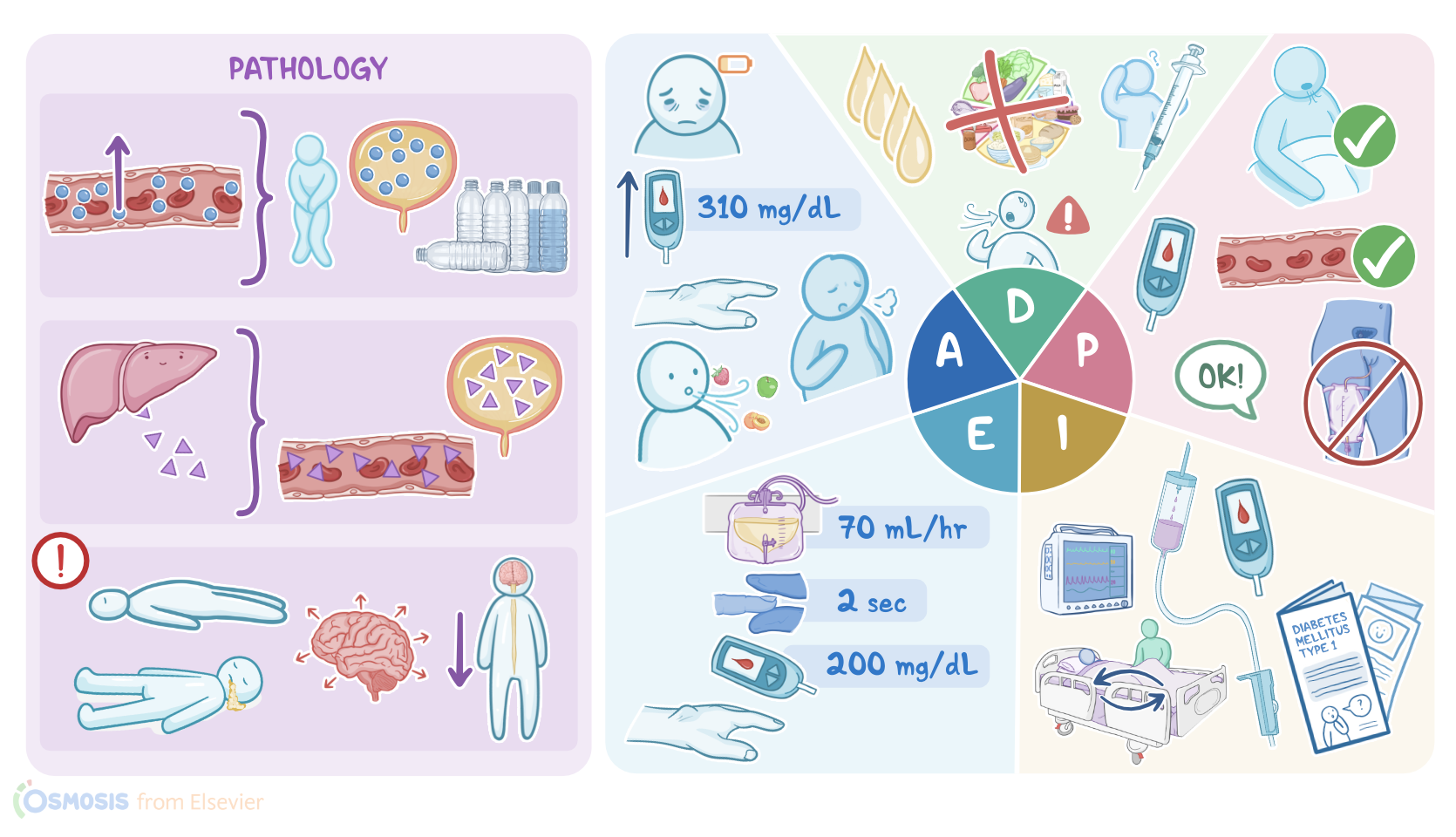
Diabetic ketoacidosis or DKA is a serious complication of diabetes mellitus. It occurs more commonly in type 1 versus type 2 diabetes mellitus because the cause is severe insulin deficiency.
When insulin levels are low, cells in the body can't utilize glucose, so fat will be metabolized for energy instead. The liver breaks down fat into ketone bodies, and as they build up in the blood, it causes a decrease in pH, leading to acidosis.
DKA has a very sudden onset and is characterized by hyperglycemia, metabolic acidosis, glucosuria, ketonuria, and ketonemia.
Risk factors for DKA include inadequate insulin administration, concurrent infection or illness, trauma, and injury. DKA can present with symptoms such as abdominal pain, nausea, lethargy, polyuria, polydipsia, fruity scented breath due to the presence of ketones, and cusal respirations.
Blood glucose readings with DKA will typically be anywhere between 300 and 800 mg per deciliter. DKA has a very sudden onset, and it starts with a severely insufficient amount of circulating insulin.
If there's not enough insulin, glucose is unable to enter cells to be used for energy. The unused glucose builds up in the blood, causing hyperglycemia.
At this point, the cells are really starving for glucose, even though it's plentiful in the blood. So the liver releases glycogen and initiates glycogenolysis, where stored glycogen is broken down into glucose.
This is accompanied by release of other counterregulatory hormones, cortisol, growth hormone, and catecholamines, which oppose the effects of insulin and initiate the breakdown of proteins to make additional glucose, a process called gluconeogenesis.
As glucose levels increase, the renal threshold for glucose resorption is surpassed, which is why we'll observe polyuria, glycosuria, and dehydration caused by the loss of large volumes of urine laden with glucose.
As the liver breaks down fatty acids into ketone bodies for cells to use for energy, ketones build up in the blood and are excreted from the body with urine, resulting in ketonemia and ketonuria.
Unfortunately, ketones increase the acidity of the blood, which leads to the development of metabolic acidosis. Acidosis is why we see coal respirations in clients with DKA.
To correct the acidosis, the body will automatically increase the respiratory rate in an attempt to blow off carbon dioxide and raise the blood pH.
Ketones are also exhaled out, so the breath may have a fruity scent. Acidosis also can lead to hyperkalemia, as cells exchange hydrogen ions with potassium.
On top of that, because insulin helps potassium enter the cell through the sodium potassium pump, the lack of insulin means more potassium stays outside the cell, compounding the hyperkalemia.
Finally, if DKA persists, it can result in severe depression of the central nervous system, changes in the client's level of consciousness, cerebral edema, and eventually coma.
Clients can decrease the risk of developing DKA by always taking their insulin as directed and monitoring their serum glucose often to make sure it stays within the desired range.
The right balance of physical activity and adherence to their diet plan is also essential. Because the body's insulin needs change during illness and stress, clients need to monitor their blood glucose levels more closely during these times.
Any significant physical or emotional stressor can lead to hyperglycemia and DKA. Now back to our client.
Assessment4:38–7:13
Upon going into your client's room, you first wash your hands, then introduce yourself and verify your client's identity.
You begin your assessment by asking Mrs. Perez how she is feeling.
She states she still feels very nauseous and tired. You ask when she started feeling tired, and she states that yesterday morning she woke up feeling exhausted and not like herself, and that it continued throughout the day.
She goes on to say that yesterday her blood glucose readings were a little high, with the lunch reading being 210 mg per deciliter and the dinner reading being 232 mg per deciliter.
You then ask if she has been taking her prescribed insulin as ordered. She tells you that she recently lost her health insurance and because she can't afford to refill her medications, she's been taking half of the prescribed amount of insulin at each meal to try to make her current supply last.
You notice her respirations are very deep and appear to be labored when she talks. She tells you that it feels hard to breathe at times.
You smell that her breath has a sweet, fruity odor. You assess her heart and lungs and determine that both are normal.
You inspect her skin and notice she has poor skin turgor and there is decreased capillary refill. You note she has a Foley catheter in place with 500 mL of clear yellow urine present.
Her last blood glucose taken one hour ago was 310 mg per deciliter. She has one intravenous catheter infusing 0.9% normal saline and a second intravenous catheter infusing 0.9% normal saline with a piggyback of regular insulin.
Continuous cardiac monitoring is in place, showing sinus tachycardia. Mrs.
Perez's vital signs are as follows Heart rate 101, respiratory rate 23, BP 98/60, oxygen saturation 95% on room air, oral temperature 97.9 °F, pain zero out of 10.
Labs taken in the ED show urine ketones positive, sodium 130 milliequivalents per liter, potassium 5.2 millequivalents per liter, BUN 32 mg per deciliter, creatinine 1.9 mg per deciliter, and blood pH 7.2.
Based on the assessment information you collected, your diagnoses include imbalanced nutrition, less than body requirements related to inability to utilize glucose, Ineffective breathing pattern related to acidosis, deficient fluid volume related to active fluid loss due to osmotic diuresis, and deficient knowledge related to inadequate insulin dosing.
Diagnosis7:13–7:38
Planning7:38–8:15
Now that morning rounds are completed with the members of the interdisciplinary team, the plan of care has been developed with input from the healthcare team, including Mrs.
Perez. The goals include blood glucose levels returning to a normal range, a normal breathing pattern with a normal blood pH, both by the time she is transferred from the ICU, balanced intake and output, and removal of the Foley catheter by the time she is transferred from the ICU, and lastly, verbalization of adherence to a prescribed insulin regimen.
Implementation8:15–9:38
After obtaining the necessary orders, you review the plan of care with the nursing assistant and begin implementation. Because Mrs.
Perez is currently on bed rest, she will need assistance to change positions every 2 hours. You delegate this task, along with strict output monitoring and hourly vital signs to the nursing assistant.
You check the blood glucose level hourly and adjust the insulin drip accordingly. As you provide care, you communicate with the healthcare team right away if you notice signs that Mrs.
Perez is not responding to your interventions, such as continued hyperglycemia, acidosis, and lethargy, as well as signs and symptoms her blood glucose level is dropping too quickly, like confusion and lethargy, which may indicate cerebral edema.
Mrs. Perez is currently awake and alert.
You place an order for a diabetes educator consultation, and in the meantime, you provide education on type 1 diabetes mellitus management, including the importance of taking the correct insulin dose as directed, monitoring her blood glucose regularly, and more frequent monitoring if she becomes ill or stressed.
You also enter an order for a case management consultation to help Mrs. Perez find a solution to the financial issues she's experiencing with her insulin.
Finally, before leaving the room, you make sure all orders have been placed to ensure the continuity of her care. It's now the end of your shift and time to evaluate how Mrs.
Evaluation9:38–11:34
Perez is doing. Her current blood glucose is 250 mg per deciliter, and per orders you decrease the insulin infusion rate and switch the intravenous fluids to 5% dextrose in 0.45% sodium chloride.
Throughout the day, the nursing assistant has documented hourly output, and you note the urinary output is now approximately 70 mL per hour.
Her skin trigger has not changed since admission, but capillary refill is now 2 seconds. Next, you assess her respiratory rate and depth.
You notice it still appears to be slightly deep and increased, and she tells you that it feels a little easier to breathe.
She goes on to tell you that she can't believe she let her sugars get out of control. Her daughter is at the bedside and tells you that when her mom is discharged she's going to help her with her insulin to prevent this from happening again.
You continue to reassess, reevaluate, and document Mrs. Perez's response to interventions to determine what goals are being met and how her plan of care should be revised.
Even though she's not stable enough to be transferred from the ICU yet, Mrs. Perez is making good progress.
Her vital signs are heart rate 82, respiratory rate 24, BP 136/80, oxygen saturation 95% on room air, oral temperature 98.9 °F, pain, 0 out of 10.
Urine ketones are negative. The results of the most recent comprehensive metabolic panel and pH are sodium 135 milliequivalents per liter, potassium 5.0 milliequivalents per liter, BUN 18 mg per deciliter, creatinine 0.9 mg per deciliter, and pH 7.3.
You place a call to the intensivist to report the results and to receive further orders. All right, as a quick recap, your assigned client, Juanita Perez, had an acute episode of DKA, which is a severe life-threatening complication that can happen with type one diabetes mellitus.
Summary11:34–13:00
DKA can occur when a client does not adhere to their prescribed insulin regimen or because of illness or other physical or emotional stress.
DKA is characterized by uncontrolled hyperglycemia, metabolic acidosis. And the production of ketones resulting in nausea, abdominal pain, coal respirations, fruity breath, and lethargy.
Your assessment revealed that Mrs. Perez was lethargic, blood glucose readings were elevated, her respirations were fast and deep, and her breath had a fruity odor.
Your nursing diagnoses were imbalanced nutrition. Ineffective breathing pattern, deficient fluid volume, and deficient knowledge.
The goals you identified when planning care for Mrs. Perez were to work towards stabilizing the physical and physiological effects of DKA and to reinforce how she should manage her type one diabetes mellitus.
Throughout her hospitalization, you and the healthcare team will continue to implement interventions, evaluate if the client care goals are being met.
And revise the plan of care as needed to achieve desired outcomes.
| DIABETIC KETOACIDOSIS (DKA) | ||
| KEY POINTS | NOTES | |
| PATIENT REPORT |
| |
| PATHOPHYSIOLOGY |
| |
| ASSESSMENT |
| |
| NURSING DIAGNOSES |
| |
| PLANNING |
| |
| IMPLEMENTATION |
| |
| EVALUATION |
| |
- "Ackley and Ladwig’s Nursing Diagnosis Handbook: An Evidence-Based Guide to Planning Care, 13th edition" Mosby (2022)
- "Euglycemic diabetic ketoacidosis: The paradox of delayed correction of acidosis" Diabetes Metab Syndr (2023)
- "Harrison’s Principles of Internal Medicine, 21st edition" McGraw Hill / Medical (2022)
- "Diabetic Ketoacidosis" Emerg Med Clin North Am (2023)
- "Evaluation of Outcomes Following Hospital-Wide Implementation of a Subcutaneous Insulin Protocol for Diabetic Ketoacidosis" JAMA Netw Open (2022)
- "Critical Care Nursing: Diagnosis and Management, 9th edition" Elsevier (2021)
No notes for this video yet
Try adding a note below