Epiglottitis: Nursing process (ADPIE)
Client Report0:00–0:23
Eve Vu is a five year old female who was brought to the emergency room, or ED by her mother with reports of a sore throat and fever.
According to her mother, Eve has been irritable, refuses liquids, and when Eve started drooling, she brought her in as soon as she could.
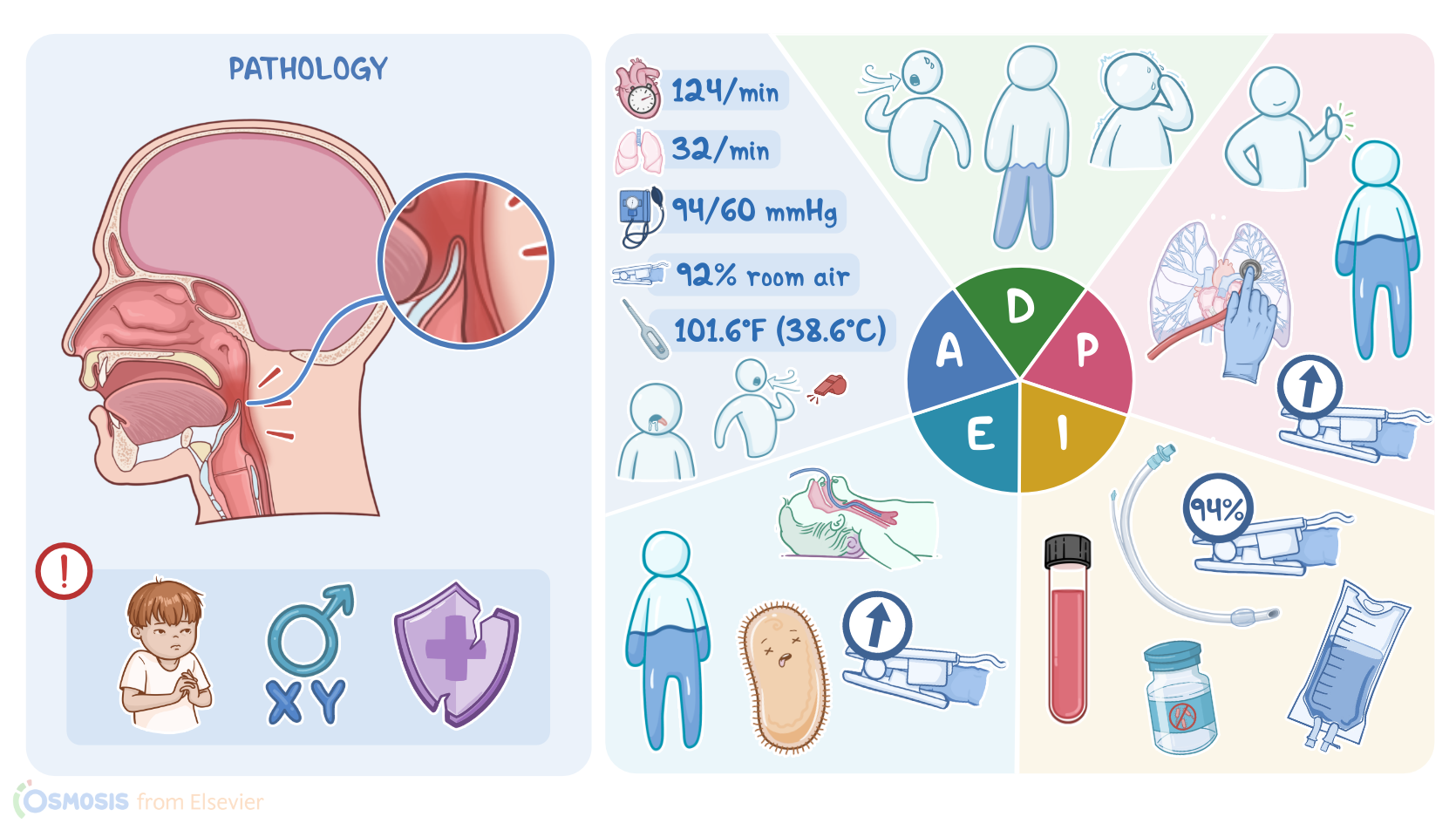
Eve is triaged quickly for suspected epiglottitis. Epiglottitis, also called supraglottitis, is inflammation of the epiglottis, which is a flap of cartilage located behind the tongue and its surrounding tissues.
Pathology0:23–3:33
Epiglottitis typically occurs in children between 2 and 5 years of age, but can occur from infancy to adulthood. Males are more at risk than females, and those who are immunocompromised are more at risk as well.
The most common causes used to be Haemophilus influenza type B, but this has become less common thanks to an increase in childhood vaccination.
Streptococcus pneumonia and Staphylococcus aureus are now the most common causes in the US. Epiglottitis can also be caused by viral and fungal infections or by non-infectious causes like smoke inhalation, hot foods or liquids, and foreign bodies.
In bacterial epiglottitis, the initial symptoms include sore throat and a sudden onset of high fever. This can happen much quicker in children compared to adults.
When the epiglottis and nearby tissue become infected, inflammation and edema develops. As the epiglottis swells up, it can fold backward and act like a ball valve that obstructs the airways during inhalation.
The swelling of the nearby tissue makes matters worse by narrowing the airways. In children this will lead to the three D's distress or anxiety, dysphagia or difficulty swallowing, and drooling due to the inability to swallow.
Airway obstruction can also cause turbulent air flow, resulting in an inspiratory stridor which sounds like a high pitched whistling.
The voice also becomes muffled, so it sounds like they have a hot potato in their mouth when they speak. The work of breathing is increased, so you'll often see suprasternal and substernal retractions.
To breathe easier, children will often sit upright and lean forward in a tripod position with the chin thrust out, mouth open, and tongue protruding to help keep the airway open.
Severe airway obstruction can lead to hypoxia, hypercapnia, and acidosis, followed by loss of consciousness and death. The diagnosis of epiglottitis is based on the client's history and physical examination.
Direct visualization can show inflammation of the throat and a large cherry red epiglottis, but it should be avoided in children and anxious clients due to the risk of triggering laryngeal spasms that could worsen the obstruction.
Other anxiety producing procedures such as IV placement, phlebotomy, supine positioning, and oral examination should also be postponed until the airway is secured.
A lateral neck X-ray will show an enlarged epiglottis that looks like a thumbprint. Throat cultures obtained during intubation, and blood cultures can confirm the organism and help make sure the right treatment is prescribed.
Treatment for epiglottitis is first focused on airway management, and once the airway is secured, antibiotics can be used to treat the infection.
Prevention measures include immunization against HIB beginning at 2 months of age to help prevent epiglottitis and other serious infections.
Assessment3:33–4:58
OK, now that we've reviewed epiglottitis, let's get back to assess our client Eve. You wash your hands, introduce yourself, and confirm Eve's identity.
Eve is sitting in her mother's lap, leaning forward. Her tongue is protruding, and she is drooling into a tissue.
Quickly you administer blow by oxygen at a rate of 10 L per minute, and you notify your team that Eve needs to be seen immediately.
Next you connect her to a cardiac monitor and pulse oximeter. Eve's mother tells you that after Eve developed a fever and sore throat, she has not wanted to eat or drink anything and would not lie down in her bed to nap.
She says, I don't understand how she could get so sick this fast. Eve's vital signs are temperature 101.6 °F or 38.6 °C, heart rate 124 BPM, respirations 32 breaths per minute with an inspiratory stridor and suprasternal retractions, BP 94/60, oxygen saturation 92%.
The pediatric emergency physician enters the room accompanied by the respiratory therapist. 100% oxygen is administered via bag valve mask.
She is successfully intubated so her breathing can be supported by mechanical ventilation. Eve will remain in the ED until the pediatric transport team arrives to admit Eve to the pediatric intensive care unit or pick you.
Diagnosis4:58–5:20
Based on the assessment data you have collected, your nursing diagnoses include ineffective airway clearance related to airway inflammation, risk for deficient fluid volume related to decreased intake, fever, and increased work of breathing, and compromised parental coping related to the sudden onset of her daughter's acute illness.
Next, you collaborate with the health care team and Eve's mother to plan some goals for stabilization before transfer. Eve will maintain an open airway, as evidenced by an intact ET tube, normal breath sounds, and optimal gas exchange demonstrated by pulse oximetry at therapeutic levels.
Planning5:20–5:46
Eve's fluid balance will be maintained, and Eve's mother will verbalize an increased ability to cope with the situation.
Next you implement the plan of care. You monitor Eve's endotracheal tube to ensure her airway is secure and auscultate her lungs to confirm equal bilateral breath sounds, symmetric chest rise and fall, and pulse oximetry at least 94%.
Implementation5:46–6:40
Next you administer the ordered IV fluids and antibiotics. Then you draw blood for a complete blood count or CBC and blood for cultures to make sure the right antibiotic is prescribed.
While you wait for the transport team to arrive, you stay with Eve's mother and answer her questions about Eve's diagnosis and treatment plan.
You ask her if she has anyone she can call for support, and she says her sister who lives nearby is on her way to come sit with her.
You continue to monitor Eve and her mother until the transport team arrives and will communicate with the healthcare team immediately if there is a decline in Eve's respiratory status.
Evaluation6:40–7:21
Now it's time to evaluate Eve's response to your intervention so far with mechanical ventilation, Eve's airway remains open, and her oxygen saturation returns to therapeutic levels.
After receiving information and emotional support, Eve's mother states she feels less stressed, and she is comforted by the support of her sister.
When the PICU team arrives, you will give them report to ensure a safe handoff of care. OK, as a quick recap, your client E Vu presented to the ED experiencing symptoms of acute epiglottitis.
Summary7:21–7:56
Your assessment revealed respiratory distress, and your nursing diagnoses were ineffective airway clearance, risk for deficient fluid volume, and compromised parental coping.
The goals you identified while planning care for Eve and her mother include maintaining a clear open airway, maintaining hydration, and demonstrating effective parental coping.
You implement actions to achieve your goals, and until Eve is transferred, you will continue to evaluate whether the goals were met.
| EPIGLOTTITIS | ||
| KEY POINTS | NOTES | |
| PATIENT REPORT |
| |
| PATHOPHYSIOLOGY |
| |
| DIAGNOSIS AND TREATMENT |
| |
| ASSESSMENT |
| |
| NURSING DIAGNOSES |
| |
| PLANNING |
| |
| IMPLEMENTATION |
| |
| EVALUATION |
| |
- "Ackley and Ladwig’s Nursing Diagnosis Handbook: An Evidence-Based Guide to Planning Care, 13th edition" Mosby (2022)
- "Medical Management of Epiglottitis" Anesth Prog (2020)
- "50 Years Ago in The Journal of Pediatrics: Acute Epiglottitis: To Trach or Not to Trach" J Pediatr (2023)
- "Epiglottitis with abscess as a source of airway obstruction" Visual Journal of Emergency Medicine (2023)
- "Harrison’s Principles of Internal Medicine, 21st edition" McGraw Hill / Medical (2022)
- "Intubation decision criteria in adult epiglottitis" Eur Ann Otorhinolaryngol Head Neck Dis (2021)
No notes for this video yet
Try adding a note below