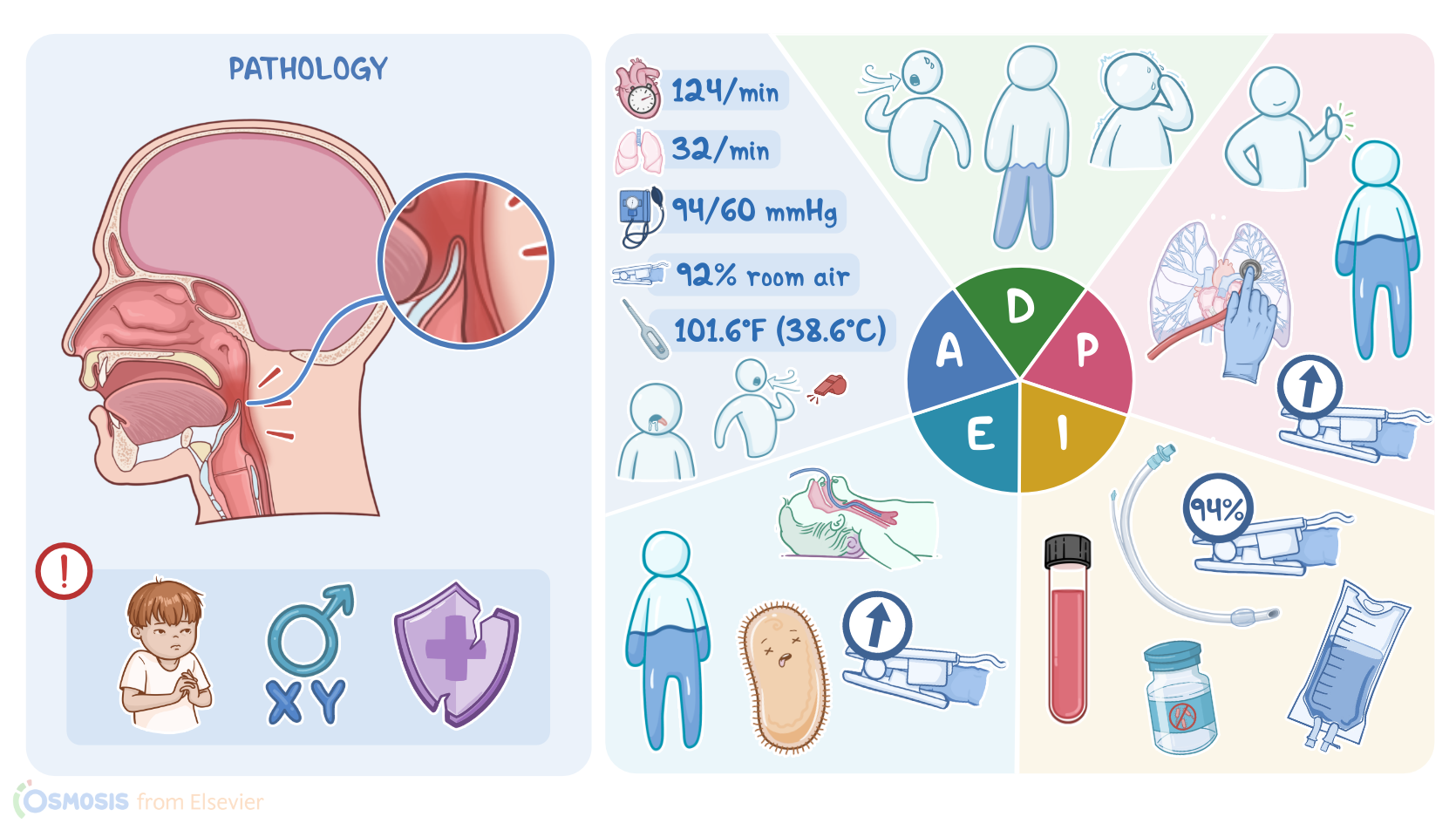
Epiglottitis: Nursing process (ADPIE)

Epiglottitis: Nursing process (ADPIE)

Watch later

Watch later

Infection prevention and control - Precautions and personal protective equipment (PPE): Nursing skills
Urinary tract infections (UTIs): Nursing process (ADPIE)
Modes of infectious disease transmission
Epstein-Barr virus (Infectious mononucleosis)
Pneumonia
Wound healing
Palliative and hospice care: Nursing
Postoperative care: Nursing
Biology of cancer: Nursing
Biliary atresia: Nursing
Cholecystitis: Nursing
Cholelithiasis: Nursing
Colorectal cancer: Nursing
Diarrhea: Nursing
Diverticular disease: Nursing
Esophageal cancer: Nursing
Gastric cancer: Nursing
Hepatitis: Nursing
Inflammatory bowel disease - Crohn disease and ulcerative colitis: Nursing
Intestinal obstruction: Nursing
Irritable bowel syndrome (IBS): Nursing
Jaundice: Nursing
Laryngeal cancer: Nursing
Liver cancer: Nursing
Pancreatic cancer: Nursing
Esophageal atresia and tracheoesophageal fistula: Nursing
Geriatric considerations - Gastrointestinal: Nursing
Hirschsprung disease: Nursing
Hyperemesis gravidarum: Nursing
Necrotizing enterocolitis: Nursing
Omphalocele and gastroschisis: Nursing
Appendicitis: Nursing process (ADPIE)
Celiac disease: Nursing process (ADPIE)
Cirrhosis: Nursing process (ADPIE)
Gastroesophageal reflux disease (GERD): Nursing process (ADPIE)
Hiatal hernia: Nursing process (ADPIE)
Pancreatitis: Nursing process (ADPIE)
Peptic ulcer disease (PUD): Nursing process (ADPIE)
Antacids: Nursing pharmacology
Antidiarrheals: Nursing pharmacology
Antiemetics: Nursing pharmacology
Antispasmodics (GI): Nursing pharmacology
Gallstone-dissolving agents: Nursing pharmacology
Gastric mucosal protective agents: Nursing pharmacology
Histamine H2 antagonists: Nursing pharmacology
Laxatives: Nursing pharmacology
Medications for hepatic encephalopathy: Nursing pharmacology
Pancreatic enzyme replacements: Nursing pharmacology
Proton pump inhibitors (PPIs): Nursing pharmacology
Treatment for Helicobacter pylori: Nursing pharmacology
Weight loss medications: Nursing pharmacology
Bladder tumors: Nursing
Chronic kidney disease (CKD): Nursing
Dialysis care: Nursing
Epididymitis: Nursing
Glomerulonephritis: Nursing
Nephrotic syndrome: Nursing
Polycystic kidney disease (PKD): Nursing
Prostate cancer: Nursing
Pyelonephritis: Nursing
Renal and urinary calculi: Nursing
Renal cancer: Nursing
Testicular cancer: Nursing
Urinary retention: Nursing
Bladder exstrophy: Nursing
Circumcision: Nursing
Cryptorchidism: Nursing
Enuresis: Nursing
Geriatric considerations - Urinary: Nursing
Hypospadias and epispadias: Nursing
Acute kidney injury (AKI): Nursing process (ADPIE)
Benign prostatic hyperplasia (BPH): Nursing process (ADPIE)
Urinary incontinence - Stress: Nursing process (ADPIE)
Antispasmodics (GU): Nursing pharmacology
Cholinergic therapy (GU): Nursing pharmacology
Diuretics - Osmotic and carbonic anhydrase inhibitors: Nursing pharmacology
Diuretics - Thiazide, thiazide-like, loop, and potassium-sparing diuretics: Nursing pharmacology
Anemia - Aplastic: Nursing
Anemia - Iron-deficiency: Nursing
Anemia - Macrocytic: Nursing
Arterial blood gas (ABG) - Overview: Nursing
Arterial blood gas (ABG) - Metabolic acidosis: Nursing
Arterial blood gas (ABG) - Metabolic alkalosis: Nursing
Arterial blood gas (ABG) - Respiratory acidosis: Nursing
Arterial blood gas (ABG) - Respiratory alkalosis: Nursing
Blood cultures: Nursing
Cardiac biomarkers - Creatine kinase (CK): Nursing
Cardiac biomarkers - Troponin: Nursing
Coagulation studies - Partial thromboplastin time (PTT): Nursing
Complete blood count (CBC) - Hemoglobin and hematocrit: Nursing
Complete blood count (CBC) - Platelets: Nursing
Complete blood count (CBC) - Red blood cells (RBC): Nursing
Complete blood count (CBC) - White blood cells (WBC) and differential: Nursing
Complete metabolic panel (CMP) - Blood urea nitrogen (BUN) and creatinine (Cr): Nursing
Complete metabolic panel (CMP) - Chloride: Nursing
Complete metabolic panel (CMP) - Estimated glomerular filtration rate (eGFR): Nursing
Complete metabolic panel (CMP) - Glucose: Nursing
Complete metabolic panel (CMP) - Liver function tests (LFT): Nursing
Complete metabolic panel (CMP) - Potassium: Nursing
Complete metabolic panel (CMP) - Sodium: Nursing
Complete metabolic panel (CMP) - Total protein: Nursing
Disseminated intravascular coagulation (DIC): Nursing
Multiple myeloma: Nursing
Neutropenia: Nursing
Polycythemia: Nursing
Thalassemia: Nursing
Thrombocytopenia: Nursing
Leukemia: Nursing process (ADPIE)
Anticoagulants - Direct thrombin and factor Xa inhibitors: Nursing pharmacology
Anticoagulants - Heparin: Nursing pharmacology
Anticoagulants - Warfarin: Nursing pharmacology
Antihyperlipidemics - Bile acid sequestrants and cholesterol absorption inhibitors: Nursing pharmacology
Antihyperlipidemics - Fibrates: Nursing pharmacology
Antihyperlipidemics - Miscellaneous: Nursing pharmacology
Antihyperlipidemics - Statins: Nursing pharmacology
Antiplatelet agents: Nursing pharmacology
Blood products: Nursing pharmacology
Hematopoietic growth factors: Nursing pharmacology
Hemostatics: Nursing pharmacology
Iron preparations: Nursing pharmacology
Thrombolytics: Nursing pharmacology
Autoimmunity: Nursing
Human immunodeficiency virus (HIV) and acquired immunodeficiency syndrome (AIDS): Nursing
Hypersensitivity reactions - Type I: Nursing
Hypersensitivity reactions - Type II: Nursing
Hypersensitivity reactions - Type III: Nursing
Hypersensitivity reactions - Type IV: Nursing
Immune response - Adaptive: Nursing
Immune response - Innate: Nursing
Immunodeficiency disorders - Primary: Nursing
Immunodeficiency disorders - Secondary: Nursing
Inflammatory process: Nursing
Scleroderma: Nursing
Shock - Anaphylactic: Nursing
Sjögren syndrome: Nursing
Systemic lupus erythematosus (SLE): Nursing
Toxic shock syndrome (TSS): Nursing
Erythema infectiosum (Fifth disease): Nursing
Fever: Nursing
Infectious mononucleosis: Nursing
Mumps (Parotitis): Nursing
Neonatal sepsis: Nursing
Pertussis: Nursing
Poliomyelitis: Nursing
Postpartum infections: Nursing
Roseola (Exanthem subitum): Nursing
Rubella (German measles): Nursing
Rubeola (Measles): Nursing
Smallpox: Nursing
Zika virus: Nursing
Anaphylaxis: Nursing process (ADPIE)
Lyme disease: Nursing process (ADPIE)
Rheumatoid arthritis (RA): Nursing process (ADPIE)
Antirejection immunosuppressants: Nursing pharmacology
Biologic agents: Nursing pharmacology
Disease-modifying therapy for multiple sclerosis: Nursing pharmacology
Immunoglobulins: Nursing pharmacology
Immunomodulators: Nursing pharmacology
Immunosuppressants for autoimmune diseases: Nursing pharmacology
Non-biologic disease-modifying antirheumatic drug (DMARD) therapy: Nursing pharmacology
Vaccines: Nursing pharmacology
Acne: Nursing
Animal and snake bites: Nursing
Burn injury: Nursing
Cutaneous fungal infections: Nursing
Erysipelas and cellulitis: Nursing
Folliculitis, carbuncles, and furuncles: Nursing
Herpes simplex virus (HSV): Nursing
Herpes zoster: Nursing
Impetigo: Nursing
Insect stings and bites: Nursing
Pediculosis and scabies: Nursing
Psoriasis: Nursing
Rocky Mountain spotted fever (RMSF): Nursing
Skin cancer - Basal cell carcinoma, squamous cell carcinoma, and melanoma: Nursing
Urticaria: Nursing
Geriatric considerations - Integumentary: Nursing
Atopic dermatitis: Nursing process (ADPIE)
Frostbite: Nursing process (ADPIE)
Methicillin-resistant Staphylococcus aureus (MRSA): Nursing process (ADPIE)
Pressure injury: Nursing process (ADPIE)
Antibiotics - Topical: Nursing pharmacology
Antifungals - Topical: Nursing pharmacology
Corticosteroids - Topical: Nursing pharmacology
Debridement agents: Nursing pharmacology
Keratolytics: Nursing pharmacology
Medications for acne vulgaris: Nursing pharmacology
Osteoarthritis: Nursing
Osteomyelitis: Nursing
Osteoporosis: Nursing
Hip fractures: Nursing
Developmental dysplasia of the hip: Nursing
Acute compartment syndrome: Nursing process (ADPIE)
Fractures: Nursing process (ADPIE)
Gout: Nursing process (ADPIE)
Musculoskeletal injuries: Nursing process (ADPIE)
Buerger disease: Nursing
Raynaud phenomenon: Nursing
Peripheral arterial disease (PAD): Nursing process (ADPIE)
Peripheral venous disease (PVD): Nursing process (ADPIE)
Atelectasis: Nursing
Geriatric considerations - Respiratory: Nursing
Venous thromboembolism (VTE): Nursing process (ADPIE)
Asthma: Nursing process (ADPIE)
Bacterial pneumonia: Nursing process (ADPIE)
Bronchiolitis and respiratory syncytial virus (RSV): Nursing process (ADPIE)
Carbon monoxide poisoning: Nursing process (ADPIE)
Chronic obstructive pulmonary disease (COPD): Nursing process (ADPIE)
Epiglottitis: Nursing process (ADPIE)
Foreign body aspiration and upper airway obstruction: Nursing process (ADPIE)
Laryngotracheobronchitis (LTB) and croup: Nursing process (ADPIE)
Smoke inhalation injury: Nursing process (ADPIE)
Papulosquamous and inflammatory skin disorders: Pathology review

Notes

EPIGLOTTITIS

KEY POINTS
NOTES
PATIENT REPORT
  • 5-year-old 
  • Emergency department
  • Reports of 
    • Sore throat 
    • Fever
    • Irritable
    • Refusing liquids
    • Drooling

PATHOPHYSIOLOGY
  • Epiglottitis aka supraglottitis 
    • Inflammation of epiglottis and surrounding tissues 
  • Occurs in children aged two to five 
    • Can occur from infancy to adulthood 
  • Risk factors
    • Biological male 
    • Immunocompromise
  • Causes 
    • Haemophilus influenzae type b 
    • Streptococcus pneumoniae 
    • Staphylococcus aureus 
    • Viral infections 
    • Fungal infections 
    • Smoke inhalation 
    • Hot foods or liquids 
    • Foreign bodies 
  • Bacterial epiglottitis symptoms 
    • Sore throat 
    • Sudden onset of high fever 
    • Faster onset in children than adults 
    • Inflammation and edema 
    • Swollen epiglottis folds backward 
    • Acts like ball valve obstructing airway 
    • Nearby tissue swelling narrows airway 
    • In children leads to three Ds 
      • Distress or anxiety 
      • Dysphagia 
      • Drooling  
    • Airway obstruction causes turbulent airflow 
    • Results in inspiratory stridor 
    • High pitched whistling sound 
    • Voice  muffled 
    • Increased work of breathing 
    • Suprasternal retractions  
    • Substernal retractions  
    • Tripod position 
  • Severe obstruction complications
    • Hypoxia 
    • Hypercapnia 
    • Acidosis 
    • Loss of consciousness 
    • Death

DIAGNOSIS AND TREATMENT
  • Diagnosis
    • History 
    • Physical assessment 
      • Cherry red epiglottis visualized
    • Diagnostic imaging
      • Thumbprint epiglottis
    • Cultures
  • Treatment
    • Airway management
    • Antibiotics
    • Immunization against Hib

ASSESSMENT
  • Patient sitting in mother’s lap 
  • Leaning forward 
  • Tongue protruding 
  • Drooling into tissue 
  • Inspiratory stridor present
  • Suprasternal retractions present
  • Vital signs 
    • Temperature 101.6 ℉ (38.6 ℃)
    • Heart rate 124/min
    • Respiratory rate 32/min
    • Blood pressure 94/60 mmHg 
    • Oxygen saturation 92 %
  • Immediate actions taken 
    • Administered blow by oxygen 
      • Flow rate 10L/min
    • Notified team for immediate evaluation 
    • Emergency physician and respiratory therapist arrive 
    • Administered 100% oxygen 
    • Used bag valve mask 
    • Intubation performed 
    • Mechanical ventilation initiated 

NURSING DIAGNOSES
  • Ineffective airway clearance related to airway inflammation
  • Risk for deficient fluid volume related to decreased intake, fever, and increased work of breathing
  • Compromised parental coping related to sudden onset of child's acute illness

PLANNING
  • Patient will maintain an open airway as evidenced by an intact ET tube, normal breath sounds and optimal gas exchange 
  • Patient's fluid balance will be maintained
  • Patient's mother will verbalize an increased ability to cope with the situation

IMPLEMENTATION
  • Monitor ET tube
  • Auscultate lung sounds
  • Confirm SpO2 is 94% or above
  • Administer IV fluids and antibiotics
  • Draw bloodwork and cultures
  • Answer questions about diagnosis
  • Ensure emotional support for patient's mother

EVALUATION
  • On mechanical ventilation, patient's airway remains open
  • Oxygen saturation therapeutic
  • IV fluids and antibiotics infusing
  • Patient's mother reports decreased stress
  • Preparing for transfer to PICU

Transcript

Watch video only

Eve Vu is a 5-year-old female who is brought to the emergency room, or ED, by her mother with reports of a sore throat and fever.

According to her mother, Eve has been irritable, refuses liquids, and when Eve started drooling, she brought her in as soon as she could.

Eve is triaged quickly for suspected epiglottitis.

Epiglottitis, also called supraglottitis, is inflammation of the epiglottis, which is a flap of cartilage located behind the tongue, and its surrounding tissues.

Epiglottitis typically occurs in children between 2 and 5 years of age, but can occur from infancy to adulthood.

Males are more at risk than females, and those who are immunocompromised are more at risk as well.

The most common causes used to be Haemophilus influenzae type b, but this has become less common thanks to an increase in childhood vaccination.

Streptococcus pneumoniae and Staphylococcus aureus are now the most common causes in the US.

Epiglottitis can also be caused by viral and fungal infections, or by non-infectious causes like smoke inhalation, hot foods or liquids, and foreign bodies.

In bacterial epiglottitis, the initial symptoms include sore throat and a sudden onset of high fever.

This can happen much quicker in children compared to adults.

When the epiglottis and nearby tissue become infected, inflammation and edema develops.

As the epiglottis swells up, it can fold backwards and act like a ball valve that obstructs the airways during inhalation.

The swelling of the nearby tissue makes matters worse by narrowing the airways.

In children, this will lead to the 3 Ds; Distress or anxiety, Dysphagia, or difficulty swallowing, and Drooling due to the inability to swallow.

Airway obstruction can also cause turbulent airflow resulting in an inspiratory stridor which sounds like a high pitched whistling.

The voice also becomes muffled so it sounds like they have a hot potato in their mouth when they speak.

The work of breathing is increased so you’ll often see suprasternal and substernal retractions.

To breathe easier, children will often sit upright and lean forward in a tripod position, with the chin thrust out, mouth open, and tongue protruding to help keep the airway open.

Severe airway obstruction can lead to hypoxia, hypercapnia, and acidosis, followed by loss of consciousness and death.

The diagnosis of epiglottitis is based on the client’s history and physical examination.

Direct visualization can show inflammation of the throat and a large, cherry red epiglottis, but it should be avoided in children and anxious clients due to the risk of triggering laryngeal spasms that could worsen the obstruction.

Other anxiety-producing procedures such as IV placement, phlebotomy, supine positioning, and oral examination should also be postponed until the airway is secured.

A lateral neck x-ray will show an enlarged epiglottis that looks like a thumbprint.

Throat cultures obtained during intubation and blood cultures can confirm the organism and help make sure the right treatment is prescribed.

Treatment for epiglottitis is first focused on airway management, and once the airway is secured, antibiotics can be used to treat the infection.

Prevention measures include immunization against Hib beginning at 2 months of age to help prevent epiglottitis and other serious infections.

Okay, now that we’ve reviewed epiglottitis, let’s get back to assess our client, Eve.

You wash your hands, introduce yourself, and confirm Eve’s identity.

Sources

  1. "Ackley and Ladwig’s Nursing Diagnosis Handbook: An Evidence-Based Guide to Planning Care, 13th edition" Mosby (2022)
  2. "Medical Management of Epiglottitis" Anesth Prog (2020)
  3. "50 Years Ago in The Journal of Pediatrics: Acute Epiglottitis: To Trach or Not to Trach" J Pediatr (2023)
  4. "Epiglottitis with abscess as a source of airway obstruction" Visual Journal of Emergency Medicine (2023)
  5. "Harrison’s Principles of Internal Medicine, 21st edition" McGraw Hill / Medical (2022)
  6. "Intubation decision criteria in adult epiglottitis" Eur Ann Otorhinolaryngol Head Neck Dis (2021)