Fever: Nursing
Introduction0:00–0:34
A fever is an abnormal increase in body temperature, and it’s part of a biologic response controlled by the central nervous system through thermoregulation.
Normally, the average body temperature should be between 36.4 and 37.5°C, or 97.5 and 99.5°F, and it can vary due to numerous factors, including the time of day, activity, age, and the phase of the menstrual cycle.
Physiology0:34–2:00
Now, let’s review the physiology of thermoregulation. The internal body temperature is maintained by the hypothalamus, which is a small part of the forebrain located just below the thalamus.
So, when there is an increase in body temperature, the hypothalamus initiates heat dissipation mechanisms to reduce it, such as vasodilation of blood vessels near the skin, and increased sweat production by sweat glands.
Meanwhile, heat production can occur as a result of metabolic processes that generate heat as a byproduct, even while at rest or during voluntary movement.
Also, when the body needs to warm up, the hypothalamus initiates the cold stress response which includes involuntary shivering.
Another contributing factor can be an increased release of the thyroid hormone, called thyroxine, which increases metabolism and in turn body temperature.
In addition, neonates rely on nonshivering thermogenesis, which utilizes brown adipose tissue, a special type of fat that usually disappears after infancy.Lastly, sympathetic stimulation helps avoid heat dissipation by triggering vasoconstriction of blood vessels on the skin, as well as piloerection, meaning erection of hairs due to contraction of the arrector pili muscles, creating an insulating layer.
Most commonly, a fever is caused by an underlying infection. Fever can also occur because of inflammation in absence of an infection.
Causes & risk factors2:00–2:31
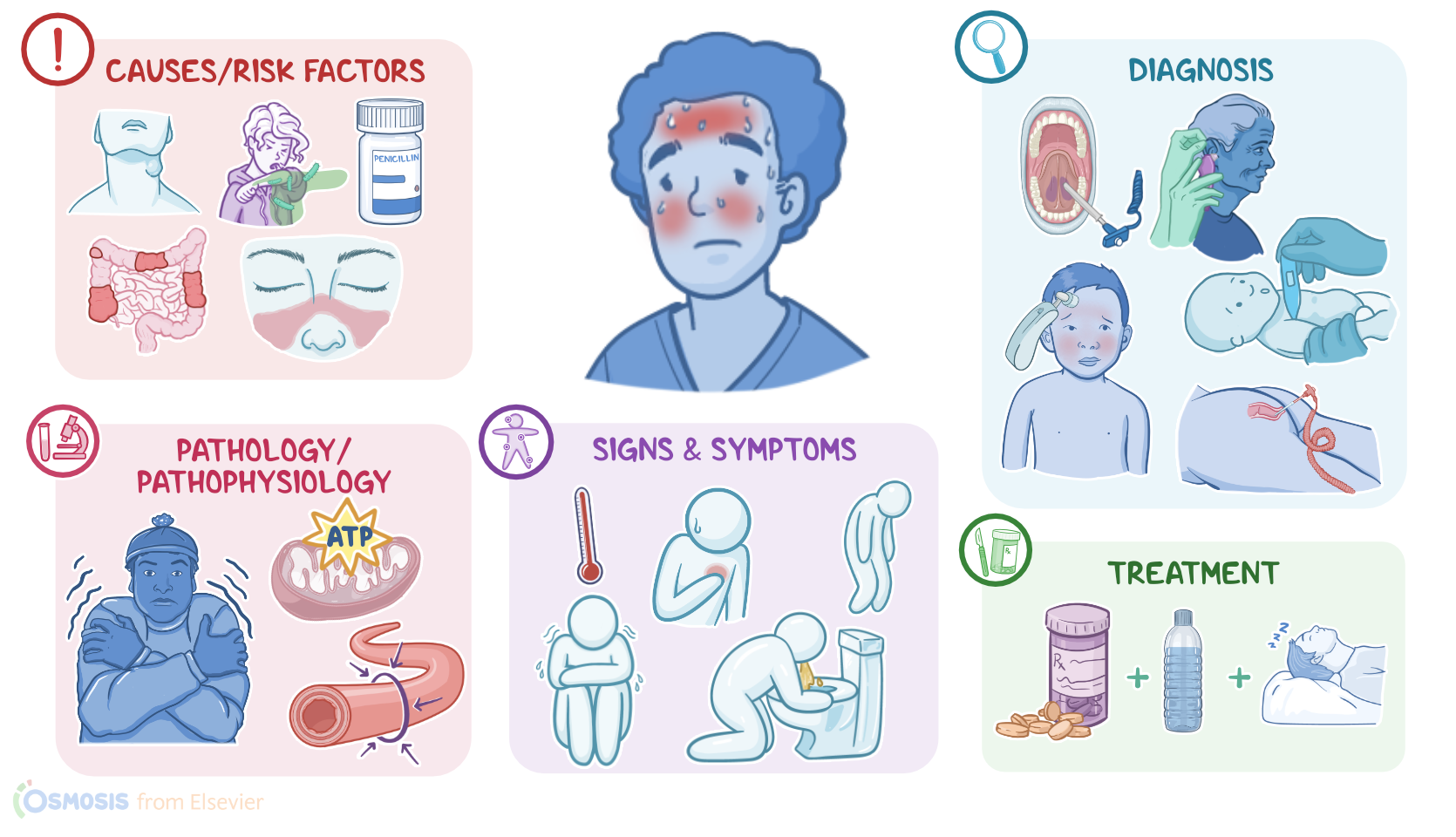
This can also happen with hypersensitivity reactions in response to a medication like penicillin; malignant conditions like lymphoma; and chronic inflammatory conditions like inflammatory bowel disease, Kawasaki disease, or autoimmune diseases like lupus.Now let’s look at the pathology of fever.
Pathology2:31–4:41
Most often, a fever is triggered by either endogenous pyrogens or exogenous pyrogens. Endogenous pyrogens are proinflammatory molecules from inside the body, like interleukin 1, tumor necrosis factor or TNF, and interferon; as well as prostaglandins.Exogenous pyrogens, on the other hand, refer to substances from outside the body, like an infectious pathogen, which trigger the production of proinflammatory molecules.
Regardless of whether the trigger is exogenous or endogenous, the end result is that the proinflammatory molecules reach the hypothalamus, and alter the hypothalamic thermoregulatory center.
Consequently, the hypothalamus employs the mechanisms used to generate heat, like shivering and an increased metabolism.
At the same time, heat loss is decreased through peripheral vasoconstriction. Ultimately, these mechanisms come together to increase the body temperature to an elevated set-point, leading to the development of a fever.
The increased temperature enhances parts of the immune response, like increasing neutrophil and T-cell production while simultaneously slowing the pathogen’s growth.
In response to the fever, the body typically produces natural antipyretics, called cryogens, which helps to prevent fevers from rising to a possibly lethal level at 41°C or 106°F.
On a side note, fever should be distinguished from hyperthermia, which has a different pathogenesis. In hyperthermia, thermoregulation fails due to causes such as extreme environmental heat or certain drugs, and the temperature can then rise unopposed to lethal levels.1 CFinally, fevers increase the need for oxygen, increase carbon dioxide production, and can cause complications such as hypoxemia and dehydration, while children who are 6 months old to 5 years old may experience febrile seizures.
Clinical manifestations4:41–5:06
Now, by definition, the primary clinical manifestation of a fever is an elevated temperature, which is often accompanied by other manifestations, such as tachycardia, lethargy or malaise, and chills.
The client may also have a decreased appetite, as well as dehydration. Additionally, there can be signs of the underlying disease, such as vomiting or a sore throat.The diagnosis of a fever is made based on the client’s history and physical assessment, including measurement of an elevated temperature, which varies in different body parts.
Diagnosis5:06–6:32
Some common measurement sites for a fever are oral, tympanic, temporal, axillary, and rectal. A fever for oral temperatures is above 37.8°C or 100°F.
For tympanic temperatures it’s above 38°C or 100.4°F; and for temporal temperatures, it’s the same: above 38°C or 100.4°F.
A fever can also be defined as an axillary temperature above 37.2°C or 99°F; or a rectal temperature above 38°C or 100.4°F.Afterwards, the underlying cause can be diagnosed through further examination, including lab tests like a complete blood count, which can show leukocytosis; a urinalysis, which can show pyuria, or the presence of white blood cells in the urine; as well as specific antibody tests when an autoimmune disease is suspected, like antinuclear antibodies to look for lupus.
Imaging methods can include a chest X-ray and an abdominal ultrasound, as well as an echocardiogram or other investigations, depending on which underlying cause is suspected.A fever is treated by addressing the underlying cause, like giving antibiotics to treat a bacterial infection, along with extra fluids and rest.
Treatment6:32–7:07
Antipyretics, such as acetaminophen or ibuprofen, work by lowering the body temperature, restoring the normal thermoregulatory set-point, and can help reduce symptoms.
Aspirin should not be given to children unless they have Kawasaki disease, as aspirin puts children at risk of Reye syndrome, which is a rare but possibly fatal disease that can cause liver and brain damage.Alright, as a quick recap… A fever is an increase in body temperature that is part of a biologic response controlled by the hypothalamus through heat dissipation and generation.
Review7:07–8:44
A fever can be caused by an underlying infection; as well as hypersensitivity reactions to a medication; malignant conditions; and chronic inflammatory conditions like inflammatory bowel disease, Kawasaki disease, or autoimmune diseases.
These conditions lead to the release of proinflammatory molecules, which in turn reach the hypothalamus. Ultimately, this increases the core body temperature above the normal set point.
The increased temperature enhances the immune response, and can help slow the pathogen’s growth. Fevers are often accompanied by other manifestations, such as tachycardia, lethargy or malaise, chills, and decreased appetite.
The diagnosis of a fever is made based on the client’s history and physical assessment. Some common measurement sites for a fever are oral, tympanic, temporal, axillary, and rectal.
A fever for oral temperatures is above 37.8°C or 100°F; for tympanic, temporal or rectal temperatures,it’s is above 38°C or 100.4°F; and for temporal temperatures is above 38°C or 100.4°F.
A fever can also be defined as an and for axillary temperature it’s above 37.2°C or 99°F; or a
| FEVER | ||
| KEY POINTS | NOTES | |
| DEFINITION |
| |
| PHYSIOLOGY |
| |
| CAUSES AND RISK FACTORS |
| |
| PATHOPHYSIOLOGY |
| |
| SIGNS AND SYMPTOMS |
| |
| DIAGNOSIS |
| |
| TREATMENT |
| |
No notes for this video yet
Try adding a note below