Hyperparathyroidism: Nursing
Introduction0:00–0:25
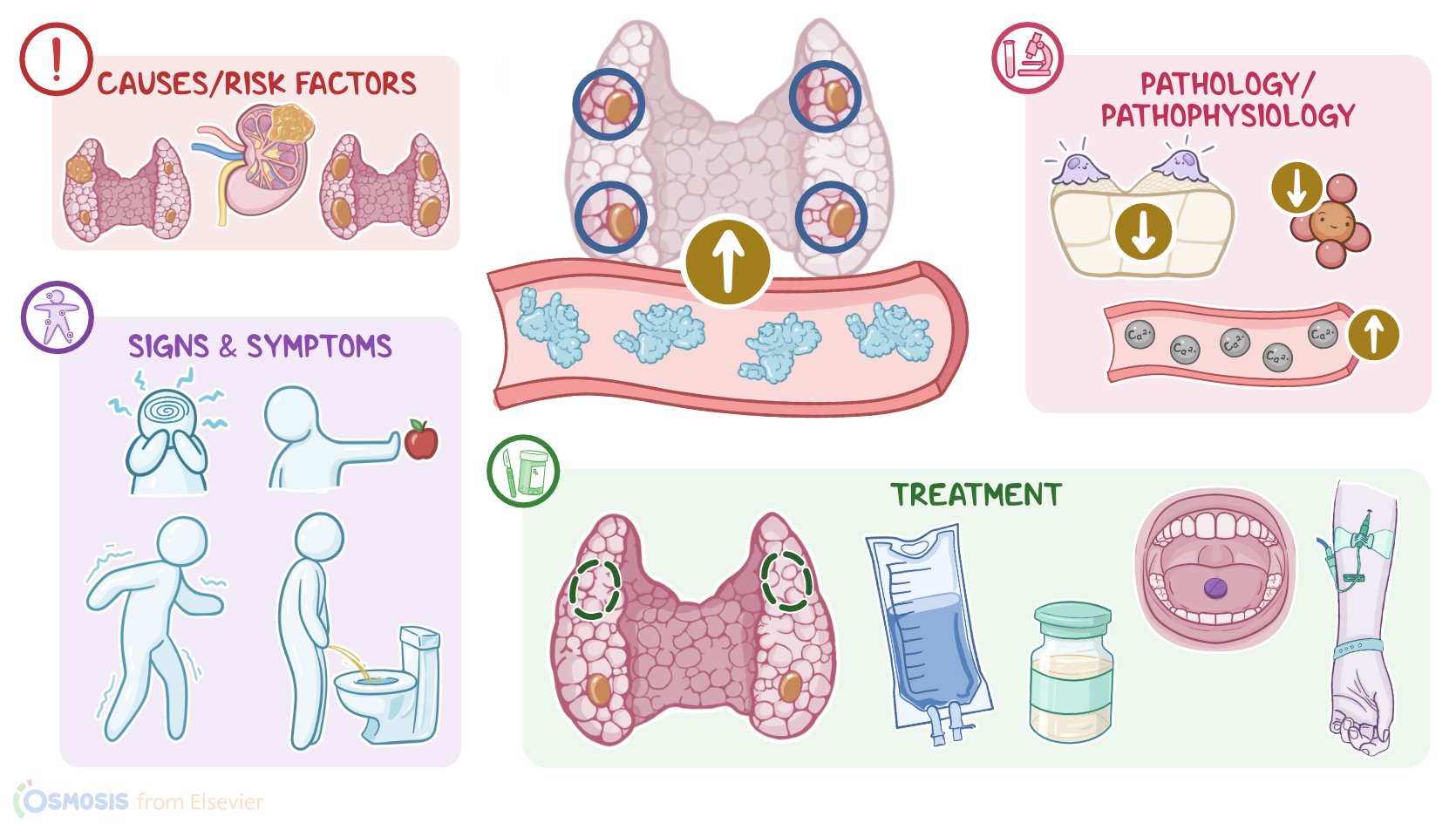
Hyperparathyroidism is a condition characterized by an increase in blood levels of the parathyroid hormone, or PTH for short, which ultimately results in hypercalcemia, or high blood calcium levels, as well as hypophosphatemia, or low blood phosphate levels.Now, PTH is produced by four small glands called the parathyroid glands.
Physiology0:25–1:18
These glands lie in the neck, being stuck to the back surface of the thyroid gland. The main function of PTH is keeping the levels of calcium within the normal range.
For example, when calcium levels are low, PTH boosts bone resorption, which causes the release of calcium and phosphate from the bone into the bloodstream.
In addition, PTH activates vitamin D, which in turn increases calcium and phosphate absorption from the gut. PTH also stimulates calcium reabsorption and phosphate excretion from the kidney.
On the other hand, high calcium levels cause the secretion of PTH to fall, which increases the deposition of calcium in bones and the excretion of calcium by the kidneys.Alright, now based on the underlying cause, hyperparathyroidism may be classified into three types.
Causes & risk factors1:18–2:42
First is primary hyperparathyroidism, which is caused by congenital hyperplasia, parathyroid tumor or cancer, and neck radiation or trauma.
Next is secondary hyperparathyroidism, which happens as a compensatory response to a condition outside the parathyroid glands that’s causing hypocalcemia, including vitamin D deficiency, chronic kidney disease, and PTH-secreting carcinomas of the lung and kidneys.
Finally, there is tertiary hyperparathyroidism, which can happen in clients who had long standing secondary hyperparathyroidism, in which the parathyroids have been producing high levels of PTH for so long that they undergo hyperplasia, or enlargement, and stop responding to feedback from calcium levels in the blood.
As a result, the parathyroids become permanently overactive, independently of blood calcium levels. Now, risk factors of developing hyperparathyroidism include radiation therapy to the neck; nutritional deficiencies like calcium deficiency, or severe, ongoing vitamin D deficiency; being assigned female at birth; and lithium use.
Regardless of the underlying cause and type of hyperparathyroidism, excess PTH levels stimulate an increase in bone resorption, as well as a decrease in bone production, ultimately causing the bones to release calcium into the blood.
Pathology2:42–3:36
In addition, there’s increased vitamin D activation, which in turn increases calcium absorption at the gut and calcium reabsorption from the kidneys.
These changes add up to finally cause hypercalcemia, as well as hypophosphatemia. Now, many organs and tissues throughout the body depend on normal calcium levels to function properly.
This is especially important in the brain and the heart, where calcium inhibits neurons and cardiac pacemaker cells from depolarizing.
As a result, hypercalcemia makes these cells less excitable. Okay, so in clients with hyperparathyroidism, signs and symptoms are typically associated with hypercalcemia.
Clinical manifestations3:36–5:12
These can include fatigue, and mental status changes, depression, confusion, and impaired memory; as well as loss of appetite, constipation, and muscle weakness, particularly in the proximal muscles of the lower limb.
Now, with hypercalcemia, the kidneys will need to work harder to filter the excess calcium, leading to hypercalciuria and polyuria, which can in turn cause dehydration.
Also, the extra calcium circulating in blood may deposit in organs and tissues, leading to the formation of calcium based kidney stones and gallstones, as well as pancreatitis.
Hypercalcemia can also interfere with the electrical impulses that regulate the heartbeat, so clients may experience cardiac arrhythmias, as well as hypertension.
Other complications of hyperparathyroidism include osteoporosis, which weakens the bones, rendering them prone to fractures.
The symptoms of hyperparathyroidism can be remembered as ‘stones, thrones, bones, groans, and psychiatric overtones’. ‘Stones’ is for calcium-based kidney stones or gallstones that can form.
‘Thrones’ refers to the toilet for polyuria. ‘Bones’ is for osteoporosis.
‘Groans’ is for constipation and muscle weakness. Finally, ‘psychiatric overtones’ refers to mental status changes.The diagnosis of hyperparathyroidism starts with history and physical assessment, followed by laboratory tests.
Diagnosis5:12–6:02
These tests include increased blood levels of PTH, as well as hypercalcemia, and hypophosphatemia; in addition to decreased urine levels of cyclic adenosine monophosphate, or cAMP for short, and hypercalciuria.
Abdominal X-rays can also be done to exclude kidney stones and calcium deposits, and to check for decreased bone density from osteoporosis and the presence of bone lesions from abnormal calcium deposits.
Other diagnostic tests include ultrasounds and CT scans, as well as arteriography, and selective venous sampling of the parathyroid blood for PTH levels.
Finally, the treatment of hyperparathyroidism may be grouped into surgical and non-surgical options. The treatment of choice for hyperparathyroidism is parathyroidectomy, which is the surgical removal of one or more of the parathyroid glands.On the other hand, non-surgical options include diuretic medications like furosemide, which increases the excretion of calcium from the kidneys, along with intravenous hydration by giving large volumes of saline solution.
Treatment6:02–7:26
This causes the levels of serum calcium to drop. Now, severe cases of hyperparathyroidism can be treated with the calcimimetic medication cinacalcet, which binds to calcium receptors in the parathyroid glands, increasing their sensitivity to the available calcium in the blood, and ultimately decreasing PTH secretion.
On the other hand, clients with chronic kidney disease are usually treated with the calcimimetic etelcalcetide. In clients with poor response to calcimimetics, oral phosphate is used, which inhibits bone resorption and decreases calcium absorption.
If calcium levels go up and needs to be lowered quickly, intravenous phosphate may be administered. Finally, clients with osteoporosis can be treated with bisphosphonates to reduce their bone loss.
Alright, let’s explore the nursing care you’ll provide to a client with hyperparathyroidism. While caring for your client, your priority goals are to prevent complications, and to provide supportive care as blood calcium levels are stabilized.
Management and care7:26–11:21
First, perform a cardiac assessment, noting your client’s vital signs and heart rhythm on the electrocardiogram, or ECG.
Be sure to report to the healthcare provider if your client develops arrhythmias or hypertension; and if your client is taking digoxin, monitor them closely and report signs of digitalis toxicity, such as nausea, vomiting, or vision changes to the healthcare provider.Next, assess your client’s kidney function by monitoring their fluid intake and output, as well as reviewing their most recent laboratory test results, including BUN, and creatinine, urinary calcium levels, and a blood calcium level greater than 10.5 mg/dL.
Report to the healthcare provider if your client complains of signs or symptoms like flank pain or hematuria, which may indicate the presence of a kidney stone.
Next, review their X-ray and DEXA scan results, and be sure to move your client carefully during care to prevent fractures.
If a fracture is suspected, report to the healthcare provider. Lastly, administer the prescribed calcimimetic and bisphosphonates medication.
Okay, if your client’s hypercalcemia is severe, administer the ordered intravenous saline and furosemide. During administration, closely monitor their intake and output and their blood calcium and phosphorus levels.
Immediately report to the healthcare provider if you notice signs of hypocalcemia like muscle cramps, abdominal pain, tingling around the mouth, as well as the presence of Trousseau sign, also known as a carpopedal spasm, which occurs when an inflated blood pressure cuff triggers an involuntary contraction and and flexure of the metacarpophalangeal joints; or Chvosteck sign, which is when facial muscles twitch after the facial nerve is lightly finger tapped 1 cm below the zygomatic process.
As you continue to monitor your client, immediately report if you notice a sudden drop in their calcium levels.Now, your client may need a parathyroidectomy as part of their treatment plan.
Preoperatively, monitor their electrolytes and ensure calcium levels are near-normal. When caring for your client postoperatively, ensure an emergency tracheostomy kit, oxygen, and suction equipment are at the client’s bedside and in working order.
Assist them into a position of comfort or semi-Fowler position while awake, and support their neck with pillows or rolled towels to maintain the neck in a neutral position, being careful to avoid neck extension.
Keep a close eye on your client’s respiratory status, and assist them with deep breathing and coughing. Suction secretions as needed, and immediately report signs of tracheal compression and respiratory distress to the healthcare provider, such as dyspnea, decreasing oxygen saturation, the inability to swallow, drooling, or stridor.
Also monitor your client’s neck dressing for bleeding, and report right away if there is more than a moderate amount of serosanguinous drainage present.
Also, assess your client for voice hoarseness and vocal changes, as these signs may indicate laryngeal nerve damage. Lastly, keep in mind that a hypocalcemic crisis can occur postoperatively, so frequently monitor their blood calcium level until it is stabilized.
Immediately report to the healthcare provider if your client demonstrates signs of a hypocalcemic crisis. Be prepared to administer intravenous calcium gluconate, as orderedOkay, now let's move on to client and family teaching.
General client and family teaching11:21–12:31
Begin by explaining how hyperparathyroidism affects the calcium levels in blood, and remind them that they need to keep follow-up appointments for routine monitoring.
In addition, teach them about any new medication prescriptions and how to self-administer them safely. Then, let your client know about the recommended lifestyle modifications.
Encourage your client to maintain adequate hydration in order to minimize their risk of kidney stones, and to eat a high-fiber diet in order to help prevent constipation.
Also, advise them to follow a moderate-calcium diet that contains vitamin D, and provide examples of recommended foods like eggs, dark leafy vegetables, low-fat milk, and other dairy products.
In addition, emphasize the importance of physical activity to promote bone calcification. Finally, if your client underwent a parathyroidectomy, advise them to immediately report signs of hypocalcemia or hypercalcemia, as well as difficulty breathing, or presence of bleeding, drainage, or redness around the incision site to their healthcare provider.Alright, as a quick recap… Hyperparathyroidism is characterized by an increase in PTH, which leads to hypercalcemia and hypophosphatemia.
Review12:31–13:32
Hyperparathyroidism may be classified as primary, secondary, or tertiary, depending on the underlying cause. Signs and symptoms of hyperparathyroidism are caused by hypercalcemia, and include fatigue, and mental status changes, such as depression, confusion, and impaired memory; as well as loss of appetite, constipation, and muscle weakness.
Hyperparathyroidism can be managed with medications or by performing a parathyroidectomy. The priority goals of nursing care are to prevent complications, and to provide supportive care as calcium levels are stabilized.
Client and family education is focused on lifestyle modifications, such as diet and physical activity, and when to contact the healthcare provider.
| HYPERPARATHYROIDISM | ||
| KEY POINTS | NOTES | |
| DEFINITION |
| |
| PHYSIOLOGY |
| |
| CAUSES AND RISK FACTORS |
| |
| PATHOPHYSIOLOGY |
| |
| SIGNS AND SYMPTOMS |
| |
| DIAGNOSIS |
| |
| TREATMENT |
| |
| MANAGEMENT OF CARE |
| |
| PATIENT AND FAMILY TEACHING |
| |
No notes for this video yet
Try adding a note below