Hypertension: Nursing process (ADPIE)
Client Report0:00–0:22
Jada Williams is a 55-year-old African American female who presents to her primary care office. At her visit one month ago, her blood pressure was 150/94 mmHg.
She was diagnosed with stage 2 hypertension and started on blood pressure medication. Hypertension, commonly referred to as high blood pressure, is a very common condition, impacting about 1 billion people around the world.
Pathology0:22–5:33
Blood pressure is classified in five categories: normal, elevated, stage 1, stage 2, and hypertensive crisis. Blood pressure is considered normal when the systolic blood pressure is more than 90 mmHg but less than 120 mmHg and the diastolic blood pressure is more than 60 mmHg but less than 80 mmHg.
When the systolic blood pressure is between 120 and 129 mmHg and the diastolic blood pressure is less than 80 mmHg, the blood pressure is said to be elevated.
Stage 1 hypertension is between 130 and 139 mmHg on the systolic side, and between 80 and 89 mmHg on the diastolic side.
Stage 2 hypertension is defined as anything that is 140 mmHg or higher on the systolic side and 90 mmHg or higher on the diastolic side.
Hypertensive crisis is present when the systolic blood pressure is over 180 mmHg or the diastolic blood pressure is over 120 mmHg.Now, there are also two types of hypertension, primary hypertension, which accounts for about 90 percent of hypertension cases, and secondary hypertension, which is much less common.
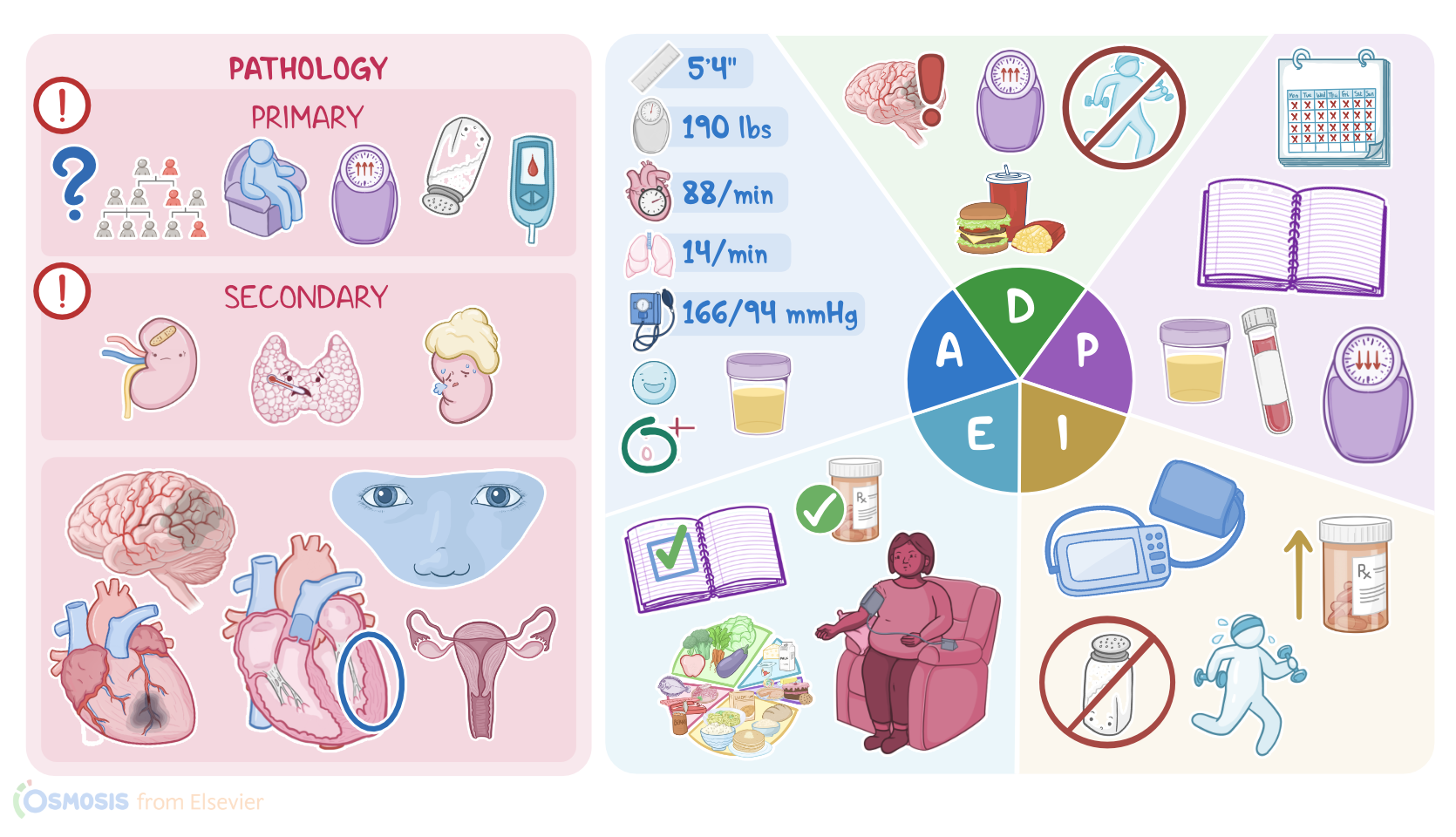
Primary hypertension has no known underlying cause, but it is thought to be due to the interaction of environmental and genetic factors affecting the cardiovascular and renal systems.
Several risk factors contribute to primary hypertension. For example, nonmodifiable risk factors include advanced age, biological male sex, a family history of hypertension, diabetes mellitus, and African American or Hispanic ethnicity.
Modifiable risk factors include a sedentary lifestyle, obesity, smoking, excess sodium and alcohol consumption, and stress.
On the other hand, secondary hypertension is caused by an underlying medical condition that elevates blood pressure, such as kidney disease, thyroid dysfunction, or adrenal disorders.Clients with hypertension often won’t have any symptoms, and this is why hypertension is known as the silent killer.
In some cases, however, high blood pressure can damage blood vessels in the heart, brain, kidneys, eyes, reproductive organs and peripheral arteries, causing symptoms such as headache, dizziness, visual changes, and chest pain.
Left untreated, hypertension can result in myocardial infarction, stroke, kidney disease, vision loss, sexual dysfunction, aortic dissection, and peripheral artery disease.
Furthermore, hypertension increases afterload, which is the amount of pressure the heart needs to work against to eject blood.
This increases the workload of the heart, eventually causing enlargement and thickening of the heart muscle and complications such as heart failure.Now, let’s talk about how hypertension is diagnosed.
In order to increase accuracy before making a diagnosis, blood pressure should be measured at least two times on two separate occasions and proper technique should be followed.
The client should rest for at least five minutes, sitting with feet on the floor, back supported, and arm supported at the level of the heart.
The blood pressure cuff should fit properly and should not be placed over clothing. Before measurement, the client should avoid anything that might increase their heart rate, like smoking or caffeine, at least thirty minutes prior to blood pressure measurement.Once hypertension is diagnosed, the client should be assessed for signs of complications from hypertension with tests such as a lipid profile, kidney function panel, urinalysis, electrocardiogram, and ophthalmic exam.
A complete blood count, fasting glucose, thyroid stimulating hormone, kidney function panel, and urinalysis may be ordered to check for conditions causing secondary hypertension.
Treatment is focused on lifestyle modifications and pharmacological interventions. The goal of treatment is to reduce blood pressure and reduce the risk of complications.
The Dietary Approaches to Stop Hypertension diet, referred to as the DASH diet, is recommended to reduce dietary sodium and help clients achieve a healthy weight.
Exercise, smoking cessation, limiting alcohol and caffeine, and reducing stress are also important lifestyle changes needed for hypertension control.
Eliminating unnecessary substances like recreational drugs that can raise blood pressure is important too. Pharmacological interventions are based on each client’s individual needs.
The four primary drug classes to treat hypertension include thiazide diuretics such as hydrochlorothiazide; angiotensin converting enzyme inhibitors; or ACE inhibitors, like lisinopril; angiotensin II receptor blockers or ARBs, such as losartan; and calcium channel blockers, or CCBs, like amlodipine.All right, back to your client Ms.
Williams. You call Ms.
Williams into the exam room, introduce yourself as her nurse, confirm her identity, and begin your assessment. She says there have been no changes in her medical, surgical, or family history since her last visit.
She tells you she doesn’t use recreational drugs and doesn’t smoke. She confirms lisinopril and a daily multivitamin are her only current medications.
Assessment5:33–7:12
When asked about her diet and activity, she shares she has been so busy with work that she stopped exercising and eats fast food at least 3 times a week.
You ask if she has brought in home blood pressure readings, and she responds by telling you unable to afford a blood pressure monitor.Next, you begin your physical exam.
Ms. Williams is 5 feet 4 inches tall and weighs 190 pounds.
Her skin is warm, dry, and intact with normal turgor; temperature is 98.0°F or 36.7 °C; lung sounds are clear and respirations are 14 per minute; heart sounds are normal and heart rate 88 per minute and regular; blood pressure is 166/94 mmHg, and pain is 0 out of 10.
You review the labs from her previous visit and flag these findings for the primary care provider, or PCP: BUN 27 mg/dL, creatinine 1.5 mg/dL, and urinalysis showing trace hematuria and proteinuria.
After completing your documentation you let Ms. Williams know her PCP will be in to examine her shortly.Now that you have assessed Ms.
Williams, you are ready to select nursing diagnoses to plan your care. Your nursing diagnoses include: risk for vascular injury related to hypertension, imbalanced nutrition more than body requirements related to dietary choices and lack of physical activity, and ineffective health maintenance related to hypertension and increased BMI.
OK, it’s time to create goals to guide your care. After collaborating with Ms.
Williams and the health care team, you establish the following goals: by her follow up visit in 1 month Ms. Williams’s blood pressure will be in a more normal range of 90 to 120 mmHg systolic and 60 to 80 mmHg diastolic and she will agree to measure her blood pressure at the same time each day and keep a log of these readings to bring with her at her next visit; prior to the end of today’s visit, Ms.
Diagnosis7:12–7:34
Williams will agree to complete her follow-up labs, verbalize understanding of lifestyle modifications, and set a goal to lose 5 pounds by her follow up visit.
Planning7:34–8:13
Now you’re ready to put your plan into action. You contact the office care manager to obtain a blood pressure monitor for Ms.
Williams to take home with her. The PCP has increased her lisinopril dose, ordered a blood draw and urinalysis for today, and requested she return to the office in 1 month.
You explain why the dosage has been increased, reinforce the importance of taking her new dose of lisinopril as prescribed and remind her the follow up labs will help monitor for complications from her hypertension.
Next, you teach Ms. Williams about how to follow the DASH diet, develop easy ways to incorporate exercise into her busy schedule, and show her how to take her own blood pressure.
Implementation8:13–8:58
Ms. Williams is excited to learn that the care manager obtained a blood pressure monitor for her to take home!OK, now it’s time to evaluate your plan of care.
Ms. Williams verbalizes her understanding of her new dose of lisinopril and states she will go to the lab after her appointment today for her follow-up labs.
She describes her new DASH diet and exercise plan, and correctly demonstrates how to take her own blood pressure. She agrees to write down her daily blood pressure readings and bring them to her next appointment.
Your evaluation reveals Ms. Williams understood the education you provided and you are hopeful the new dose of lisinopril, in addition to lifestyle modifications she plans to make, will help her lose weight and lower her blood pressure.
Evaluation8:58–9:49
You document the education provided and Ms. Williams’s understanding demonstrated via teach back.
With the help of the interdisciplinary team, you will continue evaluating Ms. Williams’s blood pressure control and for signs of complications through routine assessment and lab monitoring.So, your client Ms.
Williams presented today for a follow up after being diagnosed with hypertension. Hypertension can be either primary, with no known cause, or secondary, caused by an underlying condition.
Hypertension is classified according to the range of systolic and diastolic values. Treatment of hypertension involves lifestyle modifications, pharmacological therapy, and monitoring for complications of uncontrolled hypertension such as myocardial infarction, stroke, kidney disease and heart failure.Your assessment reveals Ms.
Williams is experiencing elevated blood pressure, has a high BMI, and needs education on managing her hypertension. Your nursing diagnoses focus on risk for vascular injury, imbalanced nutrition, and ineffective health maintenance.
Your plan of care involves interventions to ensure Ms. Williams takes her medication as prescribed, monitors her blood pressure at home, follows up as advised by her PCP, as well as teaching Ms.
Summary9:49–11:12
Williams about lifestyle modifications that will lower her BMI and blood pressure. You implement your plan with the help of the interdisciplinary team, and you evaluate the effectiveness of the education you provided.
At Ms. Williams’s follow up appointment, you will reassess and adjust your nursing diagnoses and plan accordingly with the goals of getting her blood pressure under control and helping her avoid complications from uncontrolled hypertension.
nursing diagnosis focus on risk for vascular injury imbalanced nutrition and ineffective Health maintenance. Your plan of care involves interventions to ensure Miss Williams takes her medication as prescribed monitors her blood pressure at home follows up as advised by her PCP as well as teaching Miss Williams about lifestyle modifications that will lower her BMI and blood pressure you implement your plan with the help of the interdisciplinary team and you evaluate the effectiveness of the education you provided at Miss Williams follow-up appointment, you'll reassess and adjust your nursing diagnosis and plan accordingly with a goals of getting her blood pressure under control and helping her avoid complications from
| HYPERTENSION | ||
| KEY POINTS | NOTES | |
| PATIENT REPORT |
| |
| PATHOPHYSIOLOGY |
| |
| DIAGNOSIS AND TREATMENT |
| |
| ASSESSMENT |
| |
| NURSING DIAGNOSES |
| |
| PLANNING |
| |
| IMPLEMENTATION |
| |
| EVALUATION |
| |
No notes for this video yet
Try adding a note below