Influenza: Nursing

Notes

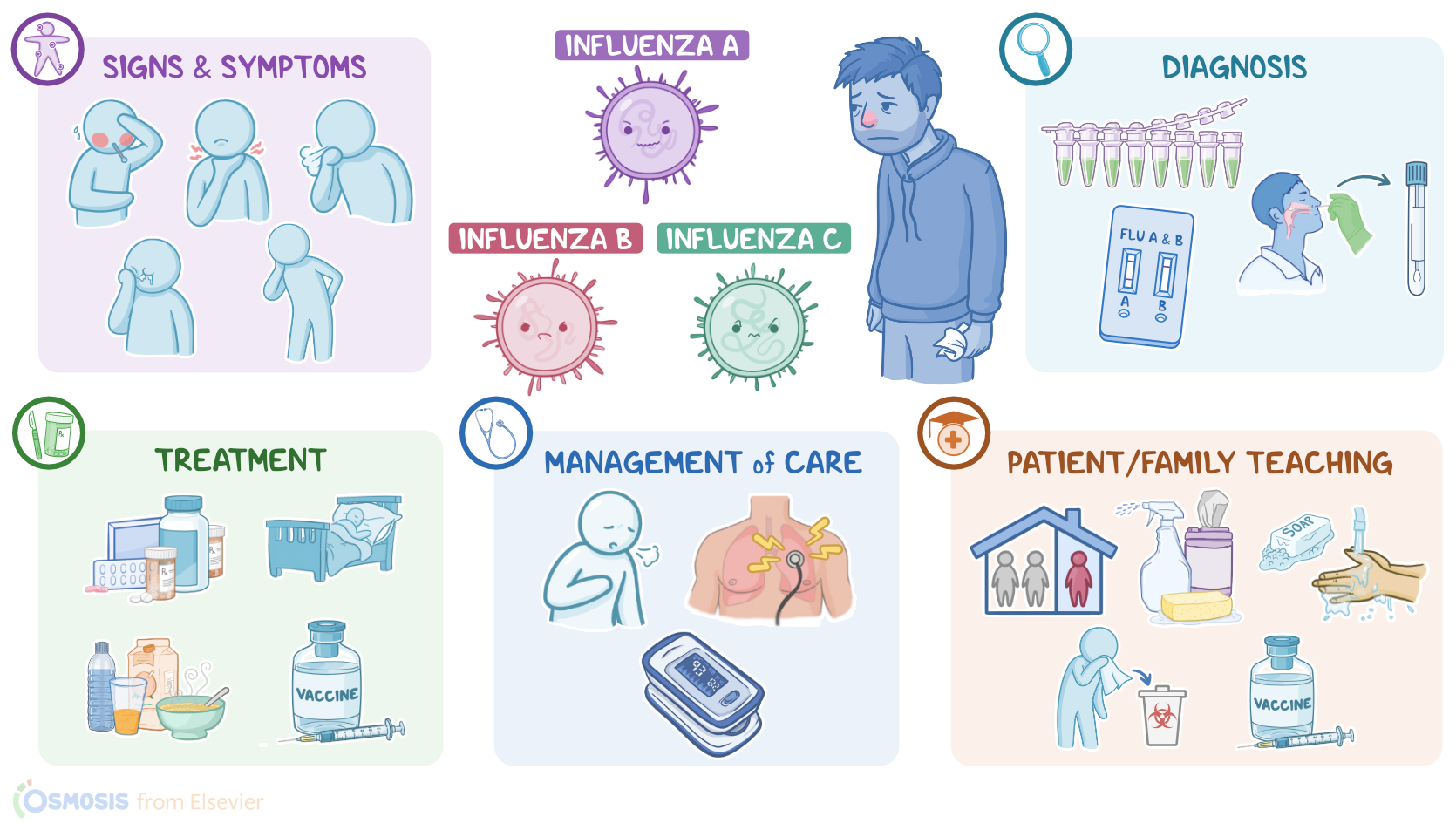
INFLUENZA

KEY POINTS
NOTES
DEFINITION
  • Contagious respiratory disease
    • Influenza A
    • Influenza B
    • Influenza C

PHYSIOLOGY
  • Upper respiratory tract
  • Lower respiratory tract 
    • Lungs
      • Bronchi
      • Bronchioles
      • Alveolar ducts
      • Alveoli
  • Alveoli
    • Air-filled sacs
    • Primary site for gas exchange

CAUSES AND RISK FACTORS
  • Causes
    • Influenza virus
  • Risk factors
    • Contact with infected individuals
    • Small spaces
    • Unvaccinated
    • Schools
    • Workplaces
    • Nursing homes
    • Public transportation

PATHOPHYSIOLOGY
  • Influenza virus multiplies and spreads in the respiratory tract lining
  • Immune system mounts inflammatory response
  • Complications
    • Sinus or ear infection
    • Pneumonia

SIGNS AND SYMPTOMS
  • Headaches
  • Fever
  • Chills
  • Fatigue 
  • Weakness
  • Muscle aches
  • Runny nose
  • Sore throat
  • Cough

DIAGNOSIS
  • History
  • Physical assessment
  • RT-PCR
  • Rapid molecular assay
  • Rapid influenza diagnostic test

TREATMENT
  • Supportive care
    • Rest
    • Hydration
    • Analgesics
    • Antipyretics
    • Antihistamines
    • Antivirals

MANAGEMENT OF CARE
  • Goals of care
    • Improve ventilation and oxygenation
    • Provide supportive care
  • Assess respiratory status
  • Monitor oxygenation and temperature
  • Encourage rest and hydration
  • Encourage coughing and deep breathing
  • Notify HCP
    • Worsening fever
    • Altered mental status
    • Dyspnea
    • Diffuse crackles 
    • Oxygen saturation below 94%

PATIENT AND FAMILY TEACHING
  • Explain condition, plan of care, and how to safely self-administer medication 
  • Reduce risk of spread
  • Teach family and household members about prevention
  • Encourage vaccination

Transcript

Watch video only

Influenza, commonly known as the flu, is a highly contagious respiratory disease caused by the influenza virus. There are three types of the influenza virus that can infect humans: influenza types A, B, and C. Influenza types A and B are responsible for the annual regional flu epidemics, or the flu season, which is when cases of influenza rise, and spans from about September to April, with peaks around December to February. On the other hand, influenza C may lead to mild illness, but not epidemics or pandemics.

Now, let’s quickly review the respiratory tract, which can be divided into two regions: the upper respiratory tract and lower respiratory tract. The upper respiratory tract includes the nose, nasal cavity, the oral cavity, pharynx, epiglottis, larynx, and the upper part of the trachea; while the lower respiratory tract includes the lower part of trachea, and the lungs containing the bronchi, then the bronchioles, onto the alveolar ducts, and finally into the alveoli.

These tiny air-filled sacs are the body’s primary sites of oxygen and carbon dioxide gas exchange. The gases move across the alveolar-capillary membrane, with oxygen moving from the alveolar sacs into the blood, and carbon dioxide moving from the blood into the alveolar sacs to be exhaled. This allows for a consistent oxygen supply to carry out bodily functions and to maintain the proper blood pH level.

Now, the influenza virus invades the respiratory tract and uses it to spread the infection. The flu is typically transmitted from person to person via respiratory droplets or, in some instances, aerosolized particles that are expelled from the respiratory tract of an infected individual. These droplets can be propelled a few feet into the air when talking, coughing, or sneezing, and can then land in the eyes, nose, or mouths of people nearby, or get inhaled into the lungs. Less frequently, the virus is transmitted indirectly when an individual touches a contaminated surface and then, prior to washing their hands, they touch their eyes, nose, or mouth.

Individuals are most likely to spread the virus to others 1 day before symptom onset until about 5 to 7 days after becoming sick. So people are at increased risk for contracting the virus if they have close contact with infected individuals or are in small spaces with large groups of people during flu season, especially if they’re not vaccinated against influenza. Common places where the influenza virus spreads include schools, work places, nursing homes, or on public transportation.

Now, after a person contracts the influenza virus, these infectious little pathogens typically multiply and spread throughout the cells lining the upper respiratory tract. In response to this, the immune system launches an inflammatory response, which results in visible tracheobronchial redness and swelling, as well as mucous discharge, as these cells start to produce more mucus that can help trap and eventually expel these pathogens.

In certain cases, the disease can become more severe and spread to nearby areas, leading to complications like a sinus or ear infection. If the virus manages to invade the lower respiratory tract, clients can potentially develop pneumonia, characterized by fluid or pus build up in the lungs. In addition, the disease may weaken the immune system, making the individual more susceptible to contracting a secondary bacterial infection. Clients at higher risk of developing complications include children under 5 years of age, and adults over 65, as well as clients who are pregnant or have a chronic heart or lung disease.

Typically, the flu manifests as symptoms that present about four days after exposure and last about a week. Common symptoms include headaches, fever, chills, fatigue, weakness, and muscle aches. Clients may also experience a runny nose with watery nasal discharge, a sore throat, and a cough. Upon auscultating the lungs, breath sounds are typically normal. Now, in addition to the other symptoms, influenza B can also lead to gastrointestinal symptoms like nausea, vomiting, and diarrhea. Most of these symptoms get better in a week, but the cough often persists for up to two weeks, and clients with comorbid conditions or over 65 may have continuing lethargy or weakness for weeks after the flu.

Sources

    1. Harding MM, Kwong J, Roberts D, Hagler D, Reinisch C. Lewis’s Medical-Surgical Nursing: Assessment and Management of Clinical Problems. 11th Edition. Mosby; 2019. ISBN: 978-0-323-55149-6 

    1. Gaitonde DY, Moore FC, Morgan MK. Influenza: Diagnosis and Treatment. Am Fam Physician. 2019;100(12):751-758. 

    1. Gu Y, Zuo X, Zhang S, et al. The Mechanism behind Influenza Virus Cytokine Storm. Viruses. 2021;13(7):1362. Published 2021 Jul 14. doi:10.3390/v13071362 

    1. Luu B, McCoy-Hass V, Kadiu T, Ngo V, Kadiu S, Lien J. Influenza viruses. Physician Assistant Clinics. 2023;8(3):531-553. doi:10.1016/j.cpha.2023.03.003 

    1. Nypaver C, Dehlinger C, Carter C. Influenza and Influenza Vaccine: A Review. J Midwifery Womens Health. 2021;66(1):45-53. doi:10.1111/jmwh.13203 

    1. Singh P, Sodhi KK, Bali A, Shree P. Influenza A virus and its antiviral drug treatment options. Medicine in Microecology. 2023;16:100083. doi:10.1016/j.medmic.2023.100083