Necrotizing enterocolitis: Nursing

Necrotizing enterocolitis: Nursing

Watch later

Watch later

Infection prevention and control - Precautions and personal protective equipment (PPE): Nursing skills
Urinary tract infections (UTIs): Nursing process (ADPIE)
Modes of infectious disease transmission
Epstein-Barr virus (Infectious mononucleosis)
Pneumonia
Wound healing
Palliative and hospice care: Nursing
Postoperative care: Nursing
Biology of cancer: Nursing
Biliary atresia: Nursing
Cholecystitis: Nursing
Cholelithiasis: Nursing
Colorectal cancer: Nursing
Diarrhea: Nursing
Diverticular disease: Nursing
Esophageal cancer: Nursing
Gastric cancer: Nursing
Hepatitis: Nursing
Inflammatory bowel disease - Crohn disease and ulcerative colitis: Nursing
Intestinal obstruction: Nursing
Irritable bowel syndrome (IBS): Nursing
Jaundice: Nursing
Laryngeal cancer: Nursing
Liver cancer: Nursing
Pancreatic cancer: Nursing
Esophageal atresia and tracheoesophageal fistula: Nursing
Geriatric considerations - Gastrointestinal: Nursing
Hirschsprung disease: Nursing
Hyperemesis gravidarum: Nursing
Necrotizing enterocolitis: Nursing
Omphalocele and gastroschisis: Nursing
Appendicitis: Nursing process (ADPIE)
Celiac disease: Nursing process (ADPIE)
Cirrhosis: Nursing process (ADPIE)
Gastroesophageal reflux disease (GERD): Nursing process (ADPIE)
Hiatal hernia: Nursing process (ADPIE)
Pancreatitis: Nursing process (ADPIE)
Peptic ulcer disease (PUD): Nursing process (ADPIE)
Antacids: Nursing pharmacology
Antidiarrheals: Nursing pharmacology
Antiemetics: Nursing pharmacology
Antispasmodics (GI): Nursing pharmacology
Gallstone-dissolving agents: Nursing pharmacology
Gastric mucosal protective agents: Nursing pharmacology
Histamine H2 antagonists: Nursing pharmacology
Laxatives: Nursing pharmacology
Medications for hepatic encephalopathy: Nursing pharmacology
Pancreatic enzyme replacements: Nursing pharmacology
Proton pump inhibitors (PPIs): Nursing pharmacology
Treatment for Helicobacter pylori: Nursing pharmacology
Weight loss medications: Nursing pharmacology
Bladder tumors: Nursing
Chronic kidney disease (CKD): Nursing
Dialysis care: Nursing
Epididymitis: Nursing
Glomerulonephritis: Nursing
Nephrotic syndrome: Nursing
Polycystic kidney disease (PKD): Nursing
Prostate cancer: Nursing
Pyelonephritis: Nursing
Renal and urinary calculi: Nursing
Renal cancer: Nursing
Testicular cancer: Nursing
Urinary retention: Nursing
Bladder exstrophy: Nursing
Circumcision: Nursing
Cryptorchidism: Nursing
Enuresis: Nursing
Geriatric considerations - Urinary: Nursing
Hypospadias and epispadias: Nursing
Acute kidney injury (AKI): Nursing process (ADPIE)
Benign prostatic hyperplasia (BPH): Nursing process (ADPIE)
Urinary incontinence - Stress: Nursing process (ADPIE)
Antispasmodics (GU): Nursing pharmacology
Cholinergic therapy (GU): Nursing pharmacology
Diuretics - Osmotic and carbonic anhydrase inhibitors: Nursing pharmacology
Diuretics - Thiazide, thiazide-like, loop, and potassium-sparing diuretics: Nursing pharmacology
Anemia - Aplastic: Nursing
Anemia - Iron-deficiency: Nursing
Anemia - Macrocytic: Nursing
Arterial blood gas (ABG) - Overview: Nursing
Arterial blood gas (ABG) - Metabolic acidosis: Nursing
Arterial blood gas (ABG) - Metabolic alkalosis: Nursing
Arterial blood gas (ABG) - Respiratory acidosis: Nursing
Arterial blood gas (ABG) - Respiratory alkalosis: Nursing
Blood cultures: Nursing
Cardiac biomarkers - Creatine kinase (CK): Nursing
Cardiac biomarkers - Troponin: Nursing
Coagulation studies - Partial thromboplastin time (PTT): Nursing
Complete blood count (CBC) - Hemoglobin and hematocrit: Nursing
Complete blood count (CBC) - Platelets: Nursing
Complete blood count (CBC) - Red blood cells (RBC): Nursing
Complete blood count (CBC) - White blood cells (WBC) and differential: Nursing
Complete metabolic panel (CMP) - Blood urea nitrogen (BUN) and creatinine (Cr): Nursing
Complete metabolic panel (CMP) - Chloride: Nursing
Complete metabolic panel (CMP) - Estimated glomerular filtration rate (eGFR): Nursing
Complete metabolic panel (CMP) - Glucose: Nursing
Complete metabolic panel (CMP) - Liver function tests (LFT): Nursing
Complete metabolic panel (CMP) - Potassium: Nursing
Complete metabolic panel (CMP) - Sodium: Nursing
Complete metabolic panel (CMP) - Total protein: Nursing
Disseminated intravascular coagulation (DIC): Nursing
Multiple myeloma: Nursing
Neutropenia: Nursing
Polycythemia: Nursing
Thalassemia: Nursing
Thrombocytopenia: Nursing
Leukemia: Nursing process (ADPIE)
Anticoagulants - Direct thrombin and factor Xa inhibitors: Nursing pharmacology
Anticoagulants - Heparin: Nursing pharmacology
Anticoagulants - Warfarin: Nursing pharmacology
Antihyperlipidemics - Bile acid sequestrants and cholesterol absorption inhibitors: Nursing pharmacology
Antihyperlipidemics - Fibrates: Nursing pharmacology
Antihyperlipidemics - Miscellaneous: Nursing pharmacology
Antihyperlipidemics - Statins: Nursing pharmacology
Antiplatelet agents: Nursing pharmacology
Blood products: Nursing pharmacology
Hematopoietic growth factors: Nursing pharmacology
Hemostatics: Nursing pharmacology
Iron preparations: Nursing pharmacology
Thrombolytics: Nursing pharmacology
Autoimmunity: Nursing
Human immunodeficiency virus (HIV) and acquired immunodeficiency syndrome (AIDS): Nursing
Hypersensitivity reactions - Type I: Nursing
Hypersensitivity reactions - Type II: Nursing
Hypersensitivity reactions - Type III: Nursing
Hypersensitivity reactions - Type IV: Nursing
Immune response - Adaptive: Nursing
Immune response - Innate: Nursing
Immunodeficiency disorders - Primary: Nursing
Immunodeficiency disorders - Secondary: Nursing
Inflammatory process: Nursing
Scleroderma: Nursing
Shock - Anaphylactic: Nursing
Sjögren syndrome: Nursing
Systemic lupus erythematosus (SLE): Nursing
Toxic shock syndrome (TSS): Nursing
Erythema infectiosum (Fifth disease): Nursing
Fever: Nursing
Infectious mononucleosis: Nursing
Mumps (Parotitis): Nursing
Neonatal sepsis: Nursing
Pertussis: Nursing
Poliomyelitis: Nursing
Postpartum infections: Nursing
Roseola (Exanthem subitum): Nursing
Rubella (German measles): Nursing
Rubeola (Measles): Nursing
Smallpox: Nursing
Zika virus: Nursing
Anaphylaxis: Nursing process (ADPIE)
Lyme disease: Nursing process (ADPIE)
Rheumatoid arthritis (RA): Nursing process (ADPIE)
Antirejection immunosuppressants: Nursing pharmacology
Biologic agents: Nursing pharmacology
Disease-modifying therapy for multiple sclerosis: Nursing pharmacology
Immunoglobulins: Nursing pharmacology
Immunomodulators: Nursing pharmacology
Immunosuppressants for autoimmune diseases: Nursing pharmacology
Non-biologic disease-modifying antirheumatic drug (DMARD) therapy: Nursing pharmacology
Vaccines: Nursing pharmacology
Acne: Nursing
Animal and snake bites: Nursing
Burn injury: Nursing
Cutaneous fungal infections: Nursing
Erysipelas and cellulitis: Nursing
Folliculitis, carbuncles, and furuncles: Nursing
Herpes simplex virus (HSV): Nursing
Herpes zoster: Nursing
Impetigo: Nursing
Insect stings and bites: Nursing
Pediculosis and scabies: Nursing
Psoriasis: Nursing
Rocky Mountain spotted fever (RMSF): Nursing
Skin cancer - Basal cell carcinoma, squamous cell carcinoma, and melanoma: Nursing
Urticaria: Nursing
Geriatric considerations - Integumentary: Nursing
Atopic dermatitis: Nursing process (ADPIE)
Frostbite: Nursing process (ADPIE)
Methicillin-resistant Staphylococcus aureus (MRSA): Nursing process (ADPIE)
Pressure injury: Nursing process (ADPIE)
Antibiotics - Topical: Nursing pharmacology
Antifungals - Topical: Nursing pharmacology
Corticosteroids - Topical: Nursing pharmacology
Debridement agents: Nursing pharmacology
Keratolytics: Nursing pharmacology
Medications for acne vulgaris: Nursing pharmacology
Osteoarthritis: Nursing
Osteomyelitis: Nursing
Osteoporosis: Nursing
Hip fractures: Nursing
Developmental dysplasia of the hip: Nursing
Acute compartment syndrome: Nursing process (ADPIE)
Fractures: Nursing process (ADPIE)
Gout: Nursing process (ADPIE)
Musculoskeletal injuries: Nursing process (ADPIE)
Buerger disease: Nursing
Raynaud phenomenon: Nursing
Peripheral arterial disease (PAD): Nursing process (ADPIE)
Peripheral venous disease (PVD): Nursing process (ADPIE)
Atelectasis: Nursing
Geriatric considerations - Respiratory: Nursing
Venous thromboembolism (VTE): Nursing process (ADPIE)
Asthma: Nursing process (ADPIE)
Bacterial pneumonia: Nursing process (ADPIE)
Bronchiolitis and respiratory syncytial virus (RSV): Nursing process (ADPIE)
Carbon monoxide poisoning: Nursing process (ADPIE)
Chronic obstructive pulmonary disease (COPD): Nursing process (ADPIE)
Epiglottitis: Nursing process (ADPIE)
Foreign body aspiration and upper airway obstruction: Nursing process (ADPIE)
Laryngotracheobronchitis (LTB) and croup: Nursing process (ADPIE)
Smoke inhalation injury: Nursing process (ADPIE)
Papulosquamous and inflammatory skin disorders: Pathology review

Notes

NECROTIZING ENTEROCOLITIS

KEY POINTS
NOTES
DEFINITION
  • Inflammatory condition of the gastrointestinal (GI) tract characterized by mucosal damage and necrosis

PHYSIOLOGY
  • Layers of GI tract
    • Adventitis (serosa)
    • Muscularis externa
    • Submucosa
    • Mucosa
  • Intestinal flora
    • Aid in digestion and protection against pathogens
    • Colonize GI tract during delivery and after birth

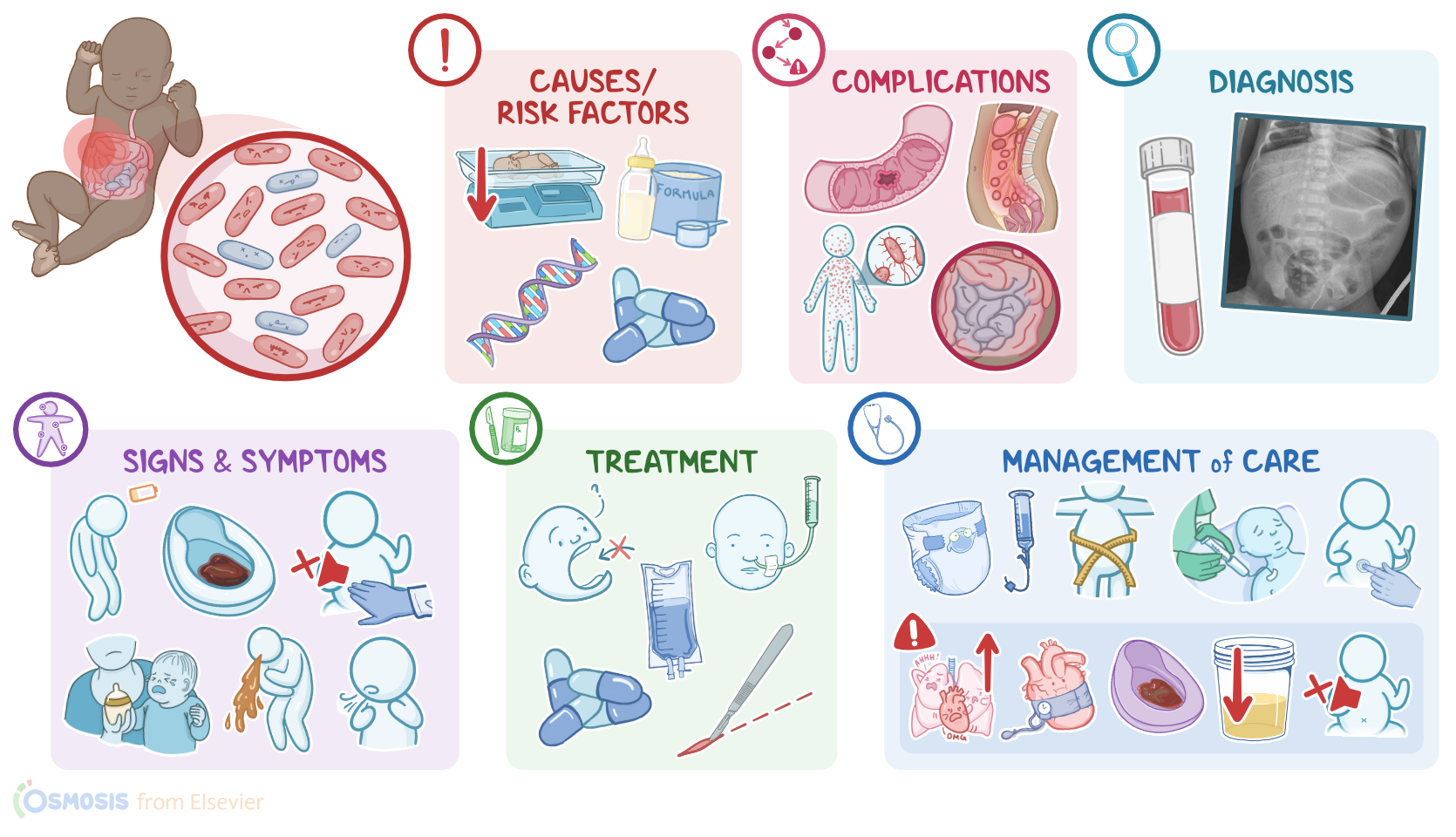
CAUSES AND RISK FACTORS
  • Causes
    • Unknown 
  • Risk factors
    • Prematurity
    • Low birth weight
    • Formula feeding
    • Genetic predisposition
    • Use of antibiotics

PATHOPHYSIOLOGY
  • Disruption of normal bacterial flora in GI tract
  • Pathogenic bacteria multiply 
  • Inflammation and tissue damage occurs
  • Bacteria able to invade GI walls
  • Complications
    • Intestinal perforation
    • Peritonitis
    • Short bowel syndrome

SIGNS AND SYMPTOMS
  • Lethargy
  • Poor feeding
  • Nausea
  • Bilious vomiting
  • Diarrhea
  • Bloody stools
  • Abdominal distension
  • Erythema
  • Tenderness
  • Decreased bowel sounds
  • Visible intestinal loop
  • Palpable abdominal mass 
  • Shallow, rapid breathing
  • Respiratory failure
  • Circulatory collapse

DIAGNOSIS
  • History
  • Physical assessment
  • X-ray
  • Blood culture

TREATMENT
  • Antibiotics
  • Fluid resuscitation 
  • Bowel rest
  • Surgery
  • Prevention
    • Breast milk feeding

MANAGEMENT OF CARE
  • Goals of care
    • Provide supportive care
    • Prevent complications
  • Discontinue enteral feedings
  • Maintain NPO status
  • Insert nasogastric tube as prescribed
  • Assist with establishing central venous access
  • Administer medications and parenteral nutrition as prescribed
  • Monitor vital signs
  • Observe abdomen
  • Auscultate bowel sounds
  • Measure abdominal girth
  • Check stools and gastric aspirates
  • Monitor intake and output
  • Notify HCP
    • Signs of worsening condition

PATIENT AND FAMILY TEACHING
  • Explain condition, plan of care, and how to safely administer medications
  • Provide instructions on feeding needs and schedule
  • Encourage use of breast milk or prescribed formula
  • Keep all follow-up appointments 
  • Notify HCP
    • Concerns about weight gain
  • Seek emergency care
    • Difficult feeding
    • Fever
    • Diarrhea
    • Bloody stools

Transcript

Watch video only

Necrotizing enterocolitis or NEC for short, is an inflammatory condition of the gastrointestinal tract characterized by mucosal damage and necrosis of the gastrointestinal wall. This is an urgent condition primarily seen in preterm infants.

Now, let’s cover some basic physiology and histology of the 4 main gastrointestinal layers. The outermost layer is called the adventitia or serosa and it’s thin and fibrous. Next up is the muscularis externa which is made up of smooth muscle cells located in the outer longitudinal layer and in the inner circular layer. These layers work together to move food forward via peristalsis which is a series of coordinated wave-like contractions.

The next layer is the submucosa, which consists of dense connective tissue that contains blood vessels, lymphatics, and nerves. Finally, the innermost layer is called the mucosa, which secretes mucus and digestive enzymes but also absorbs nutrients from the gastrointestinal lumen.

The intestines also contain a variety of non-pathogenic bacteria that make up a healthy intestinal flora. These aid with food digestion as well as protect the intestine from pathogenic microorganisms by out competing them. However, the fetus develops in a sterile environment, so their gastrointestinal tract is also sterile. Beneficial bacteria can only start colonizing their gastrointestinal tract during delivery and will continue after birth.

Now, the exact cause of necrotizing enterocolitis remains unknown, but some theories suggest that it’s associated with bacterial invasion of the gastrointestinal wall. Several risk factors have been associated with necrotizing enterocolitis, including prematurity, and low birth weight.

Another risk factor for necrotizing enterocolitis is formula-feeding, possibly due to the loss of protective components of breastmilk, such as oligosaccharides, lactoferrin, and cytokines. Other important risk factors include genetic predisposition and the use of antibiotics.

Now, the pathology of necrotizing enterocolitis is still not fully understood, but it’s thought to be due to the disruption of the normal bacterial flora of the gastrointestinal tract. So, when a trigger, like antibiotics or intestinal inflammation, kills off the beneficial bacteria, it allows pathogenic bacteria to multiply without competition.

In preterm infants, the immune system is weaker so it’s more difficult to eliminate the bacteria. However, it will still cause inflammation and damage nearby tissue. This allows the bacteria to invade into the gastrointestinal walls, where they can eventually cause transmural ischemia and necrosis of the gastrointestinal wall.

Necrotizing enterocolitis can lead to serious complications, including intestinal perforation, which can, in turn, cause peritonitis, and sepsis. In addition, short bowel syndrome can occur when a big part of the small intestine is damaged, which causes impaired water and nutrient absorption.

Now, clinical manifestations of necrotizing enterocolitis are initially nonspecific and include lethargy and poor feeding. But as the condition progresses, the infant usually develops gastrointestinal manifestations, such as nausea, bilious vomiting, diarrhea, and bloody stools.

Upon physical assessment, there can be abdominal distension, erythema, and tenderness, along with decreased bowel sounds, visible intestinal loops, or a palpable abdominal mass. In some cases, distended abdominal structures can compress the diaphragm and indirectly exert pressure on the lungs, so shallow and rapid breathing might be also observed.

In severe cases, an infant can develop systemic manifestations, like respiratory failure and circulatory collapse, which are typically associated with apnea, cyanosis, bradycardia, hypotension, and even shock.