Necrotizing enterocolitis: Nursing
Introduction0:00–0:19
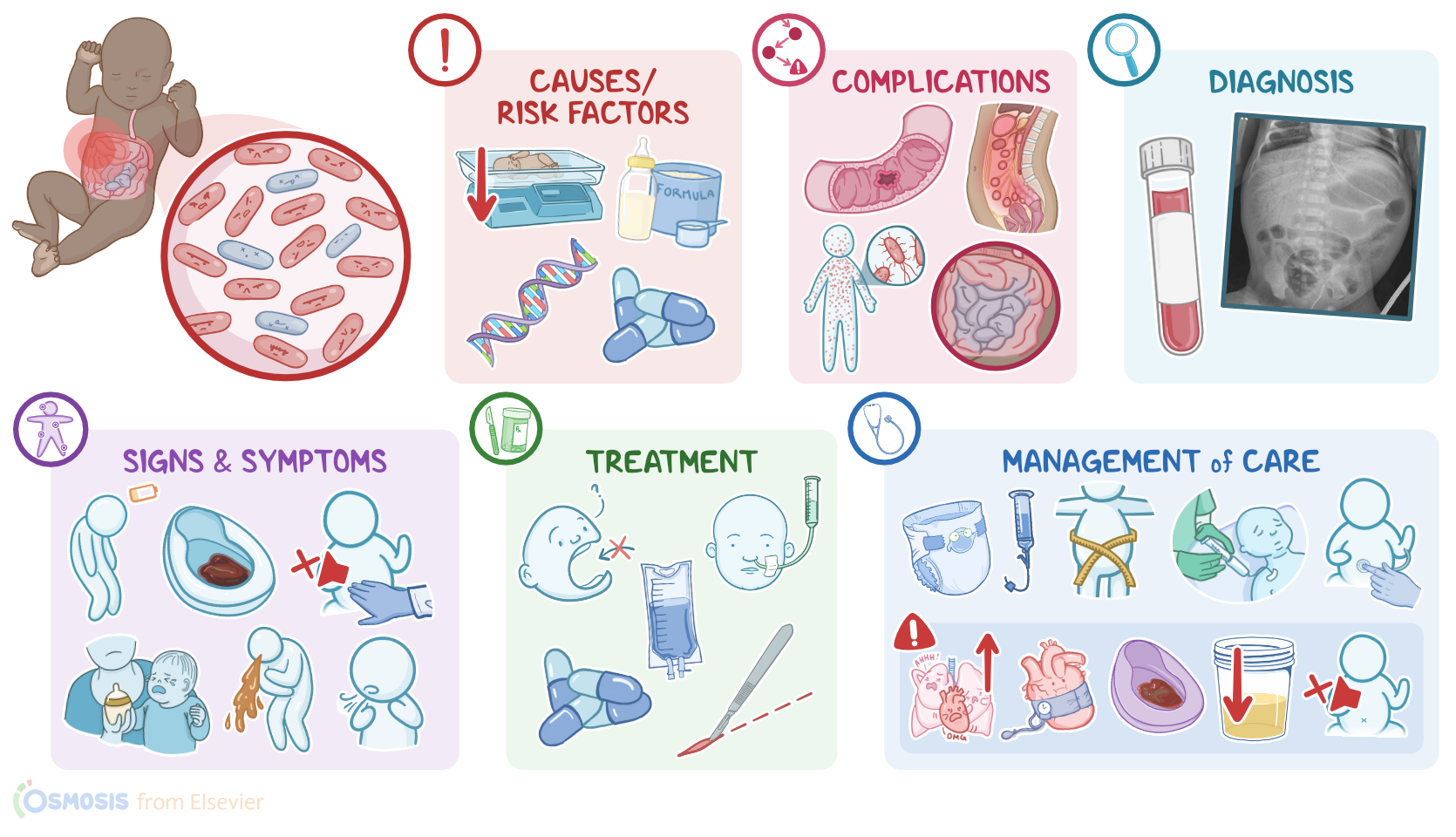
Necrotizing enterocolitis or NEC for short, is an inflammatory condition of the gastrointestinal tract characterized by mucosal damage and necrosis of the gastrointestinal wall.
This is an urgent condition primarily seen in preterm infants.Now, let’s cover some basic physiology and histology of the 4 main gastrointestinal layers.
Physiology0:19–1:32
The outermost layer is called the adventitia or serosa and it’s thin and fibrous. Next up is the muscularis externa which is made up of smooth muscle cells located in the outer longitudinal layer and in the inner circular layer.
These layers work together to move food forward via peristalsis which is a series of coordinated wave-like contractions.
The next layer is the submucosa, which consists of dense connective tissue that contains blood vessels, lymphatics, and nerves.
Finally, the innermost layer is called the mucosa, which secretes mucus and digestive enzymes but also absorbs nutrients from the gastrointestinal lumen.
The intestines also contain a variety of non-pathogenic bacteria that make up a healthy intestinal flora. These aid with food digestion as well as protect the intestine from pathogenic microorganisms by out competing them.
However, the fetus develops in a sterile environment, so their gastrointestinal tract is also sterile. Beneficial bacteria can only start colonizing their gastrointestinal tract during delivery and will continue after birth.Now, the exact cause of necrotizing enterocolitis remains unknown, but some theories suggest that it’s associated with bacterial invasion of the gastrointestinal wall.
Causes & risk factors1:32–2:06
Several risk factors have been associated with necrotizing enterocolitis, including prematurity, and low birth weight. Another risk factor for necrotizing enterocolitis is formula-feeding, possibly due to the loss of protective components of breastmilk, such as oligosaccharides, lactoferrin, and cytokines.
Other important risk factors include genetic predisposition and the use of antibiotics.Now, the pathology of necrotizing enterocolitis is still not fully understood, but it’s thought to be due to the disruption of the normal bacterial flora of the gastrointestinal tract.
Pathology2:06–3:06
So, when a trigger, like antibiotics or intestinal inflammation, kills off the beneficial bacteria, it allows pathogenic bacteria to multiply without competition.
In preterm infants, the immune system is weaker so it’s more difficult to eliminate the bacteria. However, it will still cause inflammation and damage nearby tissue.
This allows the bacteria to invade into the gastrointestinal walls, where they can eventually cause transmural ischemia and necrosis of the gastrointestinal wall.Necrotizing enterocolitis can lead to serious complications, including intestinal perforation, which can, in turn, cause peritonitis, and sepsis.
In addition, short bowel syndrome can occur when a big part of the small intestine is damaged, which causes impaired water and nutrient absorption.
Clinical manifestations3:06–4:01
Now, clinical manifestations of necrotizing enterocolitis are initially nonspecific and include lethargy and poor feeding.
But as the condition progresses, the infant usually develops gastrointestinal manifestations, such as nausea, bilious vomiting, diarrhea, and bloody stools.
Upon physical assessment, there can be abdominal distension, erythema, and tenderness, along with decreased bowel sounds, visible intestinal loops, or a palpable abdominal mass.
In some cases, distended abdominal structures can compress the diaphragm and indirectly exert pressure on the lungs, so shallow and rapid breathing might be also observed.
In severe cases, an infant can develop systemic manifestations, like respiratory failure and circulatory collapse, which are typically associated with apnea, cyanosis, bradycardia, hypotension, and even shock.
Diagnosis4:01–4:24
Diagnosis of necrotizing enterocolitis starts with the client’s history, and physical assessment, followed by an abdominal X-ray, which reveals the pathognomonic radiograph sign called pneumatosis intestinalis.
That’s air in the bowel wall produced by gas-forming bacteria. Additionally, blood cultures should be obtained to look for the causative pathogen.The mainstay of treatment for necrotizing enterocolitis is antibiotic therapy, fluid resuscitation, and bowel rest, which includes discontinuation of oral feeding, and nasogastric tube decompression.
Treatment4:24–4:56
In infants whose condition continues to worsen despite medical therapy, as well as those with intestinal perforation, surgical resection of the necrotic part of the bowel is required.
Finally, necrotizing enterocolitis can be prevented in preterm infants by feeding them exclusively with breast milk - even donor breast milk, if necessary.
Alright, now let’s look at the nursing care for an infant with NEC. Your priority goals of care are to provide supportive care and prevent complications.
Management and care4:56–6:25
Begin providing supportive care by discontinuing all enteral feedings and maintaining NPO status to promote bowel rest, and decompress the stomach and insert a nasogastric tube attached to low, intermittent suction.
Then, assist with establishing central venous access and administer IV fluids, parenteral nutrition, and antibiotics, as prescribed.
Next, frequently monitor the infant for complications. Keep a close eye on their vital signs and oxygen saturation; and observe their abdomen, auscultate bowel sounds, measure the abdominal girth, and check all stools and gastric aspirates for blood.
Also closely monitor their intake and output to check for signs of third spacing of fluids. Immediately report signs that their condition is worsening, including an increased heart and respiratory rate, unstable blood pressure, the presence of bowel loops, decreased SpO2, absent bowel sounds, increasing abdominal girth, bloody stools, or decreased urine output.
Administer the prescribed vasopressor medication to prevent hypotension, and provide respiratory and ventilatory support as needed.Then, assist with further assessments, including imaging studies and laboratory testing to determine if surgical intervention is needed.Now, let’s move on to the teaching you’ll provide to the infant’s caregivers.
General client and family teaching6:25–7:29
Begin by explaining that necrotizing enterocolitis is a condition that causes the tissue in their baby’s intestines to become inflamed and die.
Provide clear descriptions of the treatment their baby is receiving and how the interventions are aimed at preventing complications and restoring the functioning of their baby’s intestines.
Be sure to support them by allowing plenty of time to listen to their concerns and to ask questions. When their baby is ready for discharge, provide detailed instructions about their baby’s feeding needs and schedule.
Encourage them to feed their baby breast milk or the prescribed infant formula to promote gastrointestinal health. Stress the importance of keeping all scheduled follow-up appointments with their healthcare provider for ongoing monitoring and care.
Lastly, instruct them to contact their healthcare provider if they are concerned with their baby’s weight gain; and to immediately seek medical care if their baby is having difficulty feeding or has fever, diarrhea, or bloody stools.
Review7:29–9:02
All right, as a quick recap...Necrotizing enterocolitis, or NEC, is an inflammatory condition of the gastrointestinal tract primarily seen in preterm infants.
It can lead to serious complications, including intestinal perforation, peritonitis, and sepsis. Risk factors associated with necrotizing enterocolitis include prematurity and low birth weight, as well as formula-feeding and the use of antibiotics.
Clinical manifestations are initially nonspecific and include lethargy and poor feeding, but can progress to nausea, bilious vomiting, diarrhea, and bloody stools.
The physical assessment can show abdominal distension, erythema, and tenderness, along with decreased bowel sounds. In some cases, distended abdominal structures can compress the diaphragm and indirectly exert pressure on the lungs, so shallow and rapid breathing might be also observed.
Diagnosis starts with the client’s history and physical assessment, followed by an abdominal X-ray, which reveals air in the bowel wall.
Additionally, blood cultures should be obtained to look for the causative pathogen. Treatment is based on antibiotic therapy, fluid resuscitation, and bowel rest.
If the infant’s condition worsens despite medical management, surgical resection of the necrotic part of the bowel is required.
Goals of nursing care include providing supportive care and preventing complications. Teaching is focused on learning about the condition and its treatments, infant feeding, and when to seek medical care.
| NECROTIZING ENTEROCOLITIS | ||
| KEY POINTS | NOTES | |
| DEFINITION |
| |
| PHYSIOLOGY |
| |
| CAUSES AND RISK FACTORS |
| |
| PATHOPHYSIOLOGY |
| |
| SIGNS AND SYMPTOMS |
| |
| DIAGNOSIS |
| |
| TREATMENT |
| |
| MANAGEMENT OF CARE |
| |
| PATIENT AND FAMILY TEACHING |
| |
No notes for this video yet
Try adding a note below