Obsessive-compulsive disorder (OCD): Nursing
Introduction0:00–0:22
Obsessive-compulsive disorder or OCD for short, is a mental health condition characterized by the presence of obsessions, which are recurrent and intrusive thoughts that can often cause anxiety; and compulsions, which are actions that might be performed to try to reduce the anxiety associated with obsessions.
Physiology0:22–1:23
Now, let’s go over some physiology. Within the brain, there are many different types of neurons that communicate with each other with small molecules called neurotransmitters.
Neurotransmitters include serotonin, dopamine, and norepinephrine, which are released from one neuron and bind to receptors of another neuron to modulate its activity.
Now, neurons that synthesize and release the neurotransmitter called serotonin are also known as serotonergic neurons and they are involved in the regulation of mood, sleep, appetite, and reproductive behavior.
Serotonin is also important for the normal functioning of the corticostriatal-thalamocortical pathway or CSTC for short, which is an important brain pathway that connects the cortex with deeper structures of the brain, such as basal ganglia and thalamus.
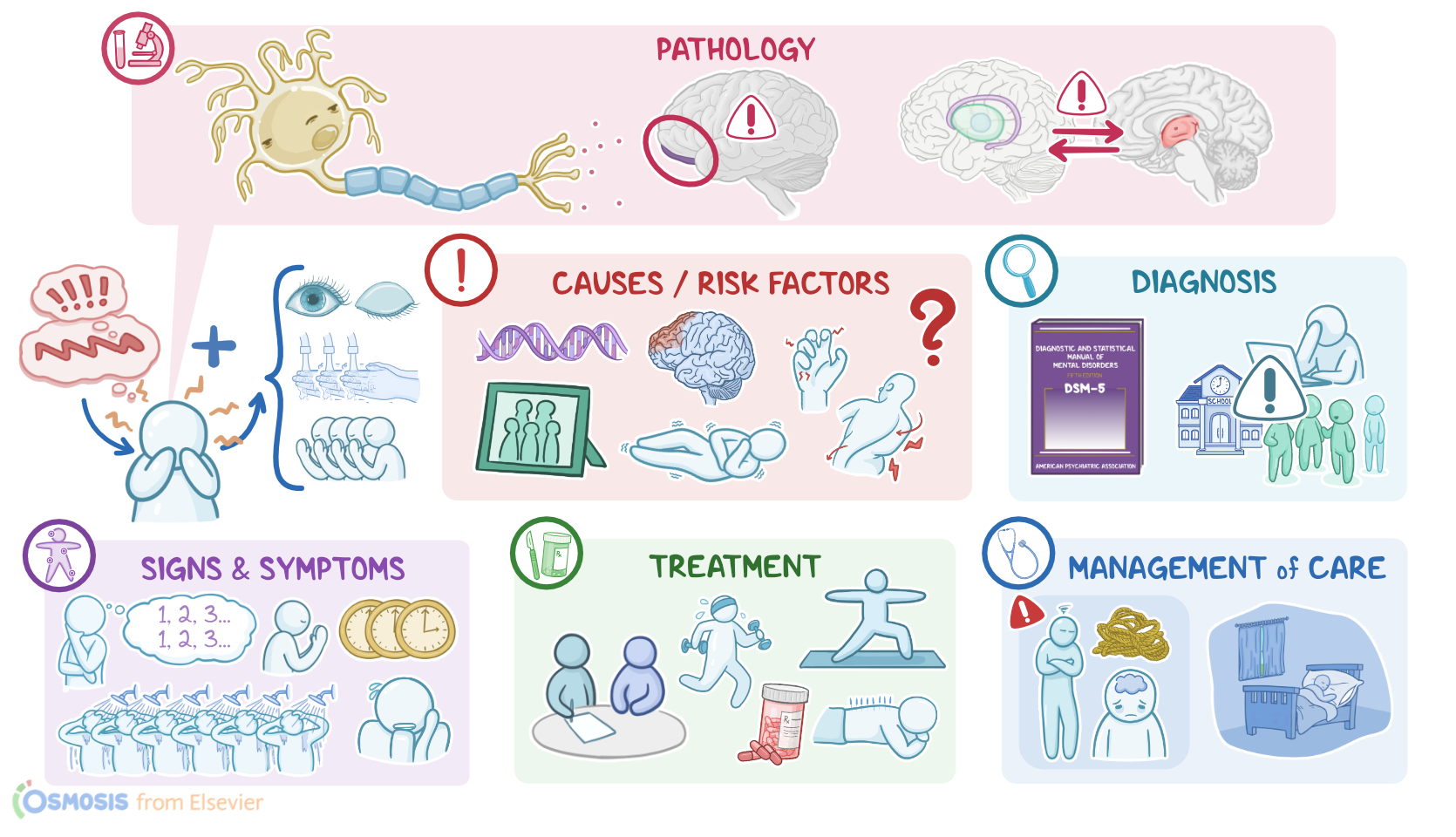
Moreover, the corticostriatal-thalamocortical pathway helps regulate habits, movement execution, and reward behavior.Now, even though the exact cause of obsessive-compulsive disorder remains unknown, what is known is that risk factors include genetic predisposition; family history, and the presence of neurological conditions, like Huntington chorea, brain trauma, and epilepsy.Now, the pathology of obsessive-compulsive disorder is also poorly understood, but there seems to be a dysfunction of serotonergic neurons, affecting the activity of the corticostriatal-thalamocortical pathway.
Causes & risk factors1:23–1:41
Pathology1:41–2:10
As a result, normal communication between the cortex and deeper brain structures is impaired. Also, it’s thought that there’s also some kind of dysfunction in the orbitofrontal cortex, which is a part of the brain that’s responsible for switching from habitual to goal-directed behavior.
Clinical manifestations2:10–3:31
Now, moving on to clinical manifestations, obsessive compulsive disorder typically presents with obsessions and compulsions that may cause significant impairment at school, work, or social life.
Obsessions are persistent, repeated, unwanted thoughts, urges, or mental images that cause anxiety or distress. For example, a client at a restaurant can’t stop thinking about how the waiter’s hands are covered in germs, so the plate of food in front of them is covered in germs, the utensils and napkins are covered in germs, and so on.
These obsessive thoughts are hard to get rid of and usually disappear only after performing a certain action or series of actions called compulsions.
Compulsions are most commonly repetitive ritualistic actions like hand washing and eye blinking, or mental acts such as praying, counting, or repeating words silently.
Compulsions are often illogical, like counting the numbers on a clock 3 times before going to work to avoid being late; or excessive, like showering 6 times a day.
The client feels driven to perform these actions because it’s the only way to relieve their anxiety or distress despite the fact that they know the actions are illogical or excessive in nature.Diagnosis of obsessive-compulsive disorder is based on detailed history and physical assessment.
Diagnosis3:31–4:22
Diagnosis is confirmed using the Diagnostic and Statistical Manual for Mental Disorders fifth edition or DSM-5 criteria, which is a set of diagnostic criteria indicating the symptoms that must be present, and for how long, to diagnose a mental health condition.
So, the first diagnostic element for obsessive-compulsive disorder is the presence of obsessions or compulsions or both.
Secondly, these obsessions and compulsions must be time-consuming, take up more than an hour per day, and should cause significant distress.
Usually, they repeat themselves to the point where the client is unable to function in school, work, or in personal relationships.
Finally, the symptoms shouldn't be caused by a substance, medication, or another medical condition.Treatment of obsessive compulsive disorder mainly involves non-pharmacological therapy.
Treatment4:22–5:27
This consists of psychotherapy, including cognitive-behavioral therapy, which focuses on teaching the client strategies to identify exaggerated patterns of thinking and obsessive thoughts, and then challenge them efficiently.
In addition, clients may benefit from lifestyle modifications like physical activity, yoga, meditation, deep-breathing exercises, and acupuncture.
Pharmacological therapy, on the other hand, can be used in addition to non pharmacological measures if those alone don’t control the disorder.
These mainly include selective serotonin reuptake inhibitors, like sertraline, and antipsychotics, such as risperidone. Also, experimental work has suggested a role for deep brain stimulation in obsessive-compulsive disorder, where a neurostimulator or a “brain pacemaker” is implanted in the brain to send electrical impulses to specific targets in the brain nuclei.Alright, let’s look at the care you will provide a client with obsessive compulsive disorder.
Management and care5:27–7:33
Your priority goals are to assist in managing their anxiety and promote safety. First, assist your client in using adaptive ways to manage their anxiety.
Provide a calm, quiet environment by dimming the lights and reducing noise; and establish a therapeutic nurse-client relationship by using active listening, supportive body language, and speaking to them in a calm, low-toned voice.
Also, administer the prescribed medications, to help reduce anxiety. Now, if their compulsive behaviors are not harmful, you can start by allowing them a specific amount of time to engage in their ritualistic behaviors, while ensuring they spend time in other activities and attending their scheduled cognitive behavioral therapy sessions.
Also be sure to encourage your client to find alternate methods of dealing with anxiety, such as progressive muscle relaxation, meditation or deep-breathing and provide positive reinforcement as they build their anxiety management skills.
Then, you can gradually decrease the time they need to use engaging in compulsive behaviors.You’ll also need to institute measures to keep your client safe from self-inflicted harm, and to protect other clients and staff from aggressive behavior.
Closely monitor their anxiety level, paying close attention to any changes in their behavior that could signal heightened anxiety.
Frequently reassure your client that they are in a safe place. Report to the healthcare provider immediately if your client experiences disordered thinking, increased agitation, or if they express the intent to harm themselves or others.
Stay with your client, speak to them in a calm voice, using short simple sentences. If possible move them to a quiet area to decrease the amount of stimuli, and administer the prescribed PRN anti-anxiety medication, as needed.
Okay, moving on to client and family teaching. First, teach your client that obsessive-compulsive disorder is a mental health condition that causes a person to perform repetitive actions to decrease anxiety.
General client & family teaching7:33–8:39
Then, review their plan of care, including their prescribed medications, and allow plenty of time for them to ask questions.
Also be sure to stress the importance of continuing with regular CBT, and provide them with community resources and support groups for additional support.
Then, review the anxiety management skills they have learned, and remind them to avoid any known triggers that can bring on feelings of anxiety.
Also discuss the importance of getting adequate sleep, eating a balanced diet, and exercising regularly to manage stress.
Finally, teach your client to seek medical attention right away if they are not able to cope with increased anxiety; if they experience a decline in daily functioning; or if they experience agitation; or have thoughts of harming themselves or others.All right, as a quick recap….
Review8:39–10:15
Obsessive-compulsive disorder, or OCD, is a mental health condition characterized by the presence of obsessions and compulsions.
Obsessions are recurrent and intrusive thoughts that often cause anxiety, while compulsions are actions performed in an attempt to reduce the anxiety associated with obsessions.
In OCD, the client feels driven to complete compulsions, such as washing their hands, in response to an obsession, which helps reduce their anxiety.
While the mechanisms underlying the pathology of obsessive compulsive disorder aren’t fully understood, serotonin dysregulation is believed to play a major role, resulting in impaired communication between the cortex and deeper brain structures.
OCD is diagnosed based on the DSM-5 criteria, which include the presence of obsessions, compulsions or both; and these must be time-consuming, cause significant distress and impair function in school, work, or in personal relationships.
Treatment of obsessive compulsive disorder mainly involves non-pharmacological therapy, like CBT and lifestyle modifications such as physical activity, stress management, and yoga.
Medications like selective serotonin reuptake inhibitors or antipsychotics can also be used in addition to psychotherapy.
The priority nursing goals when caring for a client with obsessive compulsive disorder are to assist in managing anxiety and promote safety.
Education for a client with OCD includes using anxiety management skills, avoiding triggers, and when to seek medical
| OBSESSIVE-COMPULSIVE DISORDER (OCD) | ||
| KEY POINTS | NOTES | |
| DEFINITION |
| |
| PHYSIOLOGY |
| |
| CAUSES AND RISK FACTORS |
| |
| PATHOPHYSIOLOGY |
| |
| SIGNS AND SYMPTOMS |
| |
| DIAGNOSIS |
| |
| TREATMENT |
| |
| MANAGEMENT OF CARE |
| |
| PATIENT AND FAMILY TEACHING |
| |
No notes for this video yet
Try adding a note below