Peptic ulcer disease (PUD): Nursing process (ADPIE)

2,725views

Peptic ulcer disease (PUD): Nursing process (ADPIE)

MS LEC PRELIMS 2nd SEM

MS LEC PRELIMS 2nd SEM

Esophageal disorders: Pathology review
Achalasia: Year of the Zebra
Paraesophageal and hiatal hernia: Clinical sciences
Hiatal hernia: Nursing process (ADPIE)
Gastroesophageal reflux disease (GERD)
Gastroesophageal reflux disease: Clinical sciences
Gastroesophageal reflux disease (GERD): Nursing process (ADPIE)
GERD, peptic ulcers, gastritis, and stomach cancer: Pathology review
Case study - Gastroesophageal reflux disease (GERD): Nursing
Esophageal cancer
Esophageal cancer: Nursing
Esophageal cancer: Clinical sciences
Gastrointestinal system: GI system disorders
Peptic ulcers, gastritis, and duodenitis (pediatrics): Clinical sciences
Gastritis: Clinical sciences
Peptic ulcer
Peptic ulcer disease: Clinical sciences
Peptic ulcer disease (PUD): Nursing process (ADPIE)
Gastric cancer
Gastric cancer: Clinical sciences
Gastric cancer: Nursing
Appendicitis
Appendicitis: Clinical sciences
Appendicitis: Pathology review
Appendicitis: Nursing process (ADPIE)
Case study - Pediatric appendicitis: Nursing
Diverticulosis and diverticulitis
Diverticular disease: Pathology review
Diverticulitis: Clinical sciences
Diverticular disease: Nursing
Approach to pneumoperitoneum and peritonitis (perforated viscus): Clinical sciences
Inflammatory bowel disease - Crohn disease and ulcerative colitis: Nursing
Crohn disease
Inflammatory bowel disease (Crohn disease): Clinical sciences
Ulcerative colitis
Inflammatory bowel disease (ulcerative colitis): Clinical sciences
Inflammatory bowel disease: Nursing pathophysiology
Bowel obstruction
Intestinal obstruction: Nursing
Small bowel obstruction: Clinical sciences
Hemorrhoids: Clinical sciences
Colorectal cancer
Colorectal cancer: Clinical sciences
Colorectal cancer: Nursing
Colorectal cancer screening: Clinical sciences
Colorectal polyps and cancer: Pathology review
Cleft lip and palate: Nursing
Esophageal atresia and tracheoesophageal fistula: Year of the Zebra
Esophageal atresia and tracheoesophageal fistula: Nursing
Hirschsprung disease
Hirschsprung disease: Year of the Zebra
Hirschsprung disease: Nursing
Intestinal atresia
Intussusception
Intussusception: Clinical sciences
Endocrine system anatomy and physiology
Endocrine system: Structure and function
Endocrine system: Hormone insufficiency and excess
Diabetes insipidus
Diabetes insipidus: Clinical sciences
Diabetes insipidus: Nursing process (ADPIE)
Diabetes insipidus and SIADH: Pathology review
Syndrome of inappropriate antidiuretic hormone secretion (SIADH)
Syndrome of inappropriate antidiuretic hormone secretion: Clinical sciences
Syndrome of inappropriate antidiuretic hormone (SIADH): Nursing process (ADPIE)
Hypothyroidism
Hypothyroidism: Pathology review
Approach to hypothyroidism: Clinical sciences
Hypothyroidism: Nursing process (ADPIE)
Case study - Hypothyroidism: Nursing
Hypothyroidism medications
Hyperthyroidism
Hyperthyroidism: Pathology review
Approach to hyperthyroidism and thyrotoxicosis: Clinical sciences
Hyperthyroidism: Nursing process (ADPIE)
Hyperthyroidism medications
Parathyroid disorders and calcium imbalance: Pathology review
Hypoparathyroidism
Hypoparathyroidism: Nursing
Hyperparathyroidism
Hyperparathyroidism: Clinical sciences
Hyperparathyroidism: Nursing
Pheochromocytoma
Pheochromocytoma: Clinical sciences
Primary adrenal insufficiency
Adrenal insufficiency: Pathology review
Adrenal insufficiency (Addison disease): Nursing
Adrenal insufficiency: Clinical sciences
Cushing syndrome
Cushing syndrome and Cushing disease: Pathology review
Cushing syndrome and Cushing disease: Clinical sciences
Cushing syndrome and Cushing disease: Nursing
Diabetes mellitus
Endocrine system: Diabetes mellitus
Diabetes mellitus (pediatrics): Clinical sciences
Diabetes mellitus: Pathology review
Diabetes mellitus: Nursing pathophysiology
Diabetes mellitus (DM): Nursing process (ADPIE)
Video Case Study - Diabetes Mellitus in the Pediatric Patient
Case study - New-onset diabetes mellitus: Nursing
Diabetes mellitus (Type 1): Clinical sciences
Case study - Type 1 diabetes mellitus: Nursing
Case study - Pediatric diabetes mellitus type 1: Nursing
Diabetes mellitus (Type 2): Clinical sciences
Video Case Study - Type 2 Diabetes
Approach to hypoglycemia: Clinical sciences
Approach to hypoglycemia (pediatrics): Clinical sciences
Hypoglycemics: Insulin secretagogues
Miscellaneous hypoglycemics
Complications of Diabetes
Diabetic ketoacidosis: Clinical sciences
Diabetic ketoacidosis (DKA): Nursing process (ADPIE)
Critical care case study - Diabetic ketoacidosis: Nursing
Case study - Diabetic ketoacidosis (DKA): Nursing
Hyperosmolar hyperglycemic state: Clinical sciences
Hyperosmolar hyperglycemic state (HHS): Nursing process (ADPIE)
Case study - Hyperosmolar hyperglycemic syndrome (HHS): Nursing

Notes

PEPTIC ULCER DISEASE (PUD)

KEY POINTS
NOTES
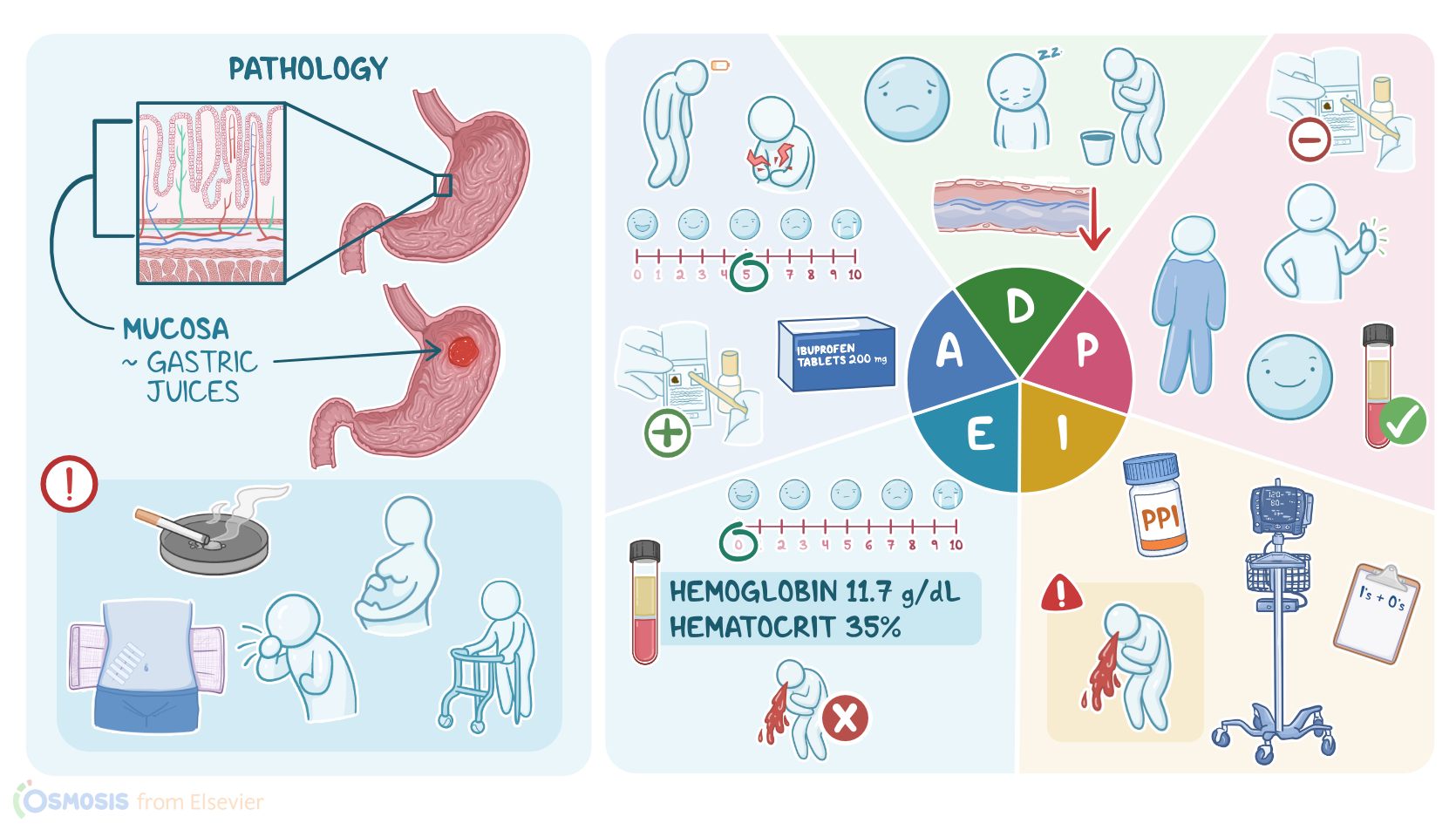
PATIENT REPORT
  • 56-year-old woman
  • Bleeding gastric ulcer controlled with thermal coagulation
  • Negative Helicobacter pylori (H. pylori)

PATHOPHYSIOLOGY
  • PUD
    • Erosion of the GI lining
  • GI lining
    • Four layers
      • Mucosa
      • Submucosa
      • Muscularis
      • Serosa
    • Mucosal cells secrete gastric juices
    • Tightly joined epithelial cells and protective mucus and bicarbonate provide protection to mucosa
    • Gastric juices can overcome protective mechanisms and damage lining
  • Signs and symptoms
    • Asymptomatic
    • Symptomatic
      • Epigastric pain
      • Bloating
      • Abdominal fullness
      • Nausea
      • Hematemesis
      • Melena
  • Complications
    • Anemia
    • Peritonitis 
    • Perforation
  • Risk factors
    • H. pylori infection
    • NSAID use
    • Smoking
    • Alcohol use
    • Black or Hispanic ethnicity
    • First-degree relative with PUD
    • Zollinger-Ellison syndrome

DIAGNOSIS AND TREATMENT
  • Diagnosis
    • History
    • Physical assessment
    • Endoscopy
    • Biopsy
    • Laboratory tests
  • Treatment
    • Discontinue NSAIDs
    • Proton pump inhibitors (PPIs)
    • Antibiotics
    • Bismuth subsalicylate
    • Prostaglandin analogue 

ASSESSMENT
  • No acute distress
  • Tired
  • Temperature: 98.9 F (37.2 C)
  • Heart rate: 98
  • Respiratory rate: 18
  • Blood pressure; 98/62 mmHg
  • Oxygen saturation: 95% 2L nasal cannula
  • Pain: 5/10
  • Cool and dry skin
  • IV with normal saline infusing
  • Hemoglobin: 11.5 g/dL (7.14 mmol/L)
  • Hematocrit: 35%
  • Fecal occult blood: positive
  • Ibuprofen daily

NURSING DIAGNOSES
  • Fluid volume deficit related to GI bleeding
  • Fatigue related to blood loss
  • Acute pain related to mucosal injury
  • Nausea related to mucosal injury
  • Ineffective health management related to use of NSAIDs

PLANNING
  • Restore fluid volume
  • Normalize hemoglobin and hematocrit
  • Decrease fatigue
  • Reduce GI pain
  • Participate in appropriate pain management

IMPLEMENTATION
  • Record strict intake and output
  • Vital signs every 4 hours
  • Administer medications as prescribed
  • Provide health promotion teaching
  • Avoid foods that trigger pain
  • Refer to physical therapy
  • Discontinue ibuprofen

EVALUATION
  • Temperature: 98.9 F (37 C)
  • Heart rate: 80
  • Respiratory rate: 16
  • Blood pressure: 110/68 mmHg
  • Pain: 0/10
  • Oxygen saturation: 97% 2L nasal cannula
  • Hemoglobin: 11.7 mg/dL (7.26 mmol/L)
  • Hemoatocrit: 35%
  • No hematemesis

Transcript

Watch video only

Paola Salazar is a 56-year-old hispanic female client admitted to your unit after an esophagogastroduodenoscopy, or EGD, revealed a bleeding gastric ulcer which was controlled by thermal coagulation.

Her recent history includes intermittent upper abdominal pain, and a recent weight loss of five pounds because of nausea and decreased appetite.

After experiencing an episode of hematemesis, her primary care physician, or PCP, ordered an EGD.

A biopsy taken during the procedure is negative for Helicobacter pylori, or H. pylori for short.

Her other health problems include fatigue and chronic back pain.

Peptic ulcer disease, or PUD, is an erosion of the lining of the gastrointestinal, or GI tract, most commonly in the proximal duodenum and stomach.

The lining of the GI tract is made of four layers, the mucosa, which is the innermost layer, followed by the submucosa, muscularis, and serosa.

Cells in the mucosa secrete harsh gastric juices, like hydrochloric acid and pepsin, which help digest food.

Normally the mucosa is protected from self-digestion due to tightly joined epithelial cells that resist penetration, and by prostaglandins that stimulate secretion of a protective layer of mucus and bicarbonate.

When the gastric juices overcome these protective mechanisms and damage the gastric lining, a peptic ulcer develops.

Sometimes PUD is asymptomatic, but often the exposure to irritating gastric juices can cause burning epigastric pain.

Typically, pain from gastric ulcers increases 15-30 minutes after a meal, while pain from duodenal ulcers increases 2-3 hours after a meal and at night.

Other common symptoms include bloating, abdominal fullness, and nausea.

If the erosion extends down to the muscularis level it can damage blood vessels resulting in an upper GI bleed, hematemesis, or melena, when blood passes through the lower GI tract, producing a dark, tarry stool.

Anemia from extensive blood loss causes symptoms like fatigue, pallor, and shortness of breath.

Sometimes, an ulcer can perforate through all four layers of the gastric lining and create an opening into the peritoneal cavity.

Free air and gastric contents that enter the abdomen cause peritonitis and findings like severe abdominal pain, abdominal rigidity, and tachycardia.

It is important to keep an eye out for these findings because a perforation requires emergent surgical management.

A major risk factor for developing PUD is infection with H. pylori, which causes an inflammatory response that disrupts protective mechanisms in the gastric mucosa.

Another common cause of PUD is NSAID use because these drugs work by inhibiting prostaglandin synthesis, which is essential for gastric protection.

Reducing the level of prostaglandins over a prolonged period of time leaves the gastric mucosa susceptible to damage, and overtime ulcers can begin to develop.

There are also certain lifestyle choices that can contribute to PUD.

Smoking reduces blood flow to the gastric mucosa and is associated with cell death and poor healing, while alcohol consumption increases cell permeability and weakens the protective mucus barrier.

Other risk factors are African American or Hispanic ethnicity, and having a first degree relative with PUD.

Finally, a rare cause of PUD is Zollinger-Ellison syndrome, which is a gastrin secreting tumor that increases gastric acid production.

Diagnosis of PUD is based on history, physical examination and by EGD which visualizes the lining in the stomach and duodenum.

During the procedure, a biopsy is obtained and analyzed for the presence of H. pylori. H. pylori may also be detected by a urea breath test.

Finally, labs like a CBC or testing for fecal occult blood are used to identify common complications of PUD like bleeding or anemia.

Treatment of PUD depends on the underlying cause and severity of the disease. NSAIDs, if used, are discontinued.

Medications like proton pump inhibitors, or PPIs, and H2-receptor antagonists, or H2RAs, are used to decrease production of stomach acid.

If H. pylori is detected, a triple or quadruple regimen is prescribed that may include a combination of a PPI, certain antibiotics, and bismuth subsalicylate.

For some clients, a prostaglandin analog, like misoprostol is prescribed, while sucralfate is administered in some cases because it forms a protective coating over the ulcer to protect it while it heals.

OK, it is time to start your assessment of Mrs. Salazar, who has just returned from the EGD where hemostasis of her bleeding ulcer was achieved.

Sources

  1. "Ackley and Ladwig’s Nursing Diagnosis Handbook: An Evidence-Based Guide to Planning Care, 13th edition" Mosby (2022)
  2. "Harrison’s Principles of Internal Medicine, 21st edition" McGraw Hill / Medical (2022)
  3. "Evidence-based clinical practice guidelines for peptic ulcer disease 2020" J Gastroenterol (2021)
  4. "Clinical Guidelines for Drug-Related Peptic Ulcer, 2020 Revised Edition" Gut Liver (2020)
  5. "Perforated and bleeding peptic ulcer: WSES guidelines" World J Emerg Surg (2020)
  6. "Health Assessment for Nursing Practice, 7th edition" Elsevier (2021)
  7. "Upper Gastrointestinal Bleeding in Adults: Evaluation and Management" Am Fam Physician (2021)