Pericarditis: Nursing
Introduction0:00–0:14
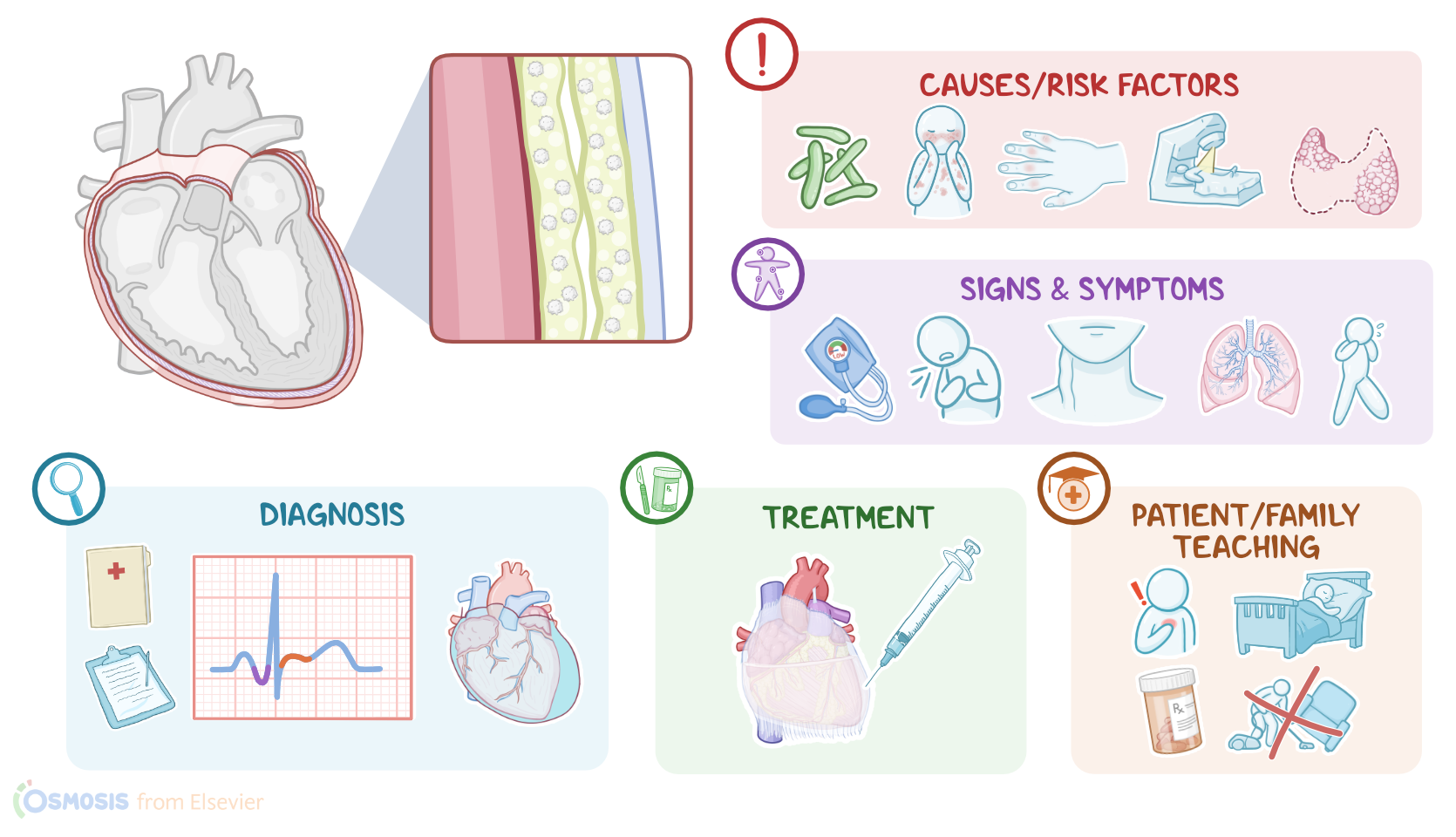
Pericarditis refers to inflammation of the pericardium, which is a thin fibroelastic sac that surrounds the heart in the roots of the great vessels, cushioning them and preventing friction during each heartbeat.
Physiology0:14–0:59
Let's start with a bit of physiology. The pericardium has two layers, an outer fibrous layer known as the parietal pericardium, and an inner serous layer called the visceral pericardium.
The visceral pericardium is continuous with the parietal pericardium, so they form an enclosed space called the pericardial cavity.
Within it there's serous pericardial fluid that's secreted by visceral pericardium cells and drained by parietal pericardial cells and lymphatics in order to maintain a normal volume of about 5 to 20 mL.
The pericardial fluid cushions the heart from any kind of external jerk or shock, and also acts as a lubricant to reduce friction with each heartbeat.
Causes & risk factors0:59–2:20
The pericardium also fixes the heart to the mediastinum, preventing it from twisting, so that blood circulation through the great vessels doesn't get cut off.
Now pericarditis is caused by inflammation of the pericardium, in most cases are idiopathic, meaning that there's no identifiable cause.
When the cause is identified, it's usually an infection, most commonly a virus, such as Coxsackie B virus or echovirus. Less frequently, pericarditis can be caused by bacteria like Streptococcus pneumonia or Staphylococcus aureus, as well as fungi like histoplasma capsulatum and Candida species.
On the other hand, non-infectious causes of pericarditis include Dressler syndrome, also known as post-myocardial infarction syndrome, which is an immune response triggered by antigens released by dying heart cells, and occurs several weeks after myocardial infarction.
Another non-infectious cause of pericarditis is uremia, which is when blood levels of urea get really high, usually due to kidney failure.
The high levels of urea irritate the visceral pericardium cells, leading them to secrete a thick pericardial fluid that's full of fibrin strands and white blood cells.
Pathology2:20–4:23
Pericarditis can also be caused by autoimmune diseases, such as systemic lupus erythematosis, rheumatoid arthritis, or scleroderma.
Finally, other causes of pericarditis include cancer and radiation therapy to the chest, as well as severe hypothyroidism and certain medications like penicillin, procaamide, and hydralazine.
Now, pathology-wise, with pericarditis, the pericardial layers are infiltrated by immune cells and fluids. As a result, these layers become inflamed, thicker and boggier.
Think about how a piece of dry, flat pasta gets cooked and thickens up as it soaks up fluid. This makes the layers rub against each other instead of gliding past with each heartbeat.
This process can be acute, which develops suddenly and lasts days to weeks, subacute, which lasts weeks to months, or chronic, which usually develops over time and lasts longer than 3 months.
In clients with acute pericarditis, inflammation causes the pericardial blood vessels to be leakier than usual, meaning fluid can make its way out of the vessels and into the pericardial cavity, causing a pericardial effusion.
This fluid can be serous, meaning the fluid is clear, hemorrhagic when there is blood in it, or purulent if there is pus in it, and this depends on the cause of pericarditis.
Additionally, if the pericardial effusion grows or worsens quickly, it can put pressure on the heart itself, preventing it from fully stretching out or relaxing between contractions.
This can cause cardiac tamponade, where the heart can't fill or pump blood properly, which is a medical emergency. On the other hand, in clients with chronic pericarditis, the visceral pericardium gradually becomes more and more fibrous, forming a stiff shell that constricts the heart.
Clinical manifestations4:23–5:42
As a result, it becomes harder for the heart to relax and fill with blood, causing a decrease in cardiac output, which is the amount of blood the heart pumps out per minute.
This is also known as constrictive pericarditis. Over time, this can lead to heart failure, where the heart is unable to pump enough blood to meet the body's requirements.
Moreover, since blood isn't being pumped forward, it starts backing up into the pulmonary and systemic circulation. Eventually, this increases the pulmonary BP, and fluid can get into the lung vessels, and also increases the amount of blood in the venous circulation.
This causes complications like pulmonary hypertension and peripheral edema, respectively. Now, the main clinical manifestation of acute pericarditis is severe sharp retrosternal chest pain called pericardial pain, which worsens when lying down or taking a deep breath and improves when the client sits upright and leans forward.
This pain can radiate to the neck, shoulders, and back. Upon auscultation, there's a pericardial friction rub, which is a scratchy, grating, high pitched rub caused by the heart rubbing against the surrounding pericardium when beating.
Diagnosis5:42–7:00
Sometimes this sound is described as being similar to the sound of sandpaper rubbed on wood. Finally, if the underlying cause is an infection, manifestations can include a fever and chills, amongst others.
Additionally, complications come with their own signs and symptoms. For example, with heart failure, there could be hypotension on account of decreased cardiac output.
And with cardiac tamponade, clinical findings could include pulses paradoxis. This is when BP drops more than 10 millimeters of mercury when the patient breathes in.
On the other hand, chronic pericarditis typically presents with clinical manifestations of right heart failure, including dyspnea, fatigue, and jugular venous distention, where the jugular vein in the neck becomes enlarged and distended.
Some clients can develop pulmonary edema, which typically presents with dyspnea and crackles, as well as peripheral edema, causing the limbs to swell.
Diagnosis of pericarditis starts with the client's history and physical assessment, followed by an ECG which typically shows initial widespread ST segment elevation, meaning the ST segment is elevated in almost all leads, along with PR segment depression.
Treatment7:00–7:34
An important element is to distinguish these findings from an ST elevation myocardial infarction, or STEMI, in which case the ST elevation is typically localized in 2 or 3 leads.
Additional diagnostic tests include laboratory tests, which can reveal an elevated white blood cell count, as well as an increased ESR and CRP.
Management and care7:34–9:03
On echocardiogram, a pericardial effusion makes the heart look like it's dancing within the pericardium, whereas chronic pericarditis shows the stiff serous pericardium restricting the heart's movements.
With a large pericardial effusion, an X-ray can show the excess fluid pooling at the bottom of the heart, giving a classic water bottle sign.
In clients with pericardial effusion, pericardiocentesis can be done to obtain and analyze the pericardial fluid, which can show elevated WBCs or the presence of bacteria or fungi, depending on the cause.
Finally, with constrictive pericarditis, a CT scan can be performed, which can reveal pericardial thickening and calcification.
In terms of treatment, the main goal is to address the underlying cause when possible, as well as reducing pericardial inflammation and pain by prescribing medications like NSAIDs or colchicine.
In clients with contraindications to NSAIDs, corticosteroids can be used. In addition, clients with pericardial effusion can require pericardial drainage, which is done by inserting a catheter into the pericardial space.
In clients with recurrent pericarditis, a last resort measure is to perform a pericardectomy, which is the surgical removal of all or part of the pericardium.
General client and family teaching9:03–9:45
All right, now, let's look at the nursing care you'll provide for a client with pericarditis. Your nursing goals will focus on managing your client's pain and monitoring for complications.
To begin, ask your client to describe their chest pain. Ask about the quality, severity, and the location of their pain, and whether it worsens when taking a deep breath, or improves when sitting up or leaning forward.
Also observe them to see if they're taking shallow breaths to avoid chest pain. To help relieve your client's pain, raise the head of their bed 60 to 90 degrees, and position their overbed table in front of them so they can lean forward and rest on the surface.
Review9:45–13:54
Then administer medications like NSAIDs, colchicine, or corticosteroids as prescribed, to decrease pain and inflammation.
Next, monitor your client's vital signs and assess their heart sounds. Be on the lookout for complications like a pericardial effusion or cardiac tamponade, which can cause a rapid decrease in cardiac output.
Then assess your client for signs of pulses paradoxis and review their ECG for any changes in heart rate or rhythm. Immediately report findings that indicate your client is developing cardiac tamponade, including pulses paradoxis, jugular venous distention, muffled heart sounds, a narrowing pulse pressure, tachycardia, tachypnea, or hypotension.
Increase the IV flow rate and standby to assist with the pericardiocentesis. OK, moving on to client and family education.
First, begin by explaining that pericarditis is inflammation of the sac that surrounds the heart, and that causes chest pain.
Let them know that pericarditis can be an acute or chronic condition, depending on the cause. Next, review the prescribed medications with your client and stress the importance of taking their medications exactly as prescribed.
Then teach them how modifying their level of activity can prevent further inflammation. Encourage them to get plenty of rest and avoid exercise or strenuous activity until their symptoms have resolved.
Finally, advise them to notify their healthcare provider right away if they experience worsening chest pain, shortness of breath, hypotension, or confusion.
All right. As a quick recap, pericarditis is an inflammatory condition of the pericardium.
In most cases of pericarditis, the cause of inflammation is idiopathic, but when the cause is identified, it's most often a virus and less frequently a bacteria or fungus.
Non-infectious causes include Dressler syndrome, uremia, autoimmune diseases, radiation therapy, and certain medications.
The main clinical manifestations of acute pericarditis are severe, sharp pericardial pain that worsens with lying down or taking a deep breath, and improves with sitting up or leaning forward.
Sometimes a pericardial friction rub can also be heard. The pain can also radiate to the neck, back, and shoulders.
If the underlying cause is infectious, the client can also experience fever, chills, and fatigue. On the other hand, clients with chronic pericarditis typically present with signs of right heart failure like dyspnea, fatigue, and jugular venous distention.
Diagnosis is made by physical exam, followed by testing such as an ECG which typically shows widespread ST elevation, and abnormal lab work like an elevated white blood cell count, ESR and CRP, in addition to other tests like echocardiogram, CT, and X-ray.
When possible, the goal of treatment is to address the underlying cause, as well as reduce inflammation and pain with NSAIDs or colchicine and sometimes glucocorticoids.
Clients with an effusion can require pericardial drainage, and when this is unsuccessful or pericarditis is recurrent, the client can be treated with pericardectomy.
Nursing management for a client with pericarditis aims to alleviate pain and monitor for complications. Client and family education focuses on treatment adherence, self-care, and when to notify the healthcare
| PERICARDITIS | ||
| KEY POINTS | NOTES | |
| DEFINITION |
| |
| PHYSIOLOGY |
| |
| CAUSES AND RISK FACTORS |
| |
| PATHOPHYSIOLOGY |
| |
| SIGNS AND SYMPTOMS |
| |
| DIAGNOSIS |
| |
| TREATMENT |
| |
| MANAGEMENT OF CARE |
| |
| PATIENT AND FAMILY TEACHING |
| |
- "Lewis’s Medical-Surgical Nursing: Assessment and Management of Clinical Problems. 11th Edition. ISBN: 978-0-323-55149-6 " Mosby (2019)
- "Heimgartner N. Medical-Surgical Nursing: Concepts for Interprofessional Collaborative Care. 10th Edition. ISBN: 978-0-323-61242-5 " Elsevier (2020)
- "Saunders Comprehensive Review for the NCLEX-RN. 9th Edition. ISBN: 978-0-323-79530-2 " Saunders (2022)
- "Acute Pericarditis: Update. 24(8):905-913. " Curr Cardiol Rep (2022)
- "Recurrent pericarditis: an update on diagnosis and management. 16(3):551-558. " Intern Emerg Med (2021)
No notes for this video yet
Try adding a note below