Peripheral arterial disease (PAD): Nursing process (ADPIE)

1,394views

Peripheral arterial disease (PAD): Nursing process (ADPIE)

Medical Surgical

Medical Surgical

Arrhythmias - Asystole: Nursing
Arrhythmias - Atrial fibrillation (Afib): Nursing
Arrhythmias - Atrial flutter (Aflutter): Nursing
Arrhythmias - Heart blocks: Nursing
Arrhythmias - Premature atrial contractions (PACs): Nursing
Arrhythmias - Premature ventricular contractions (PVCs): Nursing
Arrhythmias - Sinus tachycardia and sinus bradycardia: Nursing
Arrhythmias - Supraventricular tachycardia (SVT): Nursing
Arrhythmias - Ventricular fibrillation (Vfib): Nursing
Arrhythmias - Ventricular tachycardia (Vtach): Nursing
Arterial embolism: Nursing
Electrocardiogram (ECG) - Normal sinus rhythm (NSR): Nursing
Cardiomyopathy: Nursing
Congenital heart defects - Acyanotic: Nursing
Congenital heart defects - Cyanotic: Nursing
Endocarditis: Nursing
Heart defects that decrease pulmonary blood flow - Nursing considerations & client education: Nursing
Kawasaki disease: Nursing
Myocarditis: Nursing
Pericarditis: Nursing
Shock - Anaphylactic: Nursing
Shock - Cardiogenic: Nursing
Shock - Hypovolemic: Nursing
Shock - Neurogenic: Nursing
Shock - Obstructive: Nursing
Shock - Septic: Nursing
Valvular heart disease: Nursing
Geriatric considerations - Cardiac: Nursing
Aortic aneurysm: Nursing process (ADPIE)
Coronary artery disease (CAD) and angina pectoris: Nursing process (ADPIE)
Hypertension: Nursing process (ADPIE)
Left-sided heart failure: Nursing process (ADPIE)
Myocardial infarction (MI): Nursing process (ADPIE)
Pericardial effusion and cardiac tamponade: Nursing process (ADPIE)
Rheumatic heart disease: Nursing process (ADPIE)
Alpha-1 adrenergic blockers: Nursing pharmacology
Alpha-2 adrenergic agonists: Nursing pharmacology
Angiotensin II receptor blockers (ARBs): Nursing pharmacology
Angiotensin-converting enzyme (ACE) inhibitors: Nursing pharmacology
Antiarrhythmics: Nursing pharmacology
Antihyperlipidemics - Fibrates: Nursing pharmacology
Antihyperlipidemics - Miscellaneous: Nursing pharmacology
Antihyperlipidemics - Statins: Nursing pharmacology
Beta-adrenergic blockers: Nursing pharmacology
Calcium-channel blockers: Nursing pharmacology
Cardiac glycosides: Nursing pharmacology
Direct-acting vasodilators: Nursing pharmacology
Nitrates: Nursing pharmacology
Sympathomimetic medications: Nursing pharmacology
Adrenal insufficiency (Addison disease): Nursing
Cushing syndrome and Cushing disease: Nursing
Hyperparathyroidism: Nursing
Hypoparathyroidism: Nursing
Hypopituitarism: Nursing
Infant of a diabetic mother (IDM): Nursing
Phenylketonuria (PKU): Nursing
Diabetes insipidus: Nursing process (ADPIE)
Diabetes mellitus (DM): Nursing process (ADPIE)
Diabetic ketoacidosis (DKA): Nursing process (ADPIE)
Hyperosmolar hyperglycemic state (HHS): Nursing process (ADPIE)
Hyperthyroidism: Nursing process (ADPIE)
Hypothyroidism: Nursing process (ADPIE)
Syndrome of inappropriate antidiuretic hormone (SIADH): Nursing process (ADPIE)
Glucocorticoids and mineralocorticoids: Nursing pharmacology
Insulin: Nursing pharmacology
Medications affecting the parathyroid glands: Nursing pharmacology
Medications for antidiuretic hormone (ADH) disorders: Nursing pharmacology
Medications for thyroid disorders: Nursing pharmacology
Medications for growth hormone disorders: Nursing pharmacology
Oral antidiabetic medications - Alpha-glucosidase inhibitors: Nursing pharmacology
Oral antidiabetic medications - Biguanides and thiazolidinediones: Nursing pharmacology
Oral antidiabetic medications - DPP-4 inhibitors: Nursing pharmacology
Oral antidiabetic medications - Sodium-glucose co-transporter-2 (SGLT-2) inhibitors: Nursing pharmacology
Oral antidiabetic medications - Sulfonylureas and meglitinides: Nursing pharmacology
Amblyopia: Nursing
Cataracts: Nursing
Detached retina: Nursing
Hearing impairment and otosclerosis: Nursing
Legal blindness: Nursing
Macular degeneration: Nursing
Meniere disease: Nursing
Pharyngitis: Nursing
Strabismus: Nursing
Geriatric considerations - Sensory: Nursing
Otitis media: Nursing
Epistaxis: Nursing process (ADPIE)
Eye injury: Nursing process (ADPIE)
Glaucoma: Nursing process (ADPIE)
Tonsillitis: Nursing process (ADPIE)
Antiglaucoma medications: Nursing pharmacology
Eye anesthetics: Nursing pharmacology
Mydriatics and cycloplegics: Nursing pharmacology
Ophthalmic anti-inflammatories and anti-infectives: Nursing pharmacology
Biliary atresia: Nursing
Cholecystitis: Nursing
Cholelithiasis: Nursing
Diarrhea: Nursing
Diverticular disease: Nursing
Hepatitis: Nursing
Inflammatory bowel disease - Crohn disease and ulcerative colitis: Nursing
Intestinal obstruction: Nursing
Irritable bowel syndrome (IBS): Nursing
Jaundice: Nursing
Esophageal atresia and tracheoesophageal fistula: Nursing
Geriatric considerations - Gastrointestinal: Nursing
Hirschsprung disease: Nursing
Hyperemesis gravidarum: Nursing
Necrotizing enterocolitis: Nursing
Omphalocele and gastroschisis: Nursing
Appendicitis: Nursing process (ADPIE)
Celiac disease: Nursing process (ADPIE)
Cirrhosis: Nursing process (ADPIE)
Gastroesophageal reflux disease (GERD): Nursing process (ADPIE)
Hiatal hernia: Nursing process (ADPIE)
Pancreatitis: Nursing process (ADPIE)
Peptic ulcer disease (PUD): Nursing process (ADPIE)
Antacids: Nursing pharmacology
Antidiarrheals: Nursing pharmacology
Antiemetics: Nursing pharmacology
Antispasmodics (GI): Nursing pharmacology
Gallstone-dissolving agents: Nursing pharmacology
Gastric mucosal protective agents: Nursing pharmacology
Histamine H2 antagonists: Nursing pharmacology
Laxatives: Nursing pharmacology
Medications for hepatic encephalopathy: Nursing pharmacology
Pancreatic enzyme replacements: Nursing pharmacology
Proton pump inhibitors (PPIs): Nursing pharmacology
Treatment for Helicobacter pylori: Nursing pharmacology
Weight loss medications: Nursing pharmacology
Chronic kidney disease (CKD): Nursing
Dialysis care: Nursing
Epididymitis: Nursing
Glomerulonephritis: Nursing
Nephrotic syndrome: Nursing
Polycystic kidney disease (PKD): Nursing
Pyelonephritis: Nursing
Renal and urinary calculi: Nursing
Urinary retention: Nursing
Bladder exstrophy: Nursing
Circumcision: Nursing
Cryptorchidism: Nursing
Enuresis: Nursing
Geriatric considerations - Urinary: Nursing
Hypospadias and epispadias: Nursing
Acute kidney injury (AKI): Nursing process (ADPIE)
Benign prostatic hyperplasia (BPH): Nursing process (ADPIE)
Urinary incontinence - Stress: Nursing process (ADPIE)
Urinary tract infections (UTIs): Nursing process (ADPIE)
Diuretics - Osmotic and carbonic anhydrase inhibitors: Nursing pharmacology
Diuretics - Thiazide, thiazide-like, loop, and potassium-sparing diuretics: Nursing pharmacology
Antispasmodics (GU): Nursing pharmacology
Cholinergic therapy (GU): Nursing pharmacology
Anemia - Aplastic: Nursing
Anemia - Iron-deficiency: Nursing
Anemia - Macrocytic: Nursing
Disseminated intravascular coagulation (DIC): Nursing
Neutropenia: Nursing
Polycythemia: Nursing
Thalassemia: Nursing
Thrombocytopenia: Nursing
Arterial blood gas (ABG) - Overview: Nursing
Arterial blood gas (ABG) - Metabolic acidosis: Nursing
Arterial blood gas (ABG) - Respiratory alkalosis: Nursing
Blood cultures: Nursing
Cardiac biomarkers - Creatine kinase (CK): Nursing
Cardiac biomarkers - Troponin: Nursing
Coagulation studies - Partial thromboplastin time (PTT): Nursing
Complete blood count (CBC) - Hemoglobin and hematocrit: Nursing
Complete blood count (CBC) - Platelets: Nursing
Complete blood count (CBC) - Red blood cells (RBC): Nursing
Complete blood count (CBC) - White blood cells (WBC) and differential: Nursing
Complete metabolic panel (CMP) - Blood urea nitrogen (BUN) and creatinine (Cr): Nursing
Complete metabolic panel (CMP) - Chloride: Nursing
Complete metabolic panel (CMP) - Estimated glomerular filtration rate (eGFR): Nursing
Complete metabolic panel (CMP) - Glucose: Nursing
Complete metabolic panel (CMP) - Liver function tests (LFT): Nursing
Complete metabolic panel (CMP) - Potassium: Nursing
Complete metabolic panel (CMP) - Sodium: Nursing
Hemolytic disease of the fetus and newborn: Nursing
Hemolytic uremic syndrome: Nursing
Hemophilia: Nursing process (ADPIE)
Leukemia: Nursing process (ADPIE)
Sickle cell disease: Nursing process (ADPIE)
Anticoagulants - Direct thrombin and factor Xa inhibitors: Nursing pharmacology
Anticoagulants - Heparin: Nursing pharmacology
Anticoagulants - Warfarin: Nursing pharmacology
Antihyperlipidemics - Bile acid sequestrants and cholesterol absorption inhibitors: Nursing pharmacology
Antiplatelet agents: Nursing pharmacology
Blood products: Nursing pharmacology
Hematopoietic growth factors: Nursing pharmacology
Hemostatics: Nursing pharmacology
Iron preparations: Nursing pharmacology
Thrombolytics: Nursing pharmacology
Immune response - Adaptive: Nursing
Autoimmunity: Nursing
Human immunodeficiency virus (HIV) and acquired immunodeficiency syndrome (AIDS): Nursing
Hypersensitivity reactions - Type I: Nursing
Hypersensitivity reactions - Type II: Nursing
Hypersensitivity reactions - Type III: Nursing
Hypersensitivity reactions - Type IV: Nursing
Inflammatory process: Nursing
Immune response - Innate: Nursing
Immunodeficiency disorders - Primary: Nursing
Scleroderma: Nursing
Immunodeficiency disorders - Secondary: Nursing
Sjögren syndrome: Nursing
Systemic lupus erythematosus (SLE): Nursing
Toxic shock syndrome (TSS): Nursing
Erythema infectiosum (Fifth disease): Nursing
Fever: Nursing
Infectious mononucleosis: Nursing
Mumps (Parotitis): Nursing
Neonatal sepsis: Nursing
Pertussis: Nursing
Poliomyelitis: Nursing
Postpartum infections: Nursing
Roseola (Exanthem subitum): Nursing
Rubella (German measles): Nursing
Rubeola (Measles): Nursing
Smallpox: Nursing
Zika virus: Nursing
Anaphylaxis: Nursing process (ADPIE)
Lyme disease: Nursing process (ADPIE)
Rheumatoid arthritis (RA): Nursing process (ADPIE)
Antirejection immunosuppressants: Nursing pharmacology
Biologic agents: Nursing pharmacology
Vaccines: Nursing pharmacology
Immunoglobulins: Nursing pharmacology
Immunosuppressants for autoimmune diseases: Nursing pharmacology
Immunomodulators: Nursing pharmacology
Disease-modifying therapy for multiple sclerosis: Nursing pharmacology
Acne: Nursing
Animal and snake bites: Nursing
Burn injury: Nursing
Cutaneous fungal infections: Nursing
Erysipelas and cellulitis: Nursing
Herpes simplex virus (HSV): Nursing
Herpes zoster: Nursing
Impetigo: Nursing
Insect stings and bites: Nursing
Pediculosis and scabies: Nursing
Psoriasis: Nursing
Rocky Mountain spotted fever (RMSF): Nursing
Skin cancer - Basal cell carcinoma, squamous cell carcinoma, and melanoma: Nursing
Urticaria: Nursing
Geriatric considerations - Integumentary: Nursing
Atopic dermatitis: Nursing process (ADPIE)
Frostbite: Nursing process (ADPIE)
Methicillin-resistant Staphylococcus aureus (MRSA): Nursing process (ADPIE)
Pressure injury: Nursing process (ADPIE)
Debridement agents: Nursing pharmacology
Keratolytics: Nursing pharmacology
Antibiotics - Topical: Nursing pharmacology
Antifungals - Topical: Nursing pharmacology
Corticosteroids - Topical: Nursing pharmacology
Medications for acne vulgaris: Nursing pharmacology
Amputation: Nursing
Carpal tunnel syndrome: Nursing
Herniated intervertebral disc: Nursing
Hip fractures: Nursing
Muscular dystrophies - Duchenne and Becker: Nursing
Myasthenia gravis: Nursing
Osteoarthritis: Nursing
Osteomyelitis: Nursing
Osteoporosis: Nursing
Paget disease of bone: Nursing
Craniosynostosis: Nursing
Developmental dysplasia of the hip: Nursing
Juvenile idiopathic arthritis: Nursing
Scoliosis: Nursing
Acute compartment syndrome: Nursing process (ADPIE)
Fractures: Nursing process (ADPIE)
Gout: Nursing process (ADPIE)
Musculoskeletal injuries: Nursing process (ADPIE)
Acetylcholinesterase inhibitors for myasthenia gravis: Nursing pharmacology
Analgesics: Nursing pharmacology
Skeletal muscle relaxants: Nursing pharmacology
Altered level of consciousness (LOC): Nursing
Amyotrophic lateral sclerosis (ALS): Nursing
Bell palsy: Nursing
Cerebral palsy: Nursing
Encephalitis: Nursing
Guillain-Barré syndrome: Nursing
Head injury: Nursing
Hemorrhagic stroke - Intracranial hemorrhage (ICH) and subarachnoid hemorrhage (SAH): Nursing
Epidural and subdural hematoma: Nursing
Huntington disease: Nursing
Increased intracranial pressure (ICP): Nursing
Intracranial aneurysm: Nursing
Migraines: Nursing
Multiple sclerosis (MS): Nursing
Physiology of pain: Nursing
Spinal cord injury (SCI): Nursing
Delirium: Nursing
Dementia: Nursing
Brachial plexus injury: Nursing
Neurological assessment - Neonate: Nursing
Neural tube defects: Nursing
Meningitis: Nursing process (ADPIE)
Parkinson disease: Nursing process (ADPIE)
Seizure disorder: Nursing process (ADPIE)
Stroke: Nursing process (ADPIE)
Trigeminal neuralgia: Nursing process (ADPIE)
Antiepileptics: Nursing pharmacology
Medications for Alzheimer disease: Nursing pharmacology
Medications for migraines: Nursing pharmacology
Biology of cancer: Nursing
Bladder tumors: Nursing
Bone tumors: Nursing
Brain tumors: Nursing
Cervical cancer: Nursing
Colorectal cancer: Nursing
Esophageal cancer: Nursing
Gastric cancer: Nursing
Laryngeal cancer: Nursing
Liver cancer: Nursing
Lung cancer: Nursing
Lymphoma - Hodgkin and non-Hodgkin: Nursing
Multiple myeloma: Nursing
Neuroblastoma: Nursing
Ovarian cancer: Nursing
Pancreatic cancer: Nursing
Prostate cancer: Nursing
Renal cancer: Nursing
Retinoblastoma: Nursing
Testicular cancer: Nursing
Breast cancer: Nursing process (ADPIE)
Tumor lysis syndrome (TLS): Nursing Process (ADPIE)
Alkylating agents: Nursing pharmacology
Angiogenesis inhibitors: Nursing pharmacology
Antimetabolites: Nursing pharmacology
Antitumor antibiotics: Nursing pharmacology
Hormones and hormone modulators for cancer: Nursing pharmacology
Other antineoplastics: Nursing pharmacology
Plant extracts for chemotherapy: Nursing pharmacology
Platinum-based agents: Nursing pharmacology
Buerger disease: Nursing
Raynaud phenomenon: Nursing
Peripheral arterial disease (PAD): Nursing process (ADPIE)
Peripheral venous disease (PVD): Nursing process (ADPIE)
Contraception - Barrier methods: Nursing
Contraception - Hormonal methods: Nursing
Contraception - Natural methods: Nursing
Contraception - Permanent methods: Nursing
Endometriosis: Nursing
Genital warts: Nursing
Infertility: Nursing
Syphilis: Nursing
Gestational trophoblastic disease: Nursing
Precocious puberty: Nursing
Candidiasis: Nursing process (ADPIE)
Gonorrhea and chlamydia: Nursing process (ADPIE)
Pelvic inflammatory disease (PID): Nursing process (ADPIE)
Acute respiratory distress syndrome (ARDS): Nursing
Anthrax: Nursing
Aspergillosis: Nursing
Atelectasis: Nursing
Chest tube care: Nursing
COVID-19: Nursing
Cystic fibrosis: Nursing
Flail chest: Nursing
Influenza: Nursing
Pleural effusion: Nursing
Pleurisy: Nursing
Pneumothorax and hemothorax: Nursing
Pulmonary contusion: Nursing
Pulmonary edema: Nursing
Rib fracture: Nursing
Rupture of diaphragm: Nursing
Sarcoidosis: Nursing
Tuberculosis (TB): Nursing
Bronchopulmonary dysplasia (BPD): Nursing
Congenital diaphragmatic hernia: Nursing
Geriatric considerations - Respiratory: Nursing
Neonatal respiratory distress syndrome (NRDS): Nursing
Asthma: Nursing process (ADPIE)
Bacterial pneumonia: Nursing process (ADPIE)
Bronchiolitis and respiratory syncytial virus (RSV): Nursing process (ADPIE)
Carbon monoxide poisoning: Nursing process (ADPIE)
Chronic obstructive pulmonary disease (COPD): Nursing process (ADPIE)
Epiglottitis: Nursing process (ADPIE)
Foreign body aspiration and upper airway obstruction: Nursing process (ADPIE)
Laryngotracheobronchitis (LTB) and croup: Nursing process (ADPIE)
Smoke inhalation injury: Nursing process (ADPIE)
Venous thromboembolism (VTE): Nursing process (ADPIE)
Antihistamines: Nursing pharmacology
Bronchodilators: Nursing pharmacology
Corticosteroids - Inhaled: Nursing pharmacology
Mast cell stabilizers - Inhaled: Nursing pharmacology
Leukotriene modifiers: Nursing pharmacology
Medications to control airway secretions: Nursing pharmacology
Oxygen therapy: Nursing pharmacology
Respiratory stimulants: Nursing pharmacology
Preoperative care: Nursing
Postoperative care: Nursing
Palliative and hospice care: Nursing
Postmortem care and considerations: Nursing

Notes

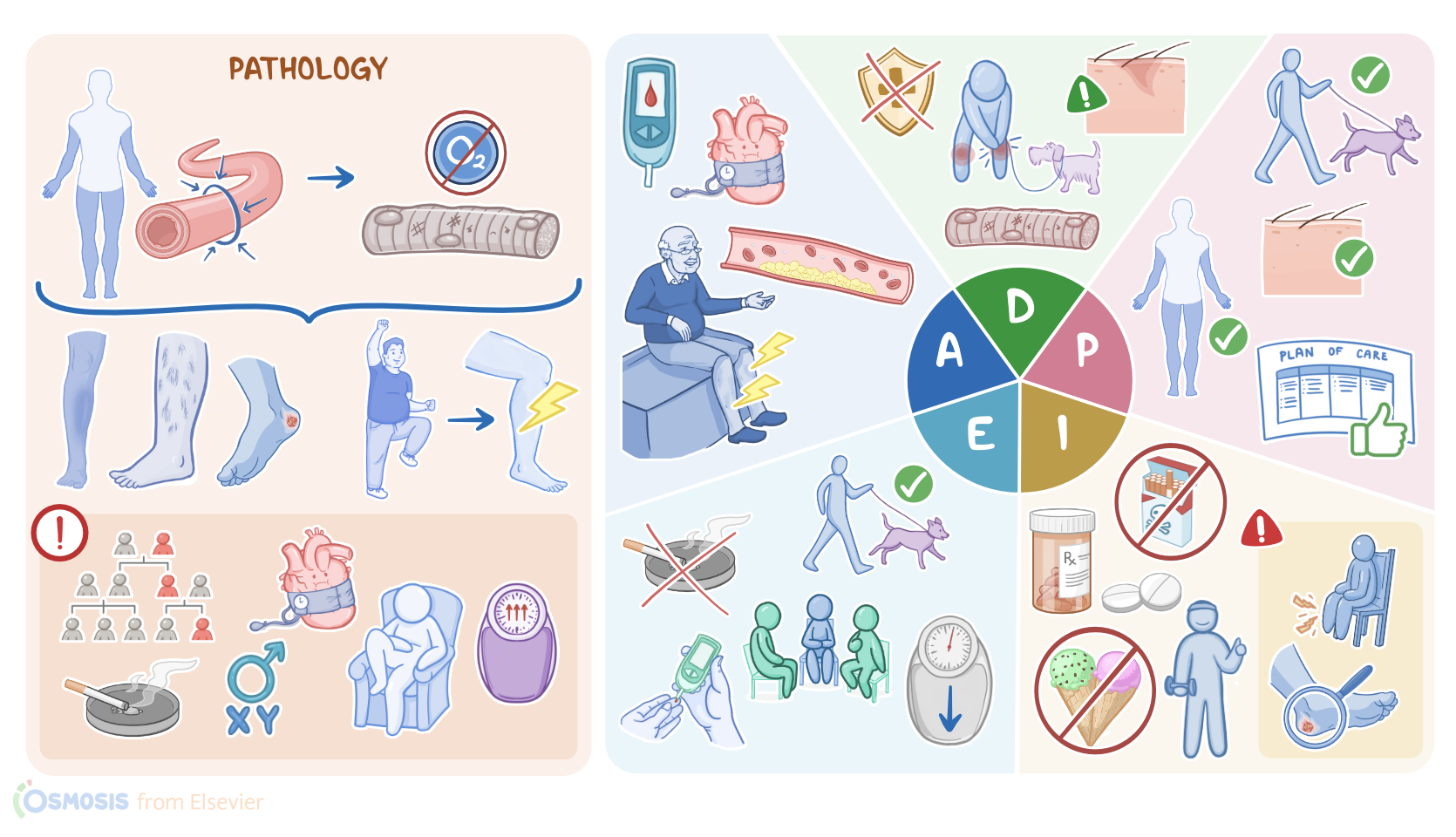
PERIPHERAL ARTERIAL DISEASE (PAD)

KEY POINTS
NOTES
PATIENT REPORT
  • 68-year-old 
  • Vascular clinic
  • History: type 2 diabetes, hypertension, and dyslipidemia
  • Reports intermittent leg pain while walking
  • Diagnosis: PAD

PATHOPHYSIOLOGY
  • Progressive narrowing of peripheral arteries 
    • Affects all arteries except heart and brain 
    • Leads to reduced blood supply 
      • Tissue ischemia 
  • Risk factors  
    • Nonmodifiable  
      • Increasing age 
      • Biological male sex 
      • Family history of PAD 
    • Modifiable  
      • Smoking 
      • Obesity 
      • Sedentary lifestyle 
      • Diabetes 
      • Dyslipidemia 
      • Hypertension 
  • Cause  
    • Atherosclerosis 
      • Buildup of fatty and fibrous material 
      • Plaque forms under inner vessel lining 
      • Develops over years 
    • Pathophysiology 
      • Vessel lumen narrows 
      • Perfusion to tissue decreases 
      • Embolism can worsen PAD 
      • Embolus from upstream artery 
      • Lodges in narrower peripheral artery 
      • Blocks blood flow 
    • Commonly affected areas 
      • Most often affects leg arteries 
      • Causes ischemia in leg muscles 
      • Leads to intermittent claudication 
    • Symptoms  
      • Symptoms appear with activity 
      • Muscle demand increases with exercise 
      • Anaerobic metabolism occurs 
      • Lactic acid builds up 
        • Pain usually in calves 
        • Can affect feet thighs hips buttocks 
      • Paresthesia tingling or numbness 
      • Decreased or absent pulses 
      • Cool extremities 
      • Muscle atrophy 
      • Hair thinning or loss 
      • Skin color changes 
      • Elevation pallor 
      • Burning or pain in forefoot and toes 
      • Pain worsens with leg elevation 
      • Pain relieved when legs lowered 
      • Foot turns red when lowered 
        • Dependent rubor 
  • Complications 
    • Nerve damage 
    • Peripheral neuropathy 
    • Loss of sensation 
    • Tissue necrosis 
    • Nonhealing wounds or ulcers 
    • Risk of gangrene 
    • Risk of amputation

DIAGNOSIS AND TREATMENT
  • Diagnosis
    • History
    • Physical assessment
    • Ankle brachial index (ABI)
    • Diagnostic imaging
  • Treatment
    • Lifestyle changes 
      • Quit smoking 
      • Lose weight 
      • Eat healthy 
      • Exercise regularly 
      • Manage diabetes and hypertension 
    • Medications  
      • Antiplatelet drugs
    • Revascularization  
      • Percutaneous intervention 
      • Surgical bypass 
    • If gangrenous, requires tissue removal 
    • Amputation 

ASSESSMENT
  • Legs are hairless and ruddy 
  • Reports worsening leg pain over past year 
  • Describes pain as severe aching cramps during walks 
  • Pain improves with rest 
  • Smokes one pack of cigarettes per week 
  • No specific diet followed 
  • Physical examination 
    • Legs become pale when lying down 
    • Femoral pulses 3+ bilaterally 
    • Popliteal pulses 2+ bilaterally 
    • Posterior tibial pulses 1+ bilaterally 
    • Dorsalis pedis pulses 1+ bilaterally 
    • Feet are cool to touch 
    • Capillary refill > 3 seconds bilaterally 
    • Toenails are thickened 
    • No impaired skin integrity noted 
  • Vital signs 
    • Temperature: 98.4°F (36.8°C) 
    • Heart rate: 78 bpm 
    • Respiratory rate: 18 bpm 
    • Blood pressure: 152/80 mmHg 
    • Pain: 0/10 
    • SpO2: 97% room air 
  • Weight: 205 lbs (93 kg)
  • Height: 5 ft 10 in (177 cm)
  • Diagnostic/lab results 
    • Hemoglobin A1c: 9.2% 
    • Total cholesterol: 249 mg/dL (6.4 mmol/L) 
    • Triglycerides: 160 mg/dL (1.8 mmol/L)
    • LDL: 163 mg/dL (4.2 mmol/L)
    • HDL: 30 mg/dL (0.78 mmol/L)
    • Right ABI: 0.63 
    • Left ABI: 0.58

NURSING DIAGNOSES
  • Ineffective peripheral tissue perfusion related to vascular dysfunction
  • Activity intolerance related to muscle pain and fatigue while walking
  • Risk for impaired skin integrity related to insufficient perfusion to lower extremities
  • Ineffective health maintenance related to disease progression

PLANNING
  • Before leaving clinic today
    • Patient will commit to lifestyle modifications and adherence to treatment plan
  • At follow-up appointment in six months, 
    • Patient will report ability to take walks with dog w/o pain
    • Patient will have adequate tissue perfusion and maintain intact skin on lower extremities; 

IMPLEMENTATION
  • Prescribed cilostazol 
  • Increased dose of lisinopril  
  • Continue other current medications 
    • Aspirin 
    • Atorvastatin 
    • Metformin 
  • Patient education 
    • Importance of quitting smoking 
    • Control blood glucose levels 
    • Maintain healthy blood pressure 
    • Manage cholesterol levels  
    • Follow diabetic diet 
    • Engage in regular exercise 
    • Daily inspection of lower extremities and feet
    • Watch for skin breakdown, sores, or ulcers
    • Report to HCP worsening leg pain or rest pain or sores
  • Appointment with diabetic educator 
  • Referral to smoking cessation support group 

EVALUATION
  • Reports no pain or fatigue during daily dog walks 
  • Taking medications as prescribed 
  • Following structured exercise and nutrition plan 
  • Monitoring blood glucose regularly 
  • Attending smoking cessation support group 
  • Has not smoked in 3 months 
  • Hemoglobin A1c: 8.4% 
  • Total cholesterol: 177 mg/dL (4.5 mmol/L)
  • Triglycerides: 99 mg/dL (1.1 mmol/L)
  • LDL: 95 mg/dL (2.4 mmol/L)
  • HDL: 62 mg/dL (1.6 mmol/L)
  • Blood pressure: 126/72 mmHg 
  • Skin on lower extremities intact

Transcript

Watch video only

Mike Craig is a 68-year-old male client who is referred to the vascular clinic by his primary care provider, or PCP. Mr. Craig has a history of type 2 diabetes, hypertension, and dyslipidemia, and he’s been experiencing intermittent leg pain in his lower legs while taking walks with his dog.

An ankle-brachial index, or ABI, is performed which confirmed a diagnosis of peripheral artery disease, or PAD. Peripheral arterial disease, or PAD for short, is the progressive narrowing of the arteries that supply peripheral tissues and organs, so basically all arteries except for the heart and brain.

As a result, there’s reduced blood supply to these tissues, which ultimately become ischemic. There are some factors that may put an individual at risk for PAD.

Non-modifiable risk factors include increasing age, male sex, and having a family history of PAD. On the other hand, modifiable risk factors include smoking, obesity, and having a sedentary life, as well as predisposing conditions like diabetes, dyslipidemia, and hypertension.

The most common cause of PAD is atherosclerosis, which is a buildup of fatty and fibrous material just under the inner lining of a blood vessel, forming a plaque.

This buildup usually happens over the course of years. Eventually, the lumen of the vessel becomes so narrow that it results in reduced perfusion to the tissue it tends to supply.

PAD can be worsened by an embolism. This happens when an embolus, which is a piece of blood clot or fatty deposit, breaks off from an atherosclerotic plaque from an upstream artery, and gets lodged in a narrower peripheral artery, blocking its blood flow.

Now, in most cases PAD affects the arteries supplying the legs. When less blood gets to the muscle tissue in the legs, that tissue becomes ischemic, causing a type of cramping pain that is often referred to as intermittent claudication.

Initially though, when the client’s at rest, there’s enough blood to meet the tissue’s demands, so they’ll be asymptomatic. But if the client starts walking or exercising, then the leg muscles start to work harder and demand more blood, which causes the claudication.

In addition, since the muscles aren’t getting enough oxygen from blood, they’ll switch from aerobic to anaerobic metabolism, and the production of lactic acid, which will build up and contribute to the pain.

This is usually felt in the calves, but can also involve the feet, thighs, hips, or buttocks. Other signs and symptoms of PAD include paresthesia, which is described as tingling or numbness, as well as decreased or absent pulses, cool extremities, and atrophy of the muscles.

In addition, clients may present with hair thinning or loss over the affected skin area, as well as skin color changes, which may become pale or bluish, especially when the leg is elevated, which is called elevation pallor.

As the PAD worsens, clients may start experiencing claudication even at rest. The client often describes this as a continuous burning or pain in the forefoot and toes that gets worse when the legs are elevated, and is relieved when they’re lowered, like hanging the feet over the bed, because gravity is working with the blood flow in this direction.

Likewise, the foot might turn red when it’s lowered, which is called dependent rubor. Ultimately, the reduced blood flow can lead to nerve damage, which results in peripheral neuropathy, where the client loses sensation in the affected tissue.

Moreover, the tissue can become necrotic and develop wounds or ulcers that don’t heal, and the limb might be at risk of gangrene and amputation.Diagnosis of PAD relies largely on the client’s history and physical examination.

A quick and noninvasive test is the ankle-brachial index, or ABI for short, where blood pressure is taken in the ankle and in the arm, and then compared. PAD is typically diagnosed if the systolic blood pressure in the ankle divided by the systolic blood pressure in the arm is less than 0.9.

In general, claudication often occurs in clients with an ABI between 0.4 and 0.9, rest pain is seen between 0.2 and 0.4, and ulcers, and gangrene between 0 to 0.4.

Diagnosis of PAD can also involve listening to the pulse in the involved arteries with a stethoscope, so for example in the legs, it would be the iliac arteries. With PAD, the narrowed artery would make a whooshing sound, called a bruit.

Another test that can be done is a doppler ultrasound, which is a way of visualizing blood-flow. Rarely, an angiography might be needed to confirm the diagnosis, by using X-rays and a contrast agent to assess the blood flow in the involved arteries.

Treatment of PAD often requires lifestyle changes that address the underlying risk factors. Clients should quit smoking, lose weight, adopt healthy eating habits, and exercise regularly; as well as managing any associated condition like diabetes and hypertension.

Some clients with PAD can also take certain medications to help reduce blood clotting, such as antiplatelet medications like aspirin or clopidogrel. Clients who fail to respond to these treatments can be treated with revascularization to reestablish arterial blood flow.

Revascularization options include percutaneous intervention or surgical bypass. Finally, clients who present with gangrene require removal of necrotic tissue, and in some cases, the limb would have to be amputated.

Sources

  1. "Epidemiology and Risk of Amputation in Patients with Diabetes Mellitus and Peripheral Artery Disease" Arterioscler Thromb Vasc Biol (2020)
  2. "Evidence-Based Medical Management of Peripheral Artery Disease" Arterioscler Thromb Vasc Biol (2020)
  3. "Lower Extremity Peripheral Artery Disease: Contemporary Epidemiology, Management Gaps, and Future Directions: A Scientific Statement from the American Heart Association" Circulation (2021)
  4. "Antithrombotic Treatment for Peripheral Arterial Occlusive Disease" Dtsch Arztebl Int (2021)
  5. "Harrison’s Principles of Internal Medicine, 21st edition" McGraw Hill / Medical (2022)
  6. "Critical Care Nursing: Diagnosis and Management, 9th edition" Elsevier (2021)
  7. "Health Assessment for Nursing Practice, 7th edition" Elsevier (2021)