Peripheral venous disease (PVD): Nursing process (ADPIE)

Last updated: February 19, 2026

Peripheral venous disease (PVD): Nursing process (ADPIE)

gap test med surg

gap test med surg

Aortic aneurysm: Nursing process (ADPIE)
Coronary artery disease (CAD) and angina pectoris: Nursing process (ADPIE)
Hypertension: Nursing process (ADPIE)
Left-sided heart failure: Nursing process (ADPIE)
Myocardial infarction (MI): Nursing process (ADPIE)
Pericardial effusion and cardiac tamponade: Nursing process (ADPIE)
Rheumatic heart disease: Nursing process (ADPIE)
Antihyperlipidemics - Statins: Nursing pharmacology
Calcium-channel blockers: Nursing pharmacology
Angiotensin II receptor blockers (ARBs): Nursing pharmacology
Angiotensin-converting enzyme (ACE) inhibitors: Nursing pharmacology
Antihyperlipidemics - Miscellaneous: Nursing pharmacology
Diabetes insipidus: Nursing process (ADPIE)
Diabetes mellitus (DM): Nursing process (ADPIE)
Diabetic ketoacidosis (DKA): Nursing process (ADPIE)
Hyperosmolar hyperglycemic state (HHS): Nursing process (ADPIE)
Hyperthyroidism: Nursing process (ADPIE)
Hypothyroidism: Nursing process (ADPIE)
Syndrome of inappropriate antidiuretic hormone (SIADH): Nursing process (ADPIE)
Medications for antidiuretic hormone (ADH) disorders: Nursing pharmacology
Medications for thyroid disorders: Nursing pharmacology
Non-insulin injectable antidiabetic drugs - GLP-1 agonists and amylinomimetics: Nursing pharmacology
Oral antidiabetic medications - Alpha-glucosidase inhibitors: Nursing pharmacology
Oral antidiabetic medications - Biguanides and thiazolidinediones: Nursing pharmacology
Oral antidiabetic medications - DPP-4 inhibitors: Nursing pharmacology
Oral antidiabetic medications - Sulfonylureas and meglitinides: Nursing pharmacology
Oral antidiabetic medications - Sodium-glucose co-transporter-2 (SGLT-2) inhibitors: Nursing pharmacology
Insulin: Nursing pharmacology
Medications for growth hormone disorders: Nursing pharmacology
Epistaxis: Nursing process (ADPIE)
Eye injury: Nursing process (ADPIE)
Glaucoma: Nursing process (ADPIE)
Tonsillitis: Nursing process (ADPIE)
Antiglaucoma medications: Nursing pharmacology
Eye anesthetics: Nursing pharmacology
Mydriatics and cycloplegics: Nursing pharmacology
Ophthalmic anti-inflammatories and anti-infectives: Nursing pharmacology
Appendicitis: Nursing process (ADPIE)
Celiac disease: Nursing process (ADPIE)
Cirrhosis: Nursing process (ADPIE)
Gastroesophageal reflux disease (GERD): Nursing process (ADPIE)
Hiatal hernia: Nursing process (ADPIE)
Pancreatitis: Nursing process (ADPIE)
Peptic ulcer disease (PUD): Nursing process (ADPIE)
Antacids: Nursing pharmacology
Antidiarrheals: Nursing pharmacology
Laxatives: Nursing pharmacology
Weight loss medications: Nursing pharmacology
Antiemetics: Nursing pharmacology
Gallstone-dissolving agents: Nursing pharmacology
Gastric mucosal protective agents: Nursing pharmacology
Antispasmodics (GI): Nursing pharmacology
Histamine H2 antagonists: Nursing pharmacology
Proton pump inhibitors (PPIs): Nursing pharmacology
Treatment for Helicobacter pylori: Nursing pharmacology
Diuretics - Osmotic and carbonic anhydrase inhibitors: Nursing pharmacology
Cholinergic therapy (GU): Nursing pharmacology
Acute kidney injury (AKI): Nursing process (ADPIE)
Benign prostatic hyperplasia (BPH): Nursing process (ADPIE)
Urinary incontinence - Stress: Nursing process (ADPIE)
Urinary tract infections (UTIs): Nursing process (ADPIE)
Hemophilia: Nursing process (ADPIE)
Leukemia: Nursing process (ADPIE)
Sickle cell disease: Nursing process (ADPIE)
Anticoagulants - Heparin: Nursing pharmacology
Antiplatelet agents: Nursing pharmacology
Hemostatics: Nursing pharmacology
Iron preparations: Nursing pharmacology
Thrombolytics: Nursing pharmacology
Antihyperlipidemics - Fibrates: Nursing pharmacology
Blood products: Nursing pharmacology
Antihyperlipidemics - Bile acid sequestrants and cholesterol absorption inhibitors: Nursing pharmacology
Anticoagulants - Direct thrombin and factor Xa inhibitors: Nursing pharmacology
Anaphylaxis: Nursing process (ADPIE)
Lyme disease: Nursing process (ADPIE)
Vaccines: Nursing pharmacology
Immunoglobulins: Nursing pharmacology
Immunosuppressants for autoimmune diseases: Nursing pharmacology
Atopic dermatitis: Nursing process (ADPIE)
Frostbite: Nursing process (ADPIE)
Methicillin-resistant Staphylococcus aureus (MRSA): Nursing process (ADPIE)
Pressure injury: Nursing process (ADPIE)
Debridement agents: Nursing pharmacology
Keratolytics: Nursing pharmacology
Antibiotics - Topical: Nursing pharmacology
Antifungals - Topical: Nursing pharmacology
Corticosteroids - Topical: Nursing pharmacology
Acute compartment syndrome: Nursing process (ADPIE)
Fractures: Nursing process (ADPIE)
Gout: Nursing process (ADPIE)
Musculoskeletal injuries: Nursing process (ADPIE)
Rheumatoid arthritis (RA): Nursing process (ADPIE)
Acetylcholinesterase inhibitors for myasthenia gravis: Nursing pharmacology
Analgesics: Nursing pharmacology
Antiepileptics: Nursing pharmacology
Medications for Alzheimer disease: Nursing pharmacology
Skeletal muscle relaxants: Nursing pharmacology
Medications for migraines: Nursing pharmacology
Meningitis: Nursing process (ADPIE)
Parkinson disease: Nursing process (ADPIE)
Seizure disorder: Nursing process (ADPIE)
Stroke: Nursing process (ADPIE)
Trigeminal neuralgia: Nursing process (ADPIE)
Breast cancer: Nursing process (ADPIE)
Tumor lysis syndrome (TLS): Nursing Process (ADPIE)
Plant extracts for chemotherapy: Nursing pharmacology
Antitumor antibiotics: Nursing pharmacology
Alkylating agents: Nursing pharmacology
Peripheral arterial disease (PAD): Nursing process (ADPIE)
Peripheral venous disease (PVD): Nursing process (ADPIE)
Candidiasis: Nursing process (ADPIE)
Gonorrhea and chlamydia: Nursing process (ADPIE)
Pelvic inflammatory disease (PID): Nursing process (ADPIE)
Asthma: Nursing process (ADPIE)
Bacterial pneumonia: Nursing process (ADPIE)
Carbon monoxide poisoning: Nursing process (ADPIE)
Chronic obstructive pulmonary disease (COPD): Nursing process (ADPIE)
Epiglottitis: Nursing process (ADPIE)
Foreign body aspiration and upper airway obstruction: Nursing process (ADPIE)
Laryngotracheobronchitis (LTB) and croup: Nursing process (ADPIE)
Smoke inhalation injury: Nursing process (ADPIE)
Venous thromboembolism (VTE): Nursing process (ADPIE)
Antihistamines: Nursing pharmacology
Bronchodilators: Nursing pharmacology
Corticosteroids - Inhaled: Nursing pharmacology
Mast cell stabilizers - Inhaled: Nursing pharmacology
Leukotriene modifiers: Nursing pharmacology
Medications to control airway secretions: Nursing pharmacology
Oxygen therapy: Nursing pharmacology

Notes

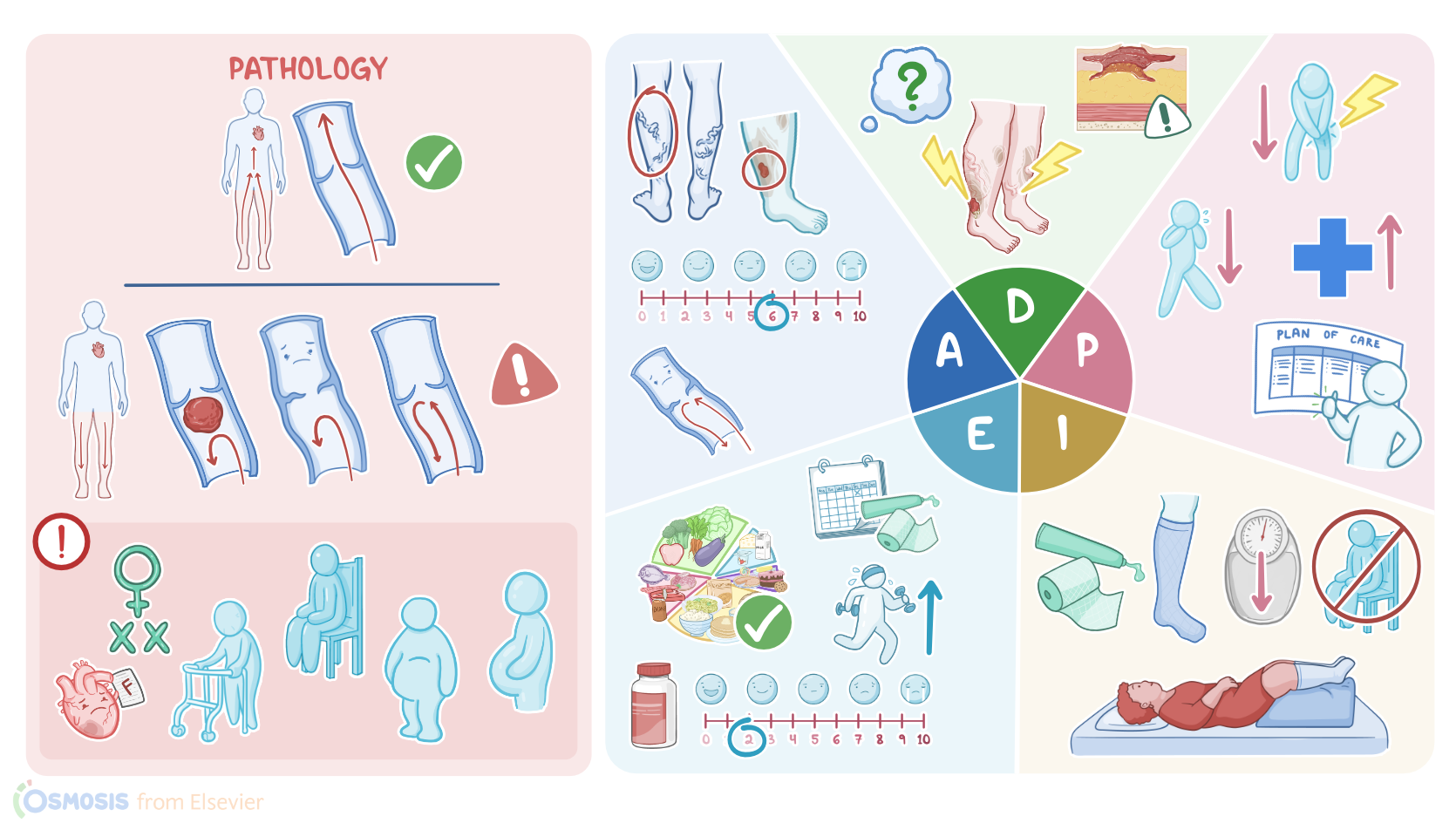
PERIPHERAL VENOUS DISEASE (PVD)

KEY POINTS
NOTES
PATIENT REPORT
  • 45-year-old 
  • Vein clinic
  • History: PVD and obesity
  • Chronic, non-healing, right lower leg ulcer

PATHOPHYSIOLOGY
  • Obstruction or defect in peripheral veins 
  • Most commonly affects the legs 
  • Veins normally return blood to the heart 
  • One-way valves prevent backflow 
  • In PVD, blood pools in lower legs 
  • Causes venous hypertension 
  • Due to clots emboli weak veins or valve issues 
  • Risk factors 
    • Biological female sex 
    • Increasing age 
    • Sedentary lifestyle 
    • Obesity 
    • Pregnancy 
    • Heart failure 
    • Varicose veins 
    • History of trauma or surgery 
    • Prolonged standing or leg crossing 
  • Signs and symptoms 
    • Leg pain and swelling 
    • Sensation of heaviness 
    • Edema and inflammation 
    • Brownish skin discoloration  
    • Thick leathery itchy skin 
    • Ulcers above medial malleolus 
  • Complications 
    • Chronic non-healing sores and ulcers 
    • Infection
    • Pain
    • Blood clots
    • Thrombophlebitis

DIAGNOSIS AND TREATMENT
  • Diagnosis 
    • History 
    • Physical assessment
    • Diagnostic imaging 
    • Lab tests
  • Treatment
    • Lifestyle modifications 
      • Increase physical activity 
      • Elevate legs above heart level 
      • Use compression stockings or support bandages 
      • Promote venous return and prevent backflow 
    • Surgical options 
      • Vein transplant 
      • Vein repair 
      • Vein removal

ASSESSMENT
  • Patient reports painful sore on right leg 
  • Legs feel swollen and heavy 
  • Vital signs 
    • Heart rate: 80 bpm, regular 
    • Respiratory rate: 16 bpm, clear breath sounds 
    • Blood pressure: 122/80 mmHg 
    • Temperature: 97.9°F (36.6°C) 
    • Pain: 6/10, right leg 
  • Physical assessment 
    • Posterior tibial and pedal pulses 2+ bilaterally 
    • Skin
      • Dry
      • Flaky
      • Leathery
      • Brownish discoloration 
    • Edema 3+ 
    • Bulging rope-like veins bilaterally 
    • Open ulcer with irregular borders 
      • Between right lateral malleolus and calf 
      • Moderate thick exudate present 
    • Height: 5 ft 2 in
    • Weight: 200 lbs (90.7 kg)
  • Diagnostic results 
    • Venous ultrasound 
      • Vein dilation 
      • Valvular incompetence 
      • Varicosities 
    • ABI 
      • Right leg: 1.0 
      • Left leg: 1.2 

NURSING DIAGNOSES
  • Impaired skin integrity related to venous hypertension
  • Chronic pain related to tissue damage
  • Ineffective health management related to difficulty implementing measures to prevent venous ulcers

PLANNING
  • At follow-up appointment in one week
    • Patient will remain free of new venous ulcers
    • Edema will be decreased
    • Existing ulcer will show signs of healing
    • Pain will be managed
    • Patient will adhere to care regimen

IMPLEMENTATION
  • Provided wound care and applied dressing 
  • Advised use of NSAID 
  • Taught proper application of compression stockings 
  • Emphasized wearing stockings during the day 
  • Encouraged increased physical activity 
  • Advised against prolonged sitting or standing 
  • Instructed to avoid leg crossing and tight clothing 
  • Recommended leg elevation above heart when sitting
  • Explained benefits of weight loss
  • Discussed dietary choices
  • Scheduled appointment with registered dietitian 
  • Instructed to report to HC
    • Increased redness or swelling 
    • Increased drainage or pain 
    • Fever or chills 

EVALUATION
  • Wound size unchanged 
  • No exudate present 
  • New dressing applied 
  • Edema decreased since last visit 
  • Legs less heavy per patient  
  • Wearing compression stockings daily 
  • Increased physical activity 
  • Enjoying new diet plan 
  • Pain controlled at 2/10 with NSAID 

Transcript

Watch video only

Muriel Diallo is a 45-year-old female client with a history of peripheral venous disease and obesity. She is referred to the vein clinic by her primary care provider for treatment of a chronic, non-healing leg ulcer in her right lower extremity.

Peripheral venous disease, or PVD for short, is characterized by an obstruction or defect of the veins, and most often affects the legs. Normally, veins drain blood from peripheral organs and tissues towards the heart, and they have one-way valves to prevent backflow.

In PVD, veins are either obstructed by a blood clot or embolus, are weak or dilated, or there’s valvular insufficiency, so blood ends up leaking backward and pooling in the lower legs, leading to venous hypertension.

Risk factors for PVD include female sex, increasing age, sedentary lifestyle, obesity, and pregnancy. Other important risk factors for PVD include associated conditions like heart failure, varicose veins, and having a history of trauma or surgery.

Finally, another risk factor for PVD involves standing or sitting with the legs crossed for long periods of time. Okay, now clients with PVD often report pain in the legs, swelling, and a sensation of heaviness.

Fluid and red blood cells can leak out of the small veins and capillaries and into the surrounding tissues, causing edema and inflammation in the lower extremities. As the red blood cells break down in the tissue, they release hemosiderin, which eventually causes the skin to take on a brownish discoloration.

Moreover, as normal subcutaneous tissue is replaced by fibrous tissue, the skin becomes thick, leathery, and itchy. This will cause the skin to become more vulnerable to ulceration and painful sores, most often above the medial malleolus.

Clients with PVD may also develop some serious complications. First off, clients may develop chronic non-healing sores and ulcers, which pose a risk for infection and pain.

In addition, pooling of blood can increase the risk of blood clots formation within the veins which can cause inflammation and thrombophlebitis. Diagnosis of PVD relies largely on the client’s history and physical examination.

In addition, a venous ultrasound is usually performed to visualize venous blood flow and determine the presence of a blood clot. Alternatively, a venography procedure can be performed by injecting a dye into the veins, and an X-ray is taken to identify any obstruction.

When DVT or pulmonary embolism are suspected, a blood test should be performed to measure the D-dimer, which is a break-down product from blood clots.

Treatment options for PVD include increasing activity, elevating the legs above the heart, as well as application of compression stockings or tubular support bandages to help prevent backflow of blood, promoting venous return upward toward the heart.

Rarely, surgical treatment is required, such as a vein transplant, repair, or removal. You begin your assessment by asking how Mrs. Diallo is feeling. She tells you the sore on her leg is painful and that lately her legs have been more swollen and have felt heavy.

Her vital signs are heart rate 80 beats per minute and regular; respiratory rate 16 breaths per minute with clear breath sounds bilaterally; blood pressure 122/80 mmHg; temperature 97.9° F or 36.6°C; pain 6/10 located on her right leg.

As you assess her lower extremities you note the following: posterior tibial and pedal pulses are 2+; the skin on her lower extremities is dry,flaky, and leathery with a brownish discoloration; edema is 3+.

You notice bulging rope-like veins bilaterally. There is an open ulcer with irregular borders located between the right lateral malleolus and calf muscle. There is a moderate amount of thick exudate present on the wound.

You review the results of her venous ultrasound which shows vein dilation, valvular incompetence, and varicosities. ABI results for right and left legs are 1.0 and 1.2 respectively.

Sources

  1. "Harrison’s Principles of Internal Medicine, 21st edition" McGraw Hill / Medical (2022)
  2. "Pathologic Disparities Between Peripheral Artery Disease and Coronary Artery Disease" Arterioscler Thromb Vasc Biol (2020)
  3. "Heart Disease and Stroke Statistics-2022 Update: A Report from the American Heart Association" Circulation (2022)
  4. "Clinically-indicated replacement versus routine replacement of peripheral venous catheters" Cochrane Database Syst Rev (2019)
  5. "Health Assessment for Nursing Practice, 7th edition" Elsevier (2021)
  6. "Critical Care Nursing: Diagnosis and Management, 9th edition" Elsevier (2021)
  7. "Symptoms in Dilating Venous Disease" Curr Cardiol Rev (2020)