Physical assessment - Neonate: Nursing
Introduction0:00–0:32
The physical assessment of a newborn is an ongoing process to monitor the newborn’s adaptation to extrauterine life, and to identify problems that need immediate intervention.
At the same time, the assessment considers factors such as the prenatal history; any complications during the pregnancy, labor, and birth; the type of anesthesia or analgesia used during birth; if any neonatal resuscitation measures were needed; and the newborn’s gestational age.Let’s start by looking at the newborn’s vital signs.
Vital signs0:32–2:32
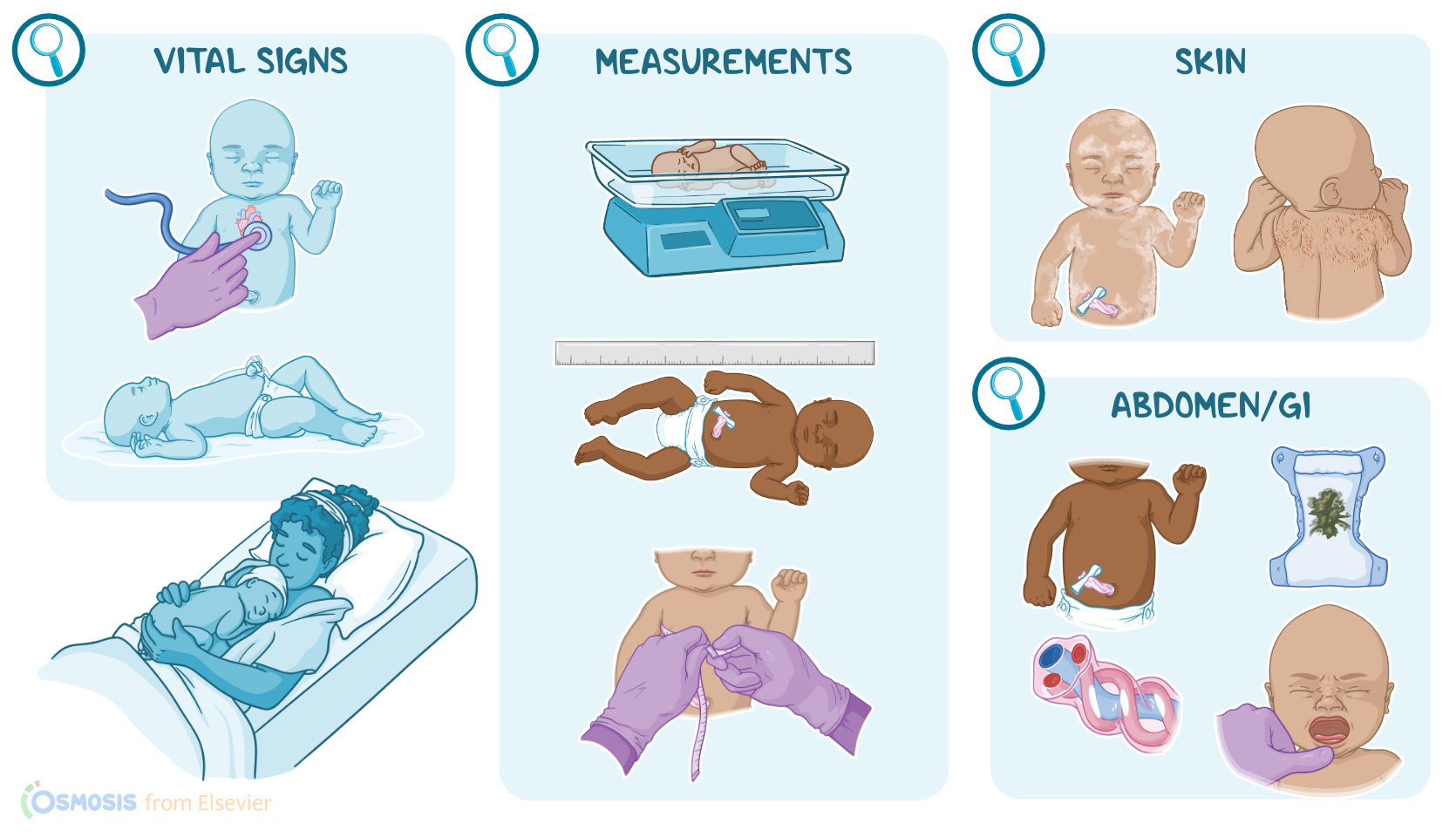
First, the apical pulse is auscultated. It’s a good idea to assess this first, when the infant is in a quiet state, and before any other assessments which could agitate them.
A newborn’s heart rate normally varies between 120 and 160 beats per minute, but it can rise to 180 beats per minute when the infant is crying or drop as low as 80 to 90 beats per minute when in deep sleep.
A consistently high or low heart rate should be investigated.Next up is the newborn’s respirations. Respirations are usually irregular, and there may be occasional 5 to 20 second pauses; so they are counted for a full minute for accuracy.
A normal respiratory rate is between 30 to 60 breaths per minute. You’ll notice that the abdomen will rise and fall with each respiration; this is normal, because newborns tend to use their diaphragm to breathe more than their intercostal muscles.
A respiratory rate of more than 60 breaths per minute could signal problems like cold stress, congenital heart defects, or infection; while a respiratory rate less than 30 breaths per minute could be associated with central nervous system depression.Then, the temperature is measured, which normally ranges between 97.7° F and 99.5° F, or 36.5° C and 37.5° C.
The axillary temperature is the preferred method of measurement, because it is easily accessed and is a close estimate to the newborn’s core temperatureBlood pressure is not routinely measured in well newborns, except when there are murmurs or other signs of cardiac complications, in which case it is measured on both the upper and lower extremities.
Normal newborn blood pressure ranges between 60 to 80 mmHg systolic over 40 to 50 mmHg diastolic.The next step in newborn assessment is to determine their measurements, including the weight, length, head, and chest measurements.
Measurements2:32–3:30
These are compared to the normal values for the infant’s gestational age. Normal weight for term newborns ranges between 2500 grams to 4000 grams.
The length of the infant is measured from the top of the head to the heel of the outstretched leg and ranges between 48 to 53 centimeters or 19 to 21 inches.
Next, the head circumference is measured around the occiput, or back of the head, and above the eyebrows. Normal values are between 33 to 35.5 centimeters or 13 to 14 inches, but that can be affected when the cranial bones overlap as the head is squeezed during birth, in a process called molding.
The chest is measured at the nipple line and is usually about 2 to 3 centimeters smaller than the head, with a normal range of 30.5 to 33 centimeters or 12 to 13 inches.Next, let’s look at the neonate’s skin.
Skin3:30–6:30
First, vernix caseosa, which is a creamy white substance that protects the fetal and newborn skin, may cover the entire body, or it may be concentrated between skin folds.
A fine, downy hair called lanugo will also be seen, especially on the back between the shoulders. The newborn's skin should be soft, smooth, and opaque, and there can be some variations from the normal range of skin coloration.
Acrocyanosis, meaning bluish discoloration of the hands and soles of the feet, is normal during the first few hours of life, and is thought to be caused by vasomotor instability during transition from fetal to neonatal life.
It normally resolves within 24-48 hours, but could be aggravated if the infant is cold. Another common type of cyanosis is bluish discoloration around the mouth, referred to as circumoral cyanosis, which can last up to 24 hours.
Color changes that should be investigated include circumoral cyanosis that persists more than 24 hours; acrocyanosis that lasts longer than 48 hours; jaundice or yellowing of the skin or sclera, especially if it appears within the first 24 hours of life; plethora, which is a ruddy skin tone that could signal an excess of RBCs, or polycythemia, and an unusually high hematocrit, commonly associated with maternal smoking, diabetes, or preeclampsia; pallor, or paleness can be an indication of poor perfusion; and lastly, central cyanosis, cyanosis that does not improve with supplemental oxygen, or cyanosis that appears when the infant is crying could be associated with a congenital heart defect or infection.Now, there are some transient skin changes that are normal in newborns.
First, there’s erythema toxicum, which sounds bad, but it’s a benign reddish-pink rash with yellowish-white papules that can be seen on the face, chest, and extremities.
The rash is also referred to as simply “newborn rash” and it usually resolves spontaneously within 4 to 5 days. Most newborns also have small pearly white papules, about the size of a pinhead, scattered across the brow, nose, chin, and cheeks.
These are called milia, and they are caused by a buildup of sebaceous gland secretions. Milia usually disappear within a few weeks.
Finally, there are some common birthmarks to note during your assessment. You may notice pale pink spots commonly found on the nape of the neck, eyelids, or forehead in newborns with light skin.
These are called nevus simplex, and are sometimes referred to as “stork bite” or “angel kiss”, and they usually fade by the second year of life.
These usually fade gradually over the first 2 years of life.Okay, moving on to the newborn’s head. Gently palpate the fontanelles, or “soft spots” which are openings in the spaces at the intersections of the sutures.
Head6:30–8:27
The main fontanelles are the anterior and posterior one, and both should be flat and soft. The diamond-shaped anterior fontanel is 4 to 6 cm at birth, and closes between 18 and 24 months.
The triangular posterior fontanelle is less than 0.5 cm at birth, and it will close by 2 to 3 months of age. You may notice that the anterior fontanelle pulsates with the heartbeat or may swell during crying, but a bulging, tense fontanelle is a sign of increased intracranial pressure.
Next, check the head for evidence of birth trauma. Often you’ll notice some swelling on the head.
A caput will be present at birth, and it usually resolves within a few days. On the other hand, a collection of blood between the periosteum and the skull is called a cephalohematoma.
It’s also caused by pressure on the skull, but unlike a caput, there’s a shearing pressure that occurs in a deeper and more vascular part of the fetal skull.
It may not be present immediately after birth, but will slowly develop over the next several hours, and take several weeks to resolve.
Also unlike a caput, the edges of a cephalohematoma will be clearly defined, since the bleeding is contained by the suture lines.
Eyes and ears8:27–9:16
Newborns with a cephalohematoma should be watched closely for hyperbilirubinemia, since the extra RBCs in the hematoma will be slowly destroyed, creating an increase in unconjugated bilirubin.Alright, let’s take a look at the newborn’s eyes and ears.
Otherwise, the sclera should be white to bluish white; though a blue sclera is associated with osteogenesis imperfecta, and warrants further investigation.
Be sure to check the position of the ears in relation to the eyes, by drawing a line from the inner canthus of the eye, to the outer canthus, and then toward the ear.
If the ear falls below the line, it is considered to be low set, and can be associated with congenital anomalies such as trisomies 13 and 18.
Cardiovascular assessment9:16–10:12
Lastly, the hearing of every newborn should be assessed before being discharged home. Now, during your cardiovascular assessment, you will find the apical impulse at the fourth intercostal space, just left of the midclavicular line in the newborn.
The heart rate should be regular, with the first and second sounds clearly audible. Any arrhythmias or murmurs should be noted during auscultation, but keep in mind heart murmurs can be temporary during the first 48 hours of life, as the ductus arteriosus closes.
Despite this, all murmurs should be investigated. Also check brachial and femoral pulses, which should be equal and bilateral.
Lastly, capillary refill is assessed to look for inadequate perfusion. This is done by depressing the skin over the abdomen with your finger, and then releasing it.
Chest and lungs10:12–10:45
Color should return within 2 to 3 seconds; a delay in capillary refill should be investigated.The chest is normally symmetrical, and a prominent xiphoid is often noted.
Upon auscultation, soft, low pitched vesicular lung sounds should be noted throughout the lung fields, though fine crackles may be noted immediately after birth as fetal lung fluid is cleared.
Now, there are some assessment findings that are associated with respiratory problems which should be reported immediately.
Abdomen and gastrointestinal system10:45–11:55
These include intercostal, subcostal, or substernal retractions; nasal flaring, and an audible grunting sound during expiration.Next up is the abdomen and gastrointestinal system.
The abdomen should be cylindrical and slightly protuberant, and it moves with breathing. Assess the umbilical stump, which should be gelatinous and bluish white at birth.
The diameter of the cord varies depending on the amount of Wharton’s jelly, which is the protective covering that keeps the cord vessels from compression.
Three umbilical vessels should be present; two small arteries and a single, larger vein. If only a single artery is noted, this should prompt further investigation, as it can be associated with congenital anomalies of the gastrointestinal system or heart.
Sometimes, an umbilical hernia is present, due to weakness in the abdominal muscles; and these usually close on their own by 2 years of age.You can usually auscultate bowel sounds 15 minutes after birth, but they are often hypoactive until after the first feeding.
Lastly, check that the hard palate is intact. Moving on to the genitourinary system.
Genitourinary system11:55–12:25
The newborn's first wet diaper should occur within 12 to 24 hours after birth. An absence of a wet diaper within the first 24 hours could be due to inadequate oral intake, or it could indicate a genitourinary obstruction or abnormality.
Sometimes there can be brick dust colored staining on the diaper, which is due to uric acid crystals in the urine. This is normal and will resolve spontaneously.
Now let’s switch gears and look at the musculoskeletal system. Extremities should move spontaneously and bilaterally.
Musculoskeletal system12:25–13:06
All fingers and toes should be inspected and counted, and any extra digits, webbing, or other malformations should be reported.
If there’s an uneven knee level when the infant is positioned supine with feet flat and knees flexed; or if the creases of the buttocks and thighs are asymmetrical, this could indicate a congenital hip dislocation.
Lastly, palpate the entire length of the vertebral column, which should be intact without openings, masses, curves, dimples, or hairy tufts that could indicate a neural tube defect.The physical assessment of a newborn is an ongoing process to monitor the newborn’s adaptation to extrauterine life, and to identify problems that need immediate intervention.
Review13:06–13:58
The newborn’s normal vital signs include a heart rate between 120 to 160 bpm, a respiration rate between 30 and 60 breaths per minute, and an axillary temperature between 36.5 and 37.5 degrees Celsius.
Blood pressure is not routinely measured, but it should range from 60 to 80 mmHg systolic over 40 to 50 mmHg diastolic. Then the weight and length of the newborn, as well as head and chest measurements are determined and compared to the norms for the infant’s gestational age.
Then, a thorough examination of each organ system is done and any abnormal findings are reported.
| PHYSICAL ASSESSMENT - NEONATE | ||
| KEY POINTS | NOTES | |
| DEFINITION |
| |
| VITAL SIGNS |
| |
| MEASUREMENTS |
| |
| SKIN |
| |
| HEAD |
| |
| EYES AND EARS |
| |
| CARDIOVASCULAR |
| |
| CHEST AND LUNGS |
| |
| ABDOMEN AND GI SYSTEM |
| |
| GENITOURINARY |
| |
| MUSCULOSKELETAL |
| |
No notes for this video yet
Try adding a note below