Shock - Neurogenic: Nursing

1,298views

Shock - Neurogenic: Nursing

Cardiovascular MedSurg

Cardiovascular MedSurg

Introduction to the cardiovascular system
Anatomy of the heart
Cardiovascular system anatomy and physiology
Pressures in the cardiovascular system
Cardiac cycle
Cardiac work
Cardiac preload
Cardiac afterload
Cardiac contractility
Stroke volume, ejection fraction, and cardiac output
Cardiac excitation-contraction coupling
Baroreceptors
Electrocardiogram (ECG) - Normal sinus rhythm (NSR): Nursing
Cardiac biomarkers - Creatine kinase (CK): Nursing
Cardiac biomarkers - Troponin: Nursing
Coagulation studies - Partial thromboplastin time (PTT): Nursing
Arrhythmias - Asystole: Nursing
Arrhythmias - Atrial fibrillation (Afib): Nursing
Arrhythmias - Atrial flutter (Aflutter): Nursing
Arrhythmias - Heart blocks: Nursing
Arrhythmias - Premature atrial contractions (PACs): Nursing
Arrhythmias - Premature ventricular contractions (PVCs): Nursing
Arrhythmias - Sinus tachycardia and sinus bradycardia: Nursing
Arrhythmias - Supraventricular tachycardia (SVT): Nursing
Arrhythmias - Ventricular fibrillation (Vfib): Nursing
Arrhythmias - Ventricular tachycardia (Vtach): Nursing
Arterial embolism: Nursing
Buerger disease: Nursing
Congenital heart defects - Acyanotic: Nursing
Congenital heart defects - Cyanotic: Nursing
Cardiomyopathy: Nursing
Endocarditis: Nursing
Myocarditis: Nursing
Pericarditis: Nursing
Heart defects that decrease pulmonary blood flow - Nursing considerations & client education: Nursing
Kawasaki disease: Nursing
Raynaud phenomenon: Nursing
Shock - Anaphylactic: Nursing
Shock - Cardiogenic: Nursing
Shock - Hypovolemic: Nursing
Shock - Neurogenic: Nursing
Shock - Obstructive: Nursing
Shock - Septic: Nursing
Valvular heart disease: Nursing
Alpha-1 adrenergic blockers: Nursing pharmacology
Alpha-2 adrenergic agonists: Nursing pharmacology
Angiotensin II receptor blockers (ARBs): Nursing pharmacology
Angiotensin-converting enzyme (ACE) inhibitors: Nursing pharmacology
Antiarrhythmics: Nursing pharmacology
Anticoagulants - Direct thrombin and factor Xa inhibitors: Nursing pharmacology
Anticoagulants - Heparin: Nursing pharmacology
Anticoagulants - Warfarin: Nursing pharmacology
Antihyperlipidemics - Bile acid sequestrants and cholesterol absorption inhibitors: Nursing pharmacology
Antihyperlipidemics - Fibrates: Nursing pharmacology
Antihyperlipidemics - Miscellaneous: Nursing pharmacology
Antihyperlipidemics - Statins: Nursing pharmacology
Antiplatelet agents: Nursing pharmacology
Beta-adrenergic blockers: Nursing pharmacology
Blood products: Nursing pharmacology
Calcium-channel blockers: Nursing pharmacology
Cardiac glycosides: Nursing pharmacology
Direct-acting vasodilators: Nursing pharmacology
Diuretics - Osmotic and carbonic anhydrase inhibitors: Nursing pharmacology
Diuretics - Thiazide, thiazide-like, loop, and potassium-sparing diuretics: Nursing pharmacology
Hematopoietic growth factors: Nursing pharmacology
Hemostatics: Nursing pharmacology
Iron preparations: Nursing pharmacology
Nitrates: Nursing pharmacology
Sympathomimetic medications: Nursing pharmacology
Thrombolytics: Nursing pharmacology
Aortic aneurysm: Nursing process (ADPIE)
Coronary artery disease (CAD) and angina pectoris: Nursing process (ADPIE)
Hypertension: Nursing process (ADPIE)
Left-sided heart failure: Nursing process (ADPIE)
Myocardial infarction (MI): Nursing process (ADPIE)
Pericardial effusion and cardiac tamponade: Nursing process (ADPIE)
Peripheral arterial disease (PAD): Nursing process (ADPIE)
Peripheral venous disease (PVD): Nursing process (ADPIE)
Rheumatic heart disease: Nursing process (ADPIE)
Venous thromboembolism (VTE): Nursing process (ADPIE)
Aneurysms
Aortic valve disease
Atherosclerosis and arteriosclerosis: Pathology review
Atrial septal defect
Cardiac and vascular tumors: Pathology review
Cor pulmonale
Dyslipidemias: Pathology review
Heart failure
Heart failure: Pathology review
Mitral valve disease
Patent ductus arteriosus
Pulmonary embolism
Pulmonary hypertension
Vasculitis: Pathology review
Ventricular septal defect
Physical assessment - Heart and neck vessels: Nursing
Normal heart sounds
Abnormal heart sounds
Geriatric considerations - Cardiac: Nursing

Notes

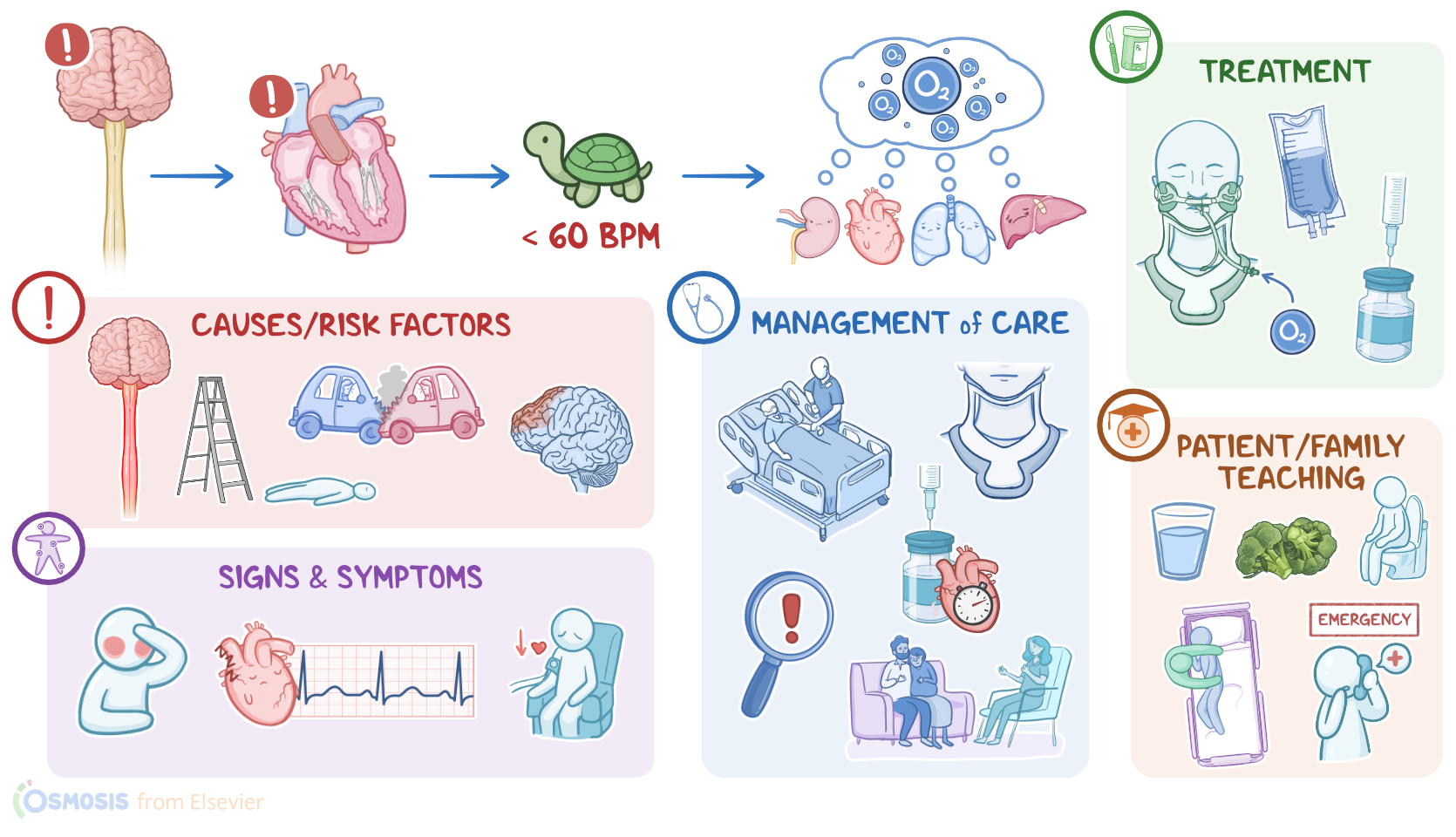
SHOCK - NEUROGENIC

KEY POINTS
NOTES
DEFINITION
  • Shock: life-threatening condition when organs don't receive enough oxygen and nutrients to function
  • Type of distributive shock
  • Brain or spinal cord damage causes cardiovascular dysfunction

PHYSIOLOGY
  • Blood vessels contain smooth muscle
  • When relaxed, diameter increased
    • Vasodilation
  • When contracted, diameter decreased
    • Vasoconstriction
  • Sympathetic nervous system (SNS) can increase or decrease diameter based on body's needs
    • Increased SNS: vasoconstriction
      • Increased blood pressure
    • Decreased SNS: vasodilation
      • Decreased blood pressure

CAUSES AND RISK FACTORS
  • Causes
    • Trauma to cervical or upper thoracic spinal cord
    • Traumatic brain injury
    • Guillain-Barre syndrome
    • Transverse myelitis
    • Spinal anesthesia
  • Risk factors
    • Any factor that increases risk of trauma to brain or spinal cord
      • High-risk behaviors
      • Bone or joint disorders

PATHOPHYSIOLOGY
  • Damage to SNS neurons
    • PNS goes unbalances
  • Systemic vasodilation
    • Decreased venous return
    • Cardiac output (CO) decreases
  • Body cells switch to anaerobic metabolism
    • Lactic acid builds up
  • Body unable to increase cardiac output
  • Severe tissue hypoxia
  • Multiple organ failure

SIGNS AND SYMPTOMS
  • Hypotension
  • Weak peripheral pulses
  • Altered mental status
  • Coma
  • Skin warm and flush
  • Bradycardia

DIAGNOSIS
  • History
  • Physical assessment
  • X-ray
  • CT
  • MRI

TREATMENT
  • Stabilize spine
  • Secure airway
  • Provide oxygen
  • IV fluids
  • Vasopressors
  • Corticosteroids
  • Address underlying cause

MANAGEMENT OF CARE
  • Goals of care
    • Support ventilation and oxygenation
    • Promote CO
    • Monitor for complications
    • Provide emotional support
  • Apply cervical collar
  • Keep head in neutral position
  • Elevate head of bed
  • Apply high flow oxygen
  • Monitor respiratory status and initiate continuous pulse oximetry
    • Report to HCP
      • Dyspnea
      • Low oxygen saturation
      • Ineffective cough
      • Tachypnea
      • Diminished or crackles lung sounds
  • Administer IV fluids as prescribed
  • Insert indwelling catheter
  • Assess vital signs
    • Report to HCP
      • Signs of decreased CO
  • Assist in preparation for surgery as needed
  • Monitor for complications
    • Report to HCP
      • Signs of autonomic dysreflexia
    • Monitor temperature
    • Prevent skin breakdown and deep vein thrombosis
  • Provide emotional support
  • Coordinate care with interdisciplinary team

PATIENT AND FAMILY TEACHING
  • Explain condition, plan of care, and how to safely self-administer medications
  • Encourage engagement in rehab activities
  • Refer to support groups
  • Instruct on toileting schedule and use of urinary catheter
  • Encourage oral fluids and diet high in fiber
  • Seek emergency care
    • Signs of autonomic dysreflexia
  • Remind to change positions every 2 hours, use devices to distribute pressure, and perform skin care
  • Notify HCP
    • Difficulty with urinary or bowel elimination
    • Sores

Transcript

Watch video only

Shock is a life-threatening condition that occurs when the organs don’t receive enough oxygen and nutrients to function properly. Shock can be grouped into four types based on the cause: hypovolemic, cardiogenic, obstructive, and distributive shock. Neurogenic shock is a type of distributive shock where damage to the brain or spinal cord causes dysregulation of the cardiovascular system, leading to decreased heart rate and vasodilation, which eventually leads to impaired tissue perfusion.

Now, to understand the neurogenic shock, let’s quickly review the physiology of blood vessels, which contain smooth muscle in their walls. When the smooth muscle relaxes, it increases the diameter of blood vessels, called vasodilation. On the other hand, when smooth muscle contracts, the diameter of blood vessels decreases, called vasoconstriction.

The contraction and relaxation of smooth muscles are primarily controlled by the sympathetic nervous system, which normally maintains a partial constriction, generating enough force to keep blood moving through the circulatory system. The sympathetic system stimulation can increase or decrease to keep up with the body’s needs. Increased sympathetic stimulation of the blood vessels causes increased heart rate and vasoconstriction, which increases peripheral vascular resistance. Vasoconstriction, when the total blood volume is constant, raises blood pressure and allows blood to flow faster through the blood vessels. In contrast, decreased heart rate and vasodilation is typically caused by decreased sympathetic stimulation, in addition to inflammatory cytokines and histamine, which decrease peripheral vascular resistance. So, vasodilatation, when blood volume is constant, lowers the blood pressure and slows down the blood flow through the blood vessels.

Now let’s switch gears and look at the causes of neurogenic shock. This type of shock is primarily caused by trauma to cervical or upper thoracic segments of the spinal cord, which is typically associated with motor vehicle crashes, as well as severe falls, such as falling from a ladder. Other, less common causes include traumatic brain injury, Guillain-Barre syndrome, transverse myelitis, as well as spinal anesthesia.

Risk factors for developing neurogenic shock include anything increasing the risk of spinal cord trauma, such as engaging in high-risk behaviors, like speeding, and not wearing safety equipment when playing sports. Additionally, clients with a history of bone or joint disorders are also at a higher risk, since even minor trauma could damage the weakened bones, thereby injuring the spinal cord and potentially resulting in neurogenic shock.

The pathology behind neurogenic shock is based on the dysregulation between the sympathetic and parasympathetic stimulation of the cardiovascular system. Injury to the spinal cord can damage the neurons responsible for sympathetic innervation. As a result, the balance is tipped towards the parasympathetic system, causing bradycardia and massive peripheral vasodilation, causing blood to remain in the limbs instead of returning to the heart. All these factors together decrease the blood pressure and organ perfusion.

Now, most types of shock can be divided into four main stages: initial, compensatory, progressive, and refractory. But neurogenic shock deviates from this pattern. Things are pretty similar to other types of distributive shock during the initial stage, when systemic vasodilation causes less blood to return to the heart through the venous system; this, in turn, decreases cardiac output. As a consequence, body cells are not well-perfused, so they switch to anaerobic metabolism to produce energy, causing lactic acid to build up in the blood. When lactic acid builds up, that lowers blood pH, causing metabolic acidosis. Normally, this activates the compensatory stage, which involves stimulation of the sympathetic nervous system to increase the heart rate and vasoconstriction. However, in neurogenic shock, there’s a loss of the sympathetic activity, so the body fails to increase cardiac output. Therefore, with neurogenic shock, there’s no compensatory stage. If not managed in time neurogenic shock can progress to severe tissue hypoxia; and vital organs like the heart, brain, and kidneys may begin to shut down, leading to multiple organ failure.

Clinical manifestations of neurogenic shock share many similarities with other types of shock. There's hypotension, weak peripheral pulse and in severe cases, altered mental status or coma. Now, unlike with hypovolemic, obstructive, or cardiogenic shock, the skin can be warm and flush instead of cold and pale, and this is due to increased peripheral vasodilation. Furthermore, neurogenic shock is the only type of shock where there’s bradycardia instead of tachycardia since sympathetic regulation of the heart is impaired.

Spinal cord injury that causes neurogenic shock is often accompanied by other neurological symptoms. These include muscle weakness or paralysis, urinary incontinence, impaired respiration, and the inability to regulate temperature, where the client becomes poikilothermic, meaning they become dependent on the environment for temperature regulation.

Diagnosis of neurogenic shock starts with the client’s history and physical assessment and it’s made based on the symptoms and ruling out other causes of shock. This is followed by imaging tests like X-rays, CT scan, or MRI to look for the exact cause and location of the spinal cord or brain injury.

Finally, let’s take a look at treatment. The first step in the management of the client with neurogenic shock is to stabilize the client’s spine using a cervical collar, secure the airway, and provide oxygen. Some clients might also need mechanical ventilatory support. The management continues with early resuscitation with IV fluids and administration of vasoactive medications like norepinephrine. In the case of persistent bradycardia, atropine can be used to increase the heart rate. Finally, clients with neurogenic shock might benefit from the administration of corticosteroids, such as methylprednisolone. Finally, it’s important to address the underlying cause whenever possible, like performing spinal decompression procedures such as closed reduction using traction, or spinal surgery.