Definitions & Key takeaways

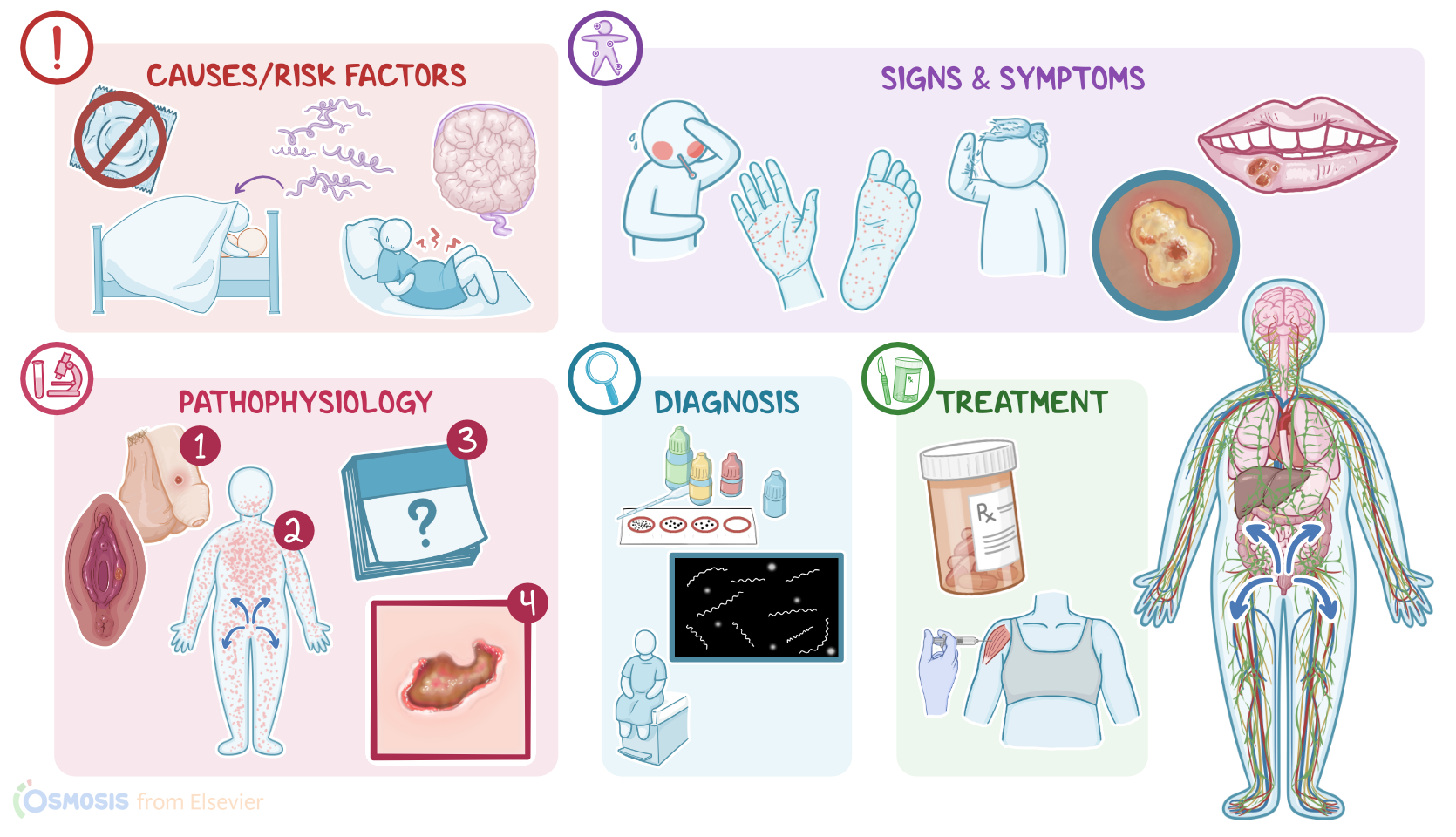
Syphilis is a sexually transmitted infection (STI) caused by the bacteria Treponema pallidum. It can spread through direct contact with a syphilis sore during vaginal, anal, or oral sex. It can cause disease in three stages. The first is localized primary syphilis, and this produces hard chancres. The second is disseminated secondary syphilis, which produces widespread maculopapular rash, and the third is systemic tertiary syphilis, which affects various organs.

Syphilis can be diagnosed by using serological tests and treated with antibiotics like penicillin. If left untreated, it can lead to severe health complications, including organ damage and even death. Syphilis is primarily treated with intramuscular penicillin G benzathine. The main goals of nursing care include the resolution of their infection, and avoiding the spread of the infection among their sexual contacts. Client teaching is aimed at promoting adherence to treatment and follow-up, as well as disease prevention.

Chapters:

Introduction0:00–0:20

Syphilis is a sexually transmitted infection or STI, that primarily affects the skin and mucous membrane of the external genitalia, and over time disseminates throughout the body, ultimately causing serious damage to the cardiovascular and nervous systems.Now, syphilis is caused by a spirochete or spiral-shaped bacteria called Treponema pallidum.

Causes & risk factors0:20–1:10

This infection is mainly transmitted from person to person during sexual contact through body fluids, such as vaginal secretions, semen, or blood, and it can also be transmitted via contact with skin or mucous membranes, including eyes, mouth, throat, and anus.
The main risk factors for contracting syphilis include having vaginal, anal, and oral unprotected sex, as well as having multiple or anonymous sexual partners.Pregnant clients can also transmit the infection to their fetus, either via the placenta, which may result in spontaneous abortion, fetal death, or poor fetal growth; or during childbirth, causing congenital syphilis.
Now, syphilis has four stages: primary, secondary, latent, and tertiary. The first stage as soon as the client gets infected is called primary syphilis or early localized stage, in which the bacteria start replicating at the contact site, most often the skin and mucous membrane of the external genitalia.

Pathophysiology1:10–3:01

After 10 to 90 days from the initial infection, clients typically develop a lesion called chancre, which contains a high number of replicating bacteria and is highly contagious.
Now, the chancre typically heals on its own within 3 to 6 weeks, but during this time, the bacteria manage to disseminate to nearby lymph nodes and into the bloodstream.
This leads to the second stage, called secondary syphilis, also called the dissemination stage, which can occur about 2 to 10 weeks after the chancre develops.
This dissemination results in a generalized rash that self-resolves within 4 to 12 weeks. At this point, the disease enters a dormant stage called latent syphilis, which can last from 1 year up to even 20 years!
During the latent stage, a small amount of bacteria can be found in the tiny capillaries of various body organs and tissues, so clients are typically asymptomatic, but may still be contagious.
Eventually, clients who don’t get treatment can progress into the final stage, which is called tertiary syphilis. Here, the body mounts a massive immune response against the bacteria in the capillaries of organs and tissues.
This results in the formation of granulomatous lesions called gummas, and ultimately causes tremendous organ damage, especially to the cardiovascular and nervous systems, which are respectively called cardiovascular syphilis and neurosyphilis.

Clinical manifestations3:01–4:45

Now, throughout each stage, clients with syphilis have different clinical manifestations. In primary syphilis, the chancre presents as a firm, oozing, painless ulcer appears at the contact site, such as the genitals, anus, lips, or mouth.
On the other hand, secondary syphilis presents with flu-like symptoms, such as fever, headache, and malaise; as well as generalized lymphadenopathy; and a generalized maculopapular rash, with small reddish bumps that start on the trunk and spread out to the arms and legs, including the palms and soles, and eventually to the genitalia, and other mucous membranes.
In addition, some clients may develop condylomata lata, which are gray-white wart-like lesions that appear over moist areas like the genitals, the anal region, and the armpits.
Lastly, some clients at this stage may experience weight loss and alopecia. Then, the latent stage is asymptomatic; and finally, the tertiary stage is characterized by gummas, which are chronic destructive lesions that can affect any body organ, especially the liver, bones, skin, and mucous membranes.
In addition, clients with tertiary syphilis can develop cardiovascular syphilis, which may lead to aortitis, aortic aneurysms, aortic insufficiency, and heart failure.
Finally, clients at this stage may develop neurosyphilis, characterized by confusion, dementia, and tabes dorsalis, which is a slow and progressive degeneration of the spinal column, leading to a loss of the sensation and proprioception, as well as ataxia or lack of coordination, and weakness or even paralysis.Diagnosis of syphilis starts with the client’s history and physical assessment, followed by non-treponemal tests, like Rapid Plasma Reagin, or the RPR test; and Venereal Disease Research Laboratory, or the VDRL test.

Diagnosis4:45–5:55

Both these tests look for antibodies against bacterial antigens, but they are not very specific, so they can yield a fair amount of false positive results.
However, they are quite cheap, so they’re preferred for establishing a presumptive diagnosis. If one or both of these tests come back positive, then treponemal tests can be used.Treponemal tests include fluorescent treponemal antibody absorption or FTA-ABS, Treponema pallidum particle agglutination assay or TPPA, and micro-hemagglutination test for antibodies to Treponema pallidum or MHA-TP, which detect antibodies that are specific against Treponema pallidum.
Finally, dark field microscopy could also be used to directly identify spirochetes in the chancre exudate; however, this procedure is more complex, and is not as often used these days.Syphilis is treated using intramuscular penicillin G benzathine for all stages.

Treatment5:55–6:09

If the client is allergic to penicillin, they can be treated with oral doxycycline or tetracycline. Alright, let’s look at the nursing care you will provide for a client with syphilis.

Management and care6:09–7:01

Your main goals are to achieve the resolution of their infection, as well as reducing the risk of infection spread, and providing emotional support.
Begin by reviewing your client’s sexual history, including risk factors like number of sexual contacts, drug and alcohol abuse, and the use of barrier methods for protection.
Also assess your client’s level of anxiety, and encourage them to express concerns or feelings they may have about their illness, such as fear, guilt, or anger.
Be sure to provide emotional support, and provide a referral for additional counseling as needed. Then, administer the prescribed penicillin G benzathine intramuscularly; and lastly, ensure local and state public health authorities have been notified to aid in local disease surveillance.
Okay, now let's move on to client and family teaching. Let them know that they will need to keep follow-up appointments for serological testing and examination for clinical manifestations in order to confirm the resolution of their infection.

General client and family teaching7:01–7:54

Teach your client to abstain from sexual activity until testing confirms their infection has resolved, and explain that all sexual contacts within the last 90 days must be informed, so that they also get tested and begin treatment as needed.
Help your client to reduce their risk of becoming reinfected or spreading syphilis in the future by recommending the use of condoms; limiting the number of their sexual partners; disclosing their sexual history regarding STIs to potential sexual contacts; as well as knowing the STI history of sexual contacts.
Lastly, stress the importance of routine screening to promote early detection and treatment. Okay, as a quick recap...

Review7:54–9:44

Syphilis is an STI that mainly affects the skin and mucous membranes of the external genitalia, although it can progress to affect a variety of organ systems.
Syphilis is caused by the bacterium Treponema pallidum and is primarily spread during sexual contact, but can be transmitted by a pregnant client to their fetus.
Syphilis progresses through four stages: primary, secondary, latent, and tertiary. The symptoms of syphilis vary throughout the stages, from a painless chancre during the primary stage, to flu-like symptoms and a generalized rash in the secondary stage, to no symptoms at all during the latent stage, and finally destructive gummas that can affect any organ during the tertiary stage; during this last stage, cardiovascular syphilis and neurosyphilis may also develop.
Diagnosis of syphilis starts with the client’s history and physical assessment, followed by non-treponemal tests, like Rapid Plasma Reagin, or the RPR test; and Venereal Disease Research Laboratory, or the VDRL test.
If one or both of these tests come back positive, then treponemal tests can be used. Treponemal tests include fluorescent treponemal antibody absorption or FTA-ABS, Treponema pallidum particle agglutination assay or TPPA, and micro-hemagglutination test for antibodies to Treponema pallidum or MHA-TP.
Syphilis is primarily treated with intramuscular penicillin G benzathine. The main goals of nursing care include resolution of their infection, and to avoid spread of the infection among their sexual contacts.
Client teaching is aimed at promoting adherence to treatment and follow-up, as well as disease prevention.