Urinary incontinence - Stress: Nursing process (ADPIE)
Definitions & Key takeaways
Stress urinary incontinence (SUI) is a type of urinary incontinence that occurs when urine leaks out because of increased intraabdominal pressure, like when coughing, sneezing, laughing, and during physical exercise. Stress incontinence is usually a result of weakened pelvic floor muscles, which are a group of muscles that support the bladder, uterus, vagina, and bowel. Pregnancy and childbirth are the most common causes of a weakened pelvic floor, especially with multiple pregnancies or trauma caused by vaginal deliveries assisted by instruments like forceps. Treatment options may include lifestyle changes, pelvic floor exercises (Kegel exercises), medical devices, medications, or surgery in severe cases.
Client Report0:00–0:30
Heidi Anderson is a 60-year-old woman who presents to a primary care clinic with reports of urine leakage when she sneezes, coughs, and during exercise.
Her symptoms started 1 year ago, and she started wearing a panty liner which she changes several times each day. Mrs.
Anderson has had 2 vaginal births and 1 cesarean section. She has been very embarrassed about her incontinence and has finally gathered the courage to seek treatment.
Pathology0:30–3:29
Urinary incontinence is the loss of bladder control, meaning that urine leaks involuntarily, causing both social and hygienic problems.
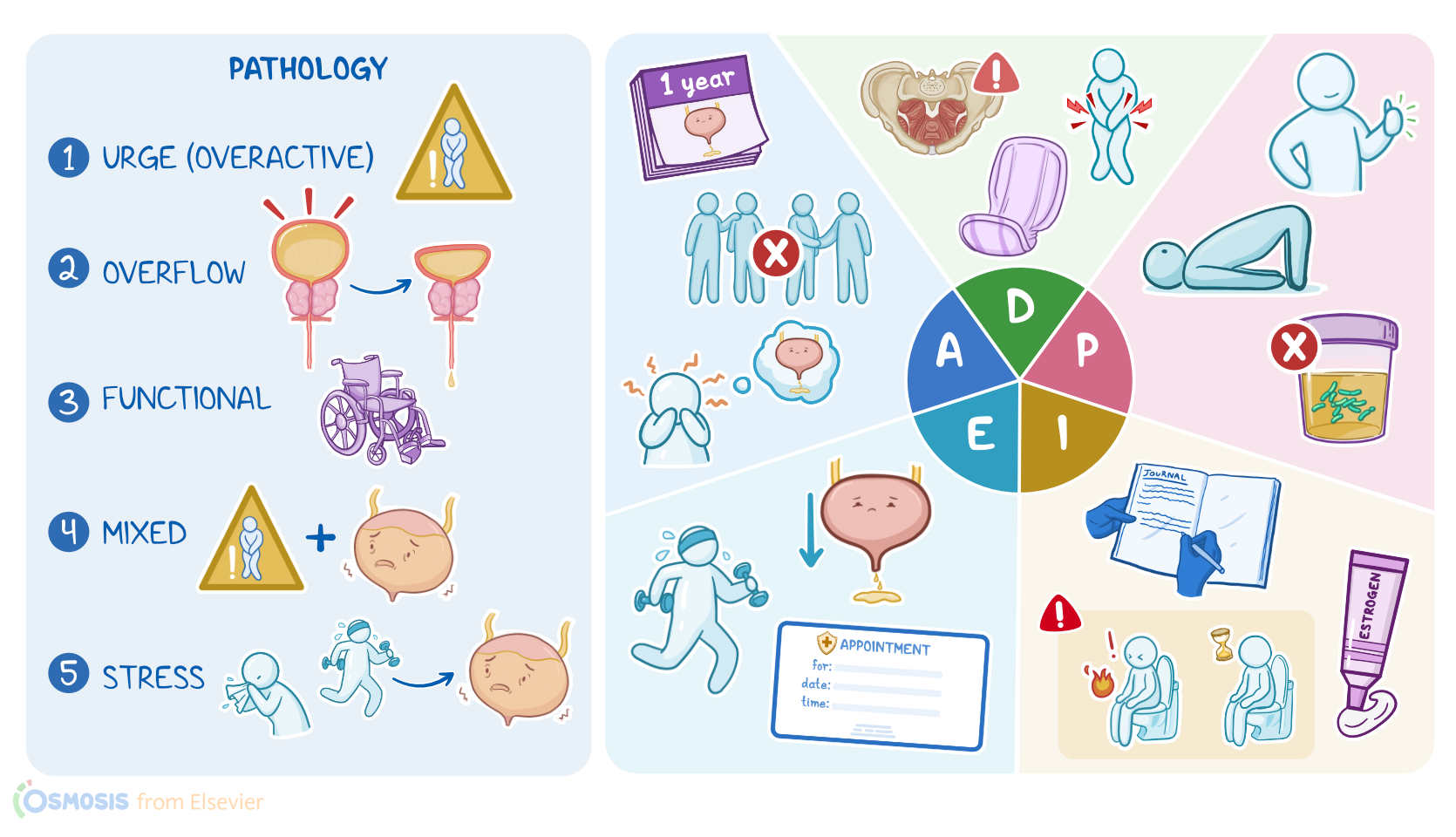
There are 5 major types of urinary incontinence. So, when there is a sudden urge to urinate that is difficult to delay, that's urge incontinence, also known as an overactive bladder.
Overflow incontinence occurs when the pressure from a bladder that gets too full causes urine to leak out. This can be caused by problems associated with urinary retention like spinal cord injury, or an enlarged prostate.
Functional incontinence happens when either a physical, cognitive, or environmental problem makes it hard to reach the bathroom in time, like with mobility problems or dementia.
There is also a type of mixed incontinence, which is a combination of two or more types of incontinence, usually urge incontinence and stress incontinence.
Stress incontinence is the most common type of incontinence. It occurs when urine leaks out because of increased intraabdominal pressure, like when coughing, sneezing, laughing, and during physical exercise.
Stress incontinence is usually caused by weakened pelvic floor muscles, which are a group of muscles that support the bladder, uterus, vagina, and bowel.
Pregnancy and childbirth are the most common causes of a weakened pelvic floor, especially with multiple pregnancies or trauma caused by vaginal deliveries assisted by instruments like forceps.
The risk also increases during menopause because decreased estrogen causes atrophy of pelvic tissue. Complications of stress incontinence include decreased quality of life and social anxiety from fear of leaking urine.
The risk for urinary tract infections is also increased, as well as the possibility of skin breakdown occurring from a moist environment.
The diagnosis of stress incontinence is based on the client's history and physical examination. A bladder stress test, also called a cough stress test, consists of observing urine loss from the bladder when the client coughs or bears down.
Pelvic floor muscle strength can be determined by a vaginal digital exam. Initial treatment of stress incontinence includes pelvic floor strength training, which will include learning how to do Kegel exercises, where the pelvic floor muscles are repeatedly tightened, held for a few seconds, and then relaxed.
The client can also be taught to quickly contract their pelvic floor muscles just before an activity that normally causes urine leakage.
In post-menopausal women, intravaginal estrogen cream can help reduce atrophy of pelvic floor tissues. Other treatments include mechanical devices, such as intravaginal pessaries that provide support to the bladder neck.
Assessment3:29–4:47
OK, now that we understand stress incontinence, let's get back to assess our client, Mrs. Anderson.
You enter her room, introduce yourself, perform hand hygiene, and confirm her identity. You begin by asking when her urinary incontinence started, and she tells you that it's been happening for about a year.
She says she's embarrassed about her incontinence, and even though she wears a panty liner, she doesn't go out in public and see her friends as often as she used to, because she's anxious she might leak urine.
Her height is 5 ft 7 inches, and her weight is 171 lbs. Vital signs are oral temperature, 98.4 °F, heart rate 68 BPM, respirations, 14 breaths per minute, and BP 118/78.
A urine dipstick test on a clean catch urine sample shows no indication of infection. Next, you use a bladder scanner and measure a 15 mL post-void residual.
You document your assessment findings and then review the results of the exam done by the primary care physician, or PCP including a cough stress test showing a moderate amount of urine leakage, and a digital exam showing weak pelvic muscle tone.
Before leaving the room, you let Mrs. Anderson know that you will talk with the PCP to discuss her plan of care.
Based on the assessment data you collected, your nursing diagnoses include involuntary urine loss related to weak pelvic floor muscles, risk for urinary tract infection related to impaired urine elimination, risk for impaired skin integrity related to frequent contact of urine with perennial tissues, and readiness for enhanced health management related to control of urine leakage.
Diagnosis4:47–5:10
After collaborating with Mrs. Anderson and her PCP, you plan some goals based on your diagnoses.
Planning5:10–5:45
By the end of the office visit today, Mrs. Anderson will verbalize understanding of how her plan of care will enhance her ability to manage her stress incontinence.
And by your three-month follow-up visit, she will report an absence of urinary tract infections and impaired perineal skin integrity.
She will demonstrate the ability to perform pelvic floor strengthening exercises and an increase in pelvic floor strength, and she will report less episodes of involuntary urine loss.
Next, you implement the plan of care. The PCP has requested Mrs.
Implementation5:45–6:47
Anderson keep an incontinence diary to record her voiding frequency, episodes of involuntary urine loss, and pad usage over a period of 3 months.
She also has a referral to see the pelvic health physical therapist, and you set up her first appointment. Because Mrs.
Anderson is post-menopausal, the PCP prescribed intravaginal estrogen cream, and you explain why it is prescribed and how to apply it.
Next, you review the importance of regular exercise, healthy eating, adequate fluid intake, avoidance of constipation, and weight management.
You explain how excess weight and straining to have a bowel movement can make stress incontinence worse. You advise her to let her PCP know right away if symptoms worsen, if she experiences difficulty urinating, or if she experiences pain or burning during urination.
Lastly, you schedule her appointment for 3 months later to review her progress and to determine if any changes need to be made to her treatment plan.
Evaluation6:47–7:37
Three months later, Mrs. Anderson returns for her follow-up appointment, and you evaluate whether her goals have been met.
She lets you know she feels better overall, because she has a plan that she can follow that helps her feel more in control of her urinary function and overall health.
She has had regular sessions with the physical therapist and has learned simple exercises to strengthen her pelvic floor muscles.
Her diary shows some decrease in involuntary urine leakage, though she continues to rely on pads for when leakage does occur.
No urinary tract infections have occurred, and her perennial skin remains intact. She has been making an effort to exercise regularly and make more healthy dietary choices, although she hasn't lost any weight.
You document your findings in the medical record and set up her next appointment to monitor her progress. All right, as a quick recap.
Summary7:37–8:24
Your client, Mrs. Anderson, presented to her primary care clinic experiencing symptoms of stress incontinence.
Your assessment revealed that Mrs. Anderson has a sudden leakage of urine when she coughed, and during physical exercise.
And your nursing diagnoses were stress urinary incontinence, risk for urinary tract infection, risk for impaired skin integrity, and readiness for enhanced health management.
The goals you identified while planning care for Mrs. Anderson include understanding her treatment regimen, maintaining skin integrity, being free of infection, improving pelvic floor strength, and decreased incontinent episodes.
You implement actions to achieve your goals and evaluate whether her goals have been met, and revise her plan of care accordingly.
| URINARY INCONTINENCE - STRESS | ||
| KEY POINTS | NOTES | |
| PATIENT REPORT |
| |
| PATHOPHYSIOLOGY |
| |
| DIAGNOSIS AND TREATMENT |
| |
| ASSESSMENT |
| |
| NURSING DIAGNOSES |
| |
| PLANNING |
| |
| IMPLEMENTATION |
| |
| EVALUATION |
| |
- "Increased risk of stress urinary incontinence surgery after hysterectomy for benign indication-a population-based cohort study" Am J Obstet Gynecol (2023)
- "The pathophysiology of stress urinary incontinence: a systematic review and meta-analysis" Int Urogynecol J (2021)
- "A levator ani midurethral support via single vaginal incision technique to treat stress urinary incontinence: A case report" Case Rep Womens Health (2023)
- "Harrison’s Principles of Internal Medicine, 21st edition" McGraw Hill / Medical (2022)
- "Critical Care Nursing: Diagnosis and Management, 9th edition" Elsevier (2021)
- "Health Assessment for Nursing Practice, 7th edition" Elsevier (2021)
- "Electromyographic Biofeedback for Stress Urinary Incontinence or Pelvic Floor Dysfunction in Women: A Systematic Review and Meta-Analysis" Adv Ther (2021)
No notes for this video yet
Try adding a note below