Urinary tract infections (UTIs): Nursing process (ADPIE)
Client Report0:00–0:26
Alejandra Ramirez is a 38-year-old female who presents to urgent care reporting that she has been experiencing painful urination, and has needed to urinate more frequently and urgently than normal over the past two days.
Ms. Ramirez has a history of type 2 diabetes mellitus.
She is sexually active with no history of sexually transmitted infections. A urinary tract infection, or UTI, happens when the urinary tract which is made up of upper urinary tract, consisting of the kidneys and the ureters, and the lower urinary tract, bladder, prostate, and the urethra, becomes infected by pathogenic microorganisms.
Pathology0:26–5:22
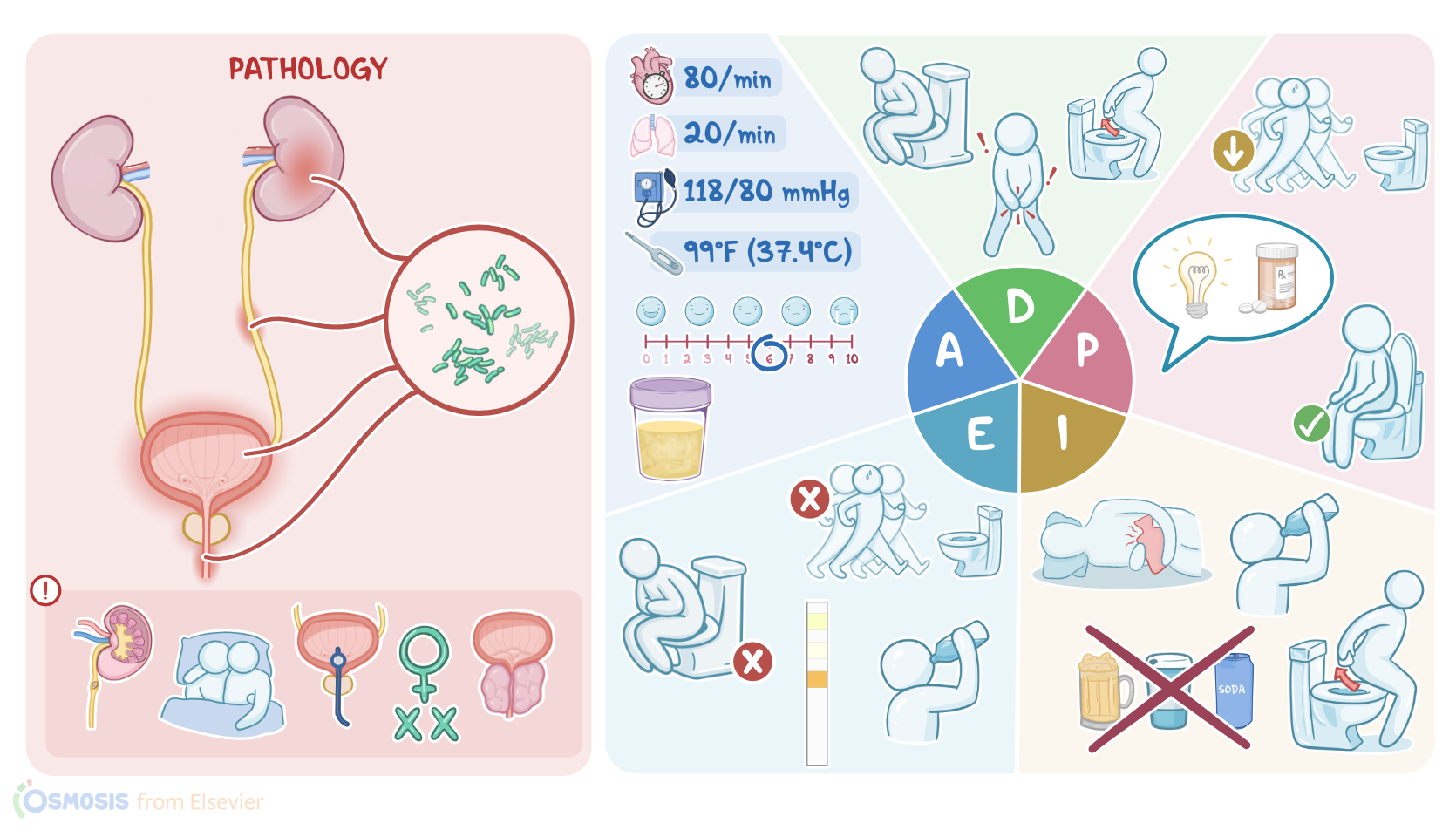
UTIs are most often caused by an ascending bacterial infection. Esherichia coli, or E.
coli accounts for 75 to 95 percent of all urinary tract infections while other bacteria such as Klebsiella pneumoniae, Staphylococcus saprophyticus, or Proteus mirabilis are also common causes of infection.
Once the bacteria enter the urinary tract, they multiply and colonize the urinary tract, causing inflammation. Inflammation of the urethra, or urethritis, results in dysuria, which is a symptom of pain or burning during urination.
Bacteria in the urine, or bacteriuria, often results in cloudy, foul smelling urine, while damage to the bladder mucosa can cause blood in the urine, referred to as hematuria.
If bacteria ascend further to the upper urinary tract, pyelonephritis, or inflammation of the ureters and kidneys, can occur, producing pain in the side of the back, or flank pain, also called costovertebral angle, or CVA, tenderness, along with manifestations of a systemic response to the infection, such as fever, chills, nausea and vomiting.
Complications of UTIs include scarring and narrowing of the urethra, called a urethral stricture, and damage to the kidney, which can impair its function.
If the infection spreads from the urinary tract to the bloodstream, it can cause urosepsis, which is a systemic reaction to infection that can lead to shock, organ failure, and death.
The risk of a UTI increases with urinary stasis, which is when the normal flow of urine is obstructed and slowed, and urinary reflux, which is when urine moves backwards from the bladder and up to the kidneys.
Urinary stasis and subsequent reflux can occur when kidney stones block the flow of urine through the ureters, or when an enlarged prostate slows the flow of urine through the urethra.
Likewise, a neurogenic bladder, a condition associated with problems like diabetes mellitus and spinal cord injuries, can slow the flow of urine because the nerves and muscles that help the bladder empty don’t work properly.
Other risk factors include the introduction of pathogens in and around the urinary tract, like with urinary catheterization and sexual intercourse, especially with multiple partners, or any factor that depresses the immune response like with HIV/AIDS and diabetes.
Furthermore, during pregnancy, increased progesterone levels and the downward pressure from an enlarged uterus tend to relax and dilate the ureters, increasing the risk of urinary stasis and reflux.
And finally, decreased estrogen during menopause alters the normal genitourinary flora, making the urinary tract more susceptible to infection by pathogens.
Diagnosis of a UTI is most often based on client history, physical examination, and diagnostic tests including urinalysis, which looks at the physical and chemical characteristics of the urine, or urine culture, to determine the number and type of organisms present in the urine.
If a UTI is present, the urine will often look cloudy, have a foul odor, will contain nitrites and leukocyte esterase which indicate the presence of bacteria,
Assessment5:22–6:55
Diagnosis6:55–7:15
Planning7:15–7:46
Implementation7:46–9:25
Evaluation9:25–10:07
Summary10:07–4:36
| URINARY TRACT INFECTIONS (UTIs) | ||
| KEY POINTS | NOTES | |
| PATIENT REPORT |
| |
| PATHOPHYSIOLOGY |
| |
| DIAGNOSIS AND TREATMENT |
| |
| ASSESSMENT |
| |
| NURSING DIAGNOSES |
| |
| PLANNING |
| |
| IMPLEMENTATION |
| |
| EVALUATION |
| |
No notes for this video yet
Try adding a note below