
BUBBLE HE · Postpartum Maternal Assessment Acronym

Published: Jan 06, 2026
Author: Nikol Natalia Armata, MD
Editor: Alyssa Haag, MD
Editor: Lily Guo, MD
Editor: Kelsey LaFayette, DNP, ARNP, FNP-C
Illustrator: Jannat Day
7-day free trial

Go deeper with Osmosis

Videos, flashcards & practice questions built for healthcare learners.

4.8 · 12,000+ reviews
1,700+ whiteboard-style videos
2,700+ board-style questions
Spaced-repetition flashcards
Mobile app — study anywhere
Start free trial

No credit card · Cancel anytime

What is BUBBLE HE?

BUBBLE HE is an acronym that highlights the critical steps in a postpartum maternal assessment. Assessing these factors may help prevent complications and detect early warning signs in individuals who have just given birth.  

Learn deeper with Osmosis

Master this topic faster with videos, questions, and AI.

Used by 8M+ healthcare learners.

Start free trial

No credit card · Cancel anytime

What does the “B” in BUBBLE HE mean?

The first “B” in BUBBLE HE stands for breasts. Breast assessment in the postpartum period is crucial and begins by determining whether the new mother is breastfeeding. Regardless of feeding choice, the breast evaluation should include specific aspects, such as the size, symmetry, and signs of infection. The size of the breasts should be observed for any significant changes or asymmetry. Any irregularities or alterations in the shape should also be noted. Areas of firmness that could indicate engorgement or blocked ducts should also be evaluated. Redness, if present, may be a sign of inflammation or infection.  

What does the “U” in BUBBLE HE mean?

The “U” in BUBBLE HE stands for uterus. The first step of uterine assessment is to  palpate the fundus (i.e., top) of the uterus to determine if it is firm or boggy. To do so, healthcare professionals make a C-shape with their hand and push against the abdomen until they feel the fundus of the uterus. This exam can help clinicians understand the postpartum position of the uterus in relation to the umbilicus, as well as its consistency (i.e., whether its firm or boggy). The fundal height decreases by approximately 1 centimeter every 24 hours for the first 10 days postpartum. 

Additionally, the fundal position is evaluated to determine if it is midline or deviated. A deviated fundus often indicates a full bladder, which should encourage the patient to void. If the fundus is not firm, a uterine massage is performed to ensure that the uterus contracts adequately. The primary concern with a non-firm fundus is hemorrhage, often caused by a distended bladder, uterine atony (i.e., failure of the uterus to contract fully), or retained placental fragments, which can cause later complications (e.g., postpartum hemorrhage, infection). 

What does the second “B” in BUBBLE HE mean?

The second “B” in BUBBLE HE stands for bowels. Assessing bowel function is an essential aspect of postpartum care. Postpartum women may experience a temporary decrease in gastrointestinal (GI) tone and motility, which typically returns to normal by the end of the second postpartum week. Several factors contribute to the risk of constipation during this period, including decreased GI motility, reduced physical activity, dehydration and fluid loss from labor, perineal pain, and trauma. To prevent constipation and ensure proper bowel function, stool softeners may be advised. This precaution minimizes the increase of intraabdominal pressure, which can cause pain or disrupt the healing of an episiotomy (i.e., surgical incision made in the perineum, the area between the vagina and the anus, during childbirth to enlarge the vaginal opening and facilitate delivery) or C-section incision. Additionally, increased fiber intake and hydration are crucial for maintaining bowel regularity. Constipation and pregnancy can increase the risk of hemorrhoids, or swollen veins in the lower rectum. Although they typically resolve slowly, hemorrhoids can be quite painful. Management strategies include using topical treatments, sitz baths (i.e., warm, shallow bath), and laxatives to ensure bowel movements are effortless and do not cause discomfort. 

What does the third “B” in BUBBLE HE mean?

The third “B” in BUBBLE HE stands for bladderPostpartum bladder assessment is a critical component of maternal care to prevent complications such as bladder distension and urinary stasis. Ideally, the individual should spontaneously void within 6 hours after birth, with each voiding session producing a minimum of 150 mL of urine. Frequency, urgency, or burning on urination may be a sign of infection. It is very helpful to establish a voiding schedule to encourage regular urination. Increasing fluid intake to at least eight glasses per day is also recommended to promote adequate hydration and urinary function. It is also suggested to urinate before each breastfeeding session to prevent bladder distension, as new parents may fall asleep while feeding their babies.  

What does the “L” in BUBBLE HE mean?

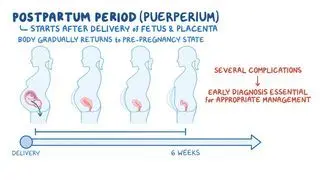
The “L” in BUBBLE HE stands for lochia, which refers to the vaginal discharge consisting of blood, mucus, and uterine tissue identified after childbirth, typically lasting a total of 6 weeks. Lochia progresses through three stages, differing in color and composition. The initial stage, lochia rubra, is characterized by bright red discharge that may contain small blood clots and typically lasts 1 to 3 days postpartum. This is followed by lochia serosa, marked by pink-brown, serous (i.e., watery) discharge, lasting 4 to 10 days postpartum. The final stage, lochia alba, features a yellow-white discharge containing white blood cells and the lining of the uterus, usually persisting 10 to 14 days. 

When assessing lochia, it is essential to evaluate its color, odor, and amount. The lochia should transition forward in stage, moving from rubra to serosa to alba, and should not regress to a previous stage in terms of color and composition. Any strong odor could be indicative of an intrauterine infection and further investigations may be necessary. Postpartum hemorrhage is clinically defined as a pad being filled with lochia within 15-30 minutes due to heavy bleeding and requires immediate medical attention 

What does the “E” in BUBBLE HE mean?

The first "E" stands for episiotomy, which refers to vaginal tearing of the perineum during childbirth or the surgical incision that may be made to facilitate delivery. The REEDA assessment is used to evaluate the episiotomy site or perineal tear. The acronym represents redness, edema (i.e., swelling), ecchymosis (i.e., bruising), discharge, and approximation of the wound edges. 

To perform a thorough perineal area assessment, the healthcare provider may gently pull the labia from front to back to inspect the episiotomy or tear sites. They may check for the collection of blood between tissues and assess for hemorrhoids, which can develop during pregnancy or as a result of the pushing process during laborMonitoring and managing the episiotomy site and perineal area are crucial for preventing complications such as infection and for ensuring proper healing.  

What does the “H” in BUBBLE HE mean?

The “H” stands for Homan sign in the postpartum assessment. It is a clinical assessment tool used to detect signs of deep vein thrombosis (DVT), a serious condition where a blood clot forms in the deep veins of the leg. The Homan test is performed with the individual’s knee in a flexed position. The examiner then forcefully and abruptly dorsiflexes the individual’s ankle. If pain is felt in the calf, Homan sign is considered positive, indicating the possibility of DVT. Other signs of DVT include sudden, unexplained pain in the back of the leg or calf, tachycardia, shortness of breath, localized edema, redness, and warmth over the affected area. 

To minimize the risk of DVT, early mobilization is encouraged. The postpartum patient should dangle her legs at the side of the bed within six hours of birth and stand up within eight hours. Progressive mobilization, starting with assistance and advancing to independent walking when ready, is essential. Potential complications of DVT include pulmonary embolism (PE), a life-threatening condition where a clot travels to the lungs, necessitating immediate medical intervention. 

What does the second “E” in BUBBLE HE mean?

The second "E" stands for the emotional status of the postpartum individual. Emotional fluctuations in the postpartum period are often attributed to the dramatic changes in estrogen levels. Additional factors contributing to this state include high stress levels, increased responsibility, and sleep deprivationObserving how a mother takes care of herself, and her baby is an essential indicator of her emotional status. Common postpartum assessment findings are categorized into three phases. 

The Taking-In Phase occurs during the first 24 to 48 hours after birth. During this time, the postpartum patient is primarily focused on personal comfort and physical changes. They may often re-live and talk about their birth experience and start to adjust to the psychological changes that accompany motherhood. The Taking-Hold Phase follows as a transition from dependent to independent behaviors and can last for several weeks. During this phase, the parent’s focus shifts to the infant. They begin to exhibit more independence and decision-making, demonstrating a growing confidence in their new role. The Letting-Go Phase involves the movement from independence to fully embracing the new role of a parent. It often overlaps with the taking-hold phase. This period is characterized by the postpartum patient integrating the new identity and responsibilities. A delay or difficulty in transitioning through these phases may indicate that the postpartum patient is experiencing challenges in adjusting to parenthood. 

Recognizing and supporting these emotional and bonding stages are critical in the postpartum period to ensure the postpartum patient’s mental health and the development of a strong parent-infant bond. Healthcare providers, such as postpartum nurses, should be attentive to signs of postpartum depression , also known as “baby blues”, or anxiety and provide appropriate interventions and support to promote the well-being of both the postpartum patient and the baby. 

What are the most important facts to know about the BUBBLE BE acronym?

The BUBBLE HE acronym is used for postpartum maternal assessments to detect early warning signs and prevent complications thereby ensuring the health and well-being of the new parent. It includes the evaluation of the breasts for size, shape, and infection signs; uterus for fundal height and firmness; bladder for voiding patterns; bowels for constipation and hemorrhoids; and lochia for color, odor, and amount of discharge. In addition, the episiotomy is assessed for healing signs; as well as the Homan sign for deep vein thrombosis detection. Lastly, the emotional status of the new parent is evaluated for postpartum psychological adjustments.  

Key Takeaways

Definition 

The BUBBLE HE acronym highlights the critical steps in a postpartum maternal assessment. 

B 

Breasts 

- Breastfeeding  

- Breast evaluation  

     - Size, symmetry, signs of infections  

U 

Uterus 

- Fundus palpation (firm/boggy) 

- Fundal height  

     - Decreases 1 cm every 24 hours for first 10 days  

- Fundal position (midline/deviated)  

- Firmness  

     - Non-firm fundus might suggest uterine atony → hemorrhage 

B 

Bowels 

- GI tone and motility may decrease until end of 2nd week postpartum 

- Increased risk of constipation from: decreased GI motility, reduced physical activity, dehydration, fluid loss from labor, perineal pain, trauma  

     - May need: stool softeners, increased fiber intake, hydration 

- Increased risk of hemorrhoids 

     - Topical treatments, sitz baths, laxatives may be needed 

B 

Bladder 

- Assessment for bladder distension and urinary stasis, signs of infection (frequency, urgency, burning) 

- Spontaneous urination within 6 hours after birth, each voiding session minimum 150 ml of urine 

- Recommendations:  

     - Establish voiding schedule 

     - Increase fluid intake (at least 8 glasses/day)  

     - Urination before each breastfeeding session  

L 

Lochia 

- Lochia = vaginal discharge consisting of blood, mucus, and uterine tissue lasting for a total of 6 weeks  

- Three stages of lochia:  

     - Lochia rubra (1-3 days postpartum): bright red discharge that may contain small blood clots 

     - Lochia serosa (4-10 days postpartum): pink-brown, serous discharge 

     - Lochia alba (10-14 days postpartum): yellow-white discharge containing white blood cells and uterus lining  

- Evaluation of: odor, color, amount, regression 

     - Strong odor → sign of possible infection 

- Postpartum hemorrhage: pad being filled with lochia within 15-30 minutes  

E 

Episiotomy 

- Vaginal tearing of the perineum during childbirth or surgical incision made to facilitate delivery  

- REEDA assessment  

     - Redness, Edema (i.e., swelling), Ecchymosis (i.e., bruising), Discharge, and Approximation of the wound edges 

- Perineal assessment, including evaluation for blood collection between tissues, hemorrhoids, and management of episiotomy site  

H 

Homan sign 

- Homan test: assessment tool for detection of deep vein thrombosis  

     - Individual’s knee in flexed position  

     - Forceful and abrupt ankle dorsiflexion by examiner  

     - Pain behind the calf → positive Homan sign  

- Other signs of DVT: sudden, unexplained pain in the back of the leg or calf, tachycardia, shortness of breath, localized edema, redness, and warmth over the affected area 

- To minimize risk of DV: early progressive mobilization 

- Potential complication: pulmonary embolism  

E 

Emotional status 

- Emotional fluctuations from changes in estrogen levels, high stress levels, increased responsibility, sleep deprivation  

- Three phases of assessment:  

     - Taking-In Phase (24-48 hours after birth) 

          - Focus on personal comfort and physical changes  

          - Often re-living and talking about birth experience 

     - Taking-Hold Phase (lasts several weeks)  

          - Transition from dependent to independent behaviors  

          - Focus shifts to infant  

          - Growing independence, decision-making skills, confidence  

     - Letting-Go Phase  

          - Fully embracing new role as parent  

          - Often overlaps with taking-hold phase  

          - Integration of new identities and responsibilities  

- Delay in transitioning through phases may indicate challenges 

- Assessment of signs of postpartum depression or anxiety  

Students say Osmosis is 100% worth it

Because Osmosis saves them time. Lowers stress. And actually helps them remember when it counts.

I used Osmosis to prepare for my first medical school licensing exam! Super helpful and interactive for people who may not do great with just pages of text info!

Cecilia Ruiz

Cecilia Ruiz

MD student

Sayan Misra

I have used Osmosis for about four years. Best thing I have ever used for my medical studies.

Sayan Misra

Sayan Misra

Med student

Osmosis videos are superior because they define simple concepts, tell a story with a clear progression, and provide context.

Jay Pate

Jay Pate

Dental student

References


Adams YJ, Miller ML, Agbenyo JS, Ehla EE, Clinton GA. Postpartum care needs assessment: women's understanding of postpartum care, practices, barriers, and educational needs. BMC Pregnancy Childbirth. 2023;23(1):502. Published 2023 Jul 7. doi:10.1186/s12884-023-05813-0


Condon J. What about dad? Psychosocial and mental health issues for new fathers. Aust Fam Physician. 2006;35(9):690-692. 


Levi M, Hart W, Büller HR. Fysische diagnostiek--het teken van Homans [Physical examination--the significance of Homan's sign]. Ned Tijdschr Geneeskd. 1999;143(37):1861-1863. 


Paladine HL, Blenning CE, Strangas Y. Postpartum care: An approach to the fourth trimester. Am Fam Physician. 2019;100(8):485-491. 


WHO Recommendations on Postnatal Care of the Mother and Newborn. Geneva: World Health Organization; October 2013.