
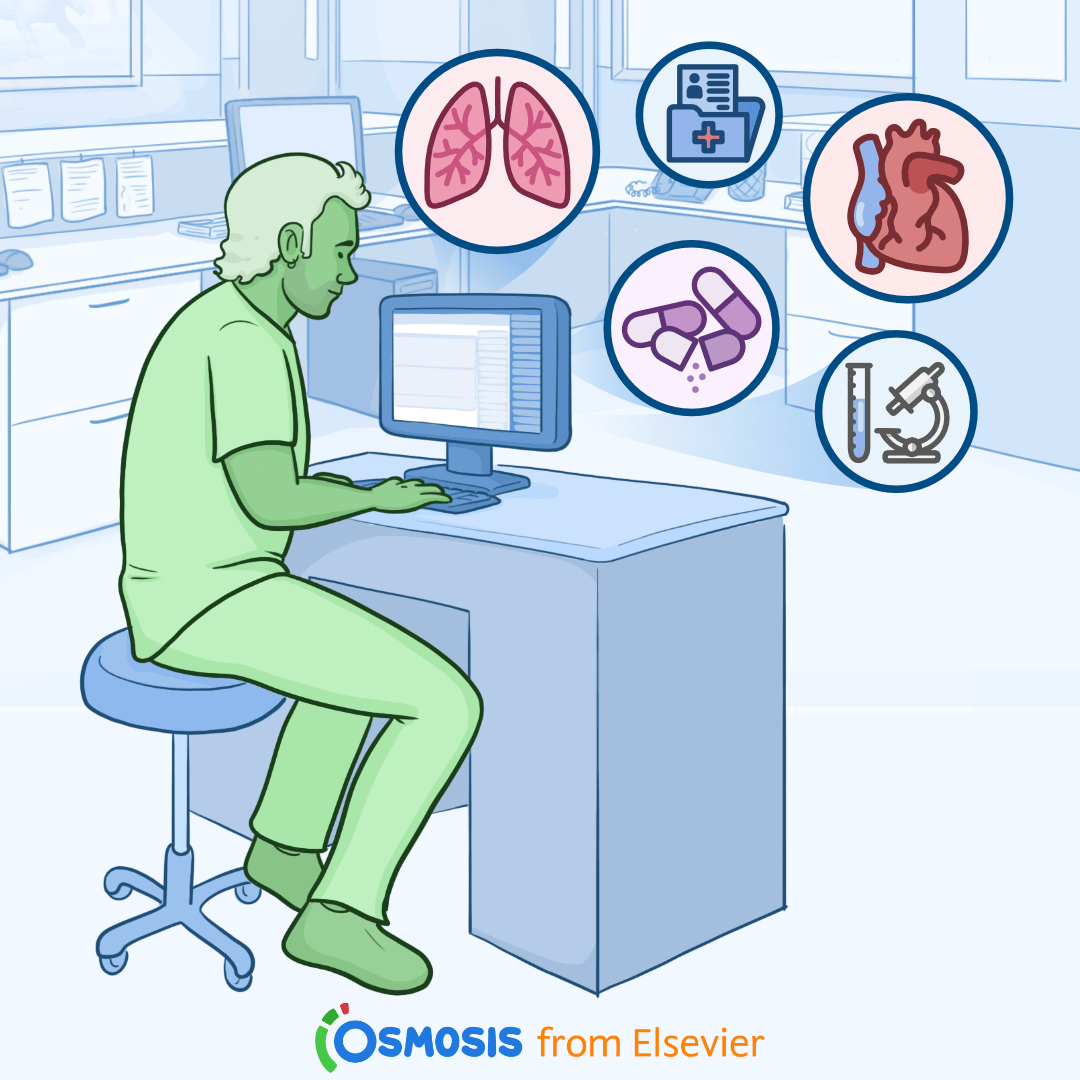
Generative artificial intelligence, or Gen AI, is beginning to show up across electronic health records (EHR) from ambient scribes in the exam room to chart summaries at the nurses’ station. So, what does that mean for clinicians and caregivers? AI-assisted clinical documentation that helps care teams draft notes, summarize records, organize handoffs, and prepare discharge and patient information. But it works best when healthcare organizations build trusted sources, patient privacy safeguards, human review, and clear accountability from the start. This article focuses on AI tools that support creation, organization, review, and communication of clinical documentation, not diagnosis or autonomous clinical decision-making.
Why Clinical Documentation Needs Better Workflow Support
Clinical documentation is one of the most important communication tools in healthcare, but it can also create a heavy administrative burden. The EHR helps clinicians organize patient information, support billing, improve continuity of care, and meet regulatory requirements. At the same time, EHR work can pull clinicians away from direct patient care and add hours of after-hours documentation time. Recent studies of ambient AI documentation tools suggest that AI-assisted documentation can reduce time spent in notes, improve documentation efficiency, and ease cognitive load for some clinicians. However, outcomes still depend on careful implementation and oversight. The use of ambient AI tools helps not only improve documentation but also helps clinicians spend more time with patients. Organizations should expect outcomes to vary depending on workflow design, governance, clinician training, and adoption. AI is most effective when it complements well-designed clinical processes rather than attempting to replace them.
The real opportunity isn’t just faster note-writing. It’s better workflow support: help finding information, organizing the patient story, documenting medical decision-making, communicating across teams, and preparing safe transitions. So far, generative AI’s biggest impact has been on workflow and communication, not replacing clinical judgment. It can help with all the above when healthcare organizations pair it with trusted sources, privacy safeguards, transparent attribution, and human review.
Who documents what in the clinical workflow?
AI-assisted documentation touches more than one kind of clinical note. Clinicians, care managers, social workers, therapists, dietitians, patient educators, learners, and educators all create or use documentation differently. Defining those roles up front makes it easier to see where AI fits, and it helps to understand the chart itself first. As nurse educator Paige Randall explains in The Anatomy of a Chart, the EHR is organized into core sections, including demographics, admission notes, results, the medication administration record, assessments, and health maintenance. Each section helps a different part of the care team understand the patient’s story.
- Prescribers document histories, physical exams, assessments, diagnoses, medical decision-making, orders, prescriptions, medication renewals, referrals, patient messages, procedure notes, discharge summaries, and attestation.
- Nurses document assessments, vital signs, medication administration, care plans, patient education, safety checks, escalation concerns, intake and output, discharge readiness, and shift-handoff reports, following standardized documentation methods and using therapeutic communication to relay what changed.
- Pharmacists document medication reconciliation, drug therapy recommendations, safety principles in medication administration, renal dosing considerations, allergy reviews, formulary substitutions, patient counseling, and discharge medication plans.
- Care managers and social workers document discharge barriers, insurance or placement needs, social drivers of health, transportation, home support, follow-up needs, and community resources.
- Therapists, dietitians, and patient educators document functional status, nutrition recommendations, mobility goals, patient understanding, education provided, and next steps.
- Learners and educators use documentation to understand clinical reasoning, patient safety, communication, care coordination, and professional accountability, a theme we dig into in Embracing Technology in Nursing Education.
From Smart Phrases to Source-grounded AI
Healthcare documentation has been evolving for decades. Smart phrases, dot phrases, templates, order sets, flowsheets, and prepopulated fields helped clinicians cut repetition and standardize routine notes. Connected devices and mobile documentation tools made some of that even more automatic, with vital signs flowing straight into the EHR and barcode medication administration syncing to the patient record.
Generative AI extends that progression. Ambient clinical documentation tools, sometimes called AI-powered medical scribes, can draft encounter notes from a clinical conversation. Enterprise chatbots can help staff retrieve policies or summarize operational information. Source-grounded AI connects responses to trusted knowledge bases instead of unsupported open-web output. Tools such as ClinicalKey AI and Osmosis AI build on trusted content, citations, and human oversight. That evidence-grounded design makes them different from general-purpose chatbots and easier to verify before the output becomes part of clinical documentation or education. ClinicalKey AI can be embedded directly into the EHR and integrated with ambient documentation tools, bringing trusted, evidence-based content into clinicians’ workflows at the point of care.
Know Your AI Assistants: A Quick Glossary
Not every tool called “AI” in healthcare does the same job. Before the patient journey below, here’s a plain-language look at the categories referenced throughout this piece.
- Ambient AI scribes: Listen to a clinical encounter and draft a note in real time. Chart-aware by design, since they’re built to capture the visit as it happens.
- EHR-embedded AI assistants: Live inside the EHR itself. ClinicalKey AI is one example, surfacing evidence-based answers and supporting inbox drafting, renewals, and handoffs without clinicians leaving the chart.
- Source-grounded knowledge and education tools: Standalone tools such as ClinicalKey AI’s general query mode and Osmosis AI answer clinical or teaching questions from cited, vetted content, but without access to a specific patient’s chart.
- Research-grade AI workspaces: Elsevier’s LeapSpace is built for literature synthesis, hypothesis generation, and evidence review across millions of peer-reviewed articles. It’s a strong fit for teams researching or writing documentation policy, but it isn’t a chart-facing tool and doesn’t belong in a bedside prompt workflow.
- General-purpose public AI chatbots: Consumer tools with no patient context and, in most organizations, no approval to touch protected health information (PHI). Useful for non-clinical drafting only.

A Patient Journey: AI-assisted Documentation from Admission to Discharge
A patient journey makes the documentation opportunity easier to see because it shows how information moves from one setting to the next. A patient journey makes the documentation opportunity easier to see because it shows how information moves from one setting to the next. At a high level, AI-assisted clinical documentation follows a repeatable workflow:
Encounter → Draft → Review → Attest → Code → Follow-up
- Encounter: Clinical information is captured during patient care.
- Draft: AI organizes information and drafts documentation from the clinical encounter or other approved sources.
- Review: The clinician verifies the draft for accuracy, completeness, and clinical context.
- Attest: The responsible clinician edits the documentation as needed and attests to its accuracy before it becomes part of the medical record.
- Code: Documentation supports coding, billing, and quality reporting, with human coding oversight.
- Follow-up: The documentation supports handoffs, discharge planning, remote monitoring, and ongoing care.
The patient journey below illustrates how each step builds on the previous one. Now let’s follow a 72-year-old patient who arrives in the emergency department with shortness of breath, fatigue, and leg swelling. The clinician opens the chart and uses AI-assisted clinical documentation to create a history and physical draft that organizes the patient’s story into a clear timeline: heart failure diagnosed five years ago, diabetes for more than a decade, chronic kidney disease progression over the past two years, two recent medication changes, three missed follow-up appointments, and a new increase in dyspnea over the past week.
The AI-generated timeline is not the final note. The clinician reviews it, corrects missing context, verifies the source material, and turns the draft into a clinically accurate history and physical. That specificity matters beyond the chart. For example, a note that says “acute on chronic systolic heart failure” gives the coding team more precise information than a note that only says “heart failure.” The same idea applies to chronic kidney disease, where the stage matters. A chart-aware AI tool can help capture those details as they are documented, so the coding team has clearer information and fewer vague terms to clarify later. During hospitalization, the care team can also use AI to draft a shift-handoff report in situation, background, assessment, and recommendation or request format, a structured way to communicate what is happening, why it matters, what the assessment shows, and what should happen next [8,9].
The pharmacist completes a medication reconciliation, reviewing the home medication list with inpatient orders and flagging medication renewal requests that need prescriber review. The care manager summarizes barriers to discharge, including transportation, follow-up access, and home support, work that builds on the nurse’s discharge-planning role throughout the stay.
At discharge, AI helps the team prepare personalized discharge instructions that reflect the patient’s health literacy, medication changes, diet recommendations, warning signs, follow-up appointments, and teach-back questions. The prescriber reviews medication renewals and documents the rationale for continuing, stopping, or adjusting therapy. The nurse reinforces the plan with plain-language instructions.
Behind the scenes, coding runs alongside all of this rather than waiting until the end. As the prescriber documents heart failure, diabetes, and chronic kidney disease (CKD) progression, the pharmacist documents medication changes, and the care team documents each intervention, AI can track that running list against the diagnoses and procedures actually addressed during the stay, checking it against ICD-10-CM diagnosis codes and Current Procedural Terminology (CPT) procedure codes as it goes. Before the encounter closes, CPT flags that a condition was treated but never formally documented, a diagnosis that’s missing the specificity a payer will need, or a procedure note that doesn’t yet have a matching code, so the coding and billing team gets an accurate, complete picture instead of chasing clarifications after the patient has already gone home. A human coder still makes the final call on every code submitted, but they’re reviewing AI-assembled documentation instead of reconstructing it from scratch.
In the days after discharge, the documentation trail doesn’t stop at the hospital doors. A home health nurse or care coordinator reviews the discharge summary and any connected remote-monitoring data, like a home scale or blood pressure cuff, and uses AI to flag concerning trends. A telephonic follow-up team drafts outreach scripts grounded in that same discharge plan, reviews incoming patient portal messages for early warning signs, and summarizes each call back into the chart. If the patient calls in with worsening swelling or shortness of breath, that update joins the same documentation trail the inpatient team built, so the story doesn’t have to be reconstructed from scratch. That continuity is the real payoff: the home care team isn’t starting from a blank page. They’re picking up a clearly documented story that AI helped the entire care team keep organized.
Across the full transition, from the emergency department to the hospital floor to the home, AI helps the care team move from scattered data to organized clinical communication. The final documentation at every step still needs human review and clinician attestation. But when used responsibly, AI can help create a clearer, safer, and more connected journey from hospital to home and beyond.
Where Generative AI Helps Most in Clinical Documentation
Across the full transition, from the emergency department to the hospital floor to the home, AI helps the care team move from scattered data to organized clinical communication. The final documentation at every step still needs human review and clinician attestation. But when used responsibly, AI can help create a clearer, safer, and more connected journey from hospital to home and beyond. AI can draft H&Ps, progress notes, patient-message responses, discharge instructions, and follow-up outreach scripts. It can summarize prior records, recent labs, medication lists, and past medical history. It can also structure content into timelines, SBAR handoffs, discharge plans, documentation-gap lists, and patient education drafts.
As the patient journey above shows, that same structuring work extends into the administrative layer around documentation, tracking diagnoses and procedures against the codes that ultimately support billing accuracy and compliance. That said, code suggestions should never become invisible automation. Clinicians and organizations need clear governance over what AI can suggest, who reviews the suggestion, how changes are tracked, and how errors get corrected.
Those tasks matter because clinicians often need to act on information before it’s perfectly organized. AI can help reduce the friction around searching, copying, rewriting, and reformatting. Studies of ambient AI documentation suggest potential benefits for documentation burden, documentation efficiency, and clinician experience, though implementation outcomes vary by setting, workflow, training, and adoption patterns.
Why Trusted Sources and Clinician Review Matter
Healthcare doesn’t need AI that sounds confident. Healthcare needs AI that’s traceable, clinically useful, privacy-conscious, and reviewed by the humans responsible for care with appropriate guardrails. Elsevier’s Responsible AI Principles emphasize real-world impact, bias prevention, explainability, human oversight, privacy, and robust data governance. Elsevier’s broader AI approach also emphasizes governed evidence, clear attribution, and human oversight in AI-enabled workflows.
That’s why source-grounded AI matters. When AI-generated output is connected to reliable clinical content, citations, and clinician review, it becomes easier to question and verify. Source-grounded AI platforms, like ClinicalKey AI and Osmosis AI, support clinical and educational workflows because they’re built around trusted Elsevier content and cited responses rather than unsupported open-web answers. And because content is embedded directly in the EHR rather than accessed through a separate tool, the chart itself stays the source of truth, with AI drafting around it rather than replacing it.
The Risks of AI-generated Clinical Documentation
So what can go wrong when AI helps write clinical documentation? The risks are real. AI can hallucinate, omit important information, overstate certainty, misread context, or produce polished language that hides clinical gaps. Automation bias is another concern: if the output looks complete, busy clinicians may trust it too quickly. Privacy, security, Health Insurance Portability and Accountability Act compliance, bias, documentation integrity, and regulatory expectations all require careful governance, a challenge echoed across the field, including in the American Academy of Family Physicians’ review of ambient AI scribes.
Clinician accountability also becomes more explicit as AI enters documentation workflows. AI can draft, organize, retrieve, and summarize, but the clinician remains responsible for the clinical meaning, accuracy, and appropriateness of the documentation. AI-generated content needs review and editing before it becomes part of the clinical record.
Best Practices for Responsible AI-assisted Documentation
The safest AI documentation workflows are source-first and human-reviewed. Healthcare organizations can prioritize tools that use approved knowledge sources, provide citations or traceability when possible, protect patient data, and fit into existing clinical workflows. Staff need training not only on how to use AI, but also on how to question its output, an emphasis shared by the American Medical Association’s guidance on augmented intelligence in health care.
Responsible organizations also define what AI cannot do. It cannot autonomously chart without review, generate orders without clinician authority, replace professional assessment, or process protected health information through unapproved public tools. The safer question isn’t “Can AI write this?” It’s “Can AI help a qualified clinician create a clearer, more accurate, better-supported document?”
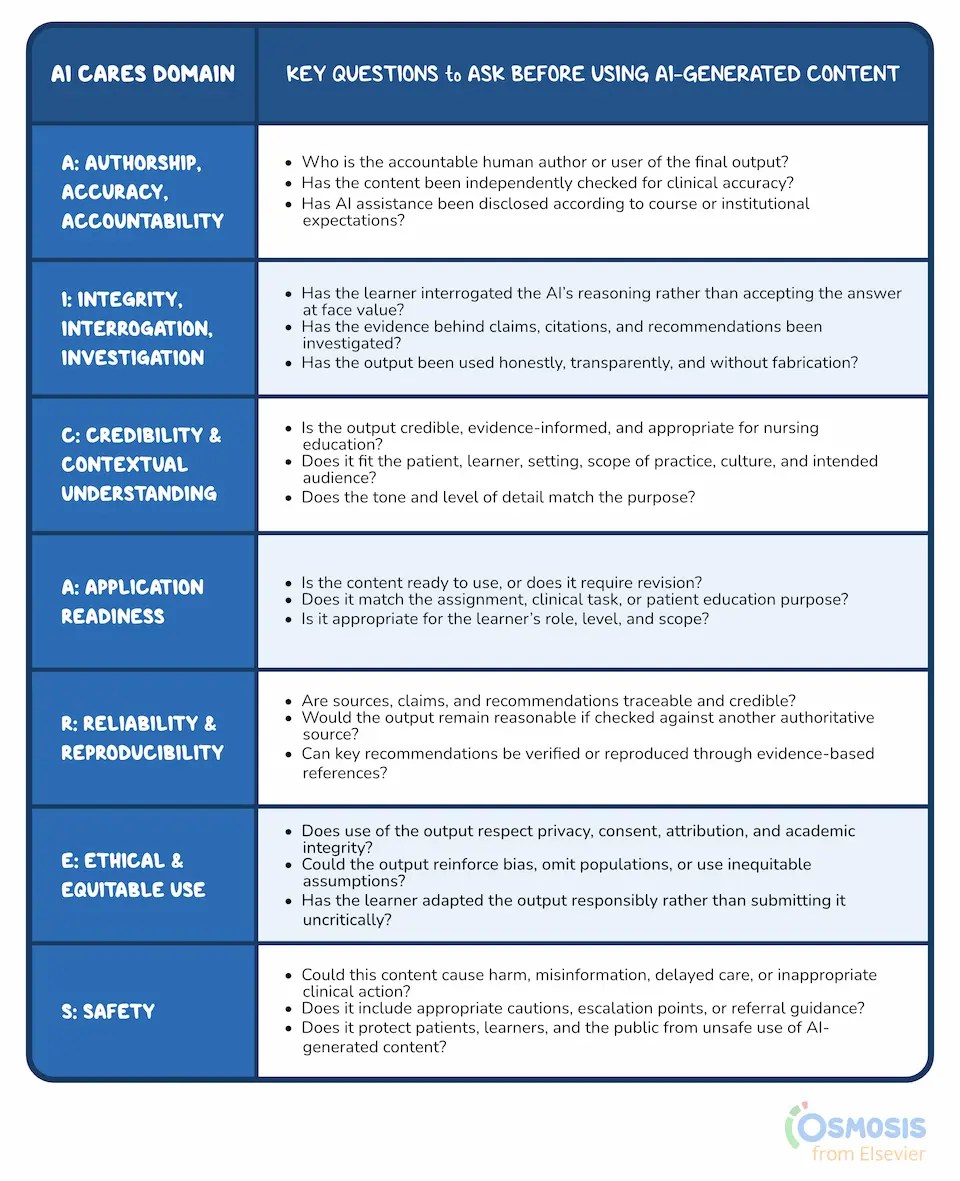
So how can clinicians and learners review AI output without treating it like the final answer? The AI CARES Model offers a practical checkpoint before AI-generated content is used in a clinical, educational, or patient-facing context. It prompts users to pause and ask whether the output is accountable, accurate, credible, relevant, ethical, equitable, and safe. In other words, the model keeps AI in the right role: a support tool for human judgment, not a substitute for it.
Here’s the AI CARES Model and a few questions to get you started evaluating AI output:
Prompts to Consider: Matching Your Prompt to Your Task, Role, and Venue
Not every AI tool knows the same things about a patient, and that changes what a clinician should ask it to do. Before using a prompt, ask two questions: Does this tool have access to the chart? And is it built on a trusted, cited knowledge base? The table below offers practical examples by task and venue. Always follow your organization’s approved-tool list and protected health information policies.
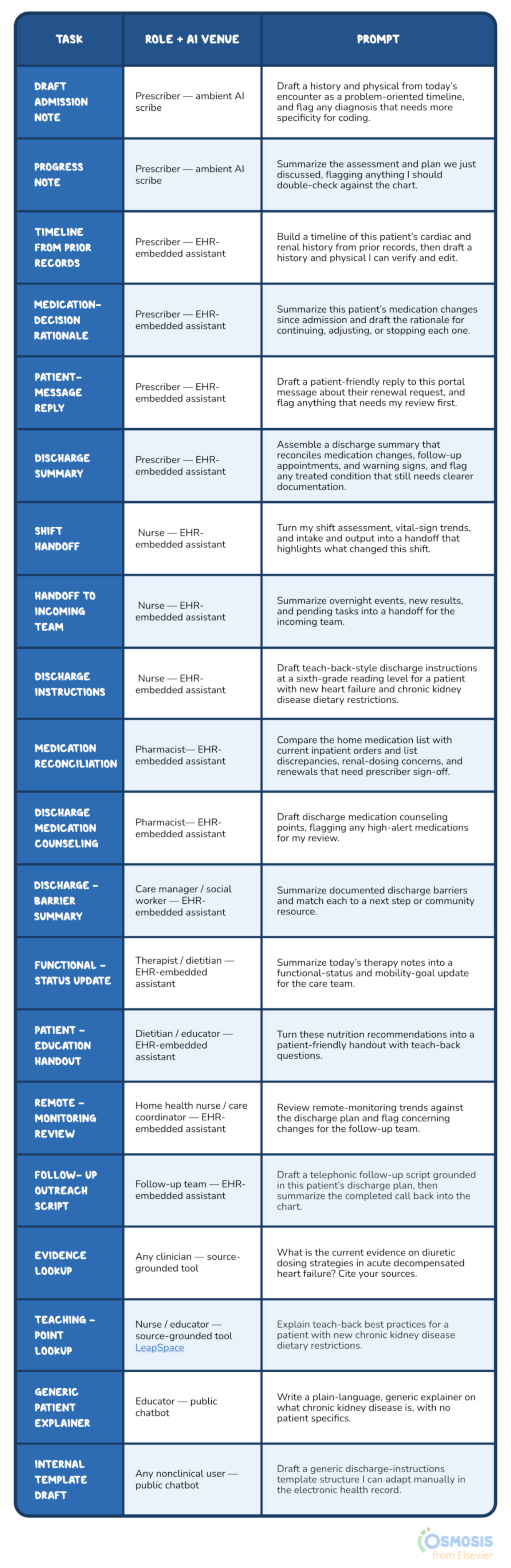
General guideline: if a tool can’t (or won’t) list sources or tell you where its information comes from, treat its output as a starting draft, not a citable fact, and never paste identifiable patient information into a tool that is not approved for protected health information.
The Future of AI-Assisted Clinical Documentation
AI-assisted clinical documentation is ultimately about improving clinical communication, not replacing clinical judgment. Across the clinical workflow, generative AI can help clinicians and care teams draft notes, organize patient timelines, summarize records, support handoffs, prepare discharge information, identify documentation gaps, and communicate more clearly across settings. The greatest value comes when AI helps make complex information easier to review, verify, and act on, especially during transitions from admission to discharge and follow-up care.
As these tools continue to evolve, healthcare organizations can focus not only on what AI can automate, but also on how it can support more accurate, transparent, patient-centered documentation. The safest and most effective workflows will use trusted evidence sources, strong governance, privacy safeguards, clinician training, meaningful human oversight, and clear attestation before AI-generated content becomes part of the medical record. In that role, AI can reduce documentation burden and make clinical documentation more efficient, connected, and reliable across the continuum of care while keeping clinicians accountable for every clinical decision.
FAQ: Generative AI and Health Documentation
What is AI-assisted clinical documentation?
AI-assisted clinical documentation uses generative AI to help clinicians draft, summarize, structure, and verify clinical information in the EHR.
How does generative AI help with EHR documentation?
Generative AI can summarize prior records, draft clinical notes, organize patient timelines, support patient-message responses, identify documentation gaps, and prepare discharge information for clinician review.
Can AI reduce clinician documentation burden?
AI can reduce documentation burden when clinical teams use it to organize information, draft routine documentation, reduce duplicate work, and support clinical workflow automation while preserving human review.
What are the risks of AI-generated clinical notes?
Risks include hallucinations, omissions, automation bias, inaccurate summaries, privacy concerns, bias, and overreliance on AI-generated content without clinician verification.
How can healthcare teams use AI safely in documentation?
Healthcare teams can use AI safely by choosing source-grounded tools, protecting patient privacy, using approved workflows, training staff, verifying AI-generated output, and requiring clinician attestation before documentation enters the clinical record.
Key Takeaways
- Generative AI can support clinical documentation by drafting, summarizing, and structuring information across the care journey.
- AI-assisted workflows can support notes, handoffs, discharge planning, patient communication, and other documentation tasks.
- Source-grounded tools make AI-generated information easier for healthcare professionals to trace and verify.
- AI-generated clinical documentation carries risks including hallucinations, omissions, automation bias, privacy concerns, and inaccurate summaries.
- Human review and clinician accountability remain essential before AI-generated content becomes part of the medical record.
References
- Husa, Robyn A., et al. “Ambient Artificial Intelligence Use and Clinician Documentation Burden, Productivity, and Efficiency.” JAMA Network Open, vol. 9, no. 5, 2026, e2615762.
- Bakken, Suzanne. “Clinician, Patient, and Organizational Perspectives on Ambient AI Scribes.” Journal of the American Medical Informatics Association, vol. 33, no. 2, 2026, pp. 253–255.
- Stults, Cheryl D., et al. “Evaluation of an Ambient Artificial Intelligence Documentation Platform for Clinicians.” JAMA Network Open, vol. 8, no. 5, 2025, e258614.
- Elsevier. “AI across Elsevier.”
- Elsevier. “ClinicalKey AI.”
- Elsevier. “Responsible AI Principles.”
- Elsevier Support. “What Is Osmosis AI?” Osmosis Support, 3 Mar. 2026.
- Agency for Healthcare Research and Quality. “Tool: SBAR.” AHRQ TeamSTEPPS.
- Osmosis. “SBAR Handoff Report Acronym.” Osmosis, 4 Mar. 2025.
- Ng, Joel Jia Wei, et al. “Evaluating the Performance of Artificial Intelligence-Based Speech Recognition for Clinical Documentation: A Systematic Review.” BMC Medical Informatics and Decision Making, 2025.
- Randall, Paige, MS, RN, CEN, CNE. “The Anatomy of a Chart: How to Read and Interpret an EHR.” Osmosis Blog, updated 24 Feb. 2026.
- Elsevier. “LeapSpace.” Elsevier Products.
- Centers for Medicare & Medicaid Services. “ICD-10-CM/PCS.” CMS.gov.
- American Medical Association. “CPT® (Current Procedural Terminology).” AMA.

Get your free trial now to discover why millions of clinicians and caregivers love learning by Osmosis.
Leave a Reply