
Prepare for the PANCE® with this hospital scenario involving a 70-year-old patient experiencing acute abdominal pain for 12 hours. What’s the diagnosis? Let’s find out!
A 70-year-old man comes to the hospital for evaluation of acute abdominal pain that began 12 hours ago. The pain is constant and stabbing. He also reports one episode of non-bloody, nonbilious emesis. Medical history is notable for hypertension and intermittent episodes of abdominal pain triggered by consuming fatty foods. The patient has a 40-pack-year smoking history. On arrival, temperature is 38.6°C (101.5°F), blood pressure is 103/71 mmHg, and pulse is 104/min. Physical examination is notable for scleral icterus. Abdominal examination reveals right upper quadrant tenderness to palpation. The mucous membranes are dry, and capillary refill is delayed. Cardiac and pulmonary examinations are noncontributory. Laboratory testing reveals the findings shown below.
| Laboratory value | Result | Reference range |
| Total bilirubin | 4.5 mg/dL | 0.1–1.0 mg/dL |
| Conjugated bilirubin | 3.8 mg/dL | 0–0.3 mg/dL |
| Aspartate aminotransferase | 87 U/L | 8–40 U/L |
| Alanine aminotransferase | 79 U/L | 8–40 U/L |
| Alkaline phosphatase | 240 U/L | 40–130 U/L |
| Lipase | 40 U/L | 12–170 U/L |
Which of the following best describes the underlying cause of the patient’s presentation?
A. Inflammation secondary to cystic duct obstruction
B. Obstruction of the common bile duct
C. Ascending infection of the biliary tract
D. Inflammation of the liver parenchyma
E. Rupture of an abdominal aortic aneurysm
Scroll down to find the answer!
The correct answer to today’s PANCE® Question is…
C. Ascending infection of the biliary tract
Correct: See Main Explanation.
Incorrect Answer Explanations
A. Inflammation secondary to cystic duct obstruction
Incorrect: This answer choice describes acute cholecystitis, which most commonly occurs when cystic duct obstruction causes gallbladder distention and inflammation. Patients can develop right upper quadrant pain and fever. However, prominent jaundice, conjugated hyperbilirubinemia, and an elevated alkaline phosphatase level are more suggestive of common bile duct obstruction than isolated cystic duct obstruction.
B. Obstruction of the common bile duct
Incorrect: This describes choledocholithiasis, which can cause right upper quadrant pain, nausea/vomiting, jaundice, and a cholestatic pattern of lab test abnormalities. However, uncomplicated choledocholithiasis alone does not account for this patient’s systemic signs of infection, including fever and tachycardia. In this patient, common bile duct obstruction has been complicated by ascending biliary infection, resulting in acute cholangitis.
D. Inflammation of the liver parenchyma
Incorrect: This describes hepatitis, right upper quadrant discomfort, jaundice, and elevated aminotransferases. However, hepatitis typically produces a predominantly hepatocellular pattern of liver injury, whereas this patient has findings suggestive of cholestasis, including conjugated hyperbilirubinemia and an elevated alkaline phosphatase level. In combination with fever, jaundice, and right upper quadrant pain, these findings are more consistent with acute cholangitis.
E. Rupture of an abdominal aortic aneurysm
Incorrect: A ruptured abdominal aortic aneurysm (AAA) can cause acute abdominal pain, tachycardia, and hypotension, and cigarette smoking is an important risk factor for AAA. However, a ruptured AAA would not account for this patient’s fever, jaundice, conjugated hyperbilirubinemia, and elevated alkaline phosphatase level.
Main Explanation
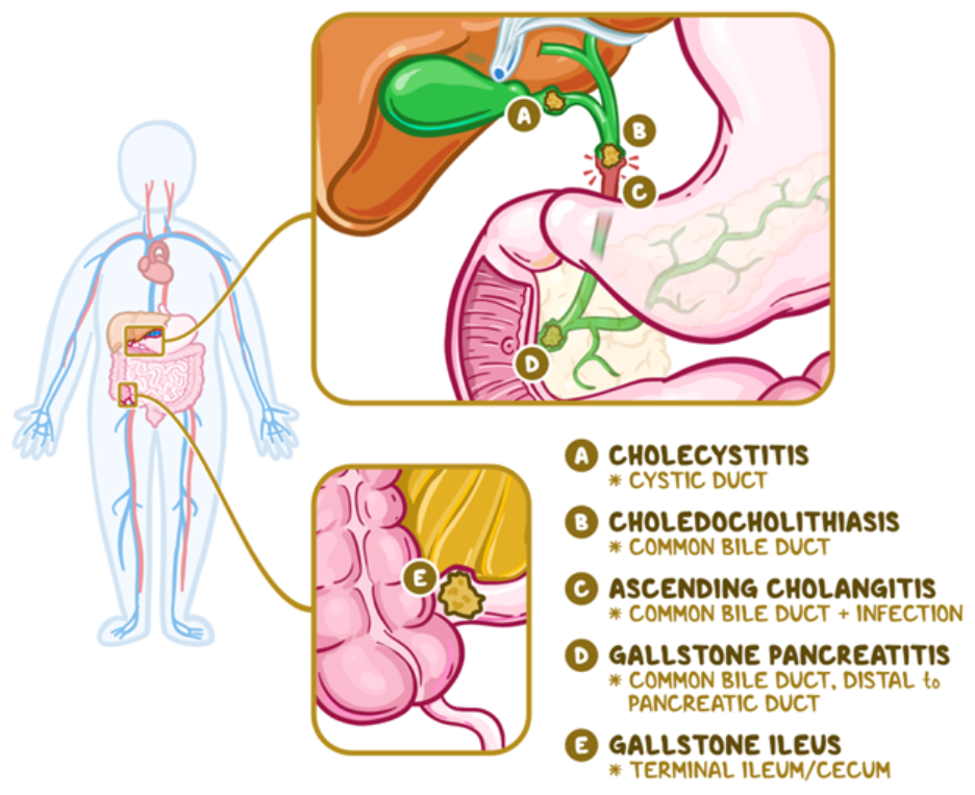
This patient most likely has acute cholangitis, also known as ascending cholangitis. Acute cholangitis is an ascending bacterial infection of the biliary tract that develops in the setting of biliary obstruction. The most common cause of biliary obstruction is choledocholithiasis. Obstruction of bile flow increases intrabiliary pressure and promotes bacterial proliferation and ascending infection. Other causes of biliary obstruction include benign or malignant strictures, tumors, parasites, and biliary stent obstruction.
Patients with acute cholangitis may present with the Charcot triad of fever, right upper quadrant pain, and jaundice. In the setting of severe infection and hemodynamic instability, patients may progress to the Reynolds pentad, which adds hypotension and altered mental status.
Laboratory testing in acute cholangitis commonly demonstrates a cholestatic pattern, including conjugated hyperbilirubinemia and elevated alkaline phosphatase levels. Aminotransferases may also be elevated. In this patient, the conjugated hyperbilirubinemia and elevated alkaline phosphatase support biliary obstruction, while the fever and tachycardia indicate superimposed infection.
Major Takeaway
Acute cholangitis is an ascending bacterial infection of the biliary tract that occurs in the setting of biliary obstruction. Patients may develop the Charcot triad of fever, right upper quadrant pain, and jaundice. Severe disease may progress to the Reynolds pentad, which adds hypotension and altered mental status.
Want to learn more about this topic?
Review this Osmosis content: Choledocholithiasis and cholangitis: Clinical sciences
References
- Ahmed M. Acute cholangitis – an update. World Journal of Gastrointestinal Pathophysiology. 2018;9(1):1–7. doi:10.4291/wjgp.v9.i1.1.

Get your free trial today to discover why millions of clinicians and caregivers love learning by Osmosis.
Leave a Reply