
Can you determine the most likely diagnosis for a 45-year-old woman presenting with left foot pain? Let’s learn more about her case!
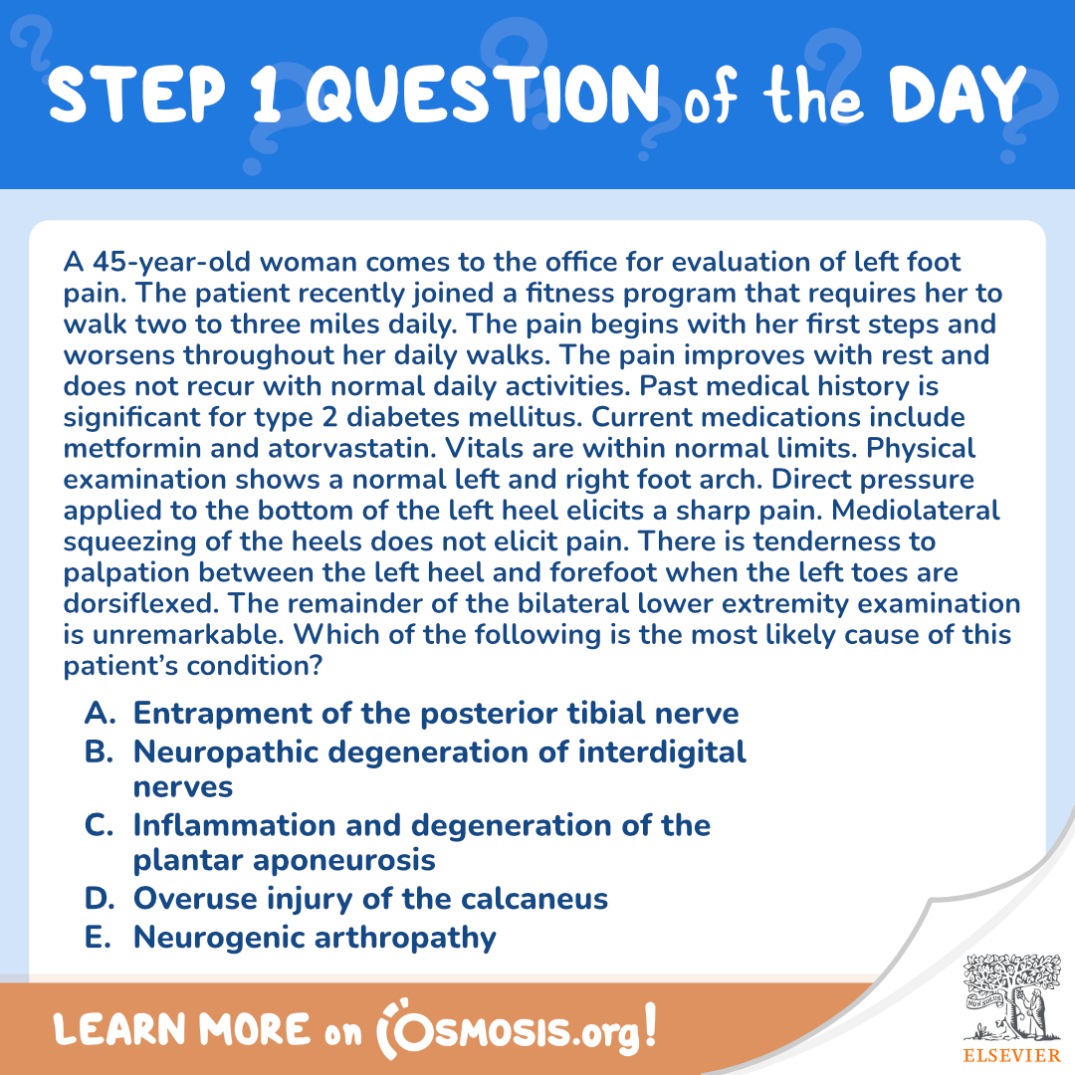
A 45-year-old woman comes to the office for evaluation of left foot pain. The patient recently joined a fitness program that requires her to walk two to three miles daily. The pain begins with her first steps and worsens throughout her daily walks. The pain improves with rest and does not recur with normal daily activities. Past medical history is significant for type 2 diabetes mellitus. Current medications include metformin and atorvastatin. Vitals are within normal limits. Physical examination shows a normal left and right foot arch. Direct pressure applied to the bottom of the left heel elicits a sharp pain. Mediolateral squeezing of the heels does not elicit pain. There is tenderness to palpation between the left heel and forefoot when the left toes are dorsiflexed. The remainder of the bilateral lower extremity examination is unremarkable.
Which of the following is the most likely cause of this patient’s condition?
A. Entrapment of the posterior tibial nerve
B. Neuropathic degeneration of interdigital nerves
C. Inflammation and degeneration of the plantar aponeurosis
D. Overuse injury of the calcaneus
E. Neurogenic arthropathy
Scroll down for the correct answer!
The correct answer to today’s USMLE® Step 1 Question is…
C. Inflammation and degeneration of the plantar aponeurosis
Correct: See Main Explanation.
Incorrect Answer Explanations
A. Entrapment of the posterior tibial nerve
Incorrect: Injury or compression of the posterior tibial nerve at the tarsal tunnel may result in numbness or paraesthesias over the sole of the foot. Pain is reproduced with percussion of the tarsal tunnel (Tinel sign) and not by the palpation of the heel.
B. Neuropathic degeneration of interdigital nerves
Incorrect: Neuropathic degeneration of interdigital nerves can result in a Morton neuroma, which presents with pain between the third and fourth toes on the plantar surface and a clicking sensation upon squeezing the metatarsal joints. Tenderness of the heel with dorsiflexion of the toes is typical of plantar fasciitis.
D. Overuse injury of the calcaneus
Incorrect: Calcaneal stress fractures can occur following the initiation of high-impact exercise programs or overuse. It causes pain at the heel that worsens with weight bearing. Pain is often elicited by firm palpation at the lateral and medial aspect of the heel. Tenderness of the heel reproduced on dorsiflexion of toes is more typical for plantar fasciitis.
E. Neurogenic arthropathy
Incorrect: Neurogenic arthropathy (charcot joint) presents with deformity and sensory deficits of the foot due to trauma, secondary to impaired proprioception and pain sensations. Therefore, pain is typically mild in these patients.
Main Explanation

This patient’s heel pain is most likely due to the inflammation and degeneration of plantar aponeurosis, resulting in plantar fasciitis.
Plantar aponeurosis is a thick fibrous band that extends from the calcaneus of the foot to the toes, which functions to support the longitudinal arch of the foot. Plantar fasciitis results from chronic overuse and repetitive trauma to aponeurosis near its insertion point at the calcaneus. Risk factors include obesity, excessive foot pronation, excessive running, and prolonged standing. Patients typically present with stabbing heel pain that worsens with walking and may worsen after activity or at the end of the day. Physical examination often demonstrates tenderness at the insertion of the plantar fascia on the calcaneus, especially with toe dorsiflexion.
The diagnosis is based on clinical findings, but plain radiographs may reveal heel spurs, which are of little diagnostic significance. Plantar fasciitis is a self-limited condition with most resolution of symptoms within twelve months. Initial treatment consists of ice, heat, massage, stretching, and elimination of exacerbating activities.
Major Takeaway
Plantar fasciitis results from inflammation and degeneration of plantar aponeurosis, secondary to chronic overuse and repetitive trauma at its insertion site. Patients typically present with sharp and stabbing heel pain that worsens with ambulation. Physical examination demonstrates tenderness at the insertion point of the plantar fascia on the calcaneus, especially with toe dorsiflexion.
Want to learn more about this topic?
Read this Osmosis Answer page: Plantar Fasciitis
References
- Langford C.A. (2018). Periarticular disorders of the extremities. Jameson J, & Fauci A.S., & Kasper D.L., & Hauser S.L., & Longo D.L., & Loscalzo J(Eds.), Harrison’s Principles of Internal Medicine, 20e. McGraw-Hill.
- Gollotto K, & Rosero E, & Connor C, & Hezel J (2014). Sports rehabilitation. Maitin I.B., & Cruz E(Eds.), CURRENT Diagnosis & Treatment: Physical Medicine & Rehabilitation. McGraw-Hill.
- Goff, J. D., & Crawford, R. (2011). Diagnosis and treatment of plantar fasciitis. American family physician, 84(6), 676-682.

Get your free trial now to discover why millions of current and future clinicians and caregivers love learning by Osmosis.
Leave a Reply