
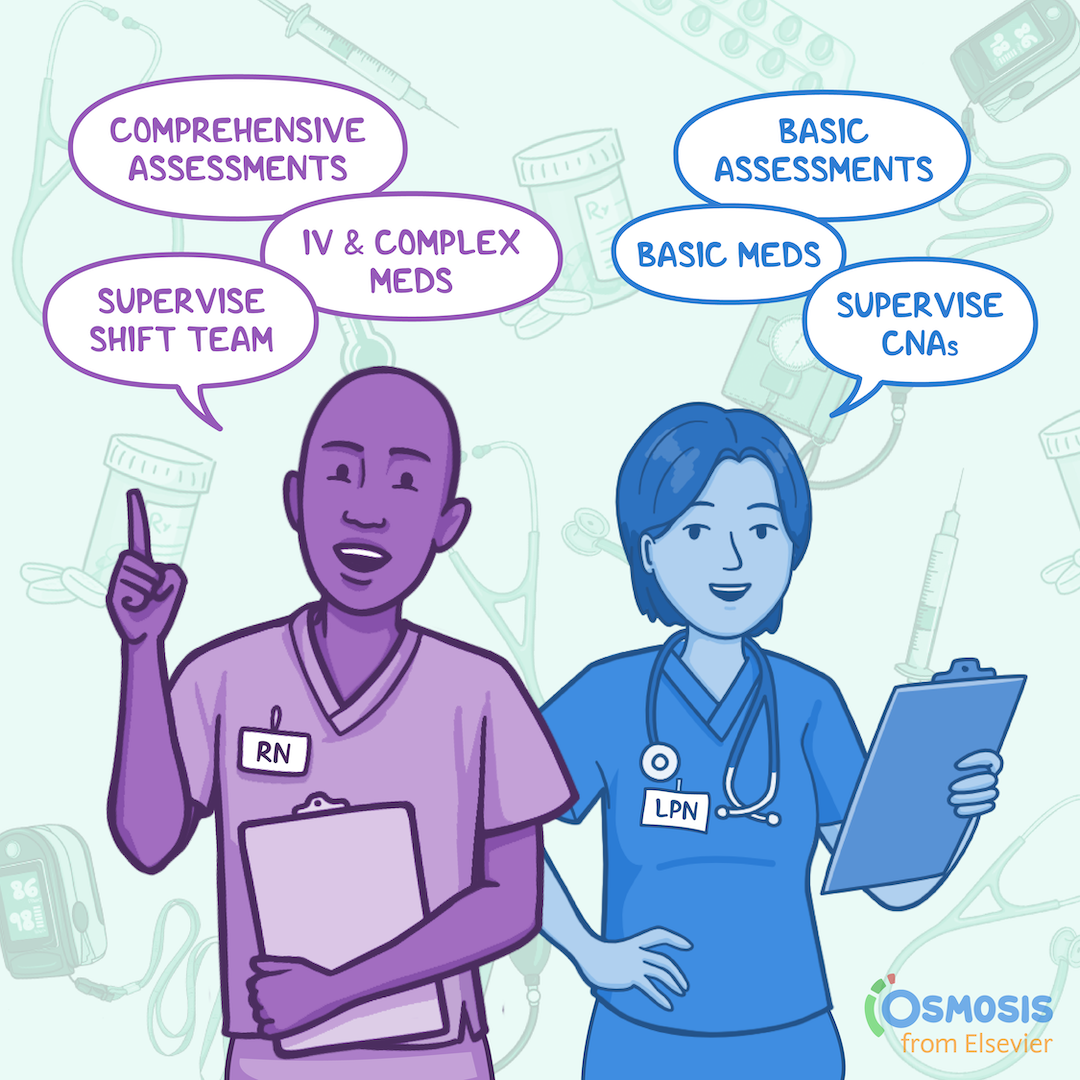
Becoming a nurse is a meaningful decision, but selecting the right career path requires careful consideration and deliberation. Both Registered Nursing (RN) and Licensed Practical Nursing (LPN) roles are vital to health care, but they differ in scope, education, responsibilities, and long-term potential. Let’s break down the differences between RNs and LPNS to help you figure out which role is right for your career goals.
RNs provide comprehensive patient care, including assessments, medication administration, patient education, and care planning. To become a licensed RN, you need to graduate from an accredited RN program, pass the National Council Licensure Examination (NCLEX®-RN), and obtain a license from the state board of nursing where you plan to work.
On the other hand, LPNs provide more basic care, like monitoring stable patients, performing simple dressing changes, and administering low-risk medications. You may also hear LPNs referred to as licensed vocational nurses (LVNs), a term mainly used in California and Texas. The only difference between LPNs and LVNs is their title, as they share the same scope of practice and licensure path.
Unlike RNs, LPNs work under the supervision of an RN or other licensed healthcare provider. Similar to becoming an RN, to become an LPN, you need to graduate from an accredited LPN program, pass the National Council Licensure Examination (NCLEX®-PN), and get licensed by your state’s nursing board.
RN and LPN Roles and Responsibilities: How do they differ?
So, let’s take a closer look at how RN and LPN responsibilities differ, keeping in mind that these vary based on your state’s nurse practice acts.
Starting with patient assessments, RNs perform initial and comprehensive assessments that involve collecting a health history, conducting a physical examination, and reviewing the health record for other relevant findings. The RN analyzes information gathered during their assessment to develop a plan of care that can be implemented and evaluated. LPNs, on the other hand, gather data such as vital signs and perform focused assessments to monitor stable patients. The information collected by LPNs contributes to the care plan developed by the RN, but is more basic than the assessment performed by an RN.
LPNs are restricted in terms of what medications they’re allowed to administer. Some states allow LPNs to administer certain intravenous (IV) medications after completing a special certification. However, only RNs are authorized to administer high-risk IV medications, such as IV push medications, blood transfusions, and total parenteral nutrition (TPN).
Patient teaching is another area where RNs and LPNs differ in their roles. RNs receive more training about teaching-learning principles and patient goal setting. LPNs, on the other hand, can reinforce education provided by the RN and review pre-written material with patients, but initial teaching and creating individualized education both require an RN.
Supervision is also a key distinction. LPNs practice under the supervision of an RN or healthcare provider, whereas RNs practice independently within their scope of practice. Along those lines, RNs can delegate appropriate tasks to unlicensed assistive personnel (UAP), LPNs, and other RNs, provided they follow the five rights of delegation: right task, right circumstance, right person, right communication, and right supervision. LPNs can assign tasks to UAPs under RN supervision, but are not allowed to delegate directly because it involves using clinical judgment and adhering to the “five rights.”
What Are the Five Rights of Delegation?
Right task, Right circumstance, Right person, Right communication, and Right supervision
With these differences in mind, let’s look at examples of daily tasks for RNs and LPNs across various settings:
- In hospitals, RNs care for acutely ill, complex patients/cases as well as participate in activities such as administering IV medications and updating care plans. LPNs administer oral medications and some injections, monitor stable patients, and collect lab samples.
- In long-term care, RNs supervise LPNs and UAPs (e.g., CNAs), perform comprehensive assessments, and manage care plans. LPNs administer medications and oversee activities of daily living.
- In outpatient clinics, RNs triage patients over the phone, provide patient education, and coordinate care. LPNs collect patient data and reinforce patient education.

Nursing Work Environments and Job Settings
While both roles are found in hospitals, long-term care facilities, outpatient clinics, and home health settings, LPNs are more common in settings where most patients are stable and require basic care, such as long-term care facilities and outpatient clinics.
Conversely, RNs are typically in settings where patients need complex care and clinical judgment (e.g., intensive care units or emergency departments). A key difference is that RNs also have opportunities to work in research, education, and management roles, due to their additional training.
Depending on the environment’s needs, RNs and LPNs may work regular office hours in places like outpatient clinics or nontraditional hours in facilities that provide around-the-clock care, such as hospitals or long-term care centers, with work typically divided into two kinds of shifts:
- Eight-hour shifts
- Day shift: 7:00 a.m. – 3:00 p.m.
- Swing shift: 3:00 p.m. – 11:00 p.m.
- Night shift: 11:00 p.m. – 7:00 a.m.
- Twelve-hour shifts
- Day shift: 7:00 a.m. – 7:00 p.m.
- Night shift: 7:00 p.m. – 7:00 a.m.
These flexible work options support a healthy work-life balance, allowing you to choose a schedule that best suits your preferred lifestyle. Most facilities also offer full-time, part-time, and PRN (as needed) positions, giving you even more control over a work schedule that fits your preferences.
Career Advancement and Professional Growth in Nursing
One thing RNs and LPNs have in common is ample opportunity for career advancement and professional development. RNs who advance their careers through a diploma or associate’s program can pursue a Bachelor of Science in Nursing (BSN), giving them deeper knowledge in areas like nursing theory, leadership, and public health. RNs can also specialize by working with specific patient populations, such as pediatrics or oncology, or by caring for patients with varying levels of acuity, like those in the intensive care unit (ICU).
Going to school for an advanced degree, such as a master’s or doctoral degree, opens the door for RNs to qualify for advanced practice roles, including nurse practitioners, certified registered nurse anesthetists, nurse midwives, clinical nurse specialists, or clinical nurse educators. Nurses with advanced degrees are also well-positioned for leadership, administrative, and research positions.
Likewise, LPNs can continue their education to advance their careers. Bridge programs help LPNs meet the requirements to become RNs with either an associate’s or a bachelor’s degree. From there, they can pursue the same professional growth opportunities available to RNs.
Both RNs and LPNs can choose to continue professional development by completing continuing education (CE), so they stay up to date on providing safe and effective care. Most states require RNs and LPNs to complete a certain number of CE hours for license renewal, typically measured in CE units (CEUs). While CEUs are usually required for licensing, earning them through online courses, workshops, seminars, and other training is a fantastic way to stay current and committed to lifelong learning.
RNs and LPNs can also pursue certification to gain specialized knowledge and demonstrate expertise in a particular area of nursing. For instance, RNs can become certified in ambulatory care nursing or as a nurse executive, while LPNs can pursue certifications in long-term care or IV therapy. Nurses interested in certification should review the requirements of the certifying organization, including the application process, associated fees, and renewal guidelines.

What Should You Consider When Choosing Between Becoming an RN or an LPN?
When it comes to determining which nursing career path to take, time and financial investments are often key factors. Typically, LPN programs take 12-18 months to complete and cost between $6,000 and $32,000, depending on the program. On the other hand, RN programs typically take between two to four years to complete, and costs range from approximately $8,000 to $140,000, depending on the chosen program.
Tip: If your salary is a factor that you’re taking into consideration, the mean annual salary for RNs is $98,430, and $64,150 for LPNs.
Your career aspirations also play a role in determining the path that best suits you. If you choose to pursue leadership roles, specialize in a particular area, or continue to advanced practice (e.g., becoming a nurse practitioner), the RN career route is a better option. RNs have broader opportunities for advancement due to their wide range of options for further education and specialization. On the other hand, becoming an LPN offers a quicker entry into the workforce, which is ideal if you’re looking to start working sooner or explore nursing before committing to a longer educational path. Many LPNs later transition to RN roles through bridge programs.
Another factor to consider is your desired level of autonomy and the associated work responsibilities that come with each position. RNs have a broader scope of practice and more autonomy, involving more critical thinking and decision-making skills, making it ideal for those who enjoy strategic problem-solving and leadership roles. Whereas LPNs focus more on direct, hands-on care, which is a better fit if you enjoy a more task-oriented role with fewer administrative responsibilities.
Make sure to consider your preferred lifestyle and work environment, because work settings and schedules tend to vary between RNs and LPNs. For example, RNs are more likely to work in hospitals, emergency departments, and specialized units, usually with 12-hour shifts and a higher level of patient care. LPNs are often found in long-term care facilities, outpatient clinics, and home health settings, where they typically work more predictable hours and in less intense environments. Consider your personality and lifestyle needs; do you excel in a fast-paced hospital work or do you need a steadier routine with less complex patients, to maintain a healthy work-life balance?
Your strengths and passions should also help to guide you. If you find yourself drawn to patient education, complex clinical decision-making, and working in diverse medical settings, the RN path offers more variety and depth. RNs often specialize in areas like pediatrics, oncology, or critical care, allowing for tailored career paths. And if you thrive in direct patient interaction and find fulfillment in providing comfort and routine care, becoming an LPN could be incredibly rewarding for you.
Real-Life Nursing Perspectives
Let’s explore some real-life perspectives to get some insight into their experiences and career satisfaction.
I completed a 4-year BSN program that exposed me to a wide variety of clinical experiences and simulations. These helped me build confidence in learning clinical skills that complemented the content I was learning in lectures. After graduating, passing the NCLEX-RN, and obtaining my state license, I began working in an adult oncology unit at my local hospital. This role provided me with experience in medical-surgical nursing, solidified my clinical skills, and strengthened my therapeutic communication skills. Later, I transitioned to nursing in primary care offices, where I grew more confident in this specialty and developed leadership skills as a regional clinical practice coordinator. I decided to pursue an advanced degree for greater flexibility in future roles and earned my Master of Science in Nursing (MSN) with a focus on nursing management and leadership. With my master’s degree, I’ve been able to work remotely in nursing education, which has been incredibly rewarding.
Overall, I’ve been pleasantly surprised by the diversity of nursing roles available. Nursing offers a lot of flexibility in daily responsibilities and scheduling, making it a fantastic career for achieving work-life balance.
To gain insight into the perspective of an LPN, I spoke with a peer who had completed an LPN-to-RN bridge program. She began her nursing journey through a career ladder program, which allowed students to enter the profession at the certified nursing assistant (CNA), LPN, or RN level.
She chose to start at the LPN level, allowing her to apply what she was learning while still in the supportive environment of nursing school. This hands-on work experience helped my colleague build a strong foundation, enabling her to develop real-world skills and confidence early in her career. By the time she advanced to the RN role, the transition felt natural and seamless. She stepped into her new role and took on the additional responsibilities with confidence, due to her comfort with patient care and clinical decision-making, all thanks to the solid groundwork she laid as an LPN.

Choosing Between RN and LPN: Final Thoughts to Guide Your Nursing Career Decision
Determining whether you should become an RN or an LPN involves careful consideration of the differences in education, time spent in school, responsibilities, and career growth opportunities. While RNs typically have broader scopes of practice and more advancement potential, LPNs have a faster path into the workforce with meaningful patient care roles.
As you consider the options, take some time to consider your personal goals, the necessary timeframe, and your preferred work environment. Be sure to research your state’s licensing requirements and educational options to make an informed decision that aligns with your aspirations.
When you’re ready to take the next step, we invite you to explore Osmosis resources to deepen your understanding and prepare for success. We’ve put together some helpful content on becoming a nurse, along with other tools designed to support your learning journey from student to nurse.
Additional Nursing Career Resources
Here are some additional resources to guide you on your journey to becoming a nurse.
Nursing School:
- 12 Questions to Ask When Choosing A Nursing Program – Osmosis Blog
- Nursing Bridge Programs: What Are My Options?
- The Osmosis Ultimate Guide to the NCLEX-PN® and REx-PN®
- How to Pass the NCLEX-RN®: The Osmosis Ultimate Guide
- Nursing School Insights: The Essential Guide to Everything You Need to Know (webinar)
Job Search:
- How to Find the Right Nursing Jobs to Achieve Your Career Goals (Webinar)
- Nursing Job Search Guides & Resources
- Nurse Interview Tips: How to Prepare & Common Questions
Career Planning:
- How to Navigate Your Nursing Career: Paths, Progression, and Opportunities
- How to Advance Your Nursing Career: Effective Strategies for LPNs (webinar)
- What It Takes to Become a Nurse Practitioner (webinar)
- How to Become a Nurse Practitioner: The Osmosis Ultimate Guide
Continuing Education:
Key Takeaways
- Consider education, job duties, and lifestyle when choosing your nursing path.
- RNs have broader scope and more education requirements than LPNs.
- LPNs provide basic care under RN supervision and requires less education.
- RNs can administer more complex treatments and lead care teams.
- Career advancement is more varied for RNs, including advanced practice roles.
About the Author
Mary Roberts, BSN, MSN, has been a registered nurse since 2011, with over 14 years of experience in the field. She earned both her BSN and MSN in Nursing Management and Leadership from OSF Saint Francis Medical Center College of Nursing. Mary began her nursing career in adult inpatient oncology but has spent the majority of her time in ambulatory primary care. She now brings her clinical expertise to Osmosis, where she enjoys researching and collaborating with others to create engaging nursing education content. Mary lives in Illinois with her husband, Brandon, their two children, and two Goldendoodles, Milo and Henry. In her free time, she enjoys spending time with her family, cooking, and listening to audiobooks.
References
- Claywell, L. (2025). LPN to RN transitions. Elsevier.
- Cooper, K., & Gosnell, K. (2023). Foundations of nursing. Elsevier.
- Incredible Health Staff. (2022, May 27). LPN vs. RN: What’s the difference? Incredible Health.
- MedQuest College. (2025, February 21). LPN vs. RN – Key differences and career paths.
- National Council of State Boards of Nursing. (2016, April). National guidelines for nursing delegation. Journal of Nursing Regulation, 7(1).
- National Council of State Boards of Nursing. (2023). Next generation NCLEX: NCLEX-PN test plan.
- Osmosis Team. (2024, September 27). Alternative careers in nursing. Osmosis from Elsevier.
- Osmosis Team. (2025, May 21). How to Become a Nurse: The Osmosis Ultimate Guide. Osmosis from Elsevier.
- Osmosis Team. (2025, May 21). How to navigate your nursing career: Paths, progression, and opportunities. Osmosis from Elsevier.
- Regis College. (2021, April 1). Registered nurse vs LPN: Understanding the key differences.
- Trumble, P. (n.d.). LPN vs. RN – What are the key similarities and differences? NursingProcess.org.
- U.S. Bureau of Labor Statistics. (2024, May). Occupational employment and wage statistics (OEWS) profiles.
- Zerwekh, J., & Garneau, A. Z. (2023). Nursing today: Transitions and trends (11th ed.). Elsevier.

Try Osmosis today! Access your free trial and find out why millions of current and future nurses love learning with us.
Leave a Reply