
Today’s USMLE® Step 1 question of the day focuses on a 66-year-old man who presents to to an emergency room for evaluation of left shoulder pain after a fall. Which of the following movements would be limited by this nerve injury? Let’s find out!
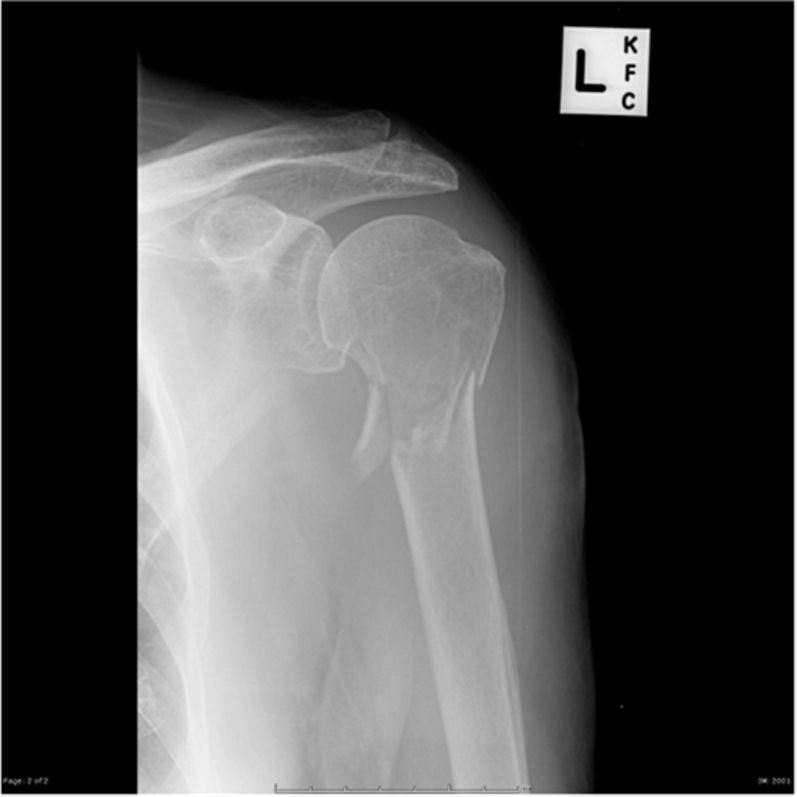
A 66-year-old man comes to the emergency department to be evaluated for left shoulder pain after a fall. The patient was skiing when he was accidentally hit from the right side and fell on his left shoulder and outstretched left hand. The patient did not strike his head or lose consciousness. Past medical history is noncontributory. Vitals are within normal limits. Physical examination shows a man supporting his left arm with his right hand. There is tenderness and swelling at the proximal humerus. An x-ray of the left shoulder is shown below. Axillary nerve injury is suspected.
Which of the following actions will be impaired due to this nerve injury?
A. Elbow, wrist, and finger extension
B. Abduction and adduction of the fingers
C. Wrist flexion and thumb opposition
D. Arm abduction at the shoulder
E. Forearm flexion and supination
Scroll down for the correct answer!
The correct answer to today’s USMLE® Step 1 Question is…
D. Arm abduction at the shoulder
Correct: See Main Explanation.
Incorrect Answer Explanations
A. Elbow, wrist, and finger extension
Incorrect: Elbow, wrist, and finger extension are functions of the radial nerve (C5-T1), which can be injured with midshaft fractures of the humerus. This patient has a fracture of the neck of the humerus.
B. Abduction and adduction of the fingers
Incorrect: The ulnar nerve is susceptible to injury in patients with fractures of the hook of hamate of the hand which can be seen in athletes. Ulnar nerve injury can cause inability to abduct the index and little fingers and inability to adduct the thumb. This patient’s presentation and radiograph are consistent with a fracture of the surgical neck of the humerus.
C. Wrist flexion and thumb opposition
Incorrect: Proximal median nerve injury can result from supracondylar fractures of the distal humerus at the elbow and can lead to the inability to flex the wrist and oppose the thumb. This patient has a fracture of the surgical neck of the humerus.
E. Forearm flexion and supination
Incorrect: Upper nerve trunk compression can injure the musculocutaneous nerve. Patients typically present with loss of arm abduction at the shoulder (>15 degrees) and loss of sensation over the lateral arm. Compression of the musculocutaneous nerve lower in the arm at the coracobrachialis muscle, can lead to weakness with forearm flexion and supination and sensory loss over the lateral forearm.
Main Explanation
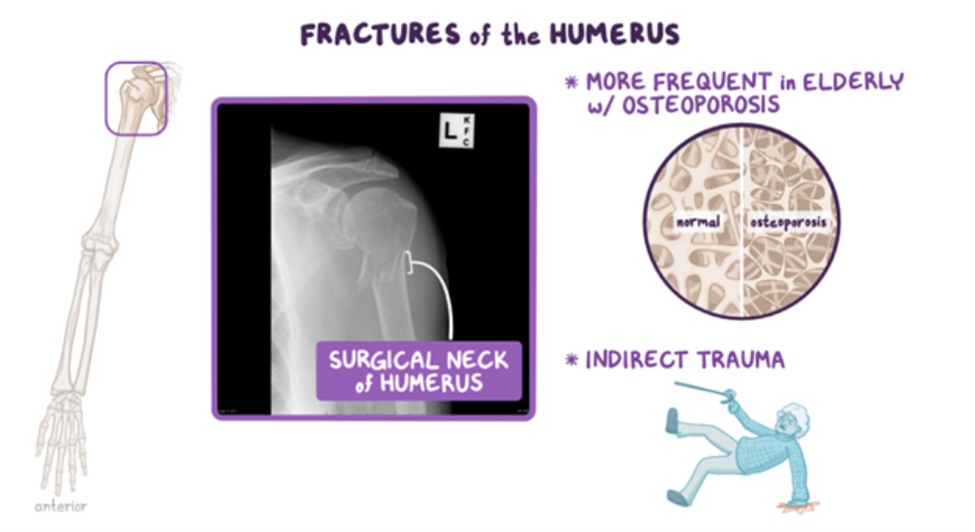
This patient’s left arm x-ray is consistent with a fracture of the surgical neck of the humerus, which is an injury pattern that occurs below the greater tubercle and lesser tubercle, and above the deltoid tuberosity.
The surgical neck is fractured much more frequently than the anatomical neck of the humerus and commonly results from a fall on the outstretched hand. It is a fracture seen in older patients particularly those with osteoporosis. Symptoms include pain over the proximal shoulder that radiates the arm’s length and swelling. The axillary nerve and posterior circumflex humeral artery are the structures that are at most risk of injury with this fracture pattern.
The axillary nerve carries fibers from the C5-C6 branch of the brachial plexus, where it courses deep to the axilla below the shoulder joint and the surgical neck of the posterior humerus. Patients with injury to this nerve present with loss of sensation over the lateral upper arm and weakness with shoulder abduction (due to denervation of the deltoid muscle). Damage to the posterior circumflex humeral artery can lead to avascular necrosis of the humeral head.
Major Takeaway
The surgical neck of the humerus is more frequently fractured than the anatomical neck of the humerus and typically results from a fall on an outstretched hand. It is common in older patients. This fracture pattern can lead to damage of the axillary nerve and posterior circumflex humeral artery. Injury to the axillary nerve can lead to loss of sensation and abduction at the shoulder.
Want to learn more about this topic?
Watch this Osmosis video: Anatomy clinical correlates: Arm, elbow and forearm
References
- The spine, pelvis, and extremities. Suneja M, & Szot J.F., & LeBlond R.F., & Brown D.D.(Eds.), (2020). DeGowin’s Diagnostic Examination, 11e. McGraw-Hill.

Get your free trial and discover why millions of current and future clinicians and caregivers love learning by Osmosis.
Leave a Reply