
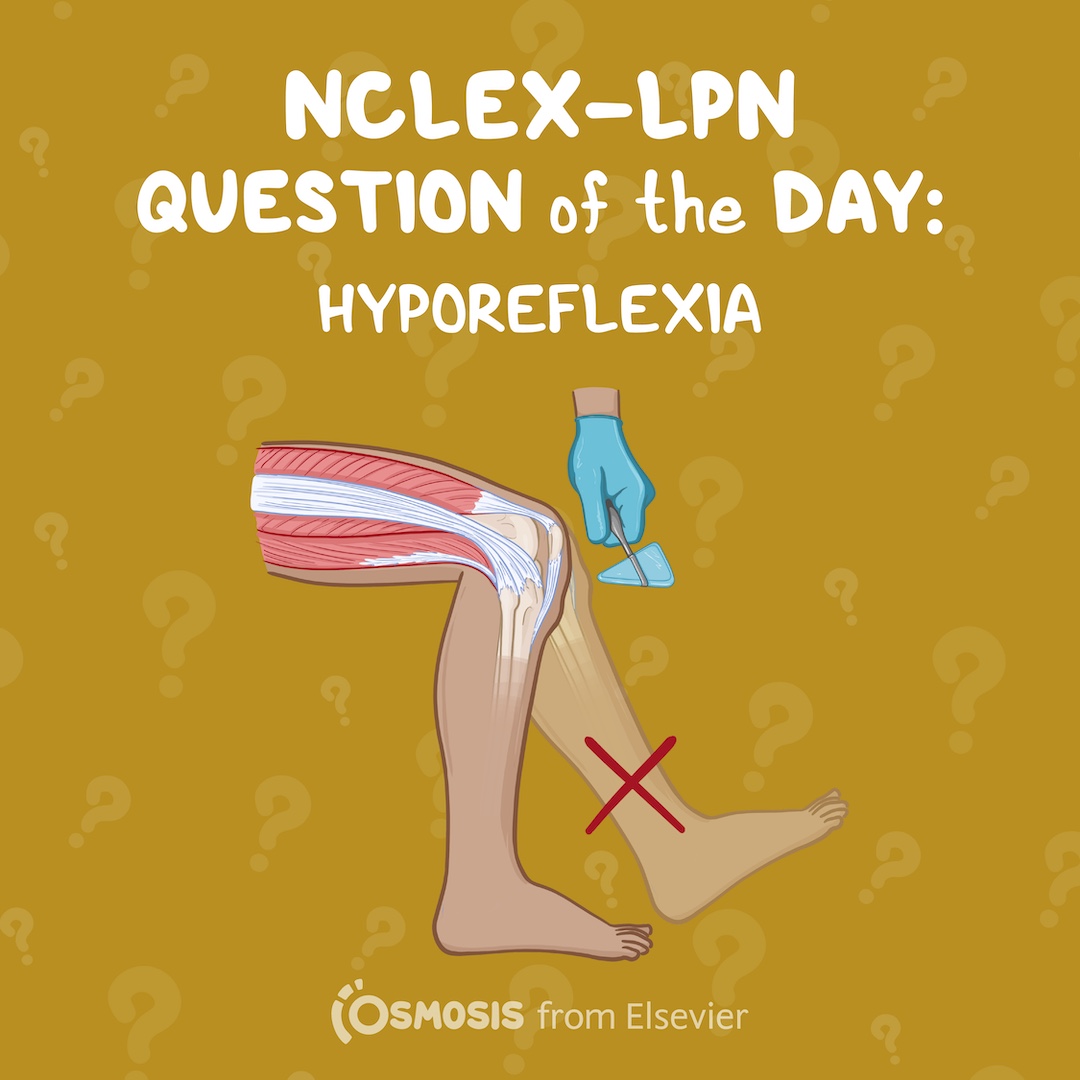
Today’s NCLEX® LPN question of the day focuses on hyporeflexia. Do you know the answer? Let’s find out!
The newly graduated nurse is reviewing the laboratory results of a patient with new onset hyporeflexia and muscle weakness. Which result should the nurse recognize as the potential cause of these symptoms?
A. Calcium level of 14 mg/dL
B. Calcium level of 9.9 mg/dL
C. Calcium level of 5 mg/dL
D. Calcium level of 10.4 mg/dL
Scroll down for the correct answer!
The correct answer to today’s NCLEX-PN® Question is…
A. Calcium level of 14 mg/dL
Rationale: The acceptable range of calcium is 9 to 10.5 mg/dL. This patient has hypercalcemia, which is likely causing their symptoms of hyporeflexia and weakness.
Main Takeaway
The serum calcium normally ranges from 9 to 10.5 mg/dL. Patients with hypercalcemia (high calcium levels) can have neuromuscular symptoms like muscle weakness and hyporeflexia due to the decreased excitability of the cell membranes.

Incorrect Answer Explanations
B. Calcium level of 9.9 mg/dL
Rationale: The acceptable range of calcium is 9 to 10.5 mg/dL, therefore, is not associated with these symptoms.
C. Calcium level of 5 mg/dL
Rationale: The acceptable range of calcium is 9 to 10.5 mg/dL; therefore, this would be considered hypocalcemia. Hyporeflexia and muscle weakness are related to hypercalcemia rather than hypocalcemia.
D. Calcium level of 10.4 mg/dL
Rationale: The acceptable range of calcium is 9 to 10.5 mg/dL, therefore, is not associated with these symptoms.
Want to learn more about this topic?
Watch the Osmosis video: Hyporeflexia

Get your free trial and find out why millions of current and future clinicians and caregivers love learning with us.
Leave a Reply