
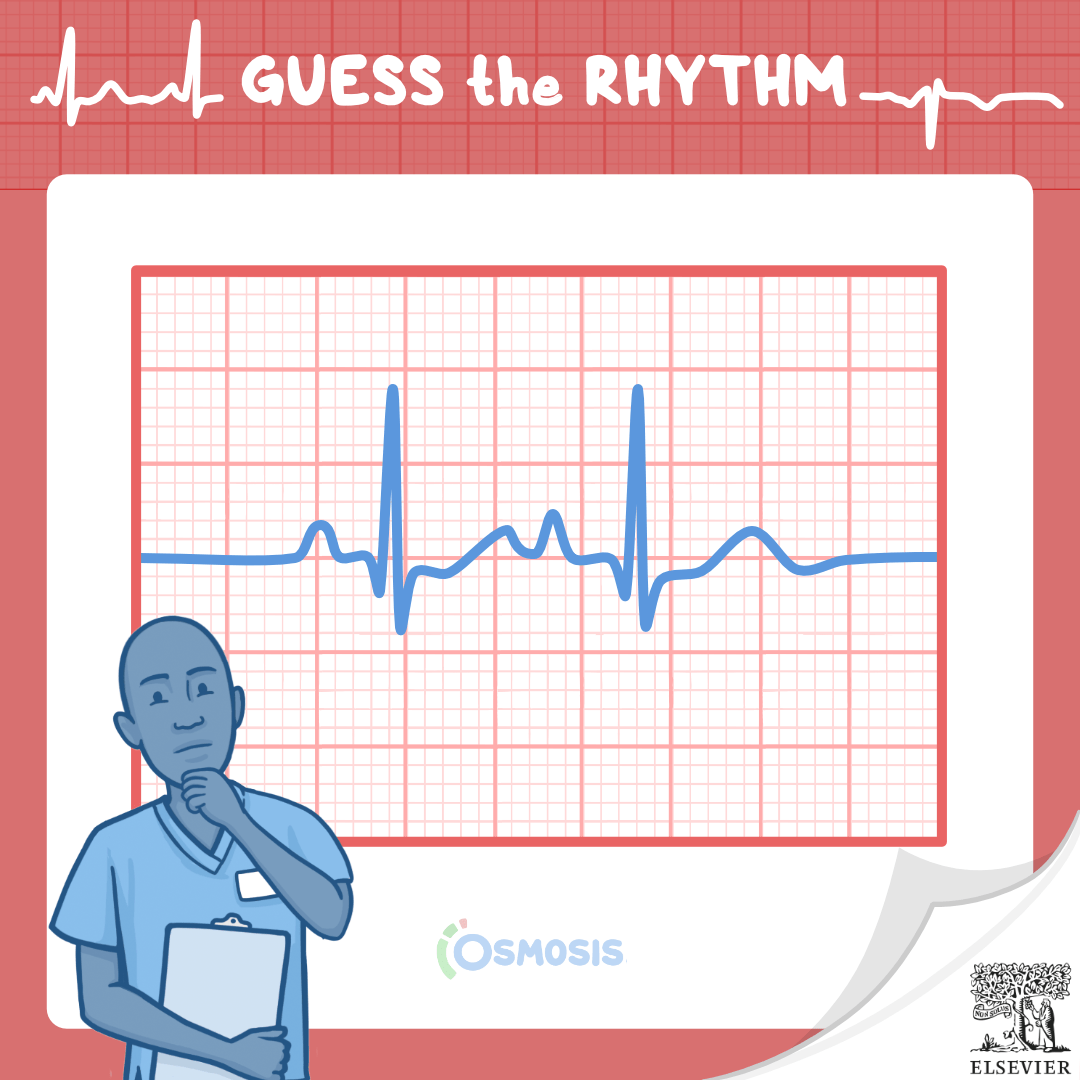
Answer: Atrial flutter
The findings of this ECG indicate atrial flutter (AF). Atrial flutter is a type of tachyarrhythmia, where tachy means fast, and arrhythmia means irregular rhythm. So AF is a fast, abnormal heart rhythm that causes poor, inefficient atrial contractions, which can affect the heart’s ability to pump blood. It’s called flutter because of its identifiable recurring, regular, sawtooth-shaped flutter waves that can be seen on an ECG.
On the ECG, the heart rate is often between 200 to 350 beats per min with characteristic recurring, regular, sawtooth-shaped flutter waves. Typically the atrial and ventricular rhythms are regular, at a ratio of 2:1, 3:1, or 4:1. More rarely, ventricular conduction can be variable. The ventricular rate may vary based upon the conduction ratio. For instance, in a 2:1 conduction ratio the ventricular rate is around 150 beats per minute. Also note, P waves are rarely seen and, as a consequence, PR intervals are variable or can’t be measured. The QRS complex is usually normal, but contains some AV blocks within flutter waves.
Learn more about this and other types of cardiac rhythms on Osmosis: Arrhythmias – Atrial flutter (Aflutter): Nursing
Key Takeaways
- Atrial flutter shows rapid atrial rates with sawtooth flutter waves on ECG.
- Ventricular rhythm often regular, with conduction ratios like 2:1 or 3:1.
- P waves are usually obscured; PR intervals variable or unmeasurable.
- QRS complexes are generally normal but can include AV blocks.
- Recognizing atrial flutter aids in diagnosing and managing tachyarrhythmias.

Try Osmosis by Elsevier today! Access your free trial and discover why millions of current and future clinicians and caregivers love learning with us.
Leave a Reply