
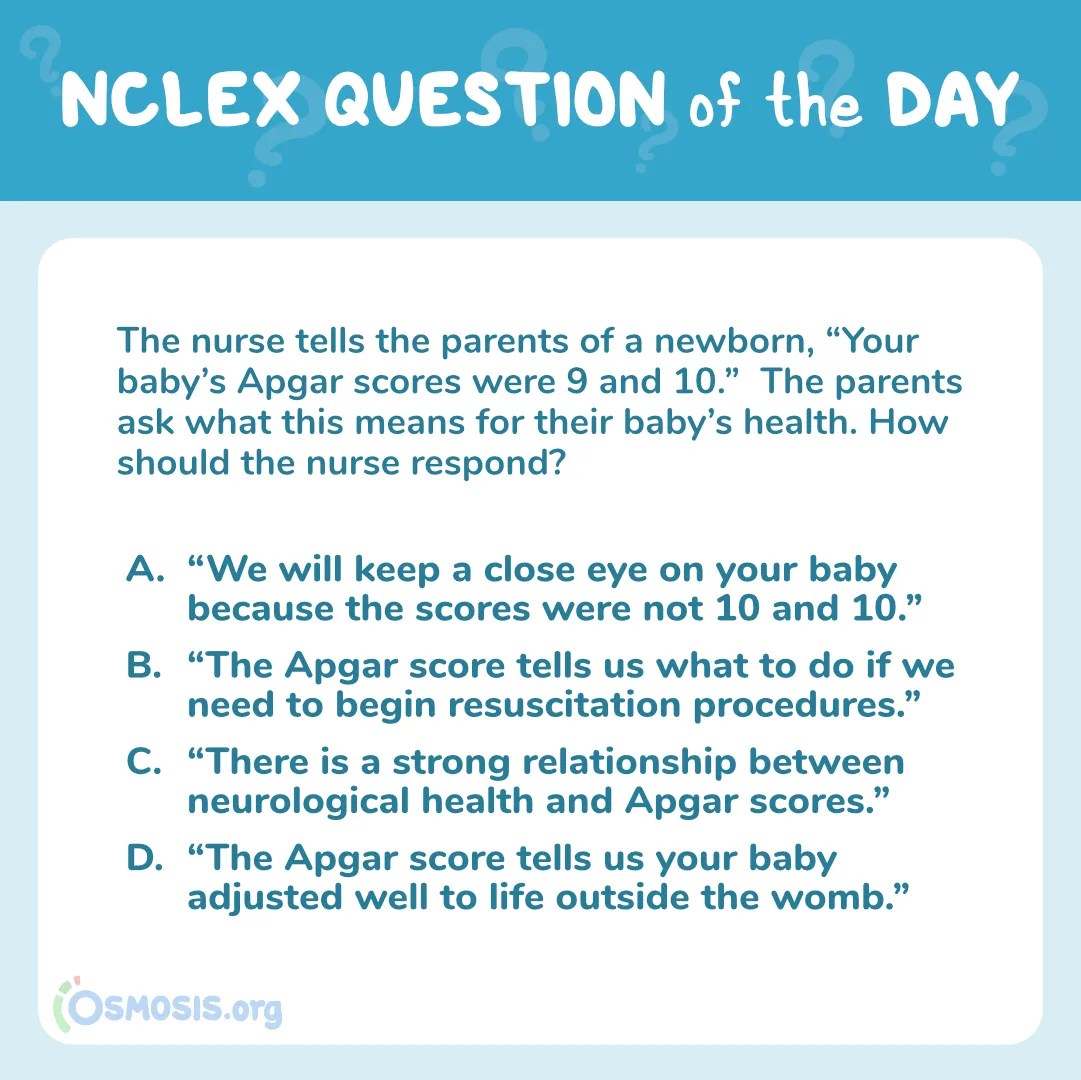
Today’s NCLEX-RN® question of the day focuses on the Apgar score, a numerical measurement used to quantify the overall health of a newborn baby. How would you explain the Apgar score to a client?
A nurse tells the parents of a newborn, “Your baby’s Apgar scores were 9 and 10.” The parents ask what this means for their baby’s health. How should the nurse respond?
A. “We will keep a close eye on your baby because the scores were not 10 and 10.”
B. “The Apgar score tells us what to do if we need to begin resuscitation procedures.”
C. “There is a strong relationship between neurological health and Apgar scores.”
D. “The Apgar score tells us your baby adjusted well to life outside the womb.”Scroll down for the correct answer!
→ Reinforce your understanding with more self-assessment items on Osmosis.
The correct answer to today’s NCLEX-RN® Question is…
D. “The Apgar score tells us your baby adjusted well to life outside the womb.”
Rationale: The Apgar score is a useful tool to document a newborn’s adjustment to the extrauterine environment as fetal circulation changes over to postnatal circulation. Most healthy term newborns do not receive a 1-minute score of 10 because acrocyanosis (bluish feet and hands) is common as new circulation patterns are established. The Apgar score does not determine resuscitation efforts and it is not an indicator of neurological health.
Major takeaway
The Apgar score is a useful tool to document the newborn’s adjustment to the extrauterine environment.
Incorrect answer explanations
A. “We will keep a close eye on your baby because the scores were not 10 and 10.”
Rationale: Because acrocyanosis is common in the first 24 hours of life, a 1-minute score of 10 is unusual, even for healthy newborns.
B. “The Apgar score tells us what to do if we need to begin resuscitation procedures.”
Rationale: Although neonatal resuscitation and Apgar scores look at some of the same parameters, the Apgar score does not determine resuscitation efforts.
C. “There is a strong relationship between neurological health and Apgar scores.”
Rationale: Apgar scores do not provide sufficient evidence to predict neurological outcomes.
References
London, M. L., Ladewig, P.A.W., Davidson, M.R., Ball, J. W., Bindler, R. C. M., & Cowen, K. J. (2017). Maternal and child nursing care (5th ed.). Boston, MA: Pearson.
_________________________
Want more NCLEX®-style practice questions? Try Osmosis today! Access your free trial and find out why millions of current and future clinicians and caregivers love learning with us.

Leave a Reply