

Prepare for the PANCE® with this clinical scenario involving a newborn with blue extremities. What are the next immediate steps in this child’s care? Let’s find out!
A newborn boy is evaluated by a pediatrician immediately after a vaginal delivery at 37 weeks’ gestation. The mother is 33 years old, and the pregnancy was uncomplicated. This is the mother’s first pregnancy, and she has no significant medical history. The newborn’s temperature is 36.7°C (98.1°F), heart rate is 150/min, respiratory rate is 40/min, and oxygen saturation is 93% on room air. The newborn is dried, stimulated, and his nose and oropharynx are suctioned. He has blue extremities, cries and pulls away from the examiner’s touch, flexes his arms and legs, and has a strong cry. Which of the following is the best next step in assessing this patient?
A. Newborn metabolic screen
B. Breastfeeding
C. Chest radiograph
D. APGAR score
E. Measurement of growth parameters
Scroll down to find the answer!
The correct answer to today’s PANCE® Question is…
D. APGAR score
Correct: See Main Explanation.
Incorrect Answer Explanations
A. Newborn metabolic screen
Incorrect: The newborn metabolic screen is typically collected between 24–48 hours of life and is used to test for various genetic conditions. The best initial step in assessing this patient is calculating the APGAR score, a time-sensitive assessment taken at one and five minutes after birth.
B. Breastfeeding
Incorrect: Although breastfeeding is a core component of immediate newborn care and is often evaluated by lactation before discharge, the APGAR score is obtained during the initial resuscitation process at one and five minutes of life.
C. Chest radiograph
Incorrect: A chest radiograph is not indicated for this patient due to the absence of respiratory distress and the presence of age-appropriate vital signs and physical examination findings. The best next step is to calculate an APGAR score, which is essential for determining disposition and subsequent management.
E. Measurement of growth parameters
Incorrect: While measurement of growth parameters is a fundamental aspect of the newborn examination, it should not take precedence over performing the APGAR score, which is crucial for determining disposition and subsequent management.
Main Explanation
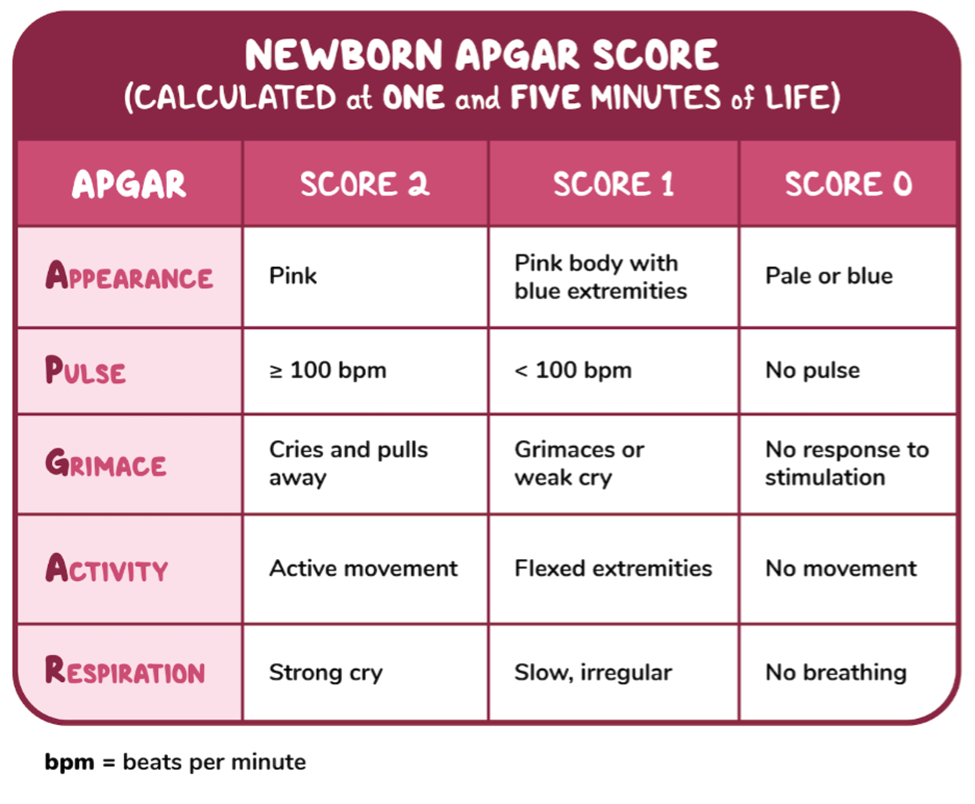
This newborn is evaluated immediately following a vaginal delivery. A core component of the immediate assessment of a newborn is to calculate an APGAR score, which is based on the infant’s Appearance, Pulse, Grimace, Activity, and Respiration.
The score is performed at one and five minutes of life, and the newborn is assigned a score out of 10 based on these five factors. The APGAR score assists in triaging newborn wellness—newborns with scores less than 7 require further monitoring.
In addition to the APGAR score, the evaluation should include vital signs and growth parameters, followed by a comprehensive physical examination. The history should focus on prenatal and maternal factors, as well as caregiver concerns and social determinants of health.
Immediate care of the well newborn begins at birth and continues through hospital discharge. It includes the identification of any abnormalities requiring further investigation, such as a cardiac murmur. Additionally, it should include feeding support, administration of immunizations (e.g., hepatitis B, respiratory syncytial virus (RSV) antibodies, if indicated), administration of preventive medications (e.g. vitamin K), routine screenings, anticipatory guidance, and optional care, such as circumcision.
Major Takeaway
A core component of the immediate care of the well newborn involves calculating an APGAR score. This score can be used to triage newborns who may require further monitoring or intervention.
Want to learn more about this topic?
Review this Osmosis Learn page: Immediate care of the well newborn: Clinical sciences
References
- (2022). Review of care of the well newborn. AAP. https://doi.org/10.1542/pir.2022-005511
- (2017). Recommendations on newborn health. WHO. WHO recommendations on newborn health: guidelines approved by the WHO Guidelines Review Committee
- Egge JA, Anderson RH, Schimelpfenig MD. Care of the Well Newborn. Pediatr Rev. 2022 Dec 1;43(12):676-690. doi: 10.1542/pir.2022-005511. PMID: 36450636.
- WHO recommendations on newborn health: guidelines approved by the WHO
- Guidelines Review Committee. Geneva: World Health Organization; 2017 (WHO/MCA/17.07). License: CC BY-NC-SA 3.0 IGO.
- Benitz WE; Committee on Fetus and Newborn, American Academy of Pediatrics. Hospital stays for healthy term newborn infants. Pediatrics. 2015 May;135(5):948-53. doi: 10.1542/peds.2015-0699. PMID: 25917993
- Lewis ML. A comprehensive newborn exam: part I. General, head, and neck, cardiopulmonary. Am Fam Physician. 2014 Sep 1;90(5):289-96. PMID: 25251088.
- Lewis ML. A comprehensive newborn exam: part II. Skin, trunk, extremities, neurologic. Am Fam Physician. 2014 Sep 1;90(5):297-302. PMID: 25251089.
- Marcdante KJ, Kliegman R, Schuh AM. Nelson Essentials of Pediatrics. 8th ed. Elsevier; 2023.

Want more PANCE®-style practice questions? Try Osmosis by Elsevier today! Access your free trial and discover why millions of current and future clinicians and caregivers love learning by Osmosis.
Leave a Reply