
Today’s NCLEX-RN® question of the day focuses on confirming a Meconium aspiration syndrome diagnosis. Do you know the answer? Let’s find out!
The nurse in the level II nursery is caring for an infant suspected of having meconium aspiration syndrome. Which diagnostic test should the nurse anticipate to confirm the diagnosis?
A. Complete blood count (CBC)
B. Chest X-ray
C. Magnetic resonance imaging (MRI)
D. Lung ultrasound
Scroll down for the correct answer!
The correct answer to today’s NCLEX® Question is…
B. Chest X-ray
Rationale: A chest X-ray is used to support the diagnosis of an infant with meconium aspiration syndrome. It may show patchy infiltrates of the lung, areas of consolidation, and hyper-expansion due to air trapping.
Main Takeaway
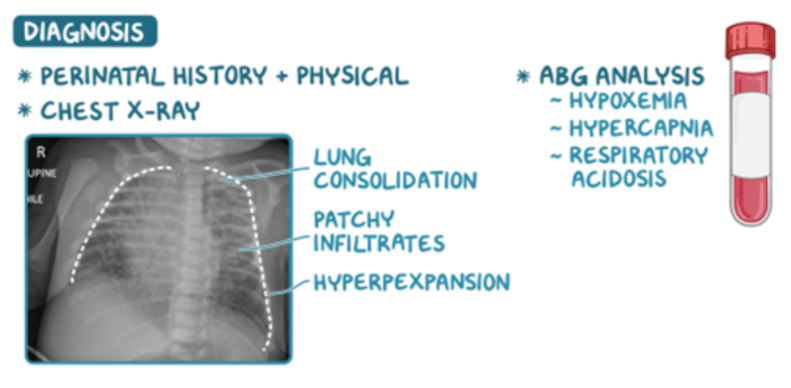
The diagnosis of meconium aspiration syndrome starts with perinatal history and physical assessment, and is supported by a chest X-ray, which may show patchy infiltrates of the lung, lung consolidation, and hyper-expansion due to air trapping. In addition, arterial blood gas (ABG) analysis may show hypoxemia, hypercapnia, and respiratory acidosis. A complete blood count (CBC), magnetic resonance imaging (MRI), and lung ultrasound are not used to diagnose meconium aspiration syndrome.
Incorrect Answer Explanations
A. Complete blood count (CBC)
Rationale: A CBC is not used to diagnose an infant with meconium aspiration syndrome but it can be used to diagnose infection or other causes of respiratory distress.
C. Magnetic resonance imaging (MRI)
Rationale: An MRI is not used to diagnose an infant with meconium aspiration syndrome. An MRI can be used to diagnose neurologic or other non-pulmonary conditions when indicated.
D. Lung ultrasound
Rationale: A lung ultrasound is not used to diagnose an infant with meconium aspiration syndrome, although it may provide information about neonatal lung conditions such as pneumothorax.
References
- Hockenberry, M. J., Duffy, E. A., & Gibbs, K. D. (2024). Wong’s nursing care of infants and children (12th ed.). Elsevier. ISBN: 978-0-323-77670-7
- Gulati, A., & Balasubramanya, R. (2023, May 1). Lung imaging. StatPearls. https://www.ncbi.nlm.nih.gov/books/NBK558976/
Want to learn more about this topic?
Watch the Osmosis video: Meconium aspiration syndrome: Nursing

Get your free trial to find out why millions of clinicians and caregivers love learning by Osmosis.
Leave a Reply