

Prepare for the PANCE® with this emergency department scenario involving a patient experiencing palpatations and lightheadedness. What are the best, next steps in her care? Let’s find out!
A 37-year-old woman presents to the emergency department for evaluation of the acute onset of palpitations and lightheadedness. The patient was sitting at her desk when the symptoms began abruptly. She has otherwise been in her usual state of health. She has no significant past medical history and does not take any medication. Temperature is 37°C (98.6°F), pulse is 170/min and regular, respirations are 22/min, blood pressure is 120/74 mmHg, and oxygen saturation is 99% on room air. The patient is well appearing but anxious. Cardiopulmonary examination is otherwise unremarkable. Lead II of the patient’s electrocardiogram (ECG) is shown below.
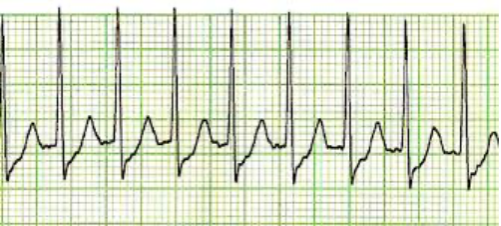
Which of the following is the best, next step in management?
A. Defibrillation
B. Adenosine
C. Synchronized cardioversion
D. Metoprolol
E. Vagal maneuvers
Scroll down to find the answer!
The correct answer to today’s PANCE® Question is…
E. Vagal maneuvers
Correct: See Main Explanation.
Incorrect Answer Explanations
A. Defibrillation
Incorrect: Defibrillation is indicated for ventricular fibrillation or pulseless ventricular tachycardia. This patient has a pulse and is hemodynamically stable with a regular, narrow-complex supraventricular tachycardia (SVT). Initial management should consist of vagal maneuvers.
B. Adenosine
Incorrect: Adenosine is indicated in the management of patients with stable SVT if vagal maneuvers do not convert the arrythmia to normal sinus rhythm. Vagal maneuvers should be attempted for this stable patient before proceeding to adenosine.
C. Synchronized cardioversion
Incorrect: Synchronized cardioversion is indicated for patients with SVT who are hemodynamically unstable, such as those with hypotension, altered mental status, or signs of shock. This patient with stable SVT should first be managed with vagal maneuvers.
D. Metoprolol
Incorrect: Beta-blockers such as metoprolol may be used to treat stable SVT when vagal maneuvers and adenosine are ineffective or contraindicated. Vagal maneuvers should be attempted first in this patient.
Main Explanation
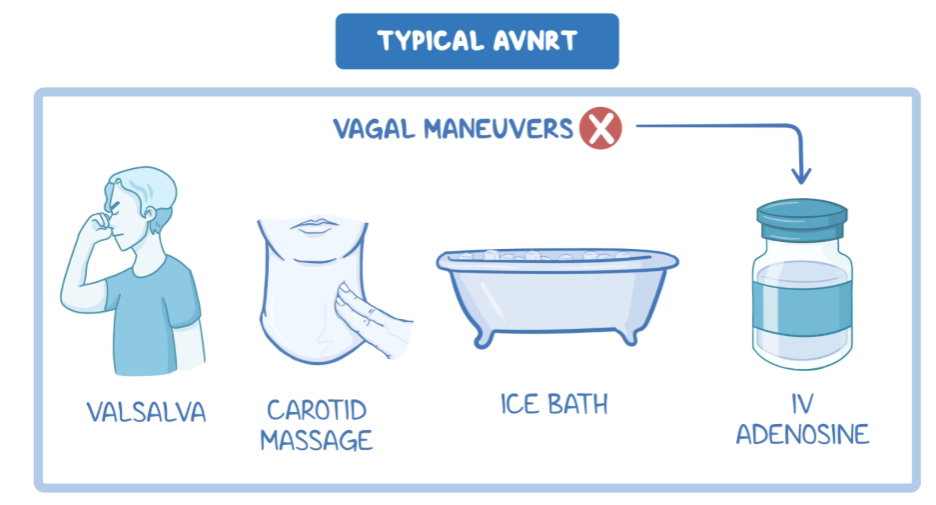
This patient presents with the abrupt onset of palpitations and lightheadedness and is hemodynamically stable. Her ECG demonstrates a regular, narrow-complex tachycardia with absent P-waves, consistent with supraventricular tachycardia (SVT), most likely typical atrioventricular nodal reentrant tachycardia (AVNRT).
Patients with stable AVNRT should be treated in a stepwise fashion. Initial treatment consists of vagal maneuvers, such as the Valsalva maneuver. If vagal maneuvers fail to convert AVNRT to normal sinus rhythm, the next step is intravenous adenosine. Adenosine transiently blocks conduction through the atrioventricular node and frequently terminates AVNRT.
If vagal maneuvers and adenosine are unsuccessful or contraindicated, then rate-controlling agents such as beta-blockers, like metoprolol, or calcium channel blockers, like verapamil or diltiazem, may be considered. Catheter-directed ablation is an effective definitive treatment for patients with recurrent symptomatic AVNRT.
All unstable patients with SVT, such as those with altered mental status, hypotension, or signs of shock, should have immediate synchronized cardioversion.
Major Takeaway
Stable AV nodal reentrant tachycardia (AVNRT) is treated in a stepwise fashion, starting with vagal maneuvers, followed by adenosine if unsuccessful, and then rate-controlling agents if needed. Hemodynamically unstable SVT requires synchronized cardioversion.
Want to learn more about this topic?
Review this Osmosis content: Supraventricular tachycardia: Clinical sciences
References
- Page RL, Joglar JA, Caldwell MA, et al. 2015 ACC/AHA/HRS Guideline for the Management of Adult Patients with Supraventricular Tachycardia: A Report of the American College of Cardiology/American Heart Association Task Force on Clinical Practice Guidelines and the Heart Rhythm Society [published correction appears in J Am Coll Cardiol. 2016 Dec 27;68(25):2922-2923]. J Am Coll Cardiol. 2016;67(13): e27-e115. doi: 10.1016/j.jacc.2015.08.856
- Mayuga KA, Fedorowski A, Ricci F, et al. Sinus Tachycardia: a Multidisciplinary Expert Focused Review. Circ Arrhythm Electrophysiol. 2022;15(9): e007960. doi:10.1161/CIRCEP.121.007960
- Jameson J, Fauci AS, Kasper DL, Hauser SL, Longo DL, Loscalzo J. eds. Harrison’s Principles of Internal Medicine, 20e. McGraw Hill; 2018.

Get your free trial today to discover why millions of clinicians and caregivers love learning by Osmosis.
Leave a Reply