
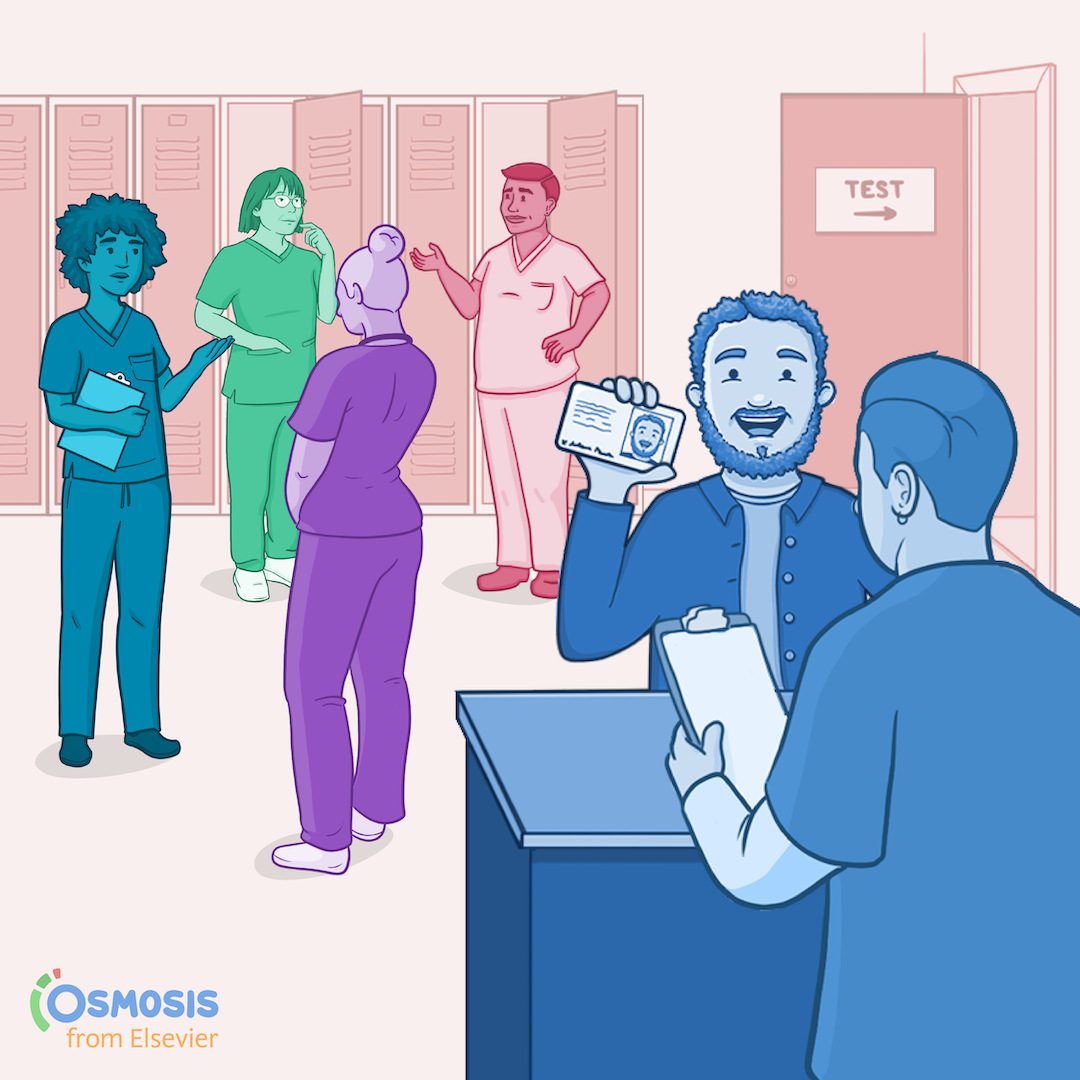
If you’re reading this guide, chances are you’ve graduated from nursing school or are at least getting close. Congratulations! Passing all those rigorous exams and grueling clinicals shows your dedication and skill. There’s just one more critical step standing between you and your Practical Nursing license, and Osmosis is here to help you through it.
Essential Nursing Terminology
Let’s start with terminology. There are a ton of acronyms and specific terms to understand in the field of nursing, and it’s no different when talking about licensure. Let’s take a moment to clarify some terms before diving in.
Practical nurse (PN)
A Practical Nurse (PN) works in a variety of healthcare settings, caring for patients by taking vital signs, administering medications, and collecting key patient health data.
Licensure Examinations
To work as a PN, you must graduate from an approved nursing program and take the appropriate licensure or registration examination.
NCSBN
The National Council of State Boards of Nursing (NCSBN) is the organization that represents nursing regulatory bodies. They develop and maintain the NCLEX and REx-PN exams.
NCLEX-PN
The National Council Licensure Examination for Practical Nurses, or NCLEX-PN, is an examination available in the US for qualified graduates of a practical nursing program. All LPN students must pass this exam before becoming licensed to practice nursing.
REx-PN
The REx-PN stands for Regulatory Exam – Practical Nurse and is the examination currently taken by practical nursing students in British Columbia and Ontario.
CPNRE
Administered in provinces and territories in Canada, excluding British Columbia and Ontario, the Canadian Practical Nurse Registration Examination (CPNRE) is the third licensure examination we’ll discuss.
Practical Nursing Licensure Types
Depending on where you live and work, practical nurses can be referred to by a variety of titles. Here are some of the most common ones.
LPN
LPN, or Licensed Practical Nurse, is the title used for practical nurses who are licensed and practicing in most states in the US, as well as in most of Canada. LPN is the term used throughout this guide. Be sure you understand the applicable title and licensure where you live and work.
LVN
LVN stands for Licensed Vocational Nurse. A few states in the US use this title instead of LPN.
RPN
RPN is used in some areas of Canada and stands for Registered Practical Nurse.

Who takes the NCLEX-PN and REx-PN?
The NCLEX-PN or REx-PN are taken by all graduates of approved practical or vocational nursing programs who want to get their practical nursing (PN) license in the United States and parts of Canada. These exams measure the competencies needed to provide safe and effective patient care as an entry-level practical nurse. Test-takers who complete a PN program and pass the associated licensure exam are eligible for licensure by their board of nursing.
On the other hand, the NCLEX-RN® focuses more on the management of care for patients. To take the NCLEX-RN you typically must graduate from a registered nursing program which can be at the diploma, associates, bachelors, or masters level. Test-takers who complete an RN program and pass the NCLEX-RN are called Registered Nurses (RNs).
How Is the NCLEX-RN Different from the NCLEX-PN?
The NCLEX-RN® focuses more on the management of patient care. To take the NCLEX-RN, you’re required to graduate from a registered nursing program, which can be at the diploma, associate’s, bachelor’s, or master’s level. Test-takers who complete an RN program and pass the NCLEX-RN are called Registered Nurses (RNs).
When did the NCLEX start?
The first nationwide nurse licensure examination was offered in 1944 and was called the State Board Test Pool Examination. After the establishment of the NCSBN, the exam name was switched to the NCLEX in 1981. In 1994, the exam transitioned from a paper-and-pencil test to a computerized adaptive test (CAT), which is what’s in use today. The National Council of State Boards of Nurses® (NCSBN) owns, develops, and administers the NCLEX and REx-PN. Each state or province’s nursing board accepts the results of the NCLEX to grant a state nursing license.
How do I take the NCLEX-PN or REx-PN?
Pearson VUE testing centers offer computer-based exams with Computerized Adaptive Testing (CAT), which is explained in more detail below. The exam tests the theoretical knowledge, practical skills, and clinical judgment abilities of each student to ensure that every new nurse is minimally competent to practice as a PN. This standardization helps ensure client safety and the maintenance of ethical practices nationwide.
Where and when do I take the NCLEX- PN or REx-PN?
Nursing students take their exams at Pearson VUE testing centers. The exam is offered year-round.
US Domestic Testing Centers
- Any state within the US, American Samoa, Guam, the Northern Mariana Islands, and the US Virgin Islands
Canadian Domestic Testing Centers
- Any Canadian province/territory and the mainland (not including territories)
International Testing Centers
- Testing centers are available in several countries. (Here’s the most up-to-date list.)
How do I register for the NCLEX-PN or REx-PN?
To register, the first step is to apply for licensure or registration through your state or provincial Nursing Regulatory Board® (NRB®), which oversees your eligibility to take the exam. Take note that a fee is associated with submitting your application.
The second step is to register with the test administrator, Pearson VUE®. You can do this online or over the phone. Once you receive your Authorization to Test (ATT), it’s time to schedule your test day and time through Pearson VUE®.
NCLEX-PN and REx-PN Fees
These exams have fees associated with them, which must be paid before you can take the exam. You can pay by debit, credit, or prepaid card, or, in some cases, your institution may cover the fees.
For current information on exact costs, visit the NCSBN’s Application & Registration page.

What topics does the NCLEX-PN and REx-PN cover?
The exam content is tailored to the overall needs of the client and organized into the Client Needs categories of Safe and Effective Care Environment, Health Promotion and Maintenance, Psychosocial Integrity, and Physiological Integrity. In addition, there are integrated processes that are fundamental to the practice of nursing and interspersed throughout all the Client Needs categories. The integrated processes for NCLEX-PN include caring, clinical judgment (discussed in more detail later), the clinical problem-solving process (also known as the nursing process), communication and documentation, culture and spirituality, and teaching/learning. The REx-PN does not include clinical judgment, but it does incorporate client safety as an integrated process. We’ll take a deeper dive into the Client Needs categories and clinical judgment a bit later. Since clients and environments vary across a broad spectrum, expect a wide range of questions. We’ll go more in-depth on the question distribution and content areas below!
More About the Next Generation NCLEX, or NGN
The NCSBN continuously reviews and updates the questions and content of the exam to make sure that they’re keeping up with current medical understanding, trends, and challenges. When nursing practices change, the relevant questions get reviewed and revised as needed.
The NCLEX test plans are updated every three years and reflect any significant changes to the exam. We highly recommend that you review the NCSBN test plan in-depth before taking the exam.
A significant change to the NCLEX-PN came in April 2023 with the launch of Next Generation NCLEX (NGN®). This exam update was in response to studies showing a lack of critical thinking skills among novice nurses. It emphasizes critical thinking and clinical judgment skills over rote memorization of tasks and content, and is based on the Clinical Judgment Measurement Model (CJMM). There are new question types, like case studies, where six sequential questions are asked, following the six steps of the CJMM, based on one scenario and client chart. This means that learning the material for the long term will be much more important than cramming right before the exam.
Which is why it’s so important to start learning by Osmosis!

What is a computerized adaptive test, or CAT exam?
The NCLEX-PN and REx-PN both use Computer Adaptive Testing (CAT), which means that the computer recalibrates the exam after each question you answer, helping to ensure that the exam is specific to your level of ability and is unique to each test-taker. Every time you answer a question correctly, the computer chooses the next question out of its question bank that you’ll have a 50% chance of answering correctly. This method means that the better you perform, the more difficult the questions will get.
Try not to read too much into the level of challenge you’re experiencing, though. The exam also randomly generates fifteen non-scored questions for the NCLEX-PN and thirty non-scored questions for the REx-PN, which are sample questions of varying difficulty levels that may appear on future exams.
At the end of the exam, you must reach a certain passing level determined by the NCSBN to demonstrate that you’re minimally competent to begin practicing as a nurse.
How is the CAT exam different from a regular exam?
In a fixed-length test, each student is given exactly the same questions to complete in the same amount of time, creating a consistent experience across the board. A CAT exam allows flexibility in the testing environment by targeting each student’s ability level and adapting to it, providing a much more accurate reflection of each student’s particular abilities across a range of topics. Since nursing practice demands a wide range of knowledge, this type of testing is particularly well-suited for nursing exams.

How do you prepare for the NCLEX- PN?
The first thing you should do after you graduate from nursing school is to take some time to rest and recuperate. Nursing school is demanding, and you’re probably exhausted both physically and emotionally.
Practice self-care by giving yourself a week or two to rest and recuperate. Sleep in, eat well, and get some exercise and fresh air. Reconnect with friends and family who may not have seen you during long days of studying and working through school.
Make sure to rest your brain, too! When you’re well-prepared, you’ll feel much calmer and more comfortable heading into the test center on exam day.
After this short break, sit down and plan out your study schedule (Osmosis happens to have a fantastic tool for that). Set your test date at least a month or two in advance to give yourself enough time to study effectively. Each person is different, but the general recommendation is to spend about three hours a day reviewing your study material.

How much should I study?
As you’re probably aware, after observing your peers at school, every student has different study habits and needs. There are always those students who seem to be able to breeze through exams with minimal studying. However, most of us need time and a plan.
Everyone’s specific needs vary widely, so we’ve gathered some tips from students who have taken the test and experts who study these topics. In addition to the advice below, read our Time Management 101: How to get (and stay) organized while you’re in school blog post, or watch the on-demand webinar.
Step 1: Get Organized
If it’s been a while since you graduated from nursing school, your study space may have gathered dust, junk, or been repurposed altogether. Create a clean, orderly, and above all quiet space. Make it comfortable, because you may be spending upwards of three to four hours a day studying.
Step 2: Make a Plan and Plan Ahead
Get out your calendar and figure out how much time you have between now and your test date. Create a schedule that you can realistically stick to. Which days will you be able todedicate to studying? Do you have work or family obligations you’ll need to attend to? When will you be able to take time to relax (which is also 100% necessary)? Also, plan out when you’ll take the practice exams. Consider taking one early in your study period to gauge your strengths, then sprinkle in a practice test here and there, with one at least two weeks before your test.
Step 3: Find a Study Partner
One of the best ways to learn is by teaching the material to someone else. Demonstrating material helps you master it in a way that passive reading and studying can’t. Schedule some reciprocal study sessions where you and your study partner can take turns explaining concepts and answering questions. These kinds of sessions can also go really far in bolstering your confidence, which is a big part of exam success.
Step 4: Read the NCSBN® Test Plans
The NCSBN® publishes in-depth test plans every three years for NCLEX-PN and REx-PN. It’s absolutely in your best interest to carefully read through the test plan to get an idea of what to expect on test day. It lays out content distribution in a detailed manner and even gives sample exam items, giving you an excellent sneak peek into the exam. The test plan also has some very thoughtful things to say about the values and beliefs underlying the exam. It may seem optional, but this is an essential step that you should do early on and revisit throughout your studies.
Step 5: Make Use of the Study Resources on Osmosis
When studying for your exam, Osmosis is one of the most powerful tools at your disposal. We have hundreds of fun, easy-to-understand videos to help nursing concepts truly stick, with new videos added regularly. We also encourage you to watch How to Use the Osmosis Nursing Library for an overview of our nursing content. Our Medication Tables cover some of the most common medication classifications. We even have a library of over 1,000 exam-style questions in various NCLEX question styles, designed to test your knowledge and put you in the right mindset for exam day.

Step 6: Take a Break Before the Actual Exam
Don’t break your brain just before you sit down to take the test! It’s important to rest your noggin, allow the knowledge to sink in, and let your stress level subside. Creating and following a detailed study schedule will reduce the need for last-minute cramming on your test day. Make sure to give yourself a day or two off before the exam. Go for a hike, go shopping, or head to the beach; whatever you do to relax and take your mind off things. Don’t worry; your hard work won’t disappear. Go into testing day refreshed and ready!
What else can I do to optimize my studying for my licensure exam?
Here are a few other tips and tricks that candidates have used to pass the NCLEX-RN and REx-PN successfully.

What are “integrated processes” on the NCLEX- RN and REx-PN?
The concept of integrated processes underpins the whole exam. These processes are the building blocks of nursing practice. They will be an essential part of each exam.
The following six processes make up this underlying exam philosophy:
Caring
Nurses demonstrate respect and concern for clients to build a collaborative and trusting environment.
Clinical Judgment
Clinical judgment is a unique aspect of the NCLEX and is vital to nursing practice. It’s the outcome of critical thinking and decision-making. Frame it this way: your patients have needs, and those needs must be met through clinical decision-making. The way to meet those needs is through clinical judgment, which is a crucial part of the NGN, as many of the new questions are based on the steps of the Clinical Judgment Measurement Model (CJMM).

Layer 3 of the CJMM speaks to recognizing and analyzing cues, prioritizing hypotheses, generating solutions, taking action, and evaluating outcomes.

Maintaining Quality Communication and Documentation
Clear and open communication between the patient, their family, and caregivers is a crucial component of the nursing process. Nurses must keep accurate medical records that precisely reflect treatment, even during stressful or confusing situations.
Culture and Spirituality
Effective nursing considers the beliefs, identity, and uniqueness of each person being cared for, as well as good communication that respects and incorporates the patient’s perspective, fostering trust and collaborative care. The NCLEX-PN uses a version that includes data collection, planning, implementation, and evaluation.
Nursing Process or Clinical Problem-Solving
While there are several versions of the nursing process, at Osmosis, we use five steps, which you can remember using the acronym “ADPIE”:
On the Practice of Teaching and Learning
Nurses are expected to continue learning throughout their careers, as well as educate their clients and their families. With Osmosis, you’ve got a partner in lifelong learning. You’ll also find that our videos are an excellent resource for clients who want to understand their diagnosis. (We’ve got some fantastic resources on rare diseases!)
How long are the licensure exams?
The NCLEX test is lengthy, and part of preparing for it involves developing the mental endurance needed to focus for several hours at a time. The NCLEX-PN ranges between a minimum of 85 questions and a maximum of 150. Similarly, the REx-PN has a minimum of 90 questions and a maximum of 150 questions. There’s no way to predict how many questions you’ll answer, so don’t read too much into getting the maximum or maximum number. However, make sure you’re prepared to take between two to four hours for the REx-PN exam and up to five hours for the NCLEX-PN exam. Your exam will automatically end when the CAT determines that you’ve gotten a passing or non-passing score or you’ve reached the maximum time allowed.
What is the exam structure?
The exam consists of four major categories and eight subcategories. The categories all fall under the framework of “Client Needs.” Let’s take a closer look at what’s included.
Category 1: Safe and Effective Care Environment
This category includes two subcategories:
Coordinated Care (Management of Care on REx-PN)
The Coordinated Care subcategory involves activities that improve patient care and reduce the amount of necessary medical services through treatment coordination. Coordinated care helps minimize duplication of treatment, resulting in better patient outcomes and lower costs. Some critical aspects of care coordination include understanding advance directives, as well as being up to date on the latest information technology needs and client rights. Other standards include ethical practices and demonstrated knowledge of legal responsibilities, confidentiality, and continuity of care.
Safety and Infection Control
The safety of both nursing staff and clients is also assessed, including the ability to prevent the spread of pathogens, as well as having a clear understanding of standard safety procedures and accident prevention. Other topics that may appear on the exam include patient identification, infection control, and incident reporting.
Category 2: Health Promotion and Maintenance
The second main category of the exam is Health Promotion and Maintenance, which examines the different health and medical needs of a patient at all stages of life. From newborn care to early childhood development, adolescence, and adulthood, humans encounter a diverse selection of health issues. The proficient PN will understand the medical needs of each stage in the aging process. Activities tested in the Health Promotion and Maintenance category cover newborn care, geriatric treatments, and all developmental stages in between.
Category 3: Psychosocial Integrity
Nursing demands an understanding of how to interpret family dynamics and the most effective ways to apply knowledge of various cultures. This category of the exam covers how nurses support not only the physical health of their patients, but also their mental, emotional, and social well-being. These processes include collecting data on potential abuse or neglect, end-of-life care, offering support through grief or loss, and reinforcing education about coping skills and aftercare. These skills are particularly important for clients experiencing mental health crises or dealing with the aftermath of traumatic injuries.
Category 4: Physiological Integrity
This category includes four subcategories:
Basic Care and Comfort
Nurses help patients with issues related to mobility, elimination, and personal hygiene. Patients often need assistive devices to learn new ways of doing things or require assistance with basic functions that they’ve been performing their whole lives.
Pharmacological Therapies (Pharmacological and Parenteral Therapies on REx-PN)
Nurses administer medications and reinforce patient education on how to self-administer them. They also monitor the effectiveness and side effects of treatment, as well as any other adverse effects. Other processes include preparing dosages and monitoring intravenous fluid infusion.
Reduction of Risk Potential
The process of reducing risk is critical for ensuring clients don’t develop life-threatening complications related to their medical care. This subcategory includes items related to reading laboratory reports, interpreting values, understanding diagnostic tests, and monitoring vital signs. Other important elements include identifying potential complications and being able to respond to them effectively.
Physiological Adaptation
Physiological adaptation centers on providing care for clients with acute, chronic, or life-threatening medical conditions, and includes dealing with alterations in body processes, facing health emergencies, responding to unexpected outcomes, and managing clients’ hemodynamics.

What is the question distribution for the Client Need categories?
Since each exam is different, the content distribution will also vary. The questions generally fall under the particular ranges.
1. Safe and Effective Care Environment
- Management of Care (18-24%)
- Safety and Infection Control (10-16%)
2. Health Promotion and Maintenance (6-12%)
3. Psychosocial Integrity (9-15%)
- 8-14% for REx-PN
4. Physiological Integrity
- Basic Care and Comfort (7-13%)
- 6-12% for REx-PN
- Pharmacological Therapies (10-16%)
- 14-20% for REx-PN
- Reduction of Risk Potential (9-15%)
- 8-14% for REx-PN
- Physiological Adaptation (7-13%
- 6-12% for REx-PN
What types of questions are on the REx-PN?
The NCLEX-PN is a bit different. It includes the same more traditional question types, such as multiple choice, multiple response, and fill-in-the-blank. However, with the launch of the NGN exam update in April 2023, several additional types were added, many of which are covered in the section below.
The different types of questions may sound daunting, but the exam will provide you with instructions on how to answer each type. Take each question one at a time and keep in mind what you DO know!

What types of questions are on the NCLEX- RN?
Okay, now NCLEX-PN is a bit different. It has those same more traditional question types, like multiple choice, multiple response, and fill-in-the-blank. However, with the launch of NGN in April 2023, there were some additional types added, many of which we will cover in the section below.
The different types of questions may sound daunting, but the exam will provide you
instructions on how to answer each type. Take each question one at a time and keep in mind what you DO know!
Case Study Question Types
Every NCLEX-PN test-taker will have three case studies on their exam. In a case study, you’re provided with patient information, such as a chart or electronic health record. You’ll need to review the patient information and then answer the six questions related to the case study. These six questions address each step of layer 3 of the Clinical Judgment Measurement Model and go in order from first to last (recognize cues, analyze cues, prioritize hypotheses, generate solutions, take actions, and evaluate outcomes). There can be a variety of question types in a case study, including drag-and-drop, drop-down, multiple-choice, multiple-response, and highlight.
Drag-and-Drop Questions
In a drag-and-drop question, you take a possible response, called a token, and drag and drop it into one or more target areas.

Drop Down Questions
In a drop-down question you must click the drop-down icon (also called a caret), which looks like this: to select the correct answer or answers.

Multiple Choice Questions
This type of question is one that we’re all probably familiar with. Select the single best answer out of a few potential answers, but note that there are two variations:
- Multiple choice: Click the radial button, which is a small circle, next to the single best answer to the question.
- Matrix multiple choice: In this question type, you must click the radial button next to the single best answer in each row of the matrix.

Multiple Response Questions
A multiple-response question, also called a select-all-that-apply, or SATA, is similar to a multiple-choice question, except there can be more than one correct answer. Instead of radial buttons, on multiple-response questions, you’ll see check boxes that look like this:
- Matrix-multiple response: A matrix multiple response is similar to a matrix multiple choice, except now there can be more than one correct answer in a single row.
- Multiple-response select-all-that-apply: This question type is similar to a multiple-choice question, except that there are at least five and up to ten options to select from. Anywhere from one to all ten options can be the correct answers.
- Multiple-response select-N: In this question type, there will be some instructions for how many answers to select. The language will be something like, “Select the two findings that…”. The computer won’t let you move to the next question unless you’ve selected the correct number of answers as directed.
- Multiple-response grouping: For this question type, possible answers are placed into groupings. There will be at least two groupings but up to a maximum of 5 groupings. You must select at least one answer from each grouping.

Highlight Enhanced Hotspot Questions
In a highlight question, also referred to as an enhanced hotspot question, you must highlight text to indicate the correct answer. The highlighted areas are tokenized, which means that the computer testing system will display options for highlighting, with a maximum of 10 tokenized areas. This eliminates the possibility of you getting it incorrect just because you included either too many or not enough words.
The NCLEX includes two types of highlight questions.
- Highlight text: In this question type, you’ll highlight one or more sections of text to indicate the correct answer or answers. The text is in paragraph form, like from a nurse’s note or a history and physical report.
- Highlight table: This question type is similar, except you’ll highlight information in a table to indicate the correct answer. The table could be patient data such as laboratory results, an intake and output chart, or vital signs.

Standalone Question Types
All of the above question types can be found within a case study. These last two question types (bowtie and trend), on the other hand, are standalone questions, which means they’re testing the Clinical Judgment Measurement Model (CJMM) but aren’t within a case study.

Bowtie Questions
A bowtie question addresses all six steps of the CJMM and functions like a drag-and-drop question. Read the question that contains some patient information, then select one potential condition from a list of possible conditions and drag it into the potential condition box; two actions to take from a list of potential actions to take, and two parameters to monitor from a list of potential parameters to monitor.
Trend Questions
This last question type addresses multiple steps of the CJMM. You’ll review the patient information, which displays changes over a specified period, such as minutes, hours, days, or months. The patient information can include nurse’s notes, history and physical, laboratory results, vital signs, admission notes, intake and output, progress notes, medications, diagnostic results, or a flow sheet. You then answer the corresponding question, which can be any question type.
What should I expect on test day?
Well, first, expect some nerves. However, if you’re not feeling nervous, that’s great! If you are, it’s totally normal; this test is a big step in your nursing career. Try to get up early and, if you can, skip caffeine in the morning, because it can add to your jitters. Eat a good breakfast with plenty of protein to keep you focused during the exam and satiated. (Hearing your stomach growl loudly in a room full of fellow test-takers is not ideal!)
Get to your testing site early to check in, which includes providing biometrics such as your signature, photo, and a palm vein scan. The NCSBN has strict rules for exam candidates regarding confidentiality and more. Make sure you take the time to review what you can and cannot bring, and any other guidelines provided by the NCSBN. You’re allowed to access some personal items that you must leave in a locker outside the testing room. You’ll be able to access some of them during your breaks, but remember that you can’t access any cell phones, tablets, or any test prep materials.

How are the NCLEX-PN and REx-PN scored?
There are three different scenarios by which a candidate may pass the test, and four failing scenarios.
Scenario 1: 95% Confidence Interval
In the most common completion scenario for NCLEX test takers, the computer will end the exam when it has reached 95% certainty that the student’s ability is above or below the passing standard. At that point, the exam will end.
Scenario 2: Maximum Length
If your ability comes very close to the passing standard without the computer achieving 95% certainty, the test will continue until the maximum number of questions has been answered. At the conclusion of the exam, the computer will determine whether the candidate has reached the passing standard or not. The computer will determine the pass-or-fail result based on that.
Scenario 3: Running Out of Time
The third scenario is called ROOT, or the Run-Out-Of-Time rule. This scenario kicks in when the test reaches the end of the allotted maximum time, and the computer hasn’t been able to determine with 95% certainty whether the test-taker has passed or failed.
At this point, the computer examines a few things. If the student hasn’t answered the minimum number of questions, the result is a fail. If the minimum threshold has been reached, the computer estimates the test-taker’s ability using the questions they’ve already answered. If the score is above the passing standard, you pass! If not, it will sadly result in an exam failure.

What is the NCLEX-PN pass rate?
The good news is that the pass rate for first-time test takers is reasonably high. However, the pass rate drops dramatically for repeat test takers to about 51%.

What should I do after the NCLEX- PN or REx-PN?
Honestly, all you can do right after the exam is wait. Many states offer a Quick Results option that will at least let you know if you pass or fail. This isn’t an official result and doesn’t constitute a nursing license, but at least you can put your mind at ease!
Quick Results are available for some test takers after two business days have passed. Once you find out you’ve passed the exam, go celebrate! You’re going to be a PN!
What happens if I don’t pass?
If you don’t pass the exam on the first try, don’t panic! You won’t be the first, and you can always retake the exam. You’ll receive a Candidate Performance Report (CPR) from the NCSBN that shows how you performed on each section of the exam. This individualized report is an invaluable guide for those who opt to retake the exam. When you retake the test, prepare by focusing on the areas where you didn’t perform well. If at first you don’t succeed, try again. And don’t be too hard on yourself—the NCLEX is a difficult challenge, and working hard at studying for it will make your ultimate success all the sweeter.
How can Osmosis help me prepare for the NCLEX and my nursing career?
Osmosis is the ideal learning platform for visual learners. Our library of over 500 videos explains complex nursing concepts using clear, easy-to-understand whiteboard-style animation. They include mnemonics and incorporate proven learning science concepts to help information stick for the long term.
As a nursing student, when you learn by Osmosis, you also get access to a library of over 1,000 NCLEX-style practice questions designed to test your knowledge and get you ready for exam day. We also post free NCLEX questions every week on our blog and Osmosis Instagram Nursing page (@OsmosisNursing) and the Osmosis Facebook page.
If you’re more of a visual learner, make sure to watch our on-demand or upcoming webinars on topics you care about, like how to answer NCLEX-style questions and how to study using Osmosis quizzes!
NCLEX-PN and REx-PN: Last Things to Consider
Graduating from nursing school is truly a feat in itself. Becoming a nurse is a worthy goal, and we congratulate you on choosing such a noble profession. The nursing profession is a vital piece of an integrated, effective, and life-saving healthcare system. The NCLEX exams help to ensure that clients receive first-class care at any facility across the country.
Good luck with the exam and for embarking on this very special calling!

Key Takeaways
- Understand essential nursing terms and licensure exam types before testing.
- NCLEX-PN and REx-PN use adaptive testing to match question difficulty to skill.
- Effective study plans include rest, practice tests, and study partners.
- Exams cover client needs: safety, health promotion, psychosocial, and physiological care.
- Critical thinking and clinical judgment are key skills tested in the latest exam versions.
About the Author
Liz Lucas, EdD, RN, CNE, has been an RN since 2008 and has an EdD with an Emphasis in Nursing and Health Professions Education. Liz’s clinical background is in oncology, and she later transitioned into nursing academia, where she taught in a pre-licensure nursing program for several years. Liz feels passionate about building a strong nursing workforce through increasing education accessibility and believes in the role of technology in that pursuit. At Osmosis by Elsevier, Liz manages the nursing assessment and scripting teams. Liz currently lives near Baltimore, MD, with her husband, two sons, and their dog.

Try Osmosis by Elsevier today! Access your free trial and discover why millions of current and future clinicians and caregivers love learning with us.
Leave a Reply