
Today’s USMLE® Step 1 question of the day features a 16-year-old patient with low back pain after training for a gymnastics competition. What’s the underlying cause of his condition? Let’s find out!
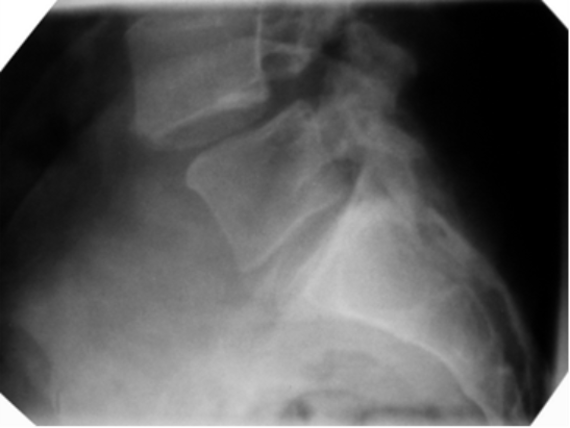
A 16-year-old boy presents to the clinic for evaluation of low back pain. The patient is participating in gymnastics training and has had difficulty preparing for an upcoming competition due to persistent low back pain that is worse with movement and relieved with rest. The patient is otherwise healthy. He has not had any recent injury or trauma. Vital signs are within normal limits. On physical examination, the low back is noted to be hyperlordotic. Pain is elicited with passive extension of the back. The straight leg test is negative bilaterally. A radiograph of the lumbar spine is shown below.
Which of the following best describes the etiology of this patient’s clinical presentation?
A. Repetitive stress on the pars interarticularis
B. Compression of L4 nerve root
C. Lytic bone lesions
D. Degeneration of the intervertebral disc
E. Narrowing of the intraspinal canal
Scroll down for the correct answer!
The correct answer to today’s USMLE® Step 1 Question is…
A. Repetitive stress on the pars interarticularis
Correct: See Main Explanation.
Incorrect Answer Explanations
B. Compression of L4 nerve root
Incorrect: Lumbar radiculopathy most commonly results from bulging intervertebral discs. The symptoms often include low back pain with associated radiation down the lower extremities. A straight leg raise is often positive with this condition.
C. Lytic bone lesions
Incorrect: The above lumbar film does not demonstrate lytic bony lesions, which often appear as punched-out areas of bone.
D. Degeneration of the intervertebral disc
Incorrect: Degenerative changes of the intervertebral discs and facet joints are a common cause of spondylolisthesis in older adults. However, in this adolescent gymnast, repetitive stress on the pars interarticularis is the more likely cause.
E. Narrowing of the intraspinal canal
Incorrect: Spinal stenosis is an uncommon condition in adolescent patients. It most commonly presents in elderly patients with pain that is worsened with walking or activity and is relieved by sitting, lying down, or bending forward at the waist.
Main Explanation
This adolescent patient presents for evaluation of low back. Imaging reveals grade 1 spondylolisthesis. Spondylolisthesis refers to anterior displacement of the vertebral body with respect to the adjacent vertebral bodies. Spondylolisthesis can be caused by degenerative changes in the spine in adult patients. It can also be congenital and seen in children. In both adolescents and children, pars defects can be caused by overuse of the low back, mainly from sports that involve repetitive back bend-like motion. This can lead to fracture of the pars interarticularis (spondylolysis) which may progress to anterior subluxation of one vertebral body with respect to an adjacent vertebral body (spondylolisthesis).
Lumbar spondylolisthesis can present with intermittent localized low back pain. The pain is typically worsened with lumbar extension and activities involving repetitive hyperextension. There may be pain with direct palpation on physical examination. Patients can also have radicular pain if the exiting nerve roots become compressed.
Radiography is the best initial test for diagnosing spondylolisthesis. CT of the spine has the highest sensitivity and specificity for diagnosis and may be performed after spinal radiographs are completed.
Major Takeaway
Overuse of the low back may lead to spondylolysis and subsequent spondylolisthesis, or the anterior displacement of the vertebral body with respect to the adjacent vertebral bodies, and present in children or adolescents as low back pain.
Overuse of the low back may lead to spondylosis and spondylolisthesis, or the anterior displacement of the vertebral body with respect to the adjacent vertebral bodies, and present in children or adolescents as low back pain.
Want to learn more about this topic?
Learn more about this condition: Spondylolisthesis
References
- Gagnet, P., Kern, K., Andrews, K., Elgafy, H., Ebraheim, N. (2018) Spondylolysis and spondylolisthesis: A review of the literature. Journal of Orthopaedics. 15(2), 404-407. Doi: 10.1016/j.jor.2018.03.008.
- Matz, P.G., Meagher, R.J., Lamer, T., et al. (2016) Guideline summary review: An evidence-based clinical guideline for the diagnosis and treatment of degenerative lumbar spondylolisthesis. The Spine Journal. 16(3), 439-448. Doi: 10.1016/j.spinee.2015.11.055.
- Walls, R., Hockberger, R., Gausche-Hill, M. (2017) Rosen’s emergency medicine: Concepts and clinical practice. Philadelphia, PA: Elsevier. ISBN: 978-0323354790.

Get your Osmosis from Elsevier free trial today to discover why millions of clinicians and caregivers love learning by Osmosis!
Leave a Reply