
Today’s USMLE® Step 1 question of the day features a 28-year-old man with a skin lesion who comes in concerned about scarring. What’s the most likely cause? Do you know the answer? Let’s find out!
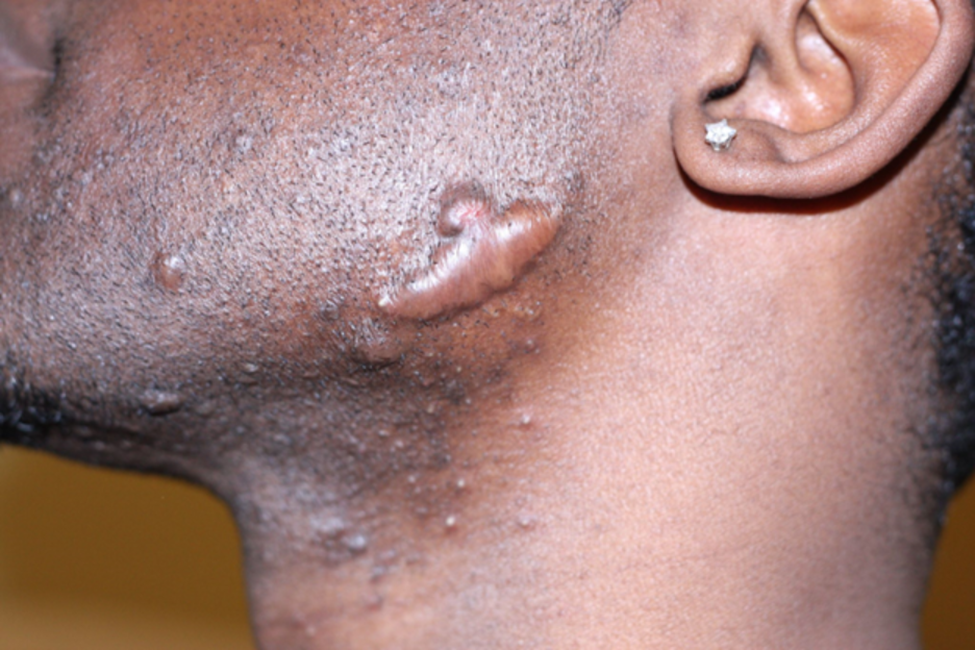
A 28-year-old man comes to the physician for a skin lesion. The patient injured his face a few months ago and now expresses his worries regarding the development of a scar. The site is itchy and painful. The image shows the scar of this patient.
Which of the following is true about the scar seen in the picture?
A. Under microscopy, it is characterized by increased production of collagen that is arranged in a haphazard pattern.
B. Under microscopy, it is characterized by increased production of collagen that is arranged in a parallel pattern.
C. It is made of type one collagen only
D. It is unlikely to recur
E. It is likely to regress
Scroll down for the correct answer!
The correct answer to today’s USMLE® Step 1 Question is…
A. Under microscopy, it is characterized by increased production of collagen that is arranged in a haphazard pattern.
Correct: See Main Explanation.
Incorrect Answer Explanations
B. Under microscopy, it is characterized by increased production of collagen that is arranged in a parallel pattern.
Incorrect: Hypertrophic scars are characterized by increased production of collagen that are arranged in a parallel pattern with the dermis. However, this patient’s scar is a keloid scar as it extends beyond the edges of the wound.
C. It is made of type one collagen only
Incorrect: Keloid scars are characterized by increased production of both type I and III collagen.
D. It is unlikely to recur
Incorrect: Keloid scars are more likely to recur. On the other hand, hypertrophic scar recurrence is rare.
E. It is likely to regress
Incorrect: Hypertrophic scars are likely to regress, unlike keloid scars.
Main Explanation
Wound healing is a process of restoration of the integrity of the damaged tissue and is balanced to produce as small scar as possible. However, if the regulation of the scar formation is disrupted, certain abnormal scars can result such as hypertrophic and keloid scars. Both keloid and hypertrophic scars share a common pathophysiology related to increased production of collagen.
In wound healing, the inflammatory phase plays an important role in determining the outcome of the wound as there is a balance in the expression of proinflammatory (e.g. Interleukin-6) and anti-inflammatory (e.g. Interleukin-10) cytokines. A change in the balance between the two may predispose to the formation of hypertrophic scars and keloid scars.
Additionally, TGF-β is the mediator that stimulates fibroblasts to produce collagen. It is believed that increased expression of TGF-β plays an important role in stimulating the fibroblasts to produce larger amounts of collagen and leading to hypertrophic or keloid scars.
However, there are notable differences in both hypertrophic scars and keloid scars.
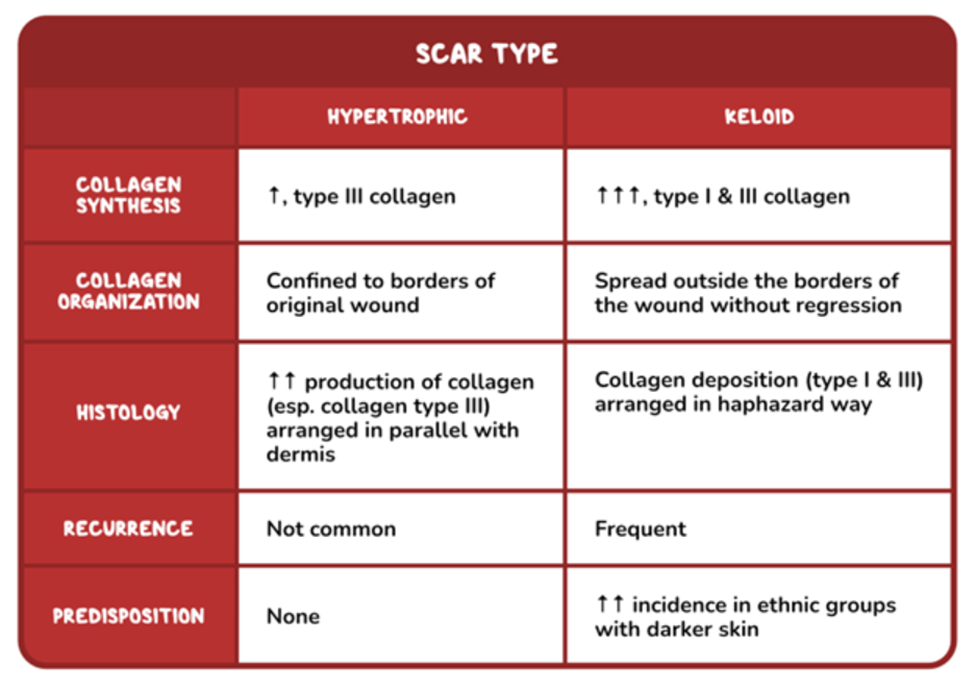
Hypertrophic scar is contained within the borders of the injury, and may regress with time. Additionally, it is not associated with genetic predisposition. Hypertrophic scars are more common in areas with more exposure to stretch as it increases the tension on the wound. The major difference between hypertrophic and keloid scars is the histological appearance. Hypertrophic scar is characterized by increased production of collagen (especially type III) that is arranged in parallel with the dermis.
On the other hand, keloid scars spread outside the borders of the wound without regression. Keloid scars are more common in people with darker skin color and are more prevalent in patients with African ethnicity. It is also more likely to be seen in areas with increased tension, but unlike hypertrophic scars, keloid scars can happen anywhere. The most common locations of keloid scars are the earlobes, face, and upper extremities. In histology, keloid scars are characterized by a massive increase in the production of collagen type I and III (up to 20 folds than normal scar) and the collagen deposition is arranged in a haphazard way (unlike hypertrophic scar). Finally, keloid scars are more likely to recur than the hypertrophic scars.
Major Takeaway
Keloid scars extend beyond the edges of the wound and are unlikely to regress. They are characterized by a massive increase in the production of type I and III collagen that are arranged in a haphazard fashion on microscopy.
Want to learn more about this topic?
Watch this Osmosis video: Collagen disorders: Pathology review
References
- Carswell L, Borger J. Hypertrophic Scarring Keloids. [Updated 2020 Aug 28]. In: StatPearls [Internet]. Treasure Island (FL): StatPearls Publishing; 2021 Jan-. Available from: https://www.ncbi.nlm.nih.gov/books/NBK537058/
- McGinty S, Siddiqui WJ. Keloid. [Updated 2020 Aug 16]. In: StatPearls [Internet]. Treasure Island (FL): StatPearls Publishing; 2021 Jan-. Available from: https://www.ncbi.nlm.nih.gov/books/NBK507899/
- Schmieder SJ, Ferrer-Bruker SJ. Hypertrophic Scarring. [Updated 2020 Sep 9]. In: StatPearls [Internet]. Treasure Island (FL): StatPearls Publishing; 2021 Jan-. Available from: https://www.ncbi.nlm.nih.gov/books/NBK470176/

Want more USMLE® Step 1 practice questions? Try Osmosis from Elsevier today! Access your free trial and discover why millions of current and future clinicians and caregivers love learning by Osmosis.
Leave a Reply