
Today’s NCLEX-RN® question of the day focuses on how to explain obstructive pulmonary disease to a caregiver. What’s the answer? Let’s find out!
The nurse in the pediatric unit is explaining obstructive pulmonary disease to the caregiver of a patient with cystic fibrosis.
Which statement by the caregiver indicates their understanding of the condition?
A. “Having an obstructive lung disease means air is blocked when my child tries to breathe in.”
B. “This means air gets trapped in my child’s lungs.”
C. “Obstructive lung diseases cause a low residual volume on pulmonary function tests.”
D. “An obstructive lung disease means the lungs can’t fill with enough oxygen-rich air.”
Scroll down for the correct answer!
Check out our NCLEX-RN Study Plan Guide!
The correct answer to today’s NCLEX-RN® Question is…
B. “This means air gets trapped in my child’s lungs.”
Rationale: This statement is correct. Obstructive lung diseases cause air to be trapped within the lungs.
Main Takeaway
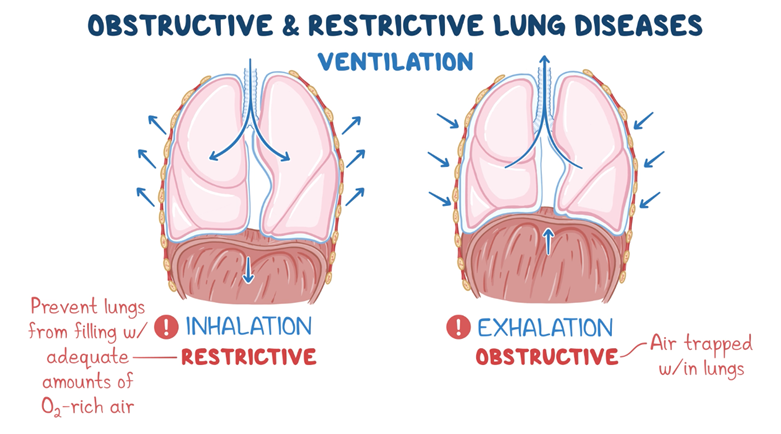
Obstructive lung diseases are characterized by obstruction of exhalation, causing air to be trapped within the lungs. Obstructive lung diseases cause slow emptying of the lungs, which leads to a high residual volume, or the amount of air left in the lungs after exhaling as hard as possible. On the other hand, restrictive lung diseases restrict inhalation, preventing the lungs from filling with adequate amounts of oxygen-rich air.
Incorrect Answer Explanations
A. “Having an obstructive lung disease means air is blocked when my child tries to breathe in.”
Rationale: Obstructive lung diseases are characterized by an obstruction of breathing out, or exhalation, rather than breathing in, or inhalation.
C. “Obstructive lung diseases cause a low residual volume on pulmonary function tests.”
Rationale: Obstructive lung diseases cause slow emptying of the lungs, which leads to a high, rather than low residual volume, or the amount of air left in the lungs after exhaling as hard as possible during a pulmonary function test.
D. “An obstructive lung disease means the lungs can’t fill with enough oxygen-rich air.”
Rationale: The lungs cannot fill with adequate amounts of oxygen-rich air in restrictive, rather than obstructive, lung diseases.
Want to learn more about this topic?
Watch the Osmosis video: Chronic obstructive pulmonary disease (COPD): Nursing process (ADPIE)

Get your free trial today to find out why millions of clinicians and caregivers love learning by Osmosis.
Leave a Reply