Animal and snake bites: Nursing
Introduction0:00–0:17
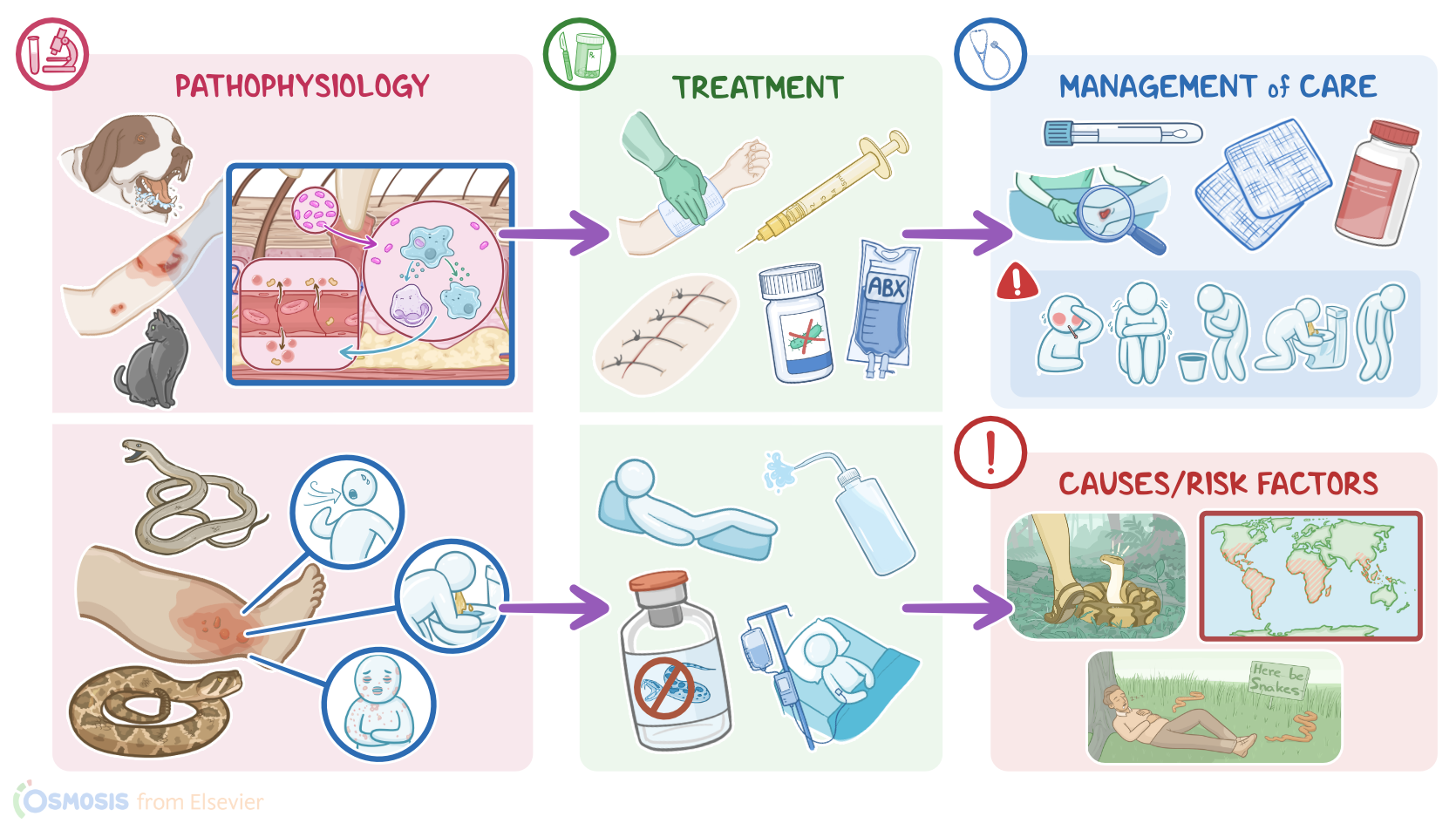
Bites can be caused by a wide variety of animals, including dogs, cats, and small rodents, like hamsters or squirrels; as well as wild animals, such as snakes.
Perhaps more surprisingly, bites can also be caused by humans! Let’s start by looking at the anatomy and physiology of the skin.
Physiology0:17–1:18
The skin is made of the epidermis, which is an outer layer that acts as a protective barrier against the environment; the dermis, which primarily contains blood vessels and nerve endings; and the hypodermis, which is a layer of connective tissue that provides structural support to the skin.
The skin also contains several immune cells which are responsible for phagocytizing invading pathogens, such as those that may have broken through the epidermis via a cut, scrape, or bite wound.
In addition, the release of cytokines causes capillaries to get larger and become more permeable, allowing plasma proteins and fluid to leave the circulation.
Ultimately, all of these factors contribute to the classic signs of inflammation: heat, pain, redness, and swelling. Now, the most common animal bites are from dogs, followed by cats and small rodents, like squirrels or rats.
Causes & Risk factors1:18–2:43
In particular, dog bites account for up to 90% of all animal bites, and they typically affect children under the age of 10.
On the other hand, cat bites are less common and tend to occur more frequently in adult clients. Finally, snake bites are a major hazard in certain areas of the world, including Southeast Asia, sub-Saharan Africa, and Latin America, as well as certain parts of the United States, depending on the species.
Most snake bites occur in forested areas, but also in regions of high density of snake population, typically farming regions where grain attracts rodents that, in turn, attract snakes.
There are two main venomous snake families: the Elapids, like corals, cobras, and mambas; and the Vipers, like rattlesnakes and copperheads.When it comes to animal bites, bites are considered provoked if done by a healthy animal when attempting to feed or handle it normally; or unprovoked, which usually occurs by an animal with rabies.
Snakebites, on the other hand, can occur inadvertently when someone steps on or disturbs a snake in the field; they can present as a bite to the head or trunk in individuals sleeping outside on the ground.
All right, now the pathology of animal bites involves both the mechanical injury caused by the bite itself, as well as any complications, including bite wound infection, or envenomation, which is the exposure to a poison or toxin.
Pathology2:43–4:21
Since dogs have strong jaws, dog bites typically cause serious tissue injury, but the lesion rarely gets infected. It’s important to note that dog bites can transmit a bacteria called Capnocytophaga canimorsus, which may cause gangrene at the bite site and then disseminate and cause sepsis, especially in asplenic clients and those with liver disease.
In contrast to dogs, cats have long, thin teeth that create deep puncture wounds, which very often get infected. Cat bites can even reach the underlying joint space or periosteum, leading to septic arthritis or osteomyelitis.
With snake bites, on the other hand, there are local changes at the bite site like erythema, swelling, and development of hemorrhagic bullae and tissue necrosis, as well as general symptoms depending on the type of snake venom.
Besides envenomation, snakebites can also lead to allergic reactions, as well as lasting injuries such as loss of a finger or limb due to amputation.
Clinical manifestations4:21–5:59
Clinical manifestations of animal bites can range from a simple laceration or puncture wound, to severe tearing of multiple skin layers because of the animal's teeth, jaw, or fangs.
In most cases, clients experience pain, swelling, redness, and possibly blistering, pus, or fluid oozing from the bite site.
There can also be a loss of sensation around the bite. With a systemic infection, manifestations can also include fatigue, fever or chills, and swollen lymph nodes.
Regarding envenomation, some snakes’ venom, like that produced by cobras, can cause neurotoxicity. This causes rapidly developing descending paralysis, resulting in diplopia, difficulty swallowing or talking, as well as limb or even respiratory muscle paralysis.Other venoms, like that of the Viper snakes, can cause direct cellular injury and hemotoxicity.
Their venom alters the balance of the coagulation system, resulting in coagulopathy, which can result in gum bleeding, epistaxis, hematemesis, or hematochezia.
In severe cases, hemorrhage secondary to coagulopathy can cause severe shock and cardiovascular collapse. Additionally, the venom may be myotoxic resulting in rhabdomyolysis.
This leads to tender, weak muscles and dark red urine. Unfortunately, some snake bites can cause death if not treated promptly.
The diagnosis of animal and snake bites starts with the client’s history, including the animal species and the circumstances of the bite, and physical assessment.
Diagnosis5:59–7:08
For mammal bites, follow-up testing may involve obtaining a CBC to look for leukocytosis, as well as ESR and CRP, which can be elevated in case of infection.
If the bite appears infected, a gram stain and culture of the wound should be obtained before starting antibiotics. Additionally, if there are signs of systemic illness, like fever or fatigue, then blood cultures should also be taken.
Finally, in a deep bite wound an X-ray should be taken to look for foreign bodies like teeth, bone or soft tissue injury, as well as subcutaneous gas.As for snakebites, laboratory testing may reveal thrombocytopenia or an elevated PT and a decreased fibrinogen, all of which are indicative of coagulopathy.
With rhabdomyolysis, laboratory testing shows an elevated CK level and an elevated urine myoglobin. Treatment of animal bite wounds begins with controlling any active bleeding with direct pressure.
The wound should be cleaned with normal saline or soap and water, and any superficial dead tissue should be debrided. In general, primary wound closure is indicated for superficial dog bites, however, cat and other severely contaminated bites aren’t closed, and instead should be left to close on their own by secondary intention due to the high risk of infection.
Treatment7:08–8:42
In addition to these general measures, tetanus prophylaxis with tetanus toxoid and tetanus immunoglobulin should be considered.
If the attack was from a wild or stray animal, then rabies prophylaxis with the rabies vaccine and immunoglobulin should be considered as well.
Finally, if the bite wound is infected, oral antibiotics like amoxicillin-clavulanic acid can be used to treat mild injuries, but deeper or more serious wound infections may require IV antibiotics like piperacillin-tazobactam.Regarding snakebites, treatment involves local wound care including cleaning the wound, analgesia with acetaminophen, NSAIDs or opioids, giving IV fluids, elevating the affected limb to prevent pooling of the venom, and giving a specific antivenom, when possible.
Contrary to popular belief, sucking out the venom is no longer recommended, and applying a tourniquet or ice to the bite site can actually cause further harm.All right, now let’s move on and talk about management of care of a client with a dog bite on the hand.
Goals of care are to promote healing and monitor for complications. First, take steps to promote healing by cleansing the wound and then gently irrigating it with normal saline.
Management of care8:42–9:59
Next, assess your client’s level of pain and administer the prescribed analgesic medication. Also administer the prescribed prophylactic antibiotic and tetanus prophylaxis; as well as rabies prophylaxis if indicated.
Also, if a joint is injured, be sure to assess your client’s range of motion and sensation, and obtain an X-ray of the hand, as ordered.Be sure to monitor your client’s vital signs and watch closely for complications, and report the presence of fever, chills, nausea, vomiting, or malaise to the healthcare provider.
Finally, report the animal bite to your local health authorities. All right, now let's move on to general client and family teaching.
Begin by instructing your client to take their prescribed antibiotic and analgesic medications exactly as directed, and teach them how to care for their wound, including how and when to change the dressing.
General client & family teaching9:59–11:22
During dressing changes, teach them to observe the wound closely, and to contact their healthcare provider right away if there is increased pain, swelling, warmth, or redness; or if they develop fever or chills.
Also emphasize the importance of seeking emergency care if there’s pus in the wound; if the wound has a bad smell; if there are red streaks extending from the wound; or if they develop numbness or tingling.
Lastly, stress the importance of following up with their healthcare provider, as directed, for continued monitoring and care.Next, teach them about how to avoid dog bites.
Explain the importance of avoiding unfamiliar dogs, and explain that a dog may show their teeth or put their tail between their legs if it is angry or scared.
Tell them not frighten a dog or disturb it when it is eating, sleeping, or caring for puppies. Also remind them to always ask before petting someone else's dog, to approach it slowly, and to let the dog sniff their hand before they touch them.
All right, as a quick recap… A variety of animals including dogs, cats, rodents, snakes, and even humans can cause bites, but dogs are the most common animal to cause bites in humans.
Risk factors of being bit by a dog include being under the age of 10, but cat bites more often affect adults. Risk factors for being bitten by a snake include living in certain areas of the world with high snake populations, or disturbing the animal.
Review11:22–13:00
Bites can cause mechanical injury, as well as complications such as infections, or envenomation, which is the exposure to a poison or toxin, in the case of snake bites.
Clinical manifestations such as pain, swelling, and redness are common at the site where the bite occurred, and symptoms such as fatigue, fever, and chills may also occur with a systemic infection.
There can also be signs and symptoms of neurotoxicity or coagulopathies with some snake bites. Diagnosis is mainly based on a history and assessment.
A CBC, blood culture, or X-ray can also be used. Treatment of most bites involve cleaning the wound and controlling any active bleeding, as well as administering tetanus, rabies, and antibiotic prophylaxis; while treatment for snakebites focuses on local wound care, fluids, and administering an antivenom, when possible.
Goals of nursing care include promoting healing and monitoring for complications. Client and family teaching focuses on self-care at home and how to prevent dog bites in the future.
When possible goals of nursing care include promoting healing and monitoring for complications Client and family teaching focuses on self care at home and how to prevent dog bites
| ANIMAL AND SNAKE BITES | ||
| KEY POINTS | NOTES | |
| DEFINITON |
| |
| PHYSIOLOGY |
| |
| CAUSES AND RISK FACTORS |
| |
| PATHOPHYSIOLOGY |
| |
| SIGNS AND SYMPTOMS |
| |
| DIAGNOSIS |
| |
| TREATMENT |
| |
| MANAGEMENT OF CARE |
| |
| PATIENT AND FAMILY TEACHING |
| |
- "Medical-Surgical Nursing" Elsevier (2020)
- "Saunders Comprehensive Review for the NCLEX-RN Examination" Saunders (2019)
- "Study Guide for the Core Curriculum for Oncology Nursing" Saunders (2019)
- "Epidemiology of snake bites in selected areas of Kenya" Pan African Medical Journal (2018)
- "First-hand knowledge about snakes and snake-bite management: an urgent need" Nagoya J Med Sci (2020)
- "Innovative Immunization Strategies for Antivenom Development" Toxins (2018)
- "Snakebite: When the Human Touch Becomes a Bad Touch" Toxins (2018)
No notes for this video yet
Try adding a note below