Bacterial pneumonia: Nursing process (ADPIE)
Client Report0:00–0:31
Nelly Singh is an 82 year old man who arrives at the urgent care clinic with his home health aide. Mr Singh has a history of cardiac disease, type one diabetes, prostate cancer and depression.
He was brought to the clinic this afternoon because of a new onset of a productive cough, dyspnea and chest pain. Mr Singh's aide tells the triage nurse nelly had these same symptoms two months ago.
I'm worried it's pneumonia again. Pneumonia is an infection in the lung tissue caused by microbes resulting in inflammation.
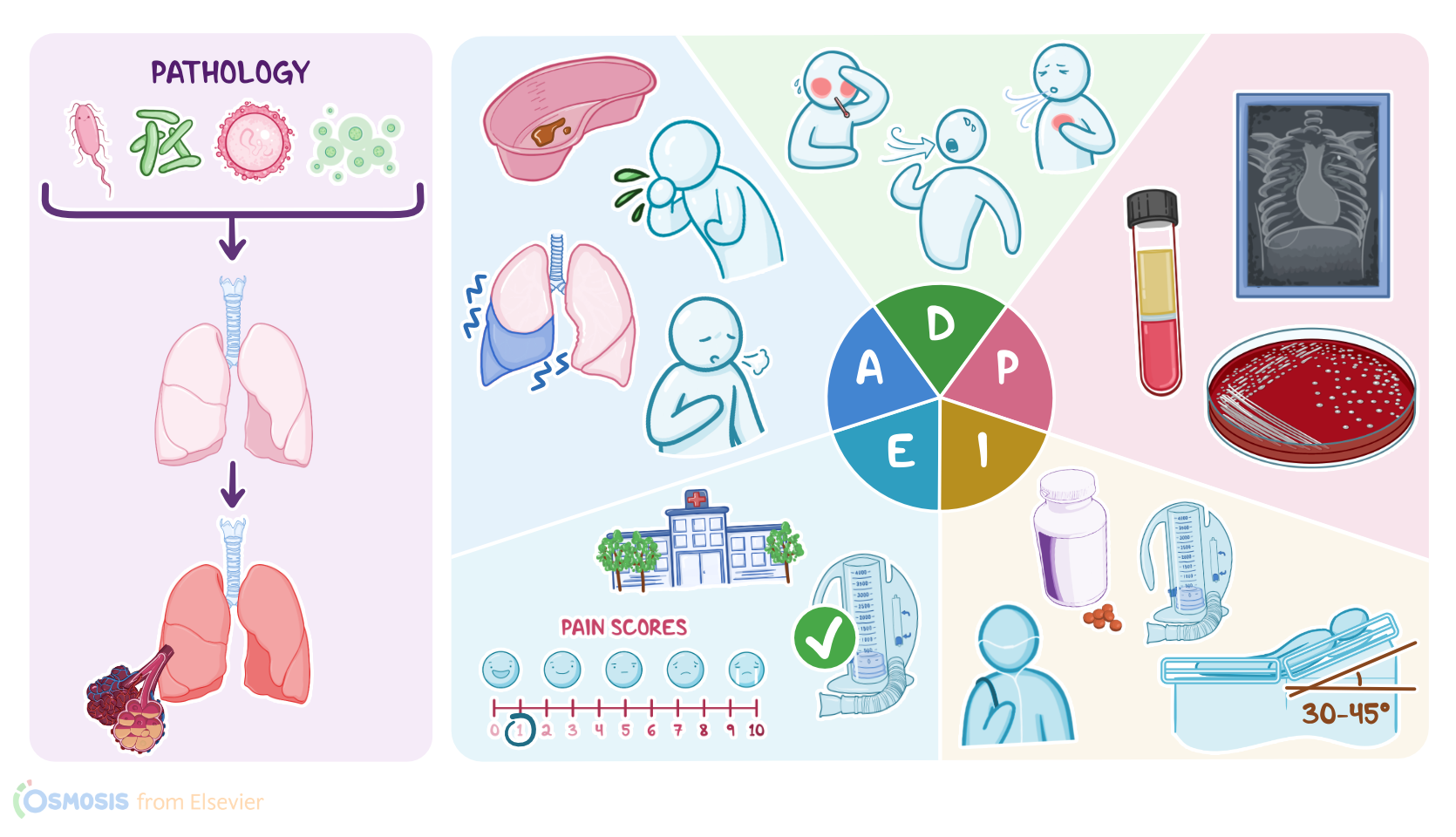
Pathology0:31–4:20
Usually it's caused by viruses and bacteria, but it can also be caused by fungi and a special class of bacteria called mycobacteria.
Bacterial causes include streptococcus pneumoniae, haemophilus influenzae, and staphylococcus aureus. There are also more unusual bacteria like mycoplasma, pneumoniae, chlamydophila, pneumoniae and legionella pneumophila, which don't have a cell wall and are well known for causing an atypical or walking pneumonia because they often cause vague symptoms.
For example, you might manifest with symptoms of a common cold and these aren't severe enough to require you to stay home or be hospitalized.
So you can still be out and about walking around in individuals with a normal immune system. Fungi are a rare cause of pneumonia and often it's regional.
For example, there is coccidioidomycosis in California and the southwest. One special fungal culprit is Pneumocystis uvea, which is a risk for immunocompromised individuals.
Finally, there's mycobacteria which are slow growing like fungi. Hence the Myco in their name, even though they're still bacteria.
The most well known one is mycobacterium tuberculosis also just called TB pneumonia can also be categorized by how it's acquired.
The most common is community acquired pneumonia. And it's called that when a person gets sick outside of a hospital or other health care setting.
Next is hospital acquired pneumonia or a nosocomial pneumonia, which is when a person gets pneumonia when they are already hospitalized for something else.
This type tends to be more serious because sick clients often have weakened immune systems and the microbes in hospitals are often resistant to common antibiotics.
That's because hospitals bring together the bacteria that are often the most virulent. Think great offense as well as the most resistant, think great defense.
Another category of pneumonia is ventilator associated pneumonia, which is a subset of the hospital acquired pneumonia that can specifically develop in ill individuals who are connected to a ventilator, oftentimes there's a biofilm which is a mix of bacteria and sugars and proteins that can co a surface that forms on the endotracheal tube.
Individuals on a ventilator can't cough, effectively have limited mobility and are often quite sick already. So over time, microbes can move from the tube directly into the lung and cause pneumonia.
Informally, we call that going down the wrong pipe. But we could also say that you aspirated that French fry.
Normally you'd automatically gag and start coughing and work that French fry out of your airway. These gag reflexes can be compromised, however, by drug and alcohol abuse, brain injuries or swallowing issues.
So in these cases that French fry might stick around in your lower airways. Now, of course, the French fry isn't sterile.
So there might be some microbes stuck to it. If those microbes infect the lungs and you get pneumonia, we call it aspiration, pneumonia, aspiration, pneumonia can also happen with drinks or even gastric contents.
Like after a bout of vomiting, aspirated gastric contents can be particularly nasty because stomach acid can cause a chemical irritation in addition to the possible infection.
So after you greet Mr Singh, introduce yourself as his nurse and confirm his identity. You can't help but notice the sound of a very productive cough when you enter the room, Nelly, as he's asked you to call him, says, I'm glad you're here.
Assessment4:20–5:59
I've got lots of phlegm coming up. You pass Nelly the emesis basin from the counter and proceed with your assessment.
You first ask how he's feeling to which he replies. Not too bad today.
Just this cough and a little chest pain still much better than I was before. I was having such a hard time breathing and couldn't finish a sentence without running out of air.
You wash your hands and listen to Nelly's breath sounds and note bronchi and wheezing in the right middle and lower lobes.
And you feel tactile fremitus, which is when you can feel increased vibrations from a person's chest or back after they repeat certain phrases.
This is because sound travels better through fluid filled, consolidated tissue than airfilled healthy tissue. As you assess his respiratory rate, you peek over into the emesis basin and observe thick dark colored sputum inside.
Next, you collect his vital signs, heart rate, 105 respiratory rate, 22 BP, 1, 38/90 oral temperature, 101.8 °F pain, four out of 10 oxygen saturation, 90% on room air.
Nelly's aide shares that he's been a little confused these days, repeating himself and forgetting what he's doing. Adding to her concern that he's not.
Well, you document all your assessment findings before leaving the room and update. Nelly and his aide that the advanced practice nurse practitioner or APR N will be in shortly to examine him further.
Based on the assessment data that you've collected, you identify that Nelly is at risk for a few problems. These include ineffective airway appearance related to increased production and viscosity of sputum pain related to his excessive coughing activity, intolerance related to impaired respiratory function, impaired gas exchange related to fluid consolidation in his lungs and deficient fluid volume related to fever and increased rapid respiratory rate.
Diagnosis5:59–6:29
Now, it's time to actively collaborate with the clinic's interdisciplinary team to provide and develop a holistic plan of care for Nelly.
After the A PRN S exam and a chest X ray. A diagnosis of bacterial pneumonia is made to confirm the causative organism.
The medical assistant collects a CBC blood culture times two and sputum culture as ordered followed by a 12 lead. ECG since Nelly has a history of cardiac disease, reflecting on the assessment data you've collected and the nursing diagnoses you've created, you determine the goals include increasing Nelly's ability to effectively clear his airway, increase his SP O2 to at least 94% on room air and ensure that he's adequately hydrating and eating, decrease or eliminate his chest pain and increase his ability to tolerate physical activity.
Planning6:29–7:25
Even though Nelly has been really pleasant. You recall his history of depression and will be monitoring and supporting his personal psychosocial needs.
After reviewing the plan of care, you check the recently reported CBC results which reveal a white blood cell count of 15 times 10 to the ninth per liter and E sr of 87 millimeters per hour with oxygen going at 2 L via nasal cannula as prescribed to increase his SP O2.
You teach Nelly and his aide how to and the importance of coughing and deep breathing, extremely important in preventing pneumonia infections.
Implementation7:25–9:29
The medical assistant has left an incentive spirometer in the room for you to use when educating Nelly, as you teach them both, you include positioning techniques in the discussion like semi Fowler's which helps facilitate breathing and lung expansion.
You also share that it's important for Nelly to change positions frequently and ambulate as much as tolerated. These are great ways to help mobilize those secretions.
He's having. You note the APR N has ordered a few more things for Nelly including Ibuprofen administering.
This will help with his chest pain, making it easier for him to cough and deep breathe and help with his fever with a clear airway and being pain free.
This also helps Nelly's ability to engage in activity without feeling out of breath. Once Nelly's oxygen saturation has increased and he's stabilized.
You prepare the albuterol nebulizer. Finally, after his airways are open, you administer his first dose of Azithromycin.
Before leaving the room, you hand nelly and his aide some visual information that you put together to review with them about the importance of hand hygiene, increasing his daily fluid intake to help thin out and move secretions and recommendations for small frequent meals that are high in calories and protein.
Since pneumonia can cause an acceleration in metabolism and being sick often decreases appetites. Both of these things can cause nelly to lose weight and increase his risk for malnutrition.
Nelly is successfully using the incentive spirometer with the assistance of his aide and says that the medication you gave me for pain helps a lot.
You reassess his vital signs. Heart rate, 108 respiratory rate, 20 BP, 1 30/86 oral temperature, 100.9 °F pain, one out of 10 oxygen saturation, 97% on 2 L of O2 via nasal cannula.
After documenting those, you report the findings to the APR N. However, after further assessment by the APR N review of Nelly's medical history and collaborating with his primary care provider, the plan of care has been updated to transfer him to the local community hospital for continued treatment and monitoring while you await transfer and continue to provide Nelly's care.
Evaluation9:29–10:27
You'll be sure to communicate that with the healthcare team immediately if there's a decline or worsening in Nelly's condition such as difficulty breathing or manifestations of hypoxia.
So, Nelly Singh has bacterial pneumonia and is experiencing some typical signs and symptoms. Pneumonia is an infection in the lung tissue caused by microbes resulting in inflammation.
Summary10:27–11:44
There are also different ways you can get pneumonia such as community acquired or hospital acquired. In some cases, pneumonia can be caused by aspiration of food, liquids or foreign bodies into the lungs.
Your assessment of nelly revealed a productive cough, chest pain, dyspnea on exertion as well as an increase in heart rate, respiratory rate and temperature with a decrease in SP O2.
His aide also informs you that he appears more confused since becoming ill. Your nursing diagnoses center around the physical and physiological responses to his health problem and include things like ineffective airway clearance related to increased production and viscosity of sputum pain related to excessive cough activity intolerance related to impaired respiratory function and impaired gas exchange related to fluid consolidation.
The goals of the plan of care are to resolve those responses and restore Nelly's health and wellbeing as well as educate him and his aide on health promotion activities along with the healthcare team you enact actions to implement to help nelly successfully achieve these goals throughout your shift at the clinic and up until nelly is transferred, you'll continue to work along with the team to evaluate if those goals have been met and if not modify the plan of care to ensure they are.
| BACTERIAL PNEUMONIA | ||
| KEY POINTS | NOTES | |
| PATIENT REPORT |
| |
| PATHOPHYSIOLOGY |
| |
| DIAGNOSIS AND TREATMENT |
| |
| ASSESSMENT |
| |
| NURSING DIAGNOSES |
| |
| PLANNING |
| |
| IMPLEMENTATION |
| |
| EVALUATION |
| |
- "Nursing Diagnosis Handbook: An Evidence-Based Guide to Planning Care. 13th edition. ISBN: 978-0-323-77683-7 " Mosby (2022.)
- "Community-acquired bacterial pneumonia in adults: An update. " Indian J Med Res. (2020;151(4):287-302. )
- "Guidelines for the Evaluation and Treatment of Pneumonia. " Prim Care. (2018;45(3):485-503. )
- "Host-Pathogen Interactions in Gram-Positive Bacterial Pneumonia. " Clin Microbiol Rev. (2019;32(3):e00107-18. Published 2019 May 29. )
- "Emerging antibiotics for community-acquired pneumonia [published correction appears in Expert Opin Emerg Drugs. 2019 Dec;24(4):i]. " Expert Opin Emerg Drugs. (2019;24(4):221-231. )
- "Harrison’s Principles of Internal Medicine. 21st edition. ISBN: 978-1-264-26850-4 " McGraw Hill / Medical (2022)
- "Critical Care Nursing: Diagnosis and Management. 9th edition. ISBN: 978-0-323-64295-8 " Elsevier (202)
No notes for this video yet
Try adding a note below