Benign prostatic hyperplasia (BPH): Nursing process (ADPIE)
Client Report0:00–0:43
Martin Lewis is a 68 year old client who presented to his community health clinic complaining of recurring trips to the bathroom, a frequent urge to urinate, and a weak urine stream that dribbles.
His family physician completed an assessment of his symptoms, including a digital rectal exam. A diagnosis of benign prostatic hyperplasia or BPH is suspected.
The physician ordered several laboratory tests, including a basic metabolic panel, prostate-specific antigen, and urinalysis to help confirm the diagnosis.
After completing these tests, Martin returns to the clinic two weeks later for a follow-up appointment. Benign prostatic hyperplasia or BPH is a condition where non-cancerous cells in the prostate gland increase in number, enlarging the prostate.
Pathology0:43–5:08
This condition is common in men over 50 and is often considered a normal part of aging. By the age of 60, around 50% of men develop BPH and over 90% have it by the age of 85.
Other risk factors for developing BPH include obesity, sedentary lifestyle, and family history of BPH. The exact cause of BPH is not well understood, but current understanding is that environmental and genetic factors play a role along with the influence of sex hormones testosterone, dihydrotestosterone, or DHT, and estrogen.
Whatever the cause, the hyperplastic growth of prostatic smooth muscle and epithelial tissue enlarges the prostate, which then compresses the urethra, obstructing the flow of urine.
BPH can be asymptomatic, but when symptoms are present, they include lower urinary tract symptoms such as urinary urgency, hesitancy, which is trouble initiating urination, a weak urine stream, dribbling and straining to urinate, and nocturia.
These symptoms significantly impair quality of life. If the bladder isn't empty completely, it can eventually cause kidney damage and even lead to kidney failure if not treated.
Also, the stasis of urine in the bladder increases the chance of kidney stones forming, and it promotes bacterial growth, which can lead to urinary tract infections or prostatitis, which is an infection in the prostate.
Fortunately, BPH does not increase the risk of developing cell mutations that lead to prostate cancer. Benign prostatic hyperplasia is diagnosed by history and physical examination with a digital rectal examination, which is where a finger is inserted into the rectum to feel the prostate against the anterior wall of the rectum.
Levels of prostate-specific antigen, or PSA, which is a substance produced by healthy prostate cells, are also elevated in benign prostatic hyperplasia, since there are more cells making the PSA.
A bladder scanner, which is a portable handheld ultrasound device, can determine the post-void residual volume, which is the amount of urine left in the bladder after urinating.
Post-void residual volume of greater than 100 mL suggests urinary retention. If an infection is suspected, a urine sample is collected for urinalysis and culture.
Treatment of BPH focuses on relieving the obstruction and allowing the urine to flow normally. For mild symptoms, lifestyle changes may be enough to manage symptoms such as avoiding liquids 1 to 2 hours before bedtime to reduce nocturia, retraining the bladder by scheduling regularly timed toileting, and attempting urination in complete privacy.
This involves waiting for a few minutes, urinating, and then trying to empty the bladder again. Treatments include medications like alpha blockers such as tamsulosin, which relax the muscles near the prostate and relieve the pressure on the urethra, allowing the urine to flow more easily.
Other medications like finasteride, a 5 alpha reductase inhibitor, reduce the size of the prostate by inhibiting the conversion of testosterone into dihydrotestosterone.
If medications are not enough to relieve symptoms, there are surgical procedures that can help. This includes techniques to ablate or destroy prostatic tissue using procedures such as transurethral resection of the prostate, which uses electrocautery energy, aqua ablation that uses high pressure saline, and photoselective vaporization of the prostate that uses laser energy.
In certain cases, a prostatectomy, where all the prostate tissue is removed, is performed. OK, let's get back to our client Martin and perform an assessment.
Assessment5:08–7:09
You enter the examination room where Martin has been waiting and introduce yourself as a registered nurse. Wash your hands and confirm his identity.
You ask Martin how he's feeling today. And he responds that he has been feeling fine, but during the past several months he's been having difficulty urinating.
He says he used the bathroom just 10 minutes ago, but his bladder still feels full. Sometimes he has to push to get the flow started and the flow is weak.
He often has to start and stop while urinating. He also says he needs to use the bathroom every 1 to 2 hours throughout the day, and when he has to go, he has to hurry to the bathroom.
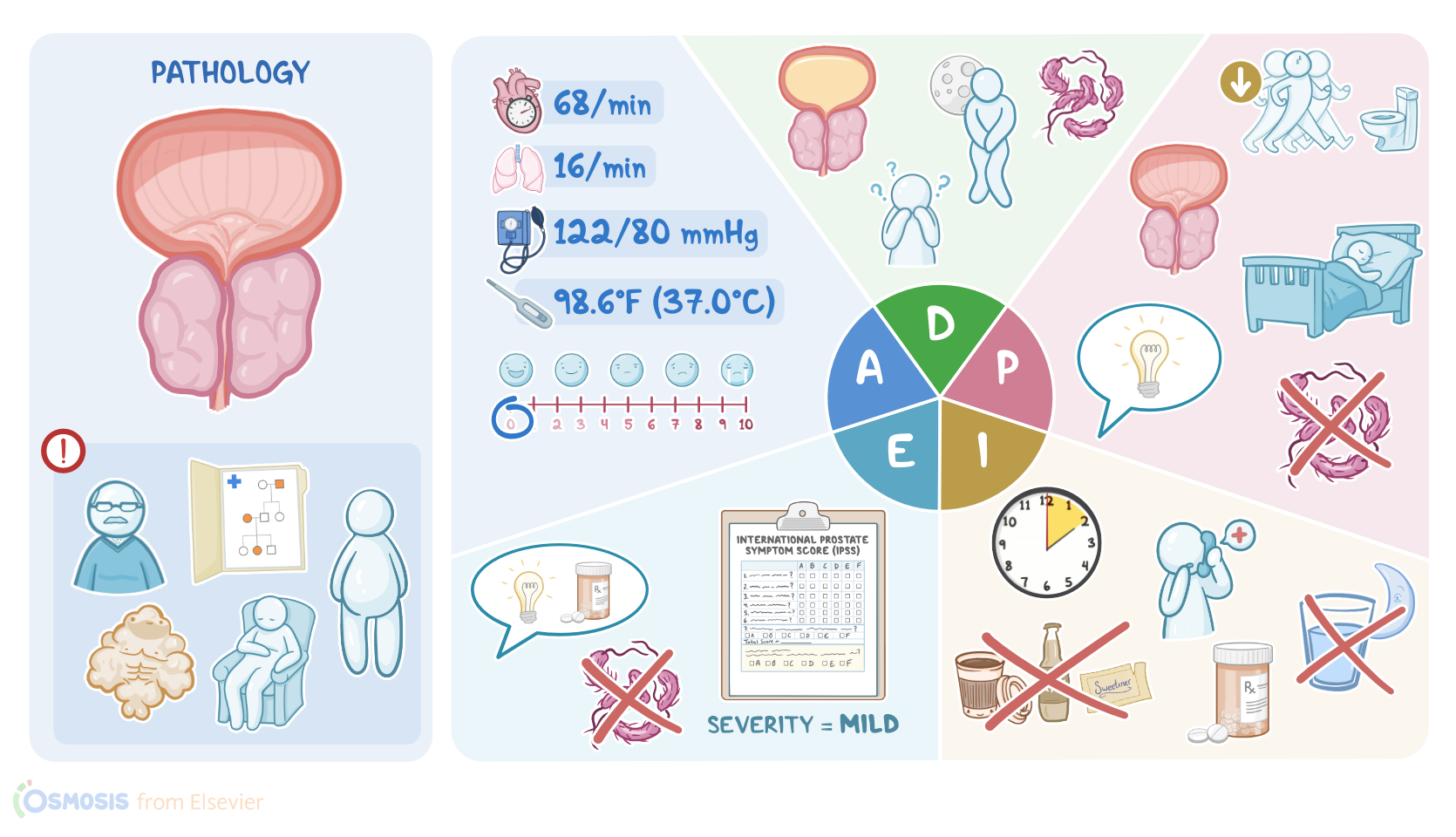
He says he feels tired during the day because he wakes up at least 4 times during the night to urinate. Using the International Prostate Symptom Score or IPSS, you rate the severity of his symptoms as moderate.
His vital signs are BP 122/80 millimeters mercury, heart rate 68 BPM, temperature 98.6 °F or 37.0 °C, respiratory rate 16 per minute, oxygen saturation 96% on room air, and pain is 0 out of 10.
Next you ask Martin to lay down on the exam table and you palpate his lower abdominal area to reveal a distended bladder.
You use the bladder scanner to determine a post-void residual, which shows 300 mL of urine. You note his blood urea nitrogen, BUN, creatinine, and electrolytes are within normal range.
His prostate-specific antigen or PSA is elevated at 4.5 nanograms per milliliter. A urinalysis shows no evidence of infection.
After documenting your assessment findings, you let him know the physician will be in shortly. Based on the assessment data you have collected, your nursing diagnoses include urinary retention related to the obstruction of the urethra, sleep deprivation related to nocturia, risk for infection related to urinary retention.
Diagnosis7:09–7:29
And deficient knowledge related to treatment regimen and self-care needs. Now that you've created nursing diagnoses, you collaborate with Martin and his physician to make a plan to achieve some important treatment goals.
Planning7:29–8:04
By this follow-up appointment in 2 weeks, Martin will report decreased urinary urgency and frequency and decreased nocturia and increased alertness during the day.
He will experience less bladder fullness after voiding, and he will remain free of urinary tract infections. Finally, he will verbalize understanding of his self-care needs and treatment regimen by the end of the visit.
Implementation8:04–9:29
All right, now it's time to implement the plan of care. Martin will begin taking tamsulosin, an alpha blocker, so you review the physician directions for taking the medication along with some of the side effects he could experience, such as orthostatic hypotension, dizziness, and sexual dysfunction.
He will also start a bladder diary where over the next 14 days he will record his bladder habits and he will bring this information to his follow-up visit.
And because certain over the counter medications like decongestants and antihistamines can make it harder to urinate, you teach him to check with his physician before taking these medications.
To help decrease nocturia, you remind him to limit liquids an hour or two before bedtime. Finally, you ensure he understands the symptoms of a urinary tract infection and that if bladder distention is producing significant pain, he should seek emergency care.
Evaluation9:29–10:32
Martin returns to the clinic two weeks later. He states his urine stream has improved since starting the tamsulosin.
After he voids, you use the bladder scanner to determine Martin's post-void residual volume, which shows 75 mL. You review the bladder diary with Martin and determine his typical voiding frequency continues to be about 2 hours during the day.
He states he is still having to get up and use the bathroom 1 to 2 times during the night but reports that his sleep has significantly improved.
His current IPSS score shows his symptom severity is mild. No signs or symptoms of a urinary tract infection are present.
Martin's symptom improvement demonstrates adherence with his treatment regimen and an increase in understanding of his self-care needs.
He will continue to require follow-up visits at the clinic to monitor his response to treatment and make adjustments to his treatment plan as required.
All right, as a quick recap, benign prostatic hyperplasia or BPH is a condition where an enlarged prostate gland obstructs urine flow.
Summary10:32–11:34
Leading to symptoms such as urinary frequency, hesitancy, dribbling, incomplete bladder emptying, and nocturia. BPH treatments include lifestyle modifications, medications like alpha blockers, and 5 alpha reductase inhibitors, or surgery.
Your assessment revealed Martin was experiencing moderate symptoms of BPH. Your nursing diagnoses were urinary retention, sleep deprivation, risk for infection, and deficient knowledge.
The goals you identified when planning care for Martin included establishing an effective urinary pattern, improving sleep quality, remaining infection-free, and understanding his treatment regimen.
Interventions will continue to be implemented and evaluated to determine if his goals are being met.
| BENIGN PROSTATIC HYPERPLASIA (BPH) | ||
| KEY POINTS | NOTES | |
| PATIENT REPORT |
| |
| PATHOPHYSIOLOGY |
| |
| DIAGNOSIS AND TREATMENT |
| |
| ASSESSMENT |
| |
| NURSING DIAGNOSES |
| |
| PLANNING |
| |
| IMPLEMENTATION |
| |
| EVALUATION |
| |
- "Ackley and Ladwig’s Nursing Diagnosis Handbook: An Evidence-Based Guide to Planning Care, 13th edition" Mosby (2022)
- "Benign prostatic hyperplasia - what do we know?" BJU Int (2021)
- "What is a disease? What is the disease clinical benign prostatic hyperplasia (BPH)?" World J Urol (2019)
- "Critical Care Nursing: Diagnosis and Management, 9th edition" Elsevier (2021)
- "Harrison’s Principles of Internal Medicine, 21st edition" McGraw Hill / Medical (2022)
- "Current Treatment for Benign Prostatic Hyperplasia" Dtsch Arztebl Int (2020)
- "Pathophysiology of Benign Prostatic Hyperplasia and Benign Prostatic Enlargement: A Mini-Review" Gerontology (2019)
No notes for this video yet
Try adding a note below