Birth-related procedures: Nursing
Introduction0:00–0:35
Labor, also called childbirth, is a physiologic process during which the fetus and placenta are expelled from the uterus.
The most common form of delivery is vaginal, meaning that the baby passes through the vaginal canal. However, some deliveries require the assistance of healthcare providers in the form of birth-related procedures.
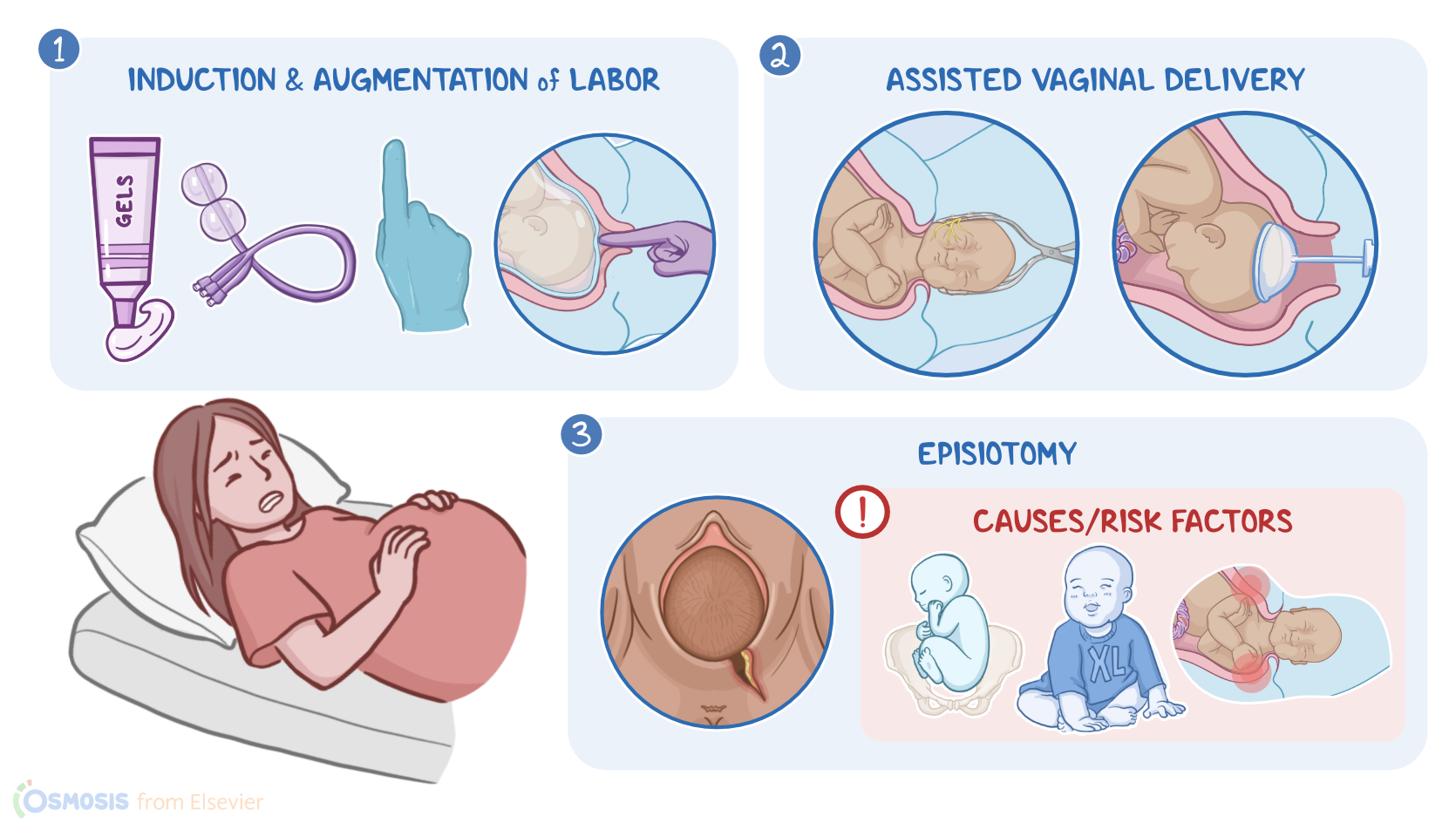
These procedures include, labor induction and augmentation, assisted vaginal delivery, sometimes called operative vaginal delivery, and episiotomy.
Labor induction and augmentation0:35–2:38
Cervical ripening can be done pharmacologically or mechanically. With pharmacological cervical ripening, prostaglandin E2, also known as dinoprostone, is most commonly used.
It comes in the form of intravaginal gel, intracervical gel, or timed-release vaginal insert. Prostaglandin E1, also known as misoprostol, can also be used for cervical ripening, but it’s an off-label use.
One setback of using prostaglandins for cervical ripening is that it also increases the contractility of the uterus, and can even result in tachysystole, or excessively frequent uterine contractions, so both the uterine activity and the fetal heart rate must be monitored when prostaglandin E2 is in place.
For mechanical cervical opening, there are two methods. The first can be done using a trans-cervical balloon catheter.
A trans-cervical catheter is inserted through the internal cervical os, or cervical opening, and the balloon is inflated.
Then, the balloon is retracted down against the cervical os. This creates direct pressure and induces release of endogenous prostaglandins.
On the other hand, membrane stripping involves the digital separation of the amniotic membrane from the cervical and uterine walls.Both pharmacological and mechanical cervical ripening can be followed by amniotomy, which is the artificial rupturing of the membranes with a plastic hook.This procedure shortens the time from induction to delivery.
Okay, moving on to assisted vaginal delivery. This is when clinicians use devices to help extract the fetus through the vaginal canal.
Assisted vaginal delivery2:38–4:23
It’s important to remember that these are only used to facilitate birth in situations where the health of the mother or fetus is at risk.
Two common methods include vacuum and forcep assisted vaginal delivery. With vacuum assisted vaginal delivery, a soft cup is attached to the fetal scalp.
The cup is connected to a vacuum that provides the suction so the cup doesn’t detach. During each contraction, the suction is increased and the clinician applies gentle traction to help guide the fetus through the vaginal canal.
Potential risks of vacuum assisted delivery include fetal injury, including scalp lacerations, hematomas and scalp bleeding, and retinal hemorrhage.With forceps assisted vaginal delivery, a special forceps that can detach into a left and right blade is used.
The blade of the forceps is curved so it will fit snugly around the curvature of the skull. Once both blades are inserted, they lock together.
Then, during each contraction, the clinician applies gentle traction to help pull the fetus and guide it through the vaginal canal.
Potential risks of forceps assisted vaginal delivery include vaginal and cervical lacerations, as well as fetal injuries such as bruising, lacerations, skull fractures and nerve injury.
Episiotomy4:23–5:17
Finally, there’s a procedure called episiotomy, which involves the incision of the perineum to widen the birth canal and allow for an easier passage of the fetus.
This incision can be in the midline, called median episiotomy, or oblique, called mediolateral episiotomy. Indications for episiotomy include vacuum or forceps assisted birth, birth of a fetus with face-up presentation, and breech delivery.
Other indications include macrosomic fetus, which is when the baby is large, and shoulder dystocia, which is when one or both fetal shoulders get stuck inside the maternal pelvis.
Episiotomy also carries certain risks, the main of which is infection. Other adverse effects include perineal pain, spontaneous laceration, and sphincter injuries.
Alright, as a quick recap, labor induction and augmentation includes cervical ripening, which can be pharmacological, using prostaglandin E2, or mechanical, which includes procedures like trans-cervical balloon catheter insertion or membrane striping.
Review5:17–6:00
After cervical ripening, an amniotomy can be done to reduce delivery time. Assisted vaginal delivery methods include vacuum assisted delivery, where a suction cup is placed on the fetal head, and forceps assisted vaginal delivery, where a special forceps that can detach into a left and right blade is used.
Finally, an episiotomy is a surgical procedure that involves creating an incision in the perineum to widen the birth canal, allowing the fetus to pass more easily.
| BIRTH-RELATED PROCEDURES | ||
| KEY POINTS | NOTES | |
| DEFINITION |
| |
| LABOR INDUCTION & AUGMENTATION |
| |
| ASSISTED VAGINAL DELIVERY |
| |
| EPISIOTOMY |
| |
No notes for this video yet
Try adding a note below