Bronchiolitis and respiratory syncytial virus (RSV): Nursing process (ADPIE)

1,804views

Bronchiolitis and respiratory syncytial virus (RSV): Nursing process (ADPIE)

Nursing

Nursing

Aortic aneurysm: Nursing process (ADPIE)
Coronary artery disease (CAD) and angina pectoris: Nursing process (ADPIE)
Hypertension: Nursing process (ADPIE)
Left-sided heart failure: Nursing process (ADPIE)
Myocardial infarction (MI): Nursing process (ADPIE)
Pericardial effusion and cardiac tamponade: Nursing process (ADPIE)
Rheumatic heart disease: Nursing process (ADPIE)
Diabetes insipidus: Nursing process (ADPIE)
Diabetes mellitus (DM): Nursing process (ADPIE)
Diabetic ketoacidosis (DKA): Nursing process (ADPIE)
Hyperthyroidism: Nursing process (ADPIE)
Hyperosmolar hyperglycemic state (HHS): Nursing process (ADPIE)
Hypothyroidism: Nursing process (ADPIE)
Syndrome of inappropriate antidiuretic hormone (SIADH): Nursing process (ADPIE)
Epistaxis: Nursing process (ADPIE)
Eye injury: Nursing process (ADPIE)
Glaucoma: Nursing process (ADPIE)
Tonsillitis: Nursing process (ADPIE)
Appendicitis: Nursing process (ADPIE)
Celiac disease: Nursing process (ADPIE)
Cirrhosis: Nursing process (ADPIE)
Gastroesophageal reflux disease (GERD): Nursing process (ADPIE)
Hiatal hernia: Nursing process (ADPIE)
Pancreatitis: Nursing process (ADPIE)
Peptic ulcer disease (PUD): Nursing process (ADPIE)
Acute kidney injury (AKI): Nursing process (ADPIE)
Benign prostatic hyperplasia (BPH): Nursing process (ADPIE)
Urinary tract infections (UTIs): Nursing process (ADPIE)
Urinary incontinence - Stress: Nursing process (ADPIE)
Age-related physiological changes: Nursing process (ADPIE)
Hemophilia: Nursing process (ADPIE)
Leukemia: Nursing process (ADPIE)
Sickle cell disease: Nursing process (ADPIE)
Anaphylaxis: Nursing process (ADPIE)
Lyme disease: Nursing process (ADPIE)
Atopic dermatitis: Nursing process (ADPIE)
Frostbite: Nursing process (ADPIE)
Methicillin-resistant Staphylococcus aureus (MRSA): Nursing process (ADPIE)
Pressure injury: Nursing process (ADPIE)
Hyperbilirubinemia: Nursing process (ADPIE)
Placenta previa: Nursing process (ADPIE)
Placental abruption: Nursing process (ADPIE)
Prolapsed umbilical cord: Nursing process (ADPIE)
Anxiety disorders: Nursing process (ADPIE)
Eating disorders: Nursing process (ADPIE)
Acute compartment syndrome: Nursing process (ADPIE)
Fractures: Nursing process (ADPIE)
Gout: Nursing process (ADPIE)
Musculoskeletal injuries: Nursing process (ADPIE)
Rheumatoid arthritis (RA): Nursing process (ADPIE)
Meningitis: Nursing process (ADPIE)
Parkinson disease: Nursing process (ADPIE)
Stroke: Nursing process (ADPIE)
Trigeminal neuralgia: Nursing process (ADPIE)
Seizure disorder: Nursing process (ADPIE)
Breast cancer: Nursing process (ADPIE)
Tumor lysis syndrome (TLS): Nursing Process (ADPIE)
Bronchiolitis and respiratory syncytial virus (RSV): Nursing process (ADPIE)
Chickenpox (Varicella): Nursing process (ADPIE)
Conjunctivitis: Nursing process (ADPIE)
Hydrocephalus: Nursing process (ADPIE)
Poisoning: Nursing process (ADPIE)
Pyloric stenosis: Nursing process (ADPIE)
Reye syndrome: Nursing process (ADPIE)
Peripheral arterial disease (PAD): Nursing process (ADPIE)
Peripheral venous disease (PVD): Nursing process (ADPIE)
Candidiasis: Nursing process (ADPIE)
Gonorrhea and chlamydia: Nursing process (ADPIE)
Pelvic inflammatory disease (PID): Nursing process (ADPIE)
Asthma: Nursing process (ADPIE)
Bacterial pneumonia: Nursing process (ADPIE)
Carbon monoxide poisoning: Nursing process (ADPIE)
Chronic obstructive pulmonary disease (COPD): Nursing process (ADPIE)
Epiglottitis: Nursing process (ADPIE)
Foreign body aspiration and upper airway obstruction: Nursing process (ADPIE)
Laryngotracheobronchitis (LTB) and croup: Nursing process (ADPIE)
Smoke inhalation injury: Nursing process (ADPIE)
Venous thromboembolism (VTE): Nursing process (ADPIE)

Notes

BRONCHIOLITIS AND RESPIRATORY SYNCTIAL VIRUS (RSV)

KEY POINTS
NOTES
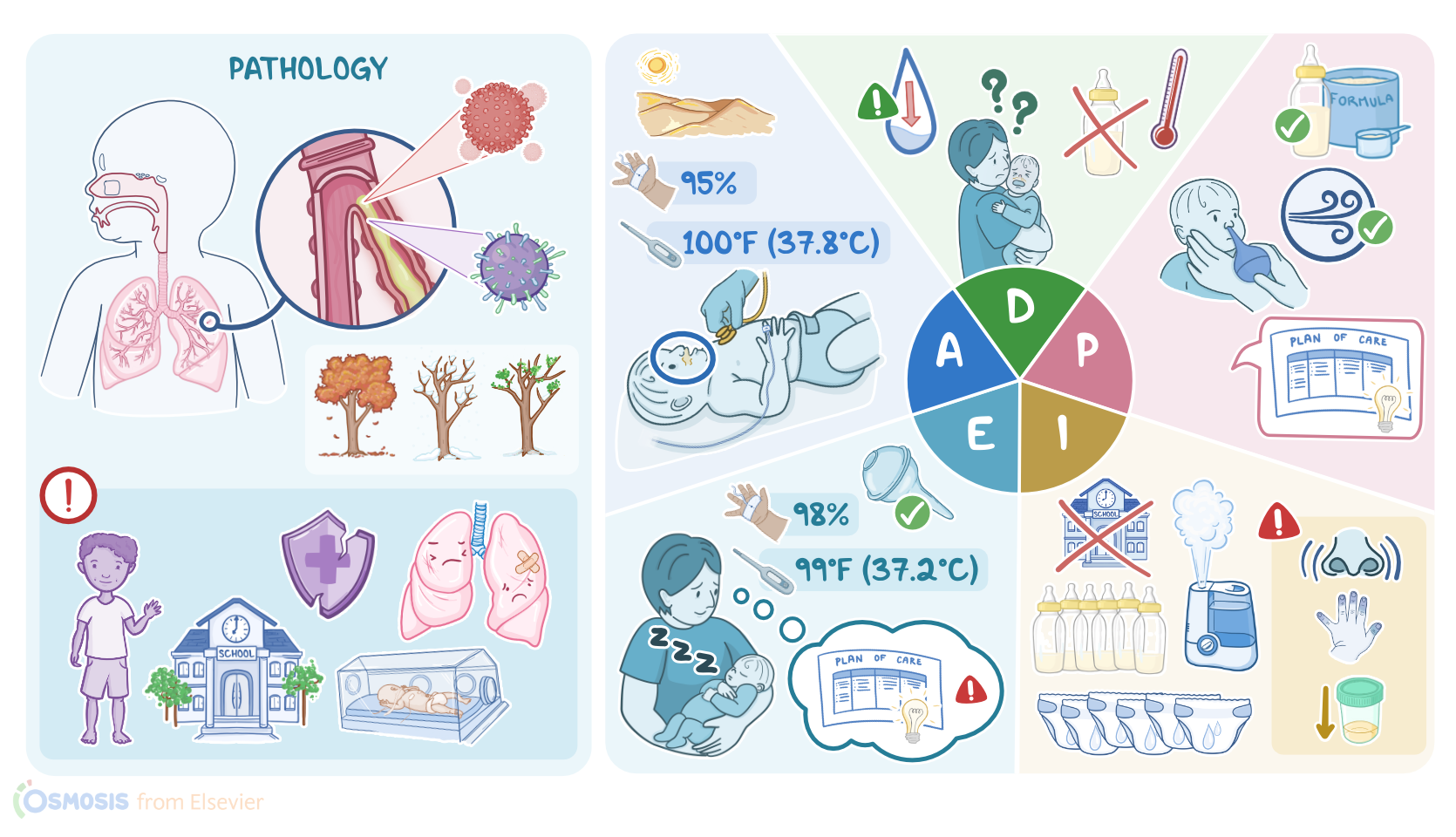
PATIENT REPORT
  • 6-month-old 
  • Urgent care clinic
  • Runny nose, temperature of 100.4 F (38 C)
  • Increased work of breathing, not feeding well
  • Suspected RSV

PATHOPHYSIOLOGY
  • Bronchiolitis  
    • Inflammation of the bronchioles 
    • Most common in colder months 
    • Common cause: RSV
    • Other causes 
      • Adenovirus 
      • Parainfluenza virus 
      • Human metapneumovirus  
  • Risk factors bronchiolitis 
    • Age < 2 years 
      • Highest risk: infants < 3 months 
    • Premature birth
    • Underlying conditions
      • Chronic lung/heart disease
      •  Immunocompromised status
    • Environmental factors
      • Daycare
      • Exposure to crowds
      • Exposure to tobacco smoke
      • Older siblings in school 
  • Transmission of RSV 
    • Direct contact with respiratory droplets from infected person 
    • Virus survives on surfaces for hours 
  • Pathophysiology of bronchiolitis 
    • Virus invades bronchiolar epithelial cells 
    • Cells become virus factories and die
    • Moves down respiratory tract to bronchioles 
    • Inflammatory response
      • Swelling 
      • Increased mucus production 
      • Dead cells and mucus form plugs 
    • Airway obstruction and alveolar collapse (atelectasis) 
    • Air trapping
  • Symptoms of bronchiolitis 
    • Early symptoms 
      • Low-grade fever 
      • Congestion 
      • Rhinorrhea 
      • Cough 
    • Progressive symptoms 
      • Fever
      • Congestion
      • Rhinorrhea
      • Cough
      • Dyspnea 
      • Tachypnea
      • Apnea
      • Hypoxemia
      • Respiratory failure

DIAGNOSIS AND TREATMENT
  • Diagnosis
    • History
    • Physical assessment
    • Laboratory testing
    • Imaging
  • Treatment
    • Supportive/symptom management
      • Cool-mist humidifier
      • Saline nasal drops
      • Nasal suction
      • Fluids
    • OTC medications
      • Antipyretic: acetaminophen/ibuprofen
    • If severe
      • Hospitalization
      • IV fluids
      • Oxygen
  • Prevention: nirsevimab for infants under 8 months of age

ASSESSMENT
  • Patient appears uncomfortable and fussy 
  • Oxygen saturation WNL
  • Large amount of clear, thick nasal secretions 
  • Wheezing heard on expiration 
  • No nasal flaring or chest retractions 
  • Dry mucous membranes 
  • Normal skin turgor 
  • Recent wet diaper  
  • Capillary refill < 3 seconds 
  • Vital signs 
    • Tympanic temperature: 100℉ (37.8℃)
    • Respiratory rate: 65/min
    • Heart rate: 140/min
    • Blood pressure: 90/55 mmHg
    • Oxygen saturation: 95%

NURSING DIAGNOSES
  • Ineffective airway clearance related to excess secretions
  • Risk for fluid volume deficit related to decreased intake, fever, and increased respiratory rate
  • Deficient parental knowledge related to unfamiliarity with the disease process and treatments

PLANNING
  • Patient will maintain a patent airway
  • Patient will be able to consume at least 20mL of infant formula
  • By the end of the visit, patient's parent will
    • Demonstrate how to properly suction patient's airway using a bulb syringe
    • Verbalize an understanding of home management of symptoms and when to seek additional medical attention

IMPLEMENTATION
  • Use of bulb syringe to relieve nasal congestion 
  • Observed patient during feeding to assess tolerance 
  • Parental education provided
    • Encourage frequent feedings 
    • Recommend acetaminophen for fever 
    • Use cool-mist humidifier to reduce congestion 
    • Maintain a smoke-free environment 
    • Keep patient home from daycare until fully recovered 
    • Seek HCP attention
      • Increased respiratory rate 
      • Chest retractions, nasal flaring 
      • Cyanosis 
      • Apnea lasting more than 15–20 seconds 
      • Decreased feeding ability 
      • Decreased urine output

EVALUATION
  • Patient consumed 25 mL of infant formula 
  • Breathing comfortably 
  • Expiratory wheezes still present on auscultation 
  • Vital signs 
    • Temporal temperature: 99℉ (37.2℃)
    • Heart rate: 135/min
    • Respiratory rate: 45/min
    • Oxygen saturation: 98% room air 
  • Parent demonstrated nasal suctioning w/ bulb syringe 
  • Verbalized understanding of discharge care

Transcript

Watch video only

Charlie Santos is a 2-month-old male who is brought to urgent care by his mother. She says that he has had a runny nose and an axillary temperature of 100.4 F, or 38 C, for the past two days.

This morning she noticed that he seemed to need to work harder to breathe, and she tells you he has been fussy and not feeding well. She also mentions that he attends daycare, and recently many of the children have been sick with similar symptoms.

Based on Charlie’s clinical presentation and history, an infection with respiratory syncytial virus, or RSV, is suspected. The respiratory tract is divided into two parts; the upper airway, which consists of the nasal cavity, paranasal sinuses, pharynx, and larynx; and the lower airway, which consists of the trachea, bronchi, bronchioles, alveoli, and lungs.

Inflammation of the bronchioles, which are the smallest airways of the lungs, is known as bronchiolitis. It commonly occurs during the colder months, so fall, winter, and early spring, and it’s most often caused by the respiratory syncytial virus, or RSV for short.

Other causes include viruses like adenovirus, parainfluenza virus, or rarely from bacteria like Mycoplasma pneumoniae. Now, the most important risk factor for bronchiolitis is young age, since it mostly affects children under 2 years of age, with infants less than 3 months being at the highest risk.

Other risk factors include premature birth, attending crowded places like daycare, or having older siblings who can catch it in school. Finally, some underlying conditions may increase the risk of bronchiolitis, including chronic lung disease, congenital heart disease, or being immunocompromised.

Transmission of RSV typically occurs from direct contact with respiratory droplets when an infected person talks, sneezes, or coughs. These droplets can then land in the mouths or noses of people nearby, or be inhaled into their lungs.

The virus can also survive on surfaces for a few hours, so it’s possible to get the virus by touching an infected surface, like a contaminated doorknob, and then touch their own eyes, nose, or mouth.

Now, once the virus has entered the body, it travels down the respiratory tract to the bronchioles and invades its epithelial cells, turning them into a virus factory, and ultimately killing them.

The viral invasion attracts immune cells, which cause an inflammatory reaction that leads to swelling and narrowing of the airway, as well as increased mucus production.

The mucus, along with the dead epithelial cells, creates a plug that can obstruct the airway and cause the alveoli to deflate, leading to atelectasis. The plug can also allow air to enter the lungs via inhalation, but not leave via exhalation.

As a result, the lungs become more inflated with each inhalation, known as air-trapping. Symptoms of bronchiolitis are similar to the common cold, including low-grade fever, congestion, rhinorrhea, and cough.

If the disease progresses, the child may experience dyspnea and tachypnea, and can present wheezing, crackles, and diminished breath sounds.

In severe cases, the child can become lethargic, irritable, and present with poor feedings, and dehydration. In addition, the child can experience central apnea, which means that they have short periods of time where they stop breathing altogether.

This can lead to hypoxia, where there is not enough oxygen in the body, and typically presents with cyanosis. Other important complications of bronchiolitis include atelectasis, as well as pneumonia if the infection spreads to the lungs. Ultimately, respiratory failure can develop.

Diagnosis of bronchiolitis is typically based on clinical assessment. However, diagnostic testing to confirm RSV can be done by swabbing secretions from the nasopharynx and running a rapid antigen detection test, or RADT, or a polymerase chain reaction, or PCR, to determine the presence of viral antigens.

If the symptoms worsen, or if there is concern about the development of complications, a chest X-ray can be done. There’s no proven antiviral therapy for bronchiolitis, so treatment is focused on symptoms.

Most cases can be treated at home by making the child more comfortable by using a cool-mist humidifier, keeping the head elevated while awake, instilling saline nose drops and using nasal suction to ease congestion, as well as promoting adequate fluid intake to prevent dehydration.

Smoke can worsen the symptoms of bronchiolitis, so it is important to maintain a smoke free environment. Over-the-counter medications like acetaminophen or ibuprofen can be given to relieve pain and reduce fever.

Sources

  1. "Ackley and Ladwig’s Nursing Diagnosis Handbook: An Evidence-Based Guide to Planning Care, 13th edition" Mosby (2022)
  2. "Rhinovirus Type in Severe Bronchiolitis and the Development of Asthma" J Allergy Clin Immunol Pract (2020)
  3. "Effectiveness of Targeted Interventions on Treatment of Infants with Bronchiolitis: A Randomized Clinical Trial" JAMA Pediatr (2021)
  4. "Bronchiolitis therapies and misadventures" Paediatr Respir Rev (2023)
  5. "Harrison’s Principles of Internal Medicine, 21st edition" McGraw Hill / Medical (2022)
  6. "Bronchiolitis" CMAJ (2022)
  7. "Recent advances in the understanding of bronchiolitis in adults" F1000Res (2020)
  8. "Critical Care Nursing: Diagnosis and Management, 9th edition" Elsevier (2021)