Child maltreatment: Nursing

Child maltreatment: Nursing

NUR243

NUR243

Growth and development - Infant: Nursing
Growth and development - Preschool-age: Nursing
Growth and development - Toddler: Nursing
Growth and development - School-age: Nursing
Growth and development - Adolescent: Nursing
Growth and development - Early and middle adulthood: Nursing
Failure to thrive (FTT): Nursing
Growth and development theories: Nursing
Congenital heart defects - Acyanotic: Nursing
Congenital heart defects - Cyanotic: Nursing
Kawasaki disease: Nursing
Amblyopia: Nursing
Hearing impairment and otosclerosis: Nursing
Pharyngitis: Nursing
Strabismus: Nursing
Otitis media: Nursing
Conjunctivitis: Nursing process (ADPIE)
Eye injury: Nursing process (ADPIE)
Tonsillitis: Nursing process (ADPIE)
Biliary atresia: Nursing
Cleft lip and palate: Nursing
Esophageal atresia and tracheoesophageal fistula: Nursing
Hirschsprung disease: Nursing
Necrotizing enterocolitis: Nursing
Nutrition - Newborn: Nursing
Omphalocele and gastroschisis: Nursing
Appendicitis: Nursing process (ADPIE)
Hyperbilirubinemia: Nursing process (ADPIE)
Poisoning: Nursing process (ADPIE)
Pyloric stenosis: Nursing process (ADPIE)
Bladder exstrophy: Nursing
Circumcision: Nursing
Cryptorchidism: Nursing
Enuresis: Nursing
Hypospadias and epispadias: Nursing
Hemolytic uremic syndrome: Nursing
Sickle cell disease: Nursing process (ADPIE)
Hypersensitivity reactions - Type I: Nursing
Hypersensitivity reactions - Type II: Nursing
Hypersensitivity reactions - Type III: Nursing
Hypersensitivity reactions - Type IV: Nursing
Diphtheria: Nursing
Erythema infectiosum (Fifth disease): Nursing
Fever: Nursing
Mumps (Parotitis): Nursing
Infectious mononucleosis: Nursing
Pertussis: Nursing
Poliomyelitis: Nursing
Rocky Mountain spotted fever (RMSF): Nursing
Roseola (Exanthem subitum): Nursing
Rubella (German measles): Nursing
Rubeola (Measles): Nursing
Smallpox: Nursing
Zika virus: Nursing
Anaphylaxis: Nursing process (ADPIE)
Chickenpox (Varicella): Nursing process (ADPIE)
Lyme disease: Nursing process (ADPIE)
Child maltreatment: Nursing
Crisis intervention: Nursing
Therapeutic communication: Nursing
Autism spectrum disorder (ASD): Nursing
Pediatric psychosocial needs during illness and hospitalization: Nursing
Anxiety disorders: Nursing process (ADPIE)
Eating disorders: Nursing process (ADPIE)
Muscular dystrophies - Duchenne and Becker: Nursing
Clubfoot: Nursing
Craniosynostosis: Nursing
Developmental dysplasia of the hip: Nursing
Juvenile idiopathic arthritis: Nursing
Scoliosis: Nursing
Shoulder dystocia: Nursing
Fractures: Nursing process (ADPIE)
Cerebral palsy: Nursing
Head injury: Nursing
Brachial plexus injury: Nursing
Phenylketonuria (PKU): Nursing
Hydrocephalus: Nursing process (ADPIE)
Reye syndrome: Nursing process (ADPIE)
Cystic fibrosis: Nursing
Influenza: Nursing
Sudden infant death syndrome (SIDS): Nursing
Asthma: Nursing process (ADPIE)
Bronchiolitis and respiratory syncytial virus (RSV): Nursing process (ADPIE)
Epiglottitis: Nursing process (ADPIE)
Foreign body aspiration and upper airway obstruction: Nursing process (ADPIE)
Laryngotracheobronchitis (LTB) and croup: Nursing process (ADPIE)
Smoke inhalation injury: Nursing process (ADPIE)

Notes

CHILD MALTREATMENT

KEY POINTS
NOTES
DEFINITION
  • Physical, sexual, or psychological abuse or neglect committed by another individual
  • Abuse
    • Act that causes harm or significant risk of harm to a child
  • Neglect 
    • Failure to provide the basic needs of a child

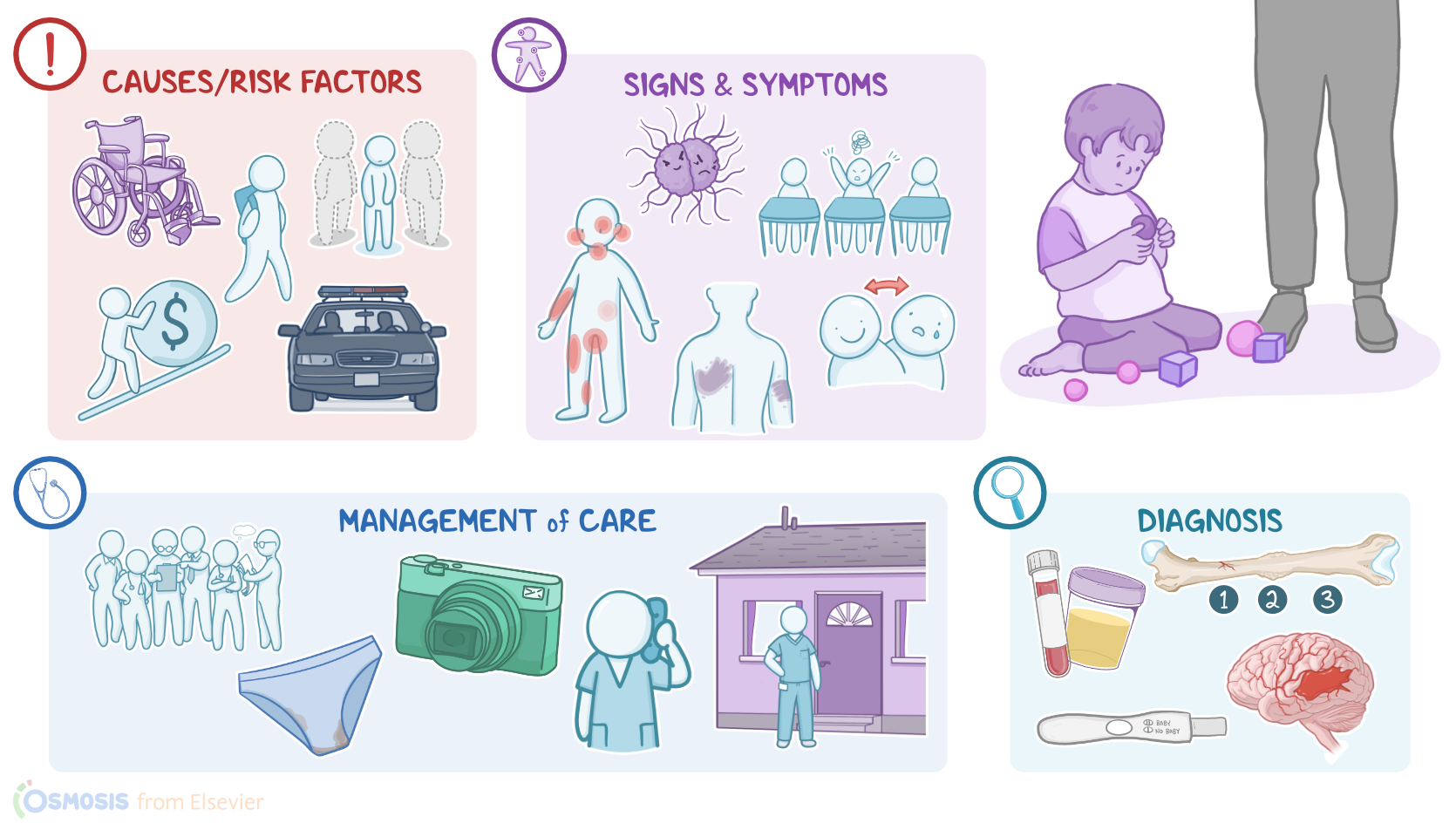
CAUSES AND RISK FACTORS
  • Child factors
    • Prematurity
    • Physical, psychological, or cognitive disabilities
    • Younger age
    • Behavioral problems
    • Unplanned or unwanted pregnancy
  • Abuser/caregiver factors
    • Low self-esteem
    • Poor impulse control
    • Young age
    • Low educational achievement 
    • Poor social support
    • Mental illness
    • Substance use
    • Experienced child abuse or domestic violence themselves 
    • Biologically unrelated adult male living in household
  • Social factors
    • Stressful situations
      • Poverty
      • Unemployment
      • Eviction
      • Involvement with law enforcement

PATHOPHYSIOLOGY
  • Physical
    • Intentional physical injury resulting in injuries
    • Physical neglect or abandonment 
  • Emotional or psychological
    • Saying or doing things to undermine a child’s emotional development or self-esteem
    • Results in child feeling worthless, unloved or unwanted
  • Sexual
    • Any form of sexual contact or exploitation of a child
  • Medical maltreatment
    • Carer fakes child's illness by seeking medical attention for fabricated symptoms

SIGNS AND SYMPTOMS
  • Physical abuse 
    • Multicolored bruises  
      • Suspicious bruise locations 
        • Cheeks
        • Eyes
        • Ears
        • Neck 
        • Buttocks
        • Genitals
        • Flexor surfaces 
      • Unusual injury patterns 
        • Belt
        • Rope
        • Hand
        • Bite marks 
        • Burns
          • Immersion burns with spared creases 
          • Clear edges from being held 
          • Round burns from cigarettes 
        • Fractures 
          • Posteromedial rib fractures 
          • Spiral humerus fractures 
          • Hand/foot fractures in non-walkers 
  • Emotional abuse or neglect 
    • Fear of caregiver 
    • Avoids eye contact or touch 
    • Cries when going home 
    • Distrusts adults, fears dark 
    • Common disorders 
      • Mood
      • Anxiety
      • Speech, learning delays 
      • Poor social skills, disruptive behavior 
      • Substance misuse, self-harm 
  • Sexual abuse 
    • Torn or stained underwear 
    • Difficulty walking or sitting 
    • Advanced sexual knowledge
    • Bruises or swelling 
      • Genital
      • Anal
      • Oropharyngeal areas 
    • Infections
      • UTIs or STIs  
  • Medical abuse 
    • Symptoms don’t match caregiver’s report 
    • Symptoms resolve when caregiver absent 
    • Illnesses unresponsive to treatment

DIAGNOSIS
  • History 
  • Physical assessment 
  • Private interview with child
  • Diagnostic imaging
    • Skeletal survey
  • Laboratory tests
  • Collaboration w/ social worker and child protective services (CPS)

TREATMENT
  • Ensure child is safe
  • Treat immediate injuries 
  • Report to CPS
  • Referral to social work

MANAGEMENT OF CARE
  • Goals of care
    • Maintaining patient safety
    • Providing supportive care
    • Instituting primary and secondary prevention strategies
  • Observe interactions b/n child and caregiver
  • Separate child from abuser
  • Follow facility protocol
  • Assess injuries
    • Take images 
    • Document evidence 
    • Collect clothing
  • Treat injuries
  • Promote comfort physically and emotionally
  • Promote trust
  • Report to law enforcement and CPS

PATIENT AND FAMILY TEACHING
  • Primary prevention
    • Screening for psychosocial risk factors for maltreatment
    • Teaching parents and other caregivers 
      • Positive parenting skills
      • Realistic expectations of child development
      • Anticipatory guidance to manage challenging developmental stages
  • Secondary prevention
    • Linking families at risk to services to address problems 
      • Food insecurity
      • Domestic violence
      • Substance abuse
    • Making referral home visitation, as needed

Transcript

Watch video only

Child maltreatment refers to physical, sexual, or psychological abuse or neglect committed by another individual such as a parent or other caregiver. Abuse refers to any act that causes harm or significant risk of harm to a child; whereas neglect is the failure to provide the basic needs of a child.

Now, risk factors for child maltreatment can be related to the child or the abuser. Factors related to the child include prematurity, and the presence of physical, psychological, or cognitive disabilities. Child maltreatment is also more common in children of younger age, if the child has behavioral problems, or if the child is unplanned or unwanted.

Now, regarding the factors related to the caregiver, important risk factors include low self-esteem, poor impulse control, young age, low educational achievement, poor social support, mental illness, such as depression, anxiety and substance misuse, or and when there is a biologically unrelated adult male living in the household.

Social factors that increase the risk of child maltreatment include stressful situations such as poverty, unemployment, eviction, or involvement with law enforcement. In addition, parents or caregivers who have experienced child abuse or domestic violence are more likely to be abusive.

Alright, now, there are several types of child maltreatment, including physical, emotional or psychological, sexual, and medical maltreatment. First, physical refers to any intentional physical injury that can result in injuries such as fractures, burns, bites, internal bleeding, or even death. In infants, a particular manifestation of physical abuse is shaken baby syndrome, where violent shaking of a baby is so traumatic that it causes subdural hemorrhage; that can lead to cerebral edema and death. Physical neglect is the failure to provide a child with food, shelter, and supervision. Physical neglect can also be manifested in abandonment, where the child is left alone, and the location of the parents or caregivers is unknown.

There’s also emotional or psychological abuse, which involves saying or doing things that undermine a child’s emotional development or self-esteem, resulting in the child feeling worthless, unloved or unwanted. This type of abuse can include threats, criticisms, rejection, or public shaming. Emotional and psychological neglect is when the emotional needs are not met, or if the child is exposed to domestic violence.

Next, sexual abuse includes any form of sexual contact or exploitation of a child. These are usually acts to provide sexual gratification of an adult and include but are not limited to touching, watching sexual acts, involving the minor in oral or penetrative sex, as well as sexual exploitation or trafficking,

Finally, medical abuse is mostly represented by fabricated or induced illness, formerly known as Munchausen syndrome by proxy. This is a rare form of child abuse where the carer fakes an illness in a child by seeking medical attention for fabricated symptoms, such as apnea, gastrointestinal disturbances, or seizures, resulting in unnecessary and excessive medical care.

Now, child maltreatment may present with different clinical manifestations depending on the type of the abuse or neglect. For instance, children experiencing physical abuse may present with bruises, and often, especially multicolored bruises, which indicates multiple assaults that are in different stages of healing. The areas of bruises that should raise supicion of child abuse are the soft parts of the body, like the cheeks and eyes, ears, neck, buttocks, flexor surfaces, or around the genitals, which are not commonly affected by unintentional injuries.

Another common finding includes unusual patterns of injury, like belt and rope marks, hand marks, and bite marks.

When it comes to burns, these are usually induced by a child being forcibly submersed into hot water. Signs of this include areas of the body that have been left unburned, like creases in the abdomen and parts of the palms and soles of the feet, reflecting a crouched, curled up position of the child. Likewise, the area from which the child was held will also be spared and show a prominent edge. Round, punctate burns may also be caused by cigarettes.

Finally, abused children may present with fractures, including rib fractures, especially posteromedial ribs that may be caused from squeezing a child too hard, spiral midshaft fractures of the humerus caused by traction or twisting the arm, and fractures of the hands or feet in children who haven’t started walking yet.

Now, maltreatment that is not physical is much more difficult to identify as the clinical manifestations are not always apparent. However, children experiencing emotional abuse or neglect may present with fear of the caregiver, rarely touching or looking at them and crying when it’s time to go home. They might also distrust other adults, like physicians and the nurses, or may have fear of the dark.

These children also commonly have mood disorders, anxiety, speech and learning disorders, or delayed physical and mental development. They also commonly have disruptive behavior at school, poor social skills, substance misuse, and a tendency to self-harm.

In sexual abuse, the child may have torn or stained underwear, difficulty walking or sitting, as well as bruises, swelling or itching on external genitalia, anal region, or the oropharynx. They might also present with urinary tract infections or sexually transmitted infections, while another clue might be having advanced knowledge about sexual acts compared to individuals of the same age.