Encephalitis: Nursing
Introduction0:00–0:13
Encephalitis is the inflammation of the brain, also known as the cerebrum, which can also involve the meninges, cerebellum, and brainstem.Let’s start by looking at the physiology of the nervous system, which is divided into the central and peripheral nervous system.
Physiology0:13–1:52
The central nervous system includes the brain and spinal cord, while the peripheral nervous system includes all the nerves that connect the central nervous system to the muscles and organs.
The brain is divided into the cerebrum, which consists of the two cerebral hemispheres, the cerebellum, which sits down at the base of the skull, and the brainstem, which is located right in front of the cerebellum.Now, the brain is protected from the rest of the body by three meningeal layers.
From outside to inside, these are the dura mater, arachnoid mater, and pia mater. Between the arachnoid and pia mater there’s the subarachnoid space, which houses the cerebrospinal fluid.
The cerebrospinal fluid is a clear, watery liquid that cushions the brain from impact and bathes it in nutrients.Zooming in, the cells that make up our brain are called neurons and they receive and send electrical impulses to one another.
Now, neurons need a lot of oxygen and nutrients to function properly, so the brain has a rich blood supply. But for any nutrients to enter and leave the brain, they have to go through the tightly regulated blood-brain barrier.
This refers to the endothelial cells in the blood vessels of the brain which are so tightly bound to one another that they only allow certain molecules to slip through them.Now, in most cases, encephalitis is caused by a virus, such as herpes simplex virus, or HSV for short; enteroviruses, like echovirus and coxsackie virus; West Nile virus; rabies; mumps; and measles.
Varicella zoster virus and cytomegalovirus can also cause encephalitis, particularly in immunocompromised clients. Less commonly, encephalitis can be caused by bacteria, fungi, or parasites.
Very rarely, encephalitis can be autoimmune in nature, in which case it can occur as a consequence of cancer somewhere else in the body, like the ovaries.Risk factors for encephalitis include clients under 1 or over 55 years of age, or clients who are immunosuppressed, such as those who have HIV.
Causes & risk factors1:52–2:57
Encephalitis is also more common during the summer months and in places rich with mosquitoes or ticks.Alright, now, regardless of the cause, there are three routes that an infection can take to reach the brain.
The first way is direct spread, which is when a pathogen gets inside the skull, for example through a skull fracture, and then penetrates the meninges, eventually ending up in the brain.
The second way is hematogenous spread, which is when a pathogen enters the bloodstream and moves through the endothelial cells in the blood vessels making up the blood-brain barrier and gets into the brain.
Finally, certain pathogens, such as the rabies virus, can move in a retrograde fashion from the peripheral nervous system to the brain.
Pathology2:57–4:31
Once inside the brain, the pathogen starts multiplying. In response to this, the immune system launches an inflammatory response, which results in brain edema, increasing the pressure inside the skull.
This can in turn reduce blood flow to the brain, which may cause neuronal activities to slow down and affect various brain functions, such as the control of movement, mood, or behavior.In severe cases, encephalitis may cause acute complications, such as the formation of a brain abscess, where pathogens wall off from the rest of the brain parenchyma.
Another complication is intracerebral hemorrhage or bleeding inside the brain. Although rare, encephalitis can also cause long-term complications, such as extensive brain damage.Clients with encephalitis typically present with fever, fatigue, and headache.
Additionally, there can be signs of increased intracranial pressure such as vomiting, as well as the Cushing triad, which includes bradycardia, irregular respiratory pattern, and hypertension.
Signs of meningeal irritation can also be present, including nuchal rigidity, in addition to Brudzinski and Kernig signs.
In Brudzinski sign, flexion of the neck causes hip and knee flexion, whereas in Kernig sign, flexion of the hip and knee to 90 degrees causes pain in the neck.Now, acute complications of encephalitis may manifest with a change in the client’s behavior, mood, and personality, as well as mental status changes, or even coma.
Clients can also experience tremors and muscle weakness. Long-term complications include seizures and residual neurological deficits, such as hemiparesis, which is the inability to move one side of the body.The diagnosis of encephalitis starts with the client’s history and physical assessment, followed by a head CT or MRI scan, which can reveal brain edema and help exclude other conditions that might mimic the presentation of encephalitis, such as stroke or brain tumor.
Clinical manifestations4:31–5:37
A head CT or MRI will also identify a brain abscess as a ring-enhancing lesion with central necrosis. A lumbar puncture can be also done to collect a sample of cerebrospinal fluid and analyze it for white blood cells, protein, glucose, and Gram stain.
With a viral infection, cerebrospinal fluid is usually clear, and there’s moderately increased white blood cells and proteins, with a normal glucose level.
With a bacterial infection, the cerebrospinal fluid can be cloudy, there’s a marked increase of white blood cells and proteins, and glucose levels are low, since bacteria eat up glucose for energy.
Polymerase chain reaction, or PCR, might be used to identify the specific pathogen. Fundoscopy of the eye can also reveal papilledema, or swelling of the optic disc, which is associated with increased intracranial pressure.
Diagnosis5:37–7:07
Finally, a complete blood count may reveal leukocytosis, as well as increased inflammatory markers like ESR and CRP. An EEG should also be done in clients who have had a seizure.In terms of treatment, corticosteroids are often started immediately to reduce brain edema, along with acyclovir.
Additional treatment focuses on relieving symptoms, so analgesics can be used to reduce fever and headache. Valproic acid might be also prescribed to clients with seizures, while mannitol is given if the client has increased intracranial pressure.
Antipsychotics are sometimes given to clients with behavioral changes.Alright, let’s talk about nursing care for a client who has been diagnosed with encephalitis.
Our nursing goals are to closely monitor neurological status and provide supportive care during treatment. Begin by providing a quiet, non-stimulating environment, and institute fall and seizure precautions.
Assess your client’s vital signs and neurological status,noting their level of consciousness. Assess their level of pain, including location, onset, frequency, and duration.
Administer the prescribed analgesic, as well as the antiviral medication, corticosteroid, and antiseizure medication. If you notice any indications of increased intracranial pressure, such as a decreasing level of consciousness, headache, vomiting, or blurred vision; report these findings to the healthcare provider, position your client so that the head of the bed is elevated to 30 degrees and their neck is midline; and be prepared to administer the prescribed osmotic diuretic to decrease intracranial pressure.Continue to monitor your client, and if you notice any indications that their condition is worsening, such as increasing confusion or agitation, loss of consciousness, or seizures, immediately report these findings to the healthcare provider.If your client develops any long-term complications like a speech, hearing, or visual impairment, be sure to coordinate their transition to home care, and ensure they have rehabilitation and other resources in place at discharge.Alright, let’s talk about client and family teaching.
Treatment7:07–7:37
Management and care7:37–9:21
First, explain how encephalitis causes inflammation of the brain, and review the treatment plan aimed at addressing the cause of the inflammation, to reduce swelling in the brain, and to prevent seizures and long-term complications.
When the client is ready for discharge, review their prescribed medications and instruct them to take them exactly as directed.
Advise them to rest at home, to increase their activity slowly, and to stay home from work or school until their healthcare provider lets them know it’s okay to return to normal activities.
Remind them to keep all of their follow-up appointments and review the home care and rehabilitation resources that are in place to support them during recovery.
Stress the importance of seeking medical treatment right away if they develop a fever of 100.4°F or 38°C, or higher or if they have nausea or vomiting; or if they develop symptoms including headache, stiff neck, increasing drowsiness or confusion, or trouble with speech or vision.Finally, teach your client and family about preventative measures to decrease the risk of encephalitis.
Remind them to always protect themselves from mosquito and tick bites by wearing insect repellent when outdoors; wearing long sleeves and pants when in heavily wooded areas or if they need to be outside at dawn or dusk when mosquitoes are most active; eliminating standing water around the home where mosquitoes like to breed such as like buckets or potted plants; and to inspect their body for ticks after spending time in areas with thick underbrush.
General client and family teaching9:21–11:23
Also teach them to avoid swimming in lakes and ponds. Lastly, encourage your client to stay up-to-date on all vaccinations.Alright, as a quick recap… Encephalitis refers to inflammation of the brain that can include the meninges, cerebellum, and brainstem.
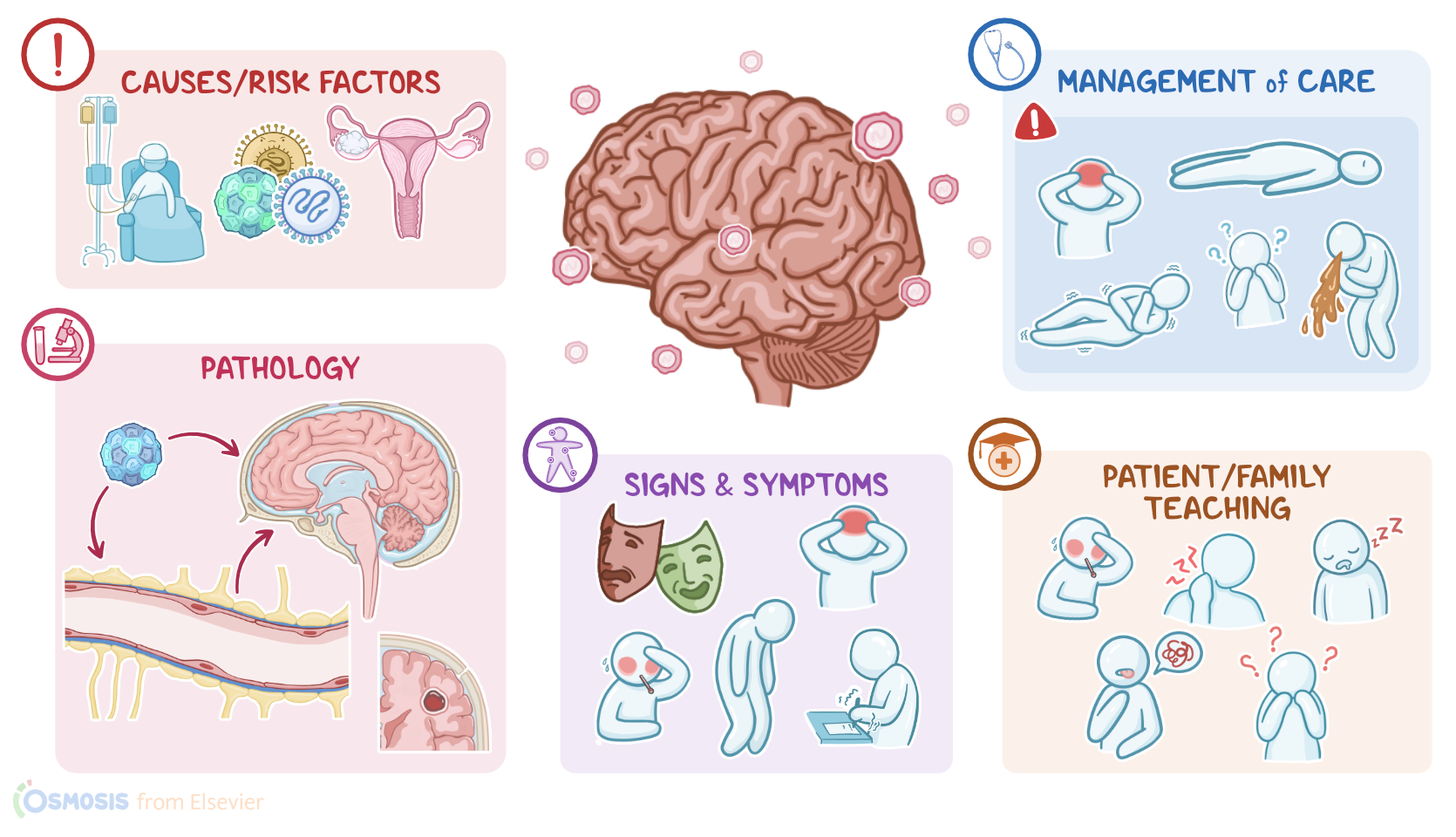
Encephalitis is most commonly caused by a variety of viruses, bacteria, and fungi. Clinical manifestations include fever, fatigue, and headache; Brudzinski and Kernig signs if meningeal irritation is present; as well as signs of increased intracranial pressure.
The Cushing triad, which includes bradycardia, irregular respiratory pattern, and hypertension may also be present if the client’s intracranial pressure is increased.
Complications can include a variety of residual neurological deficits. Diagnosis is based on the client’s history and physical assessment as well as imaging studies such as a head CT, MRI, lumbar puncture, as well as laboratory test results for inflammatory markers including ESR and CRP.
And EEG can also be done if the client has had a seizure. Treatment includes corticosteroids, acyclovir, and other medications such as antiseizure medications, analgesics, and osmotic diuretics.
Priority goals of nursing care include closely monitoring neurological status and providing supportive care during treatment.
Client and family teaching focuses on learning about the condition, self-care at home, prevention of recurrence, and knowing when to contact the healthcare provider.
ticks, after spending time, in areas with sick underbrush, also, teach them to avoid swimming in lakes and ponds. Lastly, encourage your client to stay up-to-date on all vaccinations.
Review11:23–13:08
All right, as a quick recap, Encephalitis refers to the inflammation of the brain that can include the meninges cerebellum, brain, stem.
Encephalitis is most commonly caused by a variety of viruses bacteria and fungi, clinical manifestations, include fever fatigue, and headache bruzdzinski.
And Channing signs. If meningeal irritation is present as well, as signs of increased intracranial pressure, the Cushing Triad which includes bradycardia irregular, respiratory pattern, and hypertension may also be present if the clients intracranial pressure is increased.
Complications can include a variety of residual. Neurological deficits diagnosis is based on the client's history and physical assessment, as well as Imaging studies such as a head.
CT MRI lumbar puncture, as well. As Laboratory test results, for inflammatory markers, including ESR, and CRP, and can also be done.
If the client has had a seizure treatment includes corticosteroids acyclovir and other medications, such as anti-seizure medications, analgesics osmotic diuretics.
Priority goals of Nursing Care include closely monitoring neurological status. And providing supportive care during treatment client, and family.
Teaching focuses on learning about the condition, self care at home, prevention of recurrence, and knowing when to contact the healthcare provider.
| ENCEPHALITIS | ||
| KEY POINTS | NOTES | |
| DEFINITION |
| |
| PHYSIOLOGY |
| |
| CAUSES AND RISK FACTORS |
| |
| PATHOPHYSIOLOGY |
| |
| SIGNS AND SYMPTOMS |
| |
| DIAGNOSIS |
| |
| TREATMENT |
| |
| MANAGEMENT OF CARE |
| |
| PATIENT AND FAMILY TEACHING |
| |
No notes for this video yet
Try adding a note below