Fetal development: Nursing
Introduction0:00–0:56
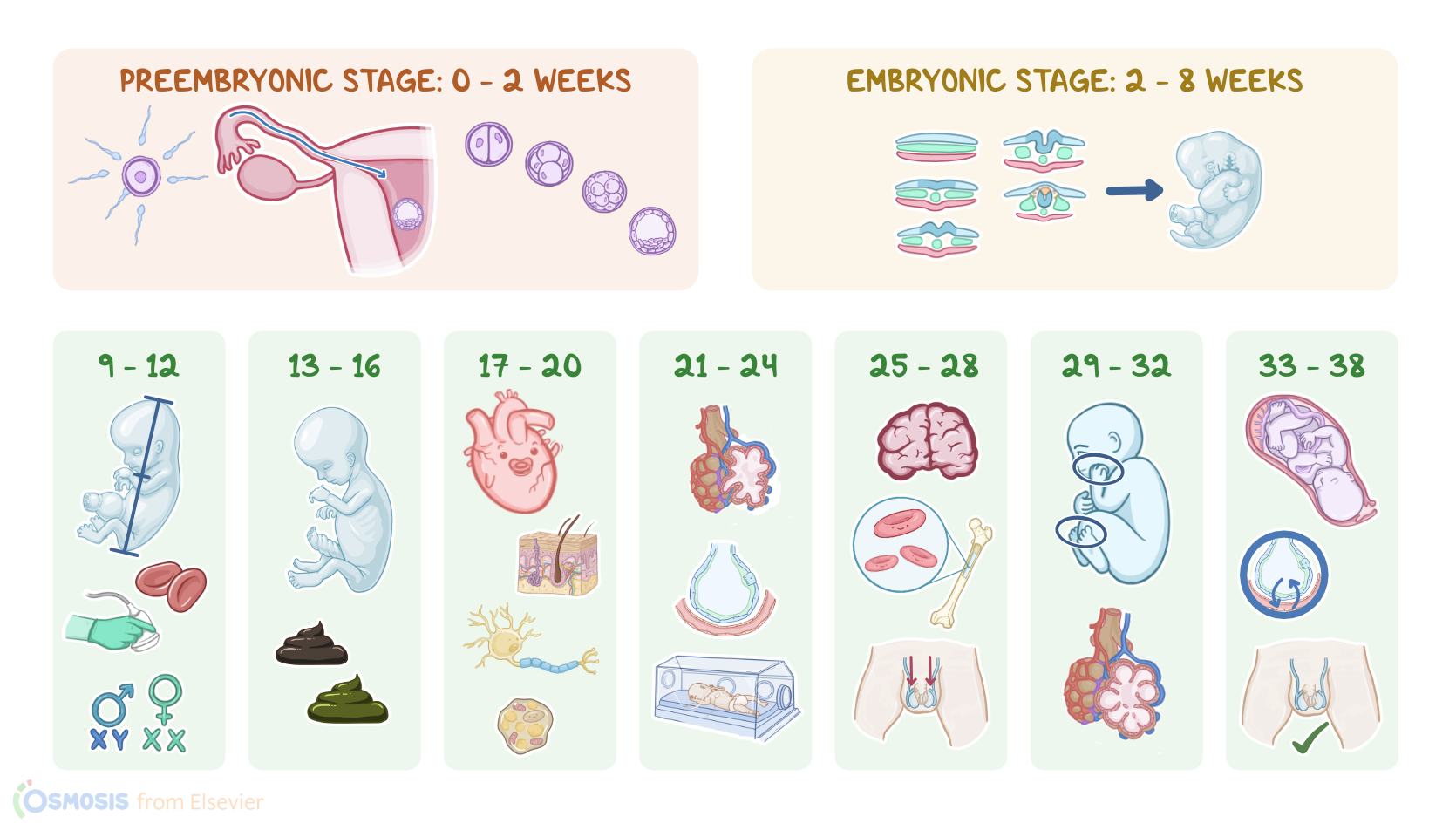
Prenatal development usually lasts 38 to 40 weeks, and it can be subdivided into three main stages. The first stage, called the preembryonic stage, starts with conception and ends with implantation, lasting for 2 weeks.
The second stage, or the embryonic stage, lasts from the third week through the eighth week, and it’s when the embryo develops until it becomes a fetus.
The last and the longest stage of prenatal development is called the fetal stage, and it lasts from the ninth week until birth.
On the other hand, gestational age is measured from the first day of the mother’s last menstrual period, so it’s usually 2 weeks longer than fertilization age.
Preembryonic stage: 0 - 2 weeks0:56–1:41
Let’s start with the preembryonic stage, which covers the first two weeks in development. This stage starts with conception, more specifically, with fertilization; this is when a sperm meets the egg in the fallopian tube and they fuse, forming the zygote.
The zygote then makes its way through the fallopian tube in order to reach the uterus; and at the same time, it undergoes mitosis, meaning it divides over and over again into smaller cells called blastomeres.
When there are 32 blastomeres, the fetus is called a morula. Next, a fluid cavity appears inside the morula to form the blastocyst.
Eventually, the blastocyst reaches the uterus and implants in the inner lining of the uterus, called the endometrium. Next comes the embryonic stage, which lasts from the beginning of the third week of gestation to the eighth week.
Embryonic stage: 2 - 8 weeks1:41–3:08
The first major change in this phase is that the embryo develops its three primitive germ layers; the ectoderm, the mesoderm, and the endoderm, so it starts looking like 3 pancakes on top of one another.
And throughout the embryonic phase, these three layers give rise to all the organs and tissues of the embryo. Cells from the ectoderm develop into the skin and nervous system, including the brain, spinal cord and peripheral nerves; but also the bones that form the skull.
Most other bones and skeletal muscles come from the mesoderm, which also give rise to the heart, circulatory system, the kidney, gonad and adrenal glands.
During this time, as the embryo grows, it folds in on itself, both on its longitudinal axis, and its transverse axis. So by the end of week 8, the embryo is similar to a kidney bean in terms of both size and shape.
Okay, now, let’s switch gears and look at the fetal stage, starting with weeks 9 through 12. During these weeks, the fetal head makes up half of the fetal length, while the lower limbs are still shorter than the upper ones.
Fetal stage: 9 - 12 weeks3:08–4:20
At this point, the fetus has fused eyelids, and the nasal septum and palate are fully developed, while the permanent teeth buds start to grow under the primary teeth.
The central nervous system is fully formed but the fetal brain is smooth, without sulci and gyri. During these weeks, the production of blood cells occurs within the liver, spleen and lymphatic tissue.
During this stage, the heart is fully developed and the heartbeat can be detected with a fetal doppler ultrasound. The development of the digestive tract is completed; the intestinal loops are within the abdominal cavity; and the liver starts bile production.
Kidneys move up from the pelvis, into the abdominal cavity and start urine production and excretion. Finally, at 12 weeks, the genitals are well differentiated as male or female; spontaneous fetal movements occur; and the crown-rump length, meaning the measurement of the fetus from the top of the head to the bottom of the buttocks, is usually around 55 millimeters.Next, the time between the 13th and 16th week is a period of rapid growth.
13 - 16 weeks4:20–4:46
The fetal skin is thin, with visible blood vessels; and lanugo, which is a type of soft, fine fetal hair, begins to develop.
Also, during this period, the fetus starts to swallow amniotic fluid and produce meconium, which is the fetus’s first stool that’s black or green in color.
17 - 20 weeks4:46–5:31
Next up, is weeks 17 through 20. During this period of time, fetal movements can be felt by the mother as fluttering sensations, known as quickening, and the fetal heartbeat can be detected using a fetoscope.
At this point, the nipples start to develop, and lanugo covers the entire body. Also, by week 20, the sebaceous glands begin to secrete a fatty substance called vernix caseosa, which is a white, creamy, cheese-like substance that protects the skin.
During this period, the fetus also begins the myelination of the nervous system. Adipose tissue, called brown fat deposits around the kidneys, behind the sternum, and on the back of the neck.
In male fetuses, the testes are still within the abdomen at this point.Next, between the 21st and 24th week, the fetal movements are stronger and more frequent.
21 - 24 weeks5:31–6:14
At this point, the fetus has eyebrows, eyelashes, and the skin is red, translucent, and wrinkled. Now, let’s focus on the fetal lungs and alveoli for a bit.
Even though they are still immature, they can produce small amounts of surfactant, which is a substance that reduces the tension within the alveoli and prevents their collapse.
This means there’s enough development of lung tissue for some gas exchange to be possible. So if delivery occurs at this point, these extremely premature fetuses require care in the neonatal intensive care unit, or NICU for short, and there’s only a 60% chance of survival.
25 - 28 weeks6:14–6:46
Between the 25th and 28th week, there’s increased deposition of the subcutaneous adipose tissue, so the fetal skin becomes smoother and less red.
Also, the eyelids open between weeks 26 and 28, and by the 28th week, lanugo starts to disappear. Other key points during this period are that the brain develops major sulci and gyri; the bone marrow is mature enough to take over red blood cell production from the spleen; and in the male fetus, the testes begin to move out of the abdomen towards the scrotal sac.Okay, now, between the 29th and 32nd week, the skin becomes pigmented and large blood vessels become visible over the abdomen.
29 - 32 weeks6:46–7:13
Fingernails and toenails are also present. After 32 weeks, the lungs’ surfactant production reaches mature levels; so, if born, the infant can survive in the extrauterine environment; but there’s still a risk that these infants are still at risk for respiratory complications.Finally, between the 33rd and 38th week, the fetus primarily gains weight due to abundant subcutaneous adipose tissue.
33 - 38 weeks7:13–7:55
The skin is smooth, pink to brownish, with vernix caseosa covering the major creases, such as groin and axilla. Additionally, almost all lanugo has disappeared.
The lungs are now able to normally perform gas exchange. Finally, at 34 weeks, the testes can be palpated in the inguinal canal, and by 38-40 weeks they have completely descended into the scrotal sac.
After 38 weeks, the fetus is usually around 50 centimeters long and can weigh between 2500 and 4000 grams at the time of delivery.All right, as a quick recap… Prenatal development usually lasts 38 to 40 weeks, and it can be subdivided into three main stages.
The first stage is called the preembryonic stage, and it starts with conception and ends with implantation. During this stage, the sperm and egg fuse to create the zygote, which undergoes repeated mitosis to form a morula, and then a blastocyst that implants in the uterine wall.
Review7:55–8:55
The second stage is called the embryonic stage, and it lasts from the third week through the eighth week. During this stage, all the major organ systems form, and the embryo grows and develops to become a fetus.
This is the stage when the embryo is most vulnerable to teratogens Finally, the last and the longest stage of prenatal development lasts from the ninth week until birth and is called the fetal stage.
During this stage, the organ systems develop and mature, and the fetus grows in order to survive the adaptation to the extrauterine world after delivery.
the fetal stage. During this stage, the organ systems, develop and mature and the fetus grows in order to survive the adaptation to the extra uterine
| FETAL DEVELOPMENT | ||
| KEY POINTS | NOTES | |
| DEFINITION |
| |
| PRE-EMBRYONIC STAGE |
| |
| EMBRYONIC STAGE |
| |
| FETAL STAGE |
| |
| 13-16 WEEKS |
| |
| 17-20 WEEKS |
| |
| 21-24 WEEKS |
| |
| 25-28 WEEKS |
| |
| 29-32 WEEKS |
| |
| 33-38 WEEKS |
| |
No notes for this video yet
Try adding a note below