Gonorrhea and chlamydia: Nursing process (ADPIE)

Last updated: February 16, 2026

Gonorrhea and chlamydia: Nursing process (ADPIE)

Nursing

Nursing

Aortic aneurysm: Nursing process (ADPIE)
Coronary artery disease (CAD) and angina pectoris: Nursing process (ADPIE)
Hypertension: Nursing process (ADPIE)
Left-sided heart failure: Nursing process (ADPIE)
Myocardial infarction (MI): Nursing process (ADPIE)
Pericardial effusion and cardiac tamponade: Nursing process (ADPIE)
Rheumatic heart disease: Nursing process (ADPIE)
Diabetes insipidus: Nursing process (ADPIE)
Diabetes mellitus (DM): Nursing process (ADPIE)
Diabetic ketoacidosis (DKA): Nursing process (ADPIE)
Hyperthyroidism: Nursing process (ADPIE)
Hyperosmolar hyperglycemic state (HHS): Nursing process (ADPIE)
Hypothyroidism: Nursing process (ADPIE)
Syndrome of inappropriate antidiuretic hormone (SIADH): Nursing process (ADPIE)
Epistaxis: Nursing process (ADPIE)
Eye injury: Nursing process (ADPIE)
Glaucoma: Nursing process (ADPIE)
Tonsillitis: Nursing process (ADPIE)
Appendicitis: Nursing process (ADPIE)
Celiac disease: Nursing process (ADPIE)
Cirrhosis: Nursing process (ADPIE)
Gastroesophageal reflux disease (GERD): Nursing process (ADPIE)
Hiatal hernia: Nursing process (ADPIE)
Pancreatitis: Nursing process (ADPIE)
Peptic ulcer disease (PUD): Nursing process (ADPIE)
Acute kidney injury (AKI): Nursing process (ADPIE)
Benign prostatic hyperplasia (BPH): Nursing process (ADPIE)
Urinary tract infections (UTIs): Nursing process (ADPIE)
Urinary incontinence - Stress: Nursing process (ADPIE)
Age-related physiological changes: Nursing process (ADPIE)
Hemophilia: Nursing process (ADPIE)
Leukemia: Nursing process (ADPIE)
Sickle cell disease: Nursing process (ADPIE)
Anaphylaxis: Nursing process (ADPIE)
Lyme disease: Nursing process (ADPIE)
Atopic dermatitis: Nursing process (ADPIE)
Frostbite: Nursing process (ADPIE)
Methicillin-resistant Staphylococcus aureus (MRSA): Nursing process (ADPIE)
Pressure injury: Nursing process (ADPIE)
Hyperbilirubinemia: Nursing process (ADPIE)
Placenta previa: Nursing process (ADPIE)
Placental abruption: Nursing process (ADPIE)
Prolapsed umbilical cord: Nursing process (ADPIE)
Anxiety disorders: Nursing process (ADPIE)
Eating disorders: Nursing process (ADPIE)
Acute compartment syndrome: Nursing process (ADPIE)
Fractures: Nursing process (ADPIE)
Gout: Nursing process (ADPIE)
Musculoskeletal injuries: Nursing process (ADPIE)
Rheumatoid arthritis (RA): Nursing process (ADPIE)
Meningitis: Nursing process (ADPIE)
Parkinson disease: Nursing process (ADPIE)
Stroke: Nursing process (ADPIE)
Trigeminal neuralgia: Nursing process (ADPIE)
Seizure disorder: Nursing process (ADPIE)
Breast cancer: Nursing process (ADPIE)
Tumor lysis syndrome (TLS): Nursing Process (ADPIE)
Bronchiolitis and respiratory syncytial virus (RSV): Nursing process (ADPIE)
Chickenpox (Varicella): Nursing process (ADPIE)
Conjunctivitis: Nursing process (ADPIE)
Hydrocephalus: Nursing process (ADPIE)
Poisoning: Nursing process (ADPIE)
Pyloric stenosis: Nursing process (ADPIE)
Reye syndrome: Nursing process (ADPIE)
Peripheral arterial disease (PAD): Nursing process (ADPIE)
Peripheral venous disease (PVD): Nursing process (ADPIE)
Candidiasis: Nursing process (ADPIE)
Gonorrhea and chlamydia: Nursing process (ADPIE)
Pelvic inflammatory disease (PID): Nursing process (ADPIE)
Asthma: Nursing process (ADPIE)
Bacterial pneumonia: Nursing process (ADPIE)
Carbon monoxide poisoning: Nursing process (ADPIE)
Chronic obstructive pulmonary disease (COPD): Nursing process (ADPIE)
Epiglottitis: Nursing process (ADPIE)
Foreign body aspiration and upper airway obstruction: Nursing process (ADPIE)
Laryngotracheobronchitis (LTB) and croup: Nursing process (ADPIE)
Smoke inhalation injury: Nursing process (ADPIE)
Venous thromboembolism (VTE): Nursing process (ADPIE)

Notes

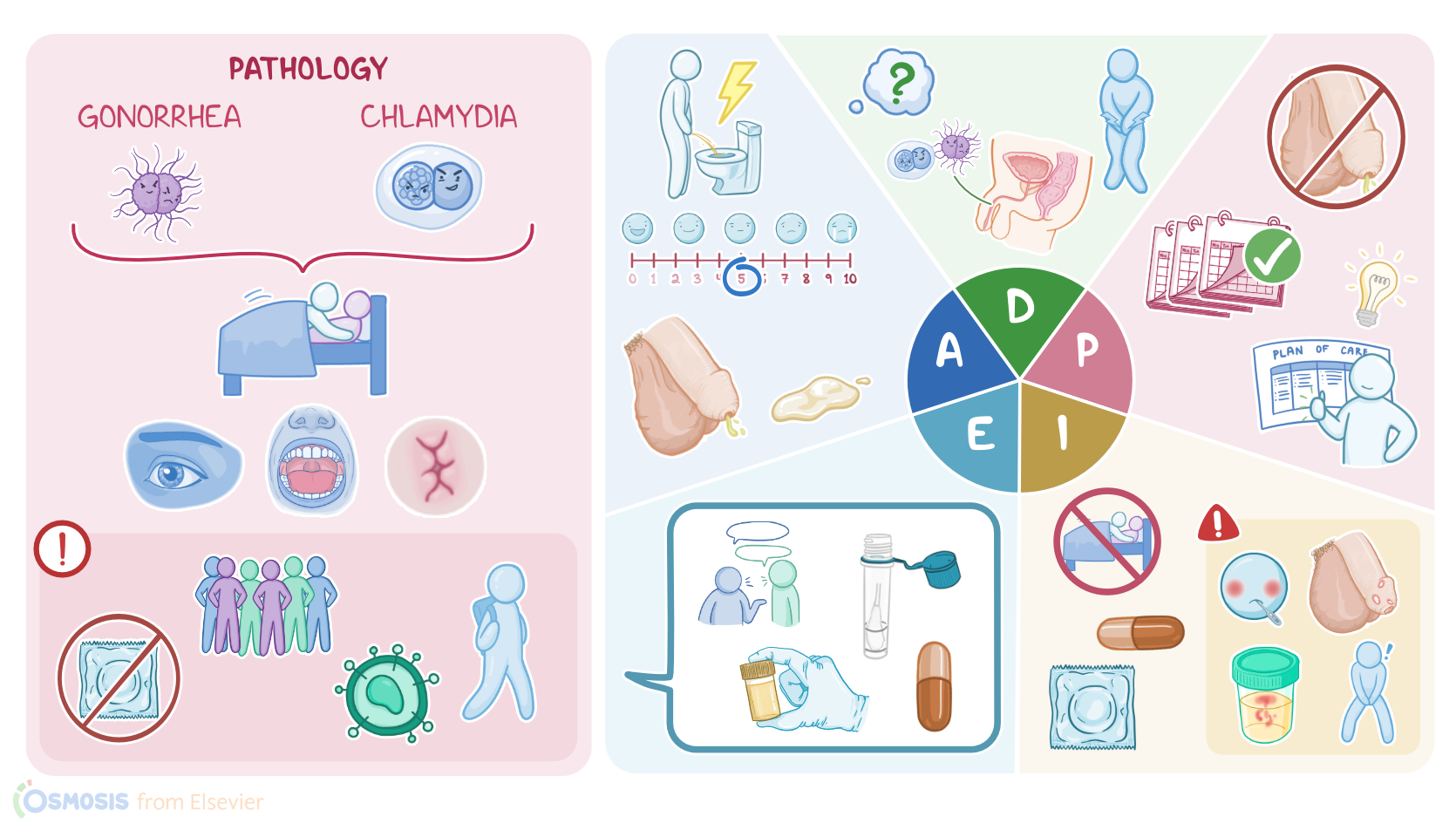
GONORRHEA AND CHLAMYDIA

KEY POINTS
NOTES
PATIENT REPORT
  • 22-year-old 
  • Health department
  • Reports painful urination and urethral discharge
  • Partner recently diagnosed with chlamydia

PATHOPHYSIOLOGY
  • Gonorrhea
    • Caused by Neisseria gonorrhoeae 
  • Chlamydia 
    • Caused by Chlamydia trachomatis  
  • Transmitted via sexual fluids 
  • Can also spread via contact with mucous membranes  
  • Risk factors 
    • Behavioral 
      • Unprotected sex 
      • New or multiple sexual partners 
    • Individual 
      • Age 15–24 years 
      • History of STIs 
      • HIV positive  
  • Symptoms 
    • Often asymptomatic
      • If symptomatic 
        • Mucopurulent discharge 
        • Dysuria  
        • Urinary frequency 
          • In biological males 
            • Urethritis 
            • Prostatitis 
            • Epididymitis 
          • In biological females 
            • Urethritis 
            • Vulvovaginitis 
            • Cervicitis 
            • Pelvic inflammatory disease 
  • Complications 
    • Infertility in both biological males and females

DIAGNOSIS AND TREATMENT
  • Diagnosis
    • History
    • Physical assessment
    • Nucleic acid amplification test (NAAT)
  • Treatment
    • Gonorrhea 
      • Treated with ceftriaxone 
    • Chlamydia 
      • Treated with azithromycin  
        or doxycycline  
    • Both infections often treated together due to frequent co-infection 
  • Prevention
    • Use condoms during sexual contact

ASSESSMENT
  • No prior history of STIs 
  • Sporadic condom use 
  • 8 lifetime female sexual partners 
  • No biological male sexual partners 
  • Current partner for 2 months 
  • Sclera: white, no conjunctivitis 
  • Oral/pharyngeal mucosa: moist, pink, no lesions 
  • Skin: intact, no rashes or lesions 
  • Heart sounds: normal 
  • Lung sounds: clear 
  • Bowel sounds: active 
  • No appetite changes, nausea, or vomiting 
  • No lesions or swelling in inguinal lymph nodes or testicles 
  • Penile swelling present 
  • Thick, cloudy, white, foul-smelling urethral discharge 
  • No rectal lesions, swelling, or bleeding 
  • Denies rectal pain or bowel changes 
  • Vital signs 
    • Temperature: 98.8°F (37.1°C) 
    • Heart rate: 75/min
    • Respiratory rate: 16/min
    • Blood pressure: 118/72 mmHg 
    • SpO2: 100% room air 
    • Pain: 0/10 at rest, 5/10 during urination

NURSING DIAGNOSES
  • Infection related to unsafe sexual practices
  • Acute pain related to urethritis
  • Impaired urinary elimination related to urethritis
  • Deficient knowledge related to chlamydia treatment and prevention

PLANNING
  • By the end of visit, patient will
    • Verbalize understanding of chlamydia transmission, treatment, and prevention
  • One week after starting treatment, patient will
    • Have no new symptoms
    • Report the resolution of dysuria, penile swelling, and penile discharge
    • Test negative for infection at 3 month follow up

IMPLEMENTATION
  • Collected specimens for 
    • Chlamydia 
    • Gonorrhea 
    • Syphilis 
    • HIV 
  • Administered single dose of azithromycin for presumed chlamydia 
  • Explained chlamydia and its mode of transmission 
  • Emphasized importance of completing antibiotic treatment 
  • Reviewed potential symptoms requiring medical attention 
    • New abdominal or pelvic pain 
    • Fever 
    • Difficulty urinating or blood in urine 
    • Scrotal pain or swelling 
    • New or worsening penile discharge 
    • Genital or anal skin lesions 
  • Advised abstaining from sexual activity for 7 days post-treatment 
  • Recommended partner abstain and be tested 
  • Advised retesting in 3 months 
  • Discussed STI transmission and prevention 
  • Emphasized consistent condom use 
  • Encouraged open communication with partners 
  • Recommended routine STI screening for nonmonogamous relationships 
  • Documented all interventions and patient education

EVALUATION
  • Patient verbalized understanding of 
    • Chlamydia treatment and testing 
    • STI transmission 
    • Prevention strategies 

Transcript

Watch video only

Chad Davis is a 22-year-old male who presents to the health department’s sexually transmitted infection clinic with symptoms of painful urination and urethral discharge for the past two days. He states his girlfriend was recently diagnosed with chlamydia, and they are sexually active. He uses condoms sporadically and he’s worried he also has chlamydia.   

Gonorrhea and chlamydia are among the most common sexually transmitted infections, or STIs, in the United States in both men and women. Now, gonorrhea is caused by a gram-negative bacterium called Neisseria gonorrhoeae; while chlamydia is caused by a gram-negative bacterium called Chlamydia trachomatis. Both infections are transmitted during sexual contact through sexual fluids, such as vaginal secretions or semen, so they often occur together, primarily affecting genital organs. However, it’s important to note that these infections can also be transmitted via contact with skin or mucous membranes, including eyes, mouth, and anus.

Risk factors associated with gonorrhea and chlamydia can be subdivided into two main groups. Behavioral risk factors include having unprotected sexual contact, as well as new or multiple sexual partners. On the flip side, individual risk factors include young age, between 15 and 24 years old, since they’re more likely to have new or multiple sexual partners, as well as having a history of prior sexually transmitted infections, and HIV positive status. 

Most often, gonorrhea and chlamydia cause asymptomatic infection. However, symptomatic clients can present with mucopurulent discharge from the vagina or penis, as well as dysuria or pain and burning during urination, and urinary frequency. In males, gonorrhea and chlamydia can infect the urethral mucosa, causing inflammation known as urethritis. Sometimes the infection can spread to the prostate, resulting in prostatitis. Also, it can cause inflammation of the epididymis, or epididymitis, and cause symptoms such as testicular pain and swelling. In females, there can also be urethritis, but typically, chlamydia affects the lower genital tract, causing vulvovaginitis when the vulva and the vagina are affected, and cervicitis when the cervix is involved. This may present with changes in vaginal discharge, intermenstrual bleedings, and bleeding after sexual activity. Now, an important complication in females is pelvic inflammatory disease, which is when the infection spreads to the uterus, fallopian tubes, and ovaries. Finally, if left untreated gonorrhea and chlamydia can cause infertility in both male and female clients. 

Diagnosis of gonorrhea and chlamydia starts with history and physical examination, and can be confirmed with nucleic acid amplification testing or NAAT, which uses a genital swab or urine sample to look for the bacterial DNA.

Treatment of gonorrhea and chlamydia requires the administration of antibiotics. Gonorrhea is usually treated with a third-generation cephalosporin called ceftriaxone; while chlamydia can be treated with macrolides like azithromycin, or tetracyclines like doxycycline. And since these infections often occur together, clients are usually given treatment for both. Finally, gonorrhea and chlamydia can be prevented using condoms during sexual contact. 

Sources

  1. "Ackley and Ladwig’s Nursing Diagnosis Handbook: An Evidence-Based Guide to Planning Care, 13th edition" Mosby (2022)
  2. "Pelvic Inflammatory Disease Due to Neisseria gonorrhoeae and Chlamydia trachomatis: Immune Evasion Mechanisms and Pathogenic Disease Pathways" J Infect Dis (2021)
  3. "An Update on Gonorrhea and Chlamydia" Obstet Gynecol Clin North Am (2023)
  4. "Harrison’s Principles of Internal Medicine, 21st edition" McGraw Hill / Medical (2022)
  5. "Screening for Chlamydia and Gonorrhea" JAMA (2021)
  6. "Etiology and Diagnosis of Pelvic Inflammatory Disease: Looking Beyond Gonorrhea and Chlamydia" J Infect Dis (2021)
  7. "Screening for chlamydia and/or gonorrhea in primary health care: systematic reviews on effectiveness and patient preferences" Syst Rev (2021)