Growth and development - Adolescent: Nursing
Adolescence, also known as the teenage years, starts at the beginning of puberty and lasts approximately until 18 to 20 years of age. This period represents the transition from childhood to adulthood and, as such, it brings many important physical, mental and psychosocial changes. Developmental psychologists involved in studying development during the adolescent period include Jean Piaget, Erik Erikson, and Lawrence Kohlberg.
Alright, there are a couple terms that we need to review first, including growth and development. Growth refers to physical changes in height, weight, and the appearance of the body; whereas development refers to the acquisition of complex motor, cognitive, and social skills.
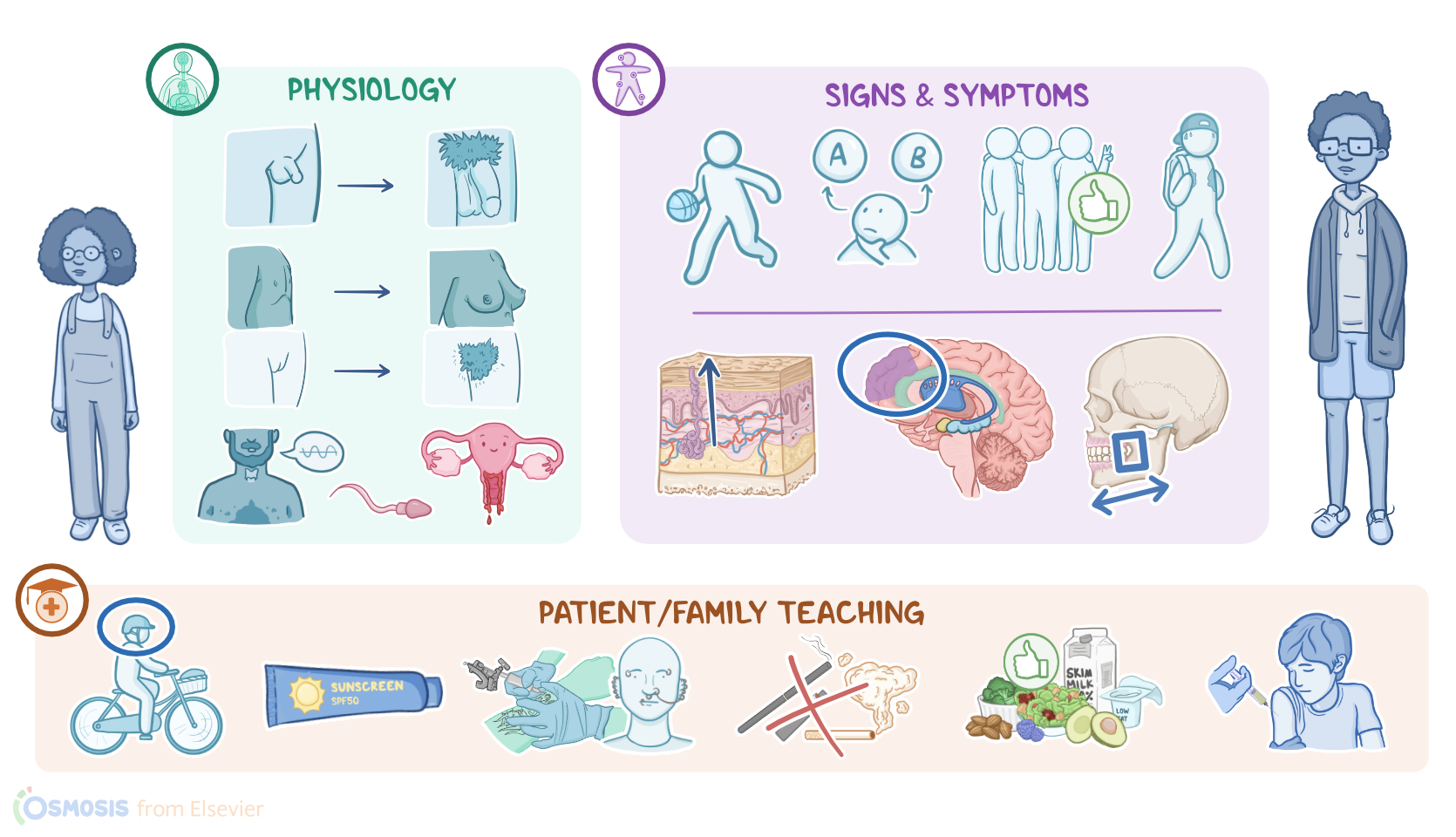
Alright, now the physical changes that occur during adolescence are related to the beginning of puberty, which is a period of rapid growth and sexual development. Puberty typically starts somewhere between 8 and 14 years of age, and tends to start earlier in those assigned female at birth than in those assigned male at birth. Puberty-related changes are driven by the increase in sex hormone level, which are mostly estrogen, progesterone and testosterone.
For those assigned female at birth, breast development is usually the first noticeable sign of puberty, and it is followed by the first menstrual cycle, or menarche, which typically occurs around 2 and a half years from the onset of puberty. Widening of the hips also occurs.
In those assigned male at birth, puberty begins with an increase in testicular size, then the penis and pubic hair grow, the voice begins to deepen, and around 2 years later, sperm production begins.
Other pubertal changes include the growth of pubic and underarm hair in both sexes, These hormone-driven changes are accompanied by growth spurts that transform children into physically mature teens as their bodies increase in height and weight.
Alright, now let’s switch gears and look at the motor, cognitive, psychosocial, and moral development during adolescence. Starting with motor development, it is usually during early adolescence that teenagers begin to develop endurance. In addition, they have more muscle mass, which enables them to perform well in various athletic activities.
During middle adolescence, speed and coordination also get better; and teenagers become more competitive with one another. By late-adolescence, teenagers have developed precise hand-eye coordination and finger dexterity, and are able to perform most tasks in the same way as adults.
Next, Piaget explains how the adolescent’s cognitive development is in the formal operations stage, meaning they begin to think abstractly, which increases as adolescence progresses. This stage is characterized by problem solving abilities, independent decision making, and becoming concerned with societal issues and politics.
The teenage years are also characterized by learning to understand the implications of the decisions they make, and eventually make plans and set long-term goals for the future. During this time, peer influence and acceptance becomes very important. Friends and peers are able to impact a teenager’s appearance, behavior, hobbies, and even language. As a result, they can have a positive influence on someone, like promoting school attendance; or a negative influence, such as involvement with risk-taking behaviors, like alcohol use, experimenting with drugs, or violence.
Regarding psychosocial development, the task for adolescents is to achieve a sense of identity. During this stage, adolescents strive to answer the question, “Who am I?” They tend to be preoccupied with their appearance and seek to discover their personal identity by exploring roles, personal beliefs, values, and goals for adulthood. Adolescents who are not encouraged to discover their individual selves can become uncertain and confused regarding their place in society.
Now, on a moral level, adolescents are situated in post-conventional morality, as they begin to understand moral and ethical principles, question the status-quo, and develop their own values.
Finally, let’s review the physiological changes that happen across different body systems, starting with the nervous system.
By the time a person reaches puberty, their brain is still not fully developed. Although the human brain reaches 90% of its adult size by age 6 or 7, the structure of the brain continues to become more complex until the late teens. The biggest changes in the folds of the brain occur in the parts of the cortex where cognitive and emotional information is processed, like the prefrontal cortex. During adolescence, myelination in the prefrontal cortex increases, thereby improving the efficiency of information processing; and neural connections between the prefrontal cortex and other regions of the brain are strengthened.
| GROWTH AND DEVELOPMENT - ADOLESCENT | ||
| KEY POINTS | NOTES | |
| DEFINITION |
| |
| GROWTH |
| |
| DEVELOPMENT |
| |
| PHYSIOLOGIC CHANGES |
| |
| PATIENT AND FAMILY TEACHING |
| |
No notes for this video yet
Try adding a note below