Infectious mononucleosis: Nursing
Introduction0:00–0:25
Infectious mononucleosis, or simply mono, is a highly contagious, but self-limiting viral infection caused by the Epstein-Barr virus.
Infectious mononucleosis is typically seen in young clients and adolescents and is often referred to as “the kissing disease” because the Epstein-Barr virus primarily spreads through saliva.First, let’s quickly review the physiology of normal immune response, which is subdivided into innate and adaptive immunity.
Physiology0:25–2:07
Innate immunity consists of natural barriers, like skin and mucous membranes; natural killer cells, which help fight virus-infected and tumor cells; and phagocytes, such as macrophages, neutrophils, and dendritic cells.
Now, when a pathogen, like a virus, reaches a person’s mouth, breaches the mucosal barrier, and enters the body, the innate immune system reacts quickly.
The first cells on the scene are macrophages and neutrophils, which directly fight the pathogen. At the same time, they also secrete small molecules called cytokines to increase the permeability of local blood vessels and message other immune cells that there’s an active fight in the body.
Additionally, cytokines induce the production of acute inflammatory proteins and cause systemic effects, such as fever. Simultaneously, dendritic cells engulf and digest the pathogen, eventually presenting small fragments of it on their surface.
At this point, the adaptive immune system, which relies on B and T lymphocytes, comes to the rescue. Specifically, T helper cells recognize these fragments and help activate B lymphocytes, primarily in pharyngeal lymph tissue, tonsils, and regional cervical lymph nodes.
Once stimulated, B cells start to produce antibodies, which circulate throughout the body and bind to pathogens, eventually enabling cytotoxic T lymphocytes and NK cells to recognize and destroy them.The most common cause of infectious mononucleosis is the Epstein-Barr virus, also known as human herpesvirus 4 or HHV-4.
Causes & risk factors2:07–2:33
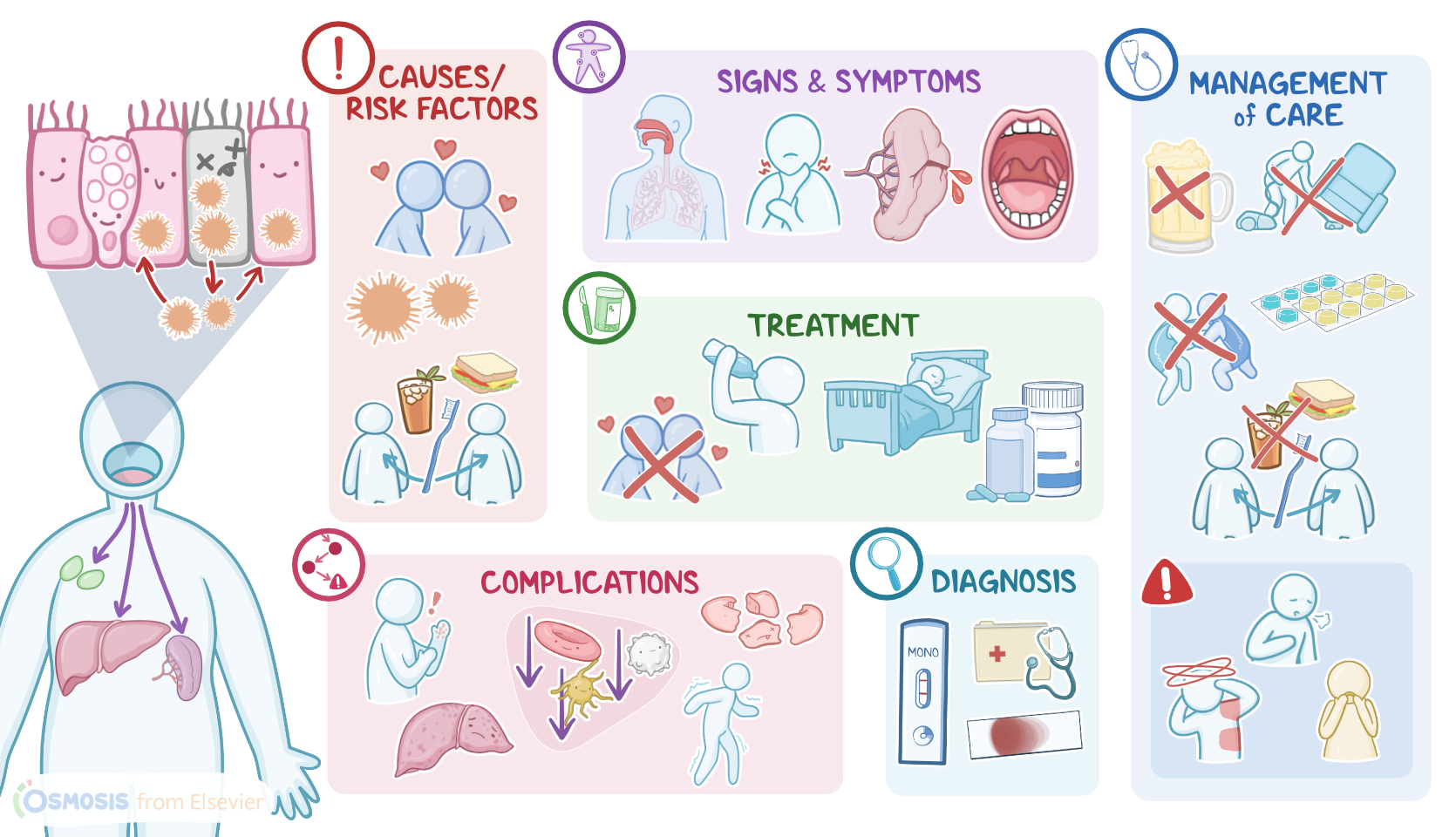
This is a small DNA virus that belongs to the Herpesviridae family. Important risk factors associated with Epstein-Barr infection include kissing, sharing drinks and food, as well as utensils or personal items, like toothbrushes.Now, let’s look at the pathology of infectious mononucleosis, which starts when the virus-containing saliva or respiratory secretions reach the mouth of a healthy person.
Pathology2:33–4:10
Once inside the mouth, the Epstein-Barr virus infects the epithelial cells of the pharynx and starts replicating, eventually forming new viral particles.
At one point, newly formed viral particles destroy the host’s cell, eventually spreading the infection and reaching the lymphoid tissue of the pharynx, tonsils, and cervical lymph nodes.
Here, the virus infects B lymphocytes. But the Epstein-Barr virus does not kill the B lymphocyte; instead, it enters the latent phase and uses the lymphocyte as a vehicle to spread throughout the body.
Eventually, the virus reaches distant sites and causes enlargement of lymph nodes, liver, and spleen, which are conditions also known as lymphadenopathy, hepatomegaly, and splenomegaly, respectively.Okay, now, important complications that may occur in clients with infectious mononucleosis include erythema multiforme, pancytopenia, and autoimmune hemolytic anemia.
Clinical manifestations4:10–4:56
Mild hepatocellular hepatitis is also a potential complication. Neurologic complications, such as Guillain-Barre syndrome and aseptic meningitis can also occur.
In severe cases, the enlargement of lymph nodes can eventually lead to upper airway obstruction; a peritonsillar abscess can also cause respiratory compromise and dysphagia; while an enlarged spleen can rupture and cause life-threatening bleeding.Clinical manifestations typically occur 4 to 8 weeks after the infection.
Diagnosis4:56–5:25
First, there can be a prodromal period that includes a gradual onset of fever, chills, malaise, and anorexia. This is followed by the classical triad of symptoms of continued fever, tonsillar pharyngitis, and lymphadenopathy.
In severe cases, cervical lymphadenopathy can lead to upper respiratory airway obstruction. Clients also present with nonspecific symptoms, such as headache and fatigue, which can persist even 6 months after the infection.
Treatment5:25–6:02
Other important clinical features include palatal petechiae, or red spots on the palate, and tonsillitis that can involve whitish exudates.Diagnosis of infectious mononucleosis is based on the client’s history, and physical assessment, followed by a peripheral blood smear, which typically reveals lymphocytosis and elevated aminotransferases.
Management and care6:02–6:23
Another important diagnostic method is the Monospot test, which can detect the presence of heterophile antibodies. It’s important to note though the Monospot test can be negative during the first 7 to 10 days of the infection.Treatment of infectious mononucleosis is primarily supportive and includes rest, as well as analgesics, antipyretics, and hydration.
General client and family teaching6:23–7:58
Generally, corticosteroids should be avoided because there’s an increased risk of immunosuppression. One exception is the treatment of upper airway obstruction, where corticosteroids help reduce local swelling and enable airway patency.
Finally, infected clients should avoid contact with others, as the Epstein-Barr virus is highly contagious, and contact sports should be avoided for at least 3 to 4 weeks to prevent splenic rupture.Alright, let’s talk about the nursing care you would provide for a client with infectious mononucleosis.
Your primary nursing goal is to provide supportive care. Begin by assessing your client’s vital signs and asking them if they are experiencing symptoms like a sore throat.
Then, administer the prescribed antipyretics and throat lozenges. Okay, moving onto client and family teaching.
Begin by teaching your client that mononucleosis is an infection that is most commonly caused by Epstein-Barr virus, and that it is primarily spread person to person through saliva.
Review7:58–8:57
Then, teach them how to prevent the spread of their infection by avoiding sharing food, drinks, or personal care items, and not to kiss anyone while they are contagious.
Lastly, encourage them to rest, and let them know that they can return to work or school when they feel better. Next, review the use of their prescribed antipyretics and analgesics, and teach them that using throat lozenges or gargling
| INFECTIOUS MONONUCLEOSIS | ||
| KEY POINTS | NOTES | |
| DEFINITION |
| |
| PHYSIOLOGY |
| |
| CAUSES AND RISK FACTORS |
| |
| PATHOPHYSIOLOGY |
| |
| SIGNS AND SYMPTOMS |
| |
| DIAGNOSIS |
| |
| TREATMENT |
| |
| MANAGEMENT OF CARE |
| |
| PATIENT AND FAMILY TEACHING |
| |
No notes for this video yet
Try adding a note below