Juvenile idiopathic arthritis: Nursing
Introduction0:00–0:15
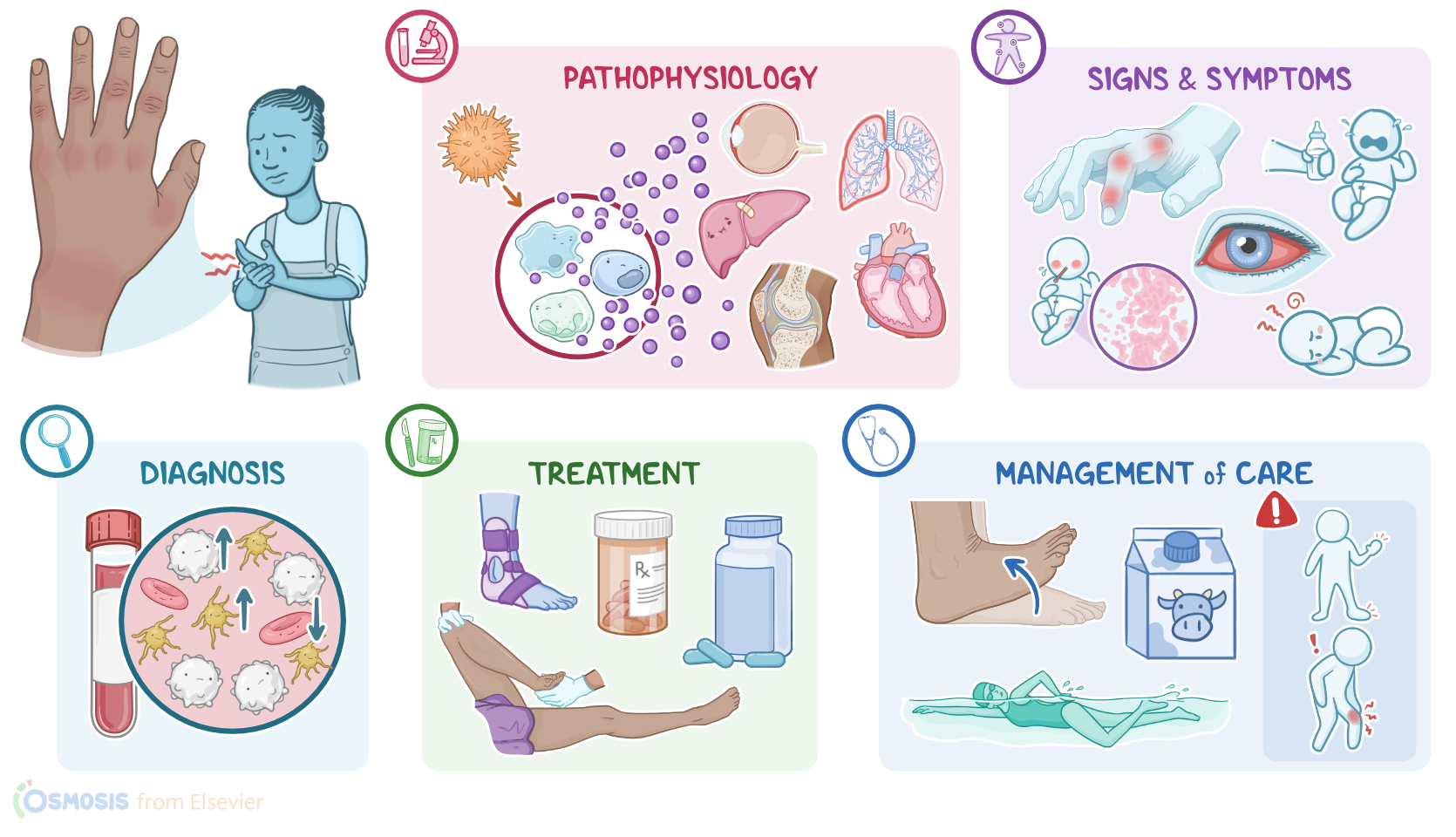
Juvenile idiopathic arthritis, previously known as juvenile rheumatoid arthritis, is an inflammatory disease that occurs in children and young adolescents under the age of 16.
Alright first, let’s start by reviewing some immune system physiology. So when an antigen enters the body, it comes in contact with a type of immune cells called antigen presenting cells, or APCs.
Physiology0:15–1:37
These include macrophages, dendritic cells, and even naive B cells. The APCs will engulf and digest the pathogen then present fragments on their surface.
Another type of immune cells, called T helper cells, then recognize the antigen, causing them to activate and proliferate; this results in an army of T helper cells that release cytokines, including interleukin 1, interleukin 6, and tumor necrosis factor, or TNF for short.
These cytokines are signalling molecules that attract other immune cells to the site. These cells can be part of the adaptive immune system, like cytotoxic T cells, or killer T cells; or part of the innate immune system, like neutrophils and natural killer, or NK cells.
In addition, T helper cells can also trigger another type of immune cells called B cells to secrete antibodies against the antigen.
Finally, after the immune response ends, some immune cells, called memory cells, survive and can remember an antigen, allowing them to activate a quicker immune response to that antigen in the future.
Okay, as the term idiopathic suggests, the exact cause of juvenile idiopathic arthritis is unknown. However, several risk factors have been identified.
Causes and risk factors1:37–2:10
These include genetic factors, like having a particular HLA subtype called HLA-B27; being assigned female at birth; as well as antibiotic use during infancy and childhood.
On the bright side, some possible protective factors have also been identified, including having been breastfed.Now, while the exact mechanism of the disease is unknown, it is believed that an environmental factor triggers an atypical autoimmune response in genetically susceptible individuals.
Pathology2:10–4:22
There could be an imbalance of immune cells with less regulatory cells to slow down the immune response and distinguish self from non-self molecules and more T-helper cells, or innate immunity cells, like macrophages and neutrophils, and proinflammatory cytokines.
This imbalance promotes inflammation. Additionally, autoantibodies, meaning antibodies that target self-molecules, are produced and target various structures in joints.
As inflammation increases, the joints as well as other organs can become damaged, and eventually arthritis may occur. Now, there are three types of juvenile idiopathic arthritis.
The most common type is oligoarticular, also called pauciarticular, in which there are up to 4 joints affected. Then, there is polyarticular which involves five or more joints, most commonly small joints, affected symmetrically, similar to rheumatoid arthritis in adults.
Finally, there is systemic juvenile arthritis which affects not only the joints but also various other tissues throughout the body.
These include pericarditis, meaning inflammation of the pericardium, which is the fibrous sac that surrounds the heart; and pericardial effusion, which is a fluid buildup in the pericardial cavity.
Finally, a serious complication of systemic arthritis is macrophage activation syndrome, which is when there is an overproduction of macrophages and T cells.
These cells can infiltrate many tissues in the body, like the liver, spleen and lymph nodes, causing them to enlarge.Alright now, juvenile idiopathic arthritis presents with typical inflammatory joint signs, such as pain, redness, warmth, swelling, and stiffness of the joints.
Clinical manifestations4:22–5:25
These are more pronounced after inactivity, like when waking up in the morning. Symptoms improve with movement.
In very young children, irritability and fussiness can be early signs. Now individuals with juvenile idiopathic arthritis may also experience malaise and poor appetite.
They can also have lymphadenopathy and organomegaly, including enlargement of the spleen and liver. Additionally, if uveitis is present, individuals can present with red eyes, pain, photophobia and blurred vision.
Finally, in systemic arthritis, the skin can be affected too, mainly showing a salmon pink macular rash that often appears with fever.
Other systemic abnormalities that can occur include a spiking fever, pericarditis and pleuritis.The diagnosis of juvenile idiopathic arthritis is mostly clinical and it is based on the client's history and physical assessment.
Diagnosis5:25–6:12
Laboratory tests can also be ordered, and typical findings can include a mild to moderate anemia; leukocytosis, especially T cells; and thrombocytosis; as well as increased erythrocyte sedimentation rate, or ESR, and C-reactive protein, or CRP.
Individuals with juvenile idiopathic arthritis can also be positive for antinuclear antibodies, or ANA, rheumatoid factor, or RF, while genetic testing might be positive for HLA-B27.
The final step in the diagnostic process is imaging of the joints, typically an X-ray first, followed by an ultrasound or MRI.Now, there is no cure for juvenile idiopathic arthritis, so treatment is supportive.
Treatment6:12–7:08
The treatment focuses on controlling inflammation, relieving pain, promoting remission, maintaining mobility, minimizing deformity, and reducing the impact on growth and development.
To reduce inflammation and pain, initially, non-steroidal anti-inflammatory drugs, or NSAIDs, are used. When their effectiveness wanes, corticosteroids or other immunosuppressant medications are prescribed.
Methotrexate is often the first choice while in more severe polyarticular disease, anti-TNF factors like etanercept are used.
Physical therapy is also often included in treatment to improve strength and mobility. In more severe cases, like when a client has joint contractures, splinting can be used or surgery can be performed to improve joint functioning.Alright, now let’s look at the nursing care you’ll provide for a client with juvenile idiopathic arthritis.
Management of care7:08–8:26
Your priority nursing goals are to manage pain, maintain mobility, and provide emotional support.To begin, assess your client’s pain.
Then, administer the prescribed pain medications, and provide comfort measures, including application of heat or cold, as indicated.Next, to help your client maintain mobility, provide passive range of motion exercises and encourage activity as tolerated.
Then, consult with the physical therapist to develop an individualized exercise regimen aimed at increasing muscle strength, maintaining range of motion, and preventing contractures.
Also consult with the occupational therapist to work with your client so they can more easily perform their activities of daily living.
Finally, provide emotional support for your client and their family. Provide clear, concise answers to their questions and concerns.
Ensure a referral is in place for counseling, as needed, and that the unit social worker is involved, so the family can be connected to local resources and support groups.Okay, let’s move on to client and family teaching.
General client & family teaching8:26–9:45
Begin by explaining that juvenile idiopathic arthritis is a disease that causes joint inflammation, causing pain and problems with mobility.
Review the plan of care, and their prescribed medications, including common medication side effects; and instruct them to take them exactly as prescribed.
Also, be sure to remind them about the importance of follow-up appointments for continued monitoring and care, including attending their physical and occupational therapy sessions.Next, teach them how they can help maintain muscle strength and joint flexibility.
Talk to them about how following a healthy diet rich in calcium will help them maintain a healthy weight, promote their overall health, and support the growth of bones and joints.
Also talk to them about the importance of regular physical activity, as tolerated, and recommend exercises such as swimming that don’t overstress their joints.
Also explain how the use of heat in the morning, like with a warm shower or bath can help reduce stiffness. Finally, instruct them to contact their healthcare provider right away if they notice new or worsening signs and symptoms, such as a sudden swelling of a joint or onset of pain.Alright, as a quick recap… Juvenile idiopathic arthritis is a chronic, rheumatological disorder in children that mainly affects the joints.
Review9:45–11:14
There are three types of juvenile idiopathic arthritis, including pauciarticular, polyarticular, and systemic. While the cause is unknown, risk factors can include having a particular HLA subtype called HLA-B27; being assigned female at birth; and antibiotic use during infancy and childhood.
Some possible protective factors have also been identified, including having been breastfed. Symptoms can include pain, redness, warmth, swelling, and stiffness of the joints that becomes more pronounced after inactivity.
Other clinical features include lymphadenopathy; enlargement of the spleen and liver; and uveitis; as well as a salmon pink macular rash that often appears with fever.
Pericarditis, pericardial effusion, and pleuritis may also occur. Diagnosis is through history and physical examination, laboratory tests, and imaging.
Treatment is supportive and can include medications such as NSAIDs, corticosteroids, and immunosuppressants. Goals of nursing care include managing pain, maintaining mobility, and providing emotional support; while client and family teaching focuses on self care at home, and when to seek medical attention.
| JUVENILE IDIOPATHIC ARTHRITIS | ||
| KEY POINTS | NOTES | |
| DEFINITION |
| |
| PHYSIOLOGY |
| |
| CAUSES AND RISK FACTORS |
| |
| PATHOPHYSIOLOGY |
| |
| SIGNS AND SYMPTOMS |
| |
| DIAGNOSIS |
| |
| TREATMENT |
| |
| MANAGEMENT OF CARE |
| |
| PATIENT AND FAMILY TEACHING |
| |
No notes for this video yet
Try adding a note below