Laryngotracheobronchitis (LTB) and croup: Nursing process (ADPIE)
Client Report0:00–0:50
Two year old Sara Little is brought to the Emergency Department, or ED, by her mother. She has a high-pitched, barking cough that started in the evening and worsened throughout the night.
Mrs. Little explains that Sara has had “cold symptoms” for about 3 days.
She initially had a runny nose and slight cough but began running a fever yesterday. She hasn’t been eating or drinking well and seems more anxious and difficult to soothe at night.
When Mrs. Little noticed wheezing, she called the pediatrician who directed her to bring Sara to the ED.
Upon arrival, Sara has a barking cough, inspiratory stridor, and a respiratory rate of 42 per minute. Sara will be treated for laryngotracheobronchitis, or LTB, also known as croup.
Pathology0:50–3:41
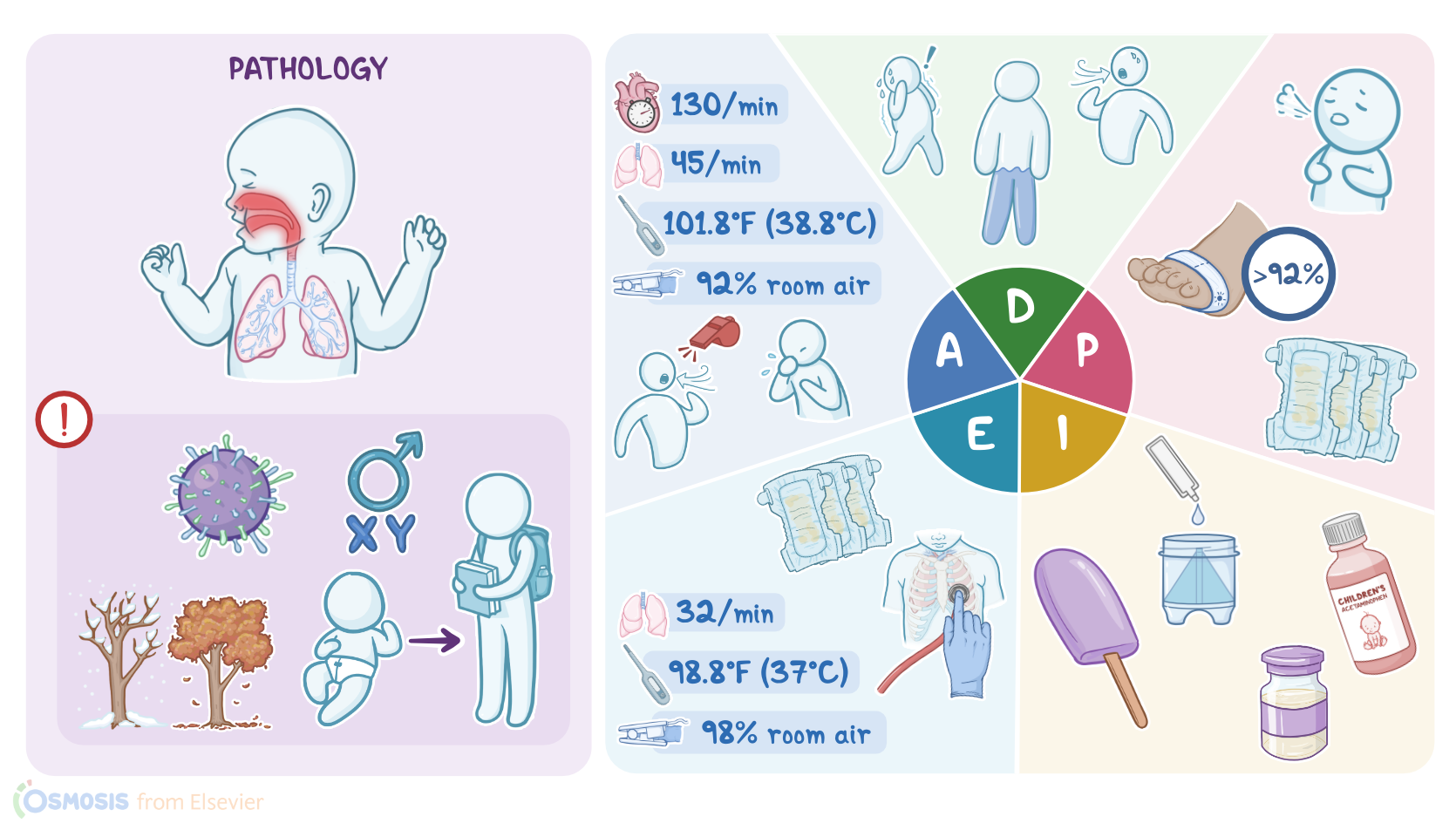
Croup is an inflammation of the upper airway, typically caused by a virus, such as parainfluenza, adenovirus, influenza A or B, or respiratory syncytial virus, or RSV.
Cases of croup are seen seasonally, most often in late fall and early winter. It affects children ages 3 months to 6 years and is most common in boys and in children where there is a family history of croup or recurrent croup.
Croup is spread through airborne respiratory droplets, saliva and physical contact with an infected person or contaminated surface.
The infection causes inflammation, edema and mucus secretion, leading to narrowing of the subglottic area, which is composed of the lower part of the vocal cords and the upper trachea.
Not only is this area the narrowest portion of a child’s upper airway, but it has a complete ring of cartilage around it which doesn’t expand.
When the airway becomes significantly narrowed, it results in hoarseness, a harsh high-pitched sound during inspiration referred to as inspiratory stridor, and a distinctive seal-like barking cough.
Nasal flaring, substernal, subcostal or intercostal retractions occur as the child works hard to breathe past the narrowed airway.
Crying and agitation causes increased oxygen demand and further airway obstruction. In addition, dehydration may result due to reluctance to drink fluids, fever, and breathing through the mouth.
Signs of severe croup include fatigue and inability to keep up with the needed respiratory effort resulting in diminished breath sounds, hypoxia, and cyanosis.
Eventually, inadequate ventilation can lead to respiratory acidosis and respiratory failure.A diagnosis of croup is based on the client’s history and clinical findings.
Other diagnostic studies such as labs and radiological studies are not indicated unless there is concern for other serious problems such as pneumonia.
A chest X-ray, if done, will often reveal a pattern known as a steeple sign, which is an inverted V shape resembling a church steeple, visualized below the vocal cords.
Treatment of croup is focused on airway management and is guided by the severity of symptoms. Commonly prescribed treatments include inhaled bronchodilators such as racemic epinephrine and albuterol; a corticosteroid like dexamethasone to decrease inflammation; and antipyretics such as acetaminophen to reduce fever.
Other treatments include humidified supplemental oxygen, and in the case of respiratory impending failure, intubation and mechanical ventilation.OK, now that we understand croup, let’s get back to Sara and her mother.
Assessment3:41–4:57
Little about how Sara has been feeling before coming to the ED. Mrs.
Little states Sara started to have a runny nose a few days ago and her fever started yesterday. She hasn’t felt like eating or drinking and has had fewer wet diapers than normal.
The barking cough started this evening.You gently approach Sara, keeping in mind agitation can further compromise her airway.
You can easily hear stridor with inspiration and the distinctive barking cough that characterizes croup. Her respiratory rate is 45 per minute, her lungs are clear to auscultation, and you note substernal retractions.
Oxygen saturation is 92 percent on room air. Her heart rate is 130 per minute and her axillary temperature is 101.8 F or 38.8 C.
Her mucous membranes appear dry, skin turgor appears normal, and capillary refill is less than 3 seconds. You document your assessment and begin to develop a plan of care for Sara.Based on the assessment data you collected, your nursing diagnoses include ineffective breathing pattern related to upper airway inflammation and obstruction; fluid volume deficit related to decreased fluid intake, fever, and increased respiratory rate; fear related to difficulty breathing and unfamiliar surroundings; and deficient parental knowledge related to unfamiliarity with the disease process and treatments.Now that you have established some nursing diagnoses, you can collaborate with Mrs.
Diagnosis4:57–5:22
Planning5:22–6:03
Little and the healthcare team to start planning some goals of care. By the end of your shift, Sara will have an effective breathing pattern as evidenced by a respiratory rate within the normal range, unlabored breathing, absence of stridor and barking cough, and a SpO2 above 92%; adequate fluid volume as evidenced by moist mucous membranes and wet diapers; and Sara’s fear will be decreased, as evidenced by a calm appearance and calm, easy respirations.
Your goal for Mrs. Little is for her to verbalize an understanding of croup, home management of mild symptoms, and when to seek medical attention.Next, you implement the plan of care.
Implementation6:03–7:10
Sara will remain on her mother’s lap to promote comfort and reduce fear. You closely monitor Sara’s respiratory status, vital signs and oxygen saturation.
The respiratory therapist administers humidified oxygen to increase oxygenation and racemic epinephrine via nebulizer to open the airways.
You administer dexamethasone IM to decrease airway inflammation, and acetaminophen for fever reduction. As her respiratory status improves, Sara will be offered flavored ice pops, as tolerated, to promote fluid intake, and you ask Mrs.
Little to alert you if Sara produces a wet diaper. Next, you teach Mrs.
Little about what to expect upon returning home with Sara, emphasizing the need for fluids and giving Sara acetaminophen to reduce fever, as directed.
Evaluation7:10–8:05
It’s near the end of your shift and time to evaluate how Sara is doing. Sara is alert, sitting comfortably in her mother’s lap and playing with her stuffed bear.
She is breathing comfortably with a respiratory rate of 32 per minute. Stridor, respiratory retractions, nasal flaring and cough are absent.
Her oxygen saturation is 98% on room air and you note clear breath sounds and good air exchange upon auscultation. Sara has had 3 ice pops and 2 wet diapers, and her mucous membranes appear moist.
Her axillary temperature is 98.8 F, or 37 C. Mrs.
Little verbalizes understanding of how to manage Sara’s illness at home, how to recognize the signs of respiratory distress and when to return to the ED.
She goes on to tell you that she will make a follow-up appointment with Sara’s pediatrician 24 hours after discharge from the ED.Alright, as a quick recap … Your assigned client, Sara Little, was brought to the ED by her mother with signs and symptoms of laryngotracheobronchitis, or croup, a viral infection that causes inflammation of the larynx, trachea and bronchial tubes.
Summary8:05–9:05
Your assessment revealed a barking seal-like cough, inspiratory stridor, tachypnea, and signs of increased work of breathing.
Sara also had a fever and showed signs of dehydration. Your nursing diagnoses were ineffective breathing pattern, fluid volume deficit, fear, and knowledge deficit.
The goals you identified when planning care for Sara include an effective breathing pattern with good oxygenation, adequate fluid volume and absence of fear.
Your goal for Sara’s mother is for an understanding of the disease process, appropriate treatments, signs of respiratory compromise, and when to seek help.
You gave your report to the oncoming nurse so the nursing interventions will continue to be evaluated in preparation for Sara’s discharge home.
| LARYNGOTRACHEOBRONCHITIS (LTB) AND CROUP | ||
| KEY POINTS | NOTES | |
| PATIENT REPORT |
| |
| PATHOPHYSIOLOGY |
| |
| DIAGNOSIS AND TREATMENT |
| |
| ASSESSMENT |
| |
| NURSING DIAGNOSES |
| |
| PLANNING |
| |
| IMPLEMENTATION |
| |
| EVALUATION |
| |
No notes for this video yet
Try adding a note below