Meningitis: Nursing process (ADPIE)
Client Report0:00–0:54
Alejandro Delgado is a 19-year-old college student who was brought to the emergency department, or ED, by his roommate with a report of a sudden onset of headache, confusion and fever.
He has a petechial rash on his arms and chest. The lesions don’t blanch, and Alejandro says they appeared a few hours before he came to the ED.
Alejandro has no known allergies or comorbidities, and he is not aware that he’s been exposed to someone who is sick. The ED physician performed a targeted neurological examination which showed nuchal rigidity.
Kernig and Brudzinski signs were negative. A lumbar puncture and blood draw were completed and sent to the lab for analysis, Gram stain and culture.
Alejandro was then transferred to the inpatient unit for treatment and continued monitoring.Meningitis refers to inflammation of the meninges, which are three protective membranes that cover the brain and spinal cord.
Pathology0:54–7:32
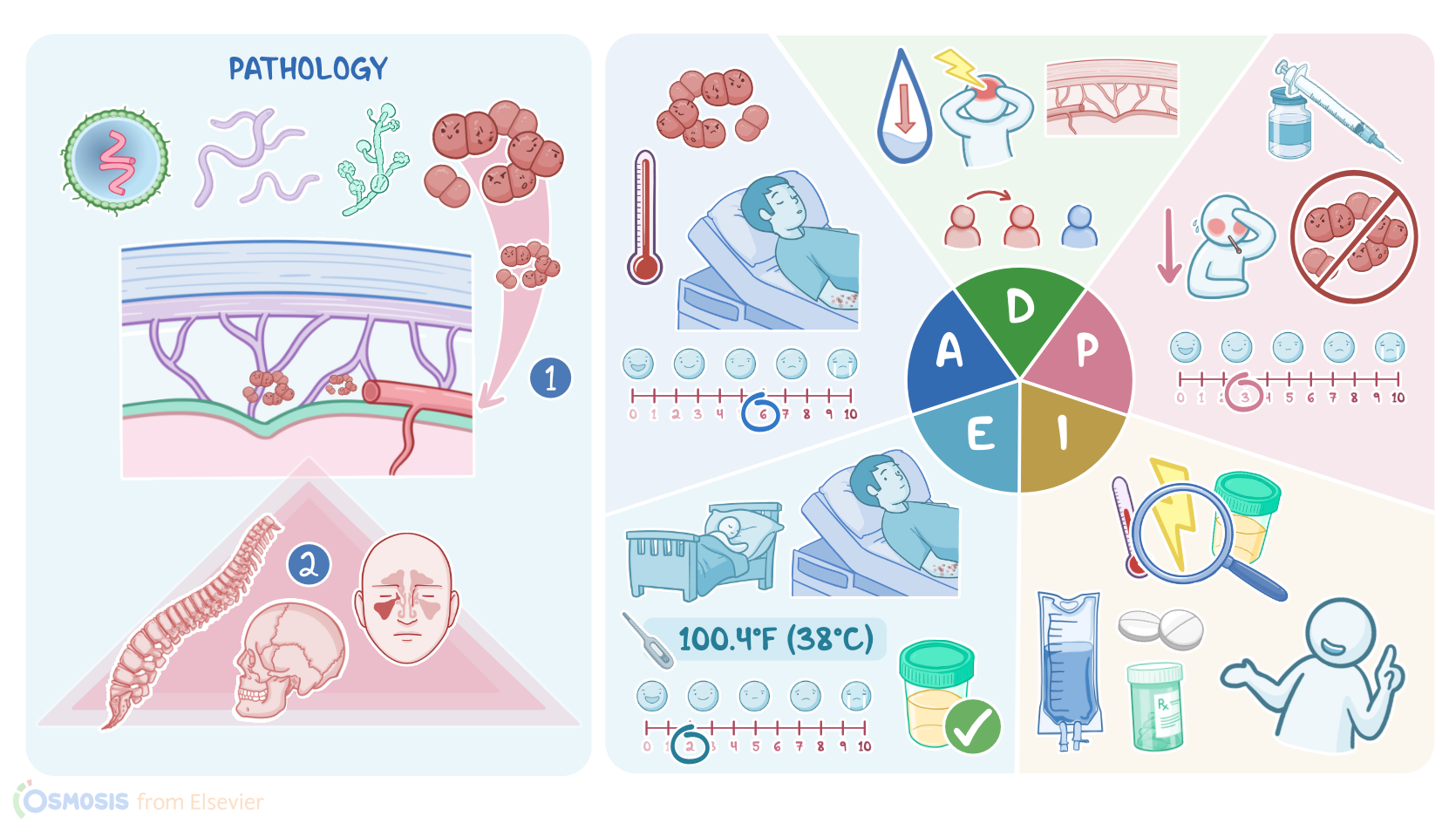
From outside to inside they’re the dura mater, arachnoid mater, and pia mater, with cerebrospinal fluid, or CSF for short, in the space between the arachnoid and pia.
Now, meningitis can be caused by any pathogen that can infect the meninges, such as viruses, bacteria, fungi, and parasites.
The most common and life-threatening type is bacterial meningitis. There are two routes that bacteria can use to reach the meninges.
The most common route is hematogenous spread, which is when bacteria enter the bloodstream and move through the blood brain barrier to reach the meninges.
The second way is by direct spread from a nearby infected structure, like the skull, spine, or sinuses. Bacterial meningitis is more common in clients at the extremes of age, such as children younger than 5 years old or adults who are older than 60, as well as those who have other conditions, such as diabetes, HIV, cirrhosis, chronic kidney disease, malignancy, cystic fibrosis, or a history of splenectomy.
Other important risk factors include nearby infections, such as sinusitis, mastoiditis, and otitis media, as well as having neurosurgery, skull fractures, or congenital defects like spina bifida.
Finally, there’s also increased risk in crowded environments, since some bacteria can be transmitted from person to person and cause outbreaks within households, military barracks or college dorms.Okay, now the most likely causative bacteria depend on the client’s age group.
In infants younger than 3 months, the most common causes are bacteria that normally can colonize the vaginal mucosa, so the baby can come in contact with them during labor.
This includes group B Streptococci, Escherichia coli, and Listeria monocytogenes. In children between 3 months to 12 years old, as well as in adults, meningitis is generally caused by bacteria that can colonize the nasopharynx.
Specifically, Streptococcus pneumoniae is the most common cause, followed by Neisseria meningitidis, and Haemophilus influenzae.
Between these two group ages, there’s adolescents between 13 to 17 years old, in which the most common cause is Neisseria meningitidis, which takes more close or lengthy personal contact to spread, such as kissing, followed by Streptococcus pneumoniae, and Haemophilus influenzae.
Vaccines such as the Meningococcal, Pneumococcal, and Hib vaccines can help prevent meningitis caused by these bacteria.
Finally, in adults over the age of 50 or those who are immunocompromised, an important cause is Listeria monocytogenes, since it causes an opportunistic infection that a strong immune system would usually be able to fend off.
Also, in clients of any age group who have a history of neurosurgical procedures or trauma to the head, an honorable mention goes to Staphylococcus aureus, which normally colonizes the skin, so any breaks can allow it to spread.All right, now meningitis usually presents with a triad of fever, headache, and neck rigidity or stiffness.
Other common symptoms include nausea and vomiting, as well as photophobia or extreme sensitivity to light, and phonophobia or extreme sensitivity to noise.
Upon physical exam, some characteristic signs that indicate meningeal irritation include the Kernig sign, where the client feels pain and spasm in the hamstring when their knee is fully extended from a flexed, 90 degree angle; and the Brudzinski sign, where passively flexing the neck forward triggers pain and an involuntary flexion of the hips.If untreated, meningitis can lead to complications, which can eventually lead to coma or even death.
One of the main complications is meningoencephalitis, which is when the infection spreads to the brain, and can present with seizures and mental status alterations, such as confusion,personality changes, drowsiness, and lethargy.
Sometimes, the bacteria can also collect and wall off from the rest of the brain forming a brain abscess. Another well-known complication is cranial nerve palsy, which is characterized by inflammation and impaired function of one or more cranial nerves; most often, this involves the 8th cranial nerve, which is responsible for hearing and balance, resulting in deafness or dizziness.
Other potential complications of meningitis include stroke, increased intracranial pressure due to cerebral edema, and brain herniation, which is the most common cause of death.
In other cases, bacteria can enter the bloodstream and lead to systemic complications, such as septic shock, and disseminated intravascular coagulation.Now, when meningitis is suspected, the key diagnostic procedure is a lumbar puncture, in which a needle is inserted into the spinal canal to obtain a sample of CSF.
However, lumbar puncture is contraindicated if the client has cerebral edema since this can further increase intracranial pressure, so a blood culture is obtained instead.
Once a sample is obtained, the CSF can be analyzed for white blood cells, protein, and glucose. In bacterial meningitis, there’s an increased white blood cell count, especially neutrophils.
Protein levels also tend to be elevated, whereas glucose levels are mostly decreased, since both bacteria and immune cells use glucose as an energy source.
Gram stain culture of the CSF or blood are also done to confirm acute bacterial meningitis. Last but not least, standard laboratory tests are usually done to monitor a client with meningitis.With bacterial infection, a complete blood count often reveals an increased neutrophil count, while an electrolyte panel often shows hyponatremia.
Finally, brain CT scan and MRI can be done to identify complications.After diagnosis, the next step is to start IV steroids like dexamethasone, to reduce the inflammation, and antibiotics that can cross the blood-brain barrier.
A combination of antibiotics that is commonly used is ceftriaxone, along with vancomycin to cover resistant bacteria.You greet Alejandro as you receive him from the transport team and begin your assessment.
Assessment7:32–8:29
Droplet precautions are instituted, and you explain that until the blood and CSF cultures are known, you’ll be wearing a mask and gloves during care.You begin by taking his vital signs which are temporal temperature 102.4 F, or 39 C, heart rate 86 beats per minute and regular, respiratory rate 22 breaths per minute with clear lung sounds bilaterally, blood pressure 130/68 mmHg, SpO2 96% on room air, and pain 6/10.You help Alejandro into a comfortable position with the head of the bed elevated at 30 degrees, and let him know that you’ll be back soon after you check the physician orders for treatments to address his fever, pain, and infection.Now that you’ve completed your nursing assessment, you establish your nursing diagnoses for Alejandro: acute pain related to meningeal irritation, risk for decreased intracranial adaptive capacity related to infection, risk for fluid volume deficit related to fever, risk for infection transmission related to potential spread to close contacts.Next, you collaborate with Alejandro and the attending physician to develop goals for the plan of care.
Diagnosis8:29–8:51
Planning8:51–9:29
Within 1-2 hours of pain management intervention, Alejandro will report a decrease in pain to 3/10, which is his stated pain tolerance level.
Before discharge, Alejandro’s infection will be resolved, his temperature will return to normal, his fluid balance will remain adequate, and he will have normal neurological function.
Finally, Alejandro will receive the meningococcal conjugate vaccine at discharge, and with his consent, you will contact the college’s health department to follow-up with others who live in Alejandro’s dormitory.
Now you are ready to implement the plan of care. First, you administer the ordered IV fluids, antibiotics, the steroid dexamethasone, and PO pain medication and fever reducer.
Implementation9:29–10:19
You explain that these treatments will help make him more comfortable, reduce inflammation, and begin to resolve the infection, and you let him know you will be checking on him frequently to monitor his temperature, pain, and urine output.
You teach Alejandro about how his infection affects his neurological system, so you’ll be watching him closely for complications like seizures or symptoms such as confusion.
Lastly, you stress the importance of keeping his vaccinations up to date, especially when living on campus in a dormitory, and that the physician has ordered the meningococcal conjugate vaccine to be administered at discharge.
It’s the end of your shift, so it’s time to evaluate how Alejandro is doing so far.His last pain rating was 2/10. His vital signs are temporal temperature 100.4 F, or 38 C, heart rate 70 beats per minute and regular, respiratory rate 18 breaths per minute with clear lung sounds bilaterally, blood pressure 122/60 mmHg, SpO2 98% on room air.
Evaluation10:19–11:14
He’s producing adequate amounts of light yellow urine. He’s been sleeping on and off during your shift, and when he’s awake, he remains oriented and free from signs of neurological complications.
You are glad to see that Alejandro is starting to improve! You hand off care to the nurse on the oncoming shift, who will continue to evaluate the interventions and adjust Alejandro’s plan of care as needed.
Okay, as a quick recap… Your client, Alejandro, is a 19-year-old college student who presented to the ED with signs and symptoms of meningitis.
He was transferred to inpatient care, where your assessment findings guided the nursing diagnoses of acute pain, risk for decreased intracranial adaptive capacity, risk for fluid volume deficit, and risk for infection transmission.
Summary11:14–11:57
The goals you planned included pain management, fever reduction, resolution of his infection and neurological symptoms, and vaccination.
Along with the health care team, you work to implement interventions to achieve the goals of the plan of care. Throughout your shift you will continue to evaluate and revise your plan of care as needed.
symptoms and vaccinations along with the healthcare team you work to implement interventions that achieve the goals of the plan of care throughout your shift.
You will continue to evaluate and revise your plan of
| MENINGITIS | ||
| KEY POINTS | NOTES | |
| PATIENT REPORT |
| |
| PATHOPHYSIOLOGY |
| |
| DIAGNOSIS AND TREATMENT |
| |
| ASSESSMENT |
| |
| NURSING DIAGNOSES |
| |
| PLANNING |
| |
| IMPLEMENTATION |
| |
| EVALUATION |
| |
No notes for this video yet
Try adding a note below